Between the Gallery of Maps and the Sistine Chapel, the standard Vatican Museums route passes through four connected rooms most first-timers barely register. They shouldn’t. These are the Stanze di Raffaello — the papal apartment Pope Julius II commissioned Raphael to fresco in 1508, and the room where the School of Athens lives. If you’re doing the Vatican in three hours, this is one of the two things you must not rush.
This page is the plain guide: what the four rooms are, what to look for in each, and why they’re historically the moment the High Renaissance begins. If you’d rather have a licensed guide walk you through them at a proper pace, our Vatican tours include the Raphael Rooms in every itinerary.
The Raphael Rooms at a glance
- Where: Inside the Vatican Museums, on the standard visitor route between the Gallery of Maps and the Sistine Chapel.
- What’s inside: Four connected rooms of the papal apartment, frescoed by Raphael and his workshop.
- Painted: 1508–1524. Raphael died in 1520; his workshop finished the last room.
- Commissioned by: Pope Julius II (r. 1503–1513).
- Famous for: Chief among many — the School of Athens, in the Stanza della Segnatura.
- Ticket: Included with standard Vatican Museums entry.
- Time to spend: 30–45 minutes if you look properly. Standard “Raphael Rooms + Sistine Chapel” guided tour is 2 hours.
What the Raphael Rooms are
In 1508 Pope Julius II decided he wouldn’t sleep in the same apartment as his predecessor, Alexander VI (a Borgia; the two families weren’t friends). He moved to a set of four second-floor rooms of the papal palace and commissioned a virtually unknown 25-year-old from Urbino — Raphael — to decorate them.
Raphael had barely arrived in Rome. Michelangelo was already at work on the Sistine ceiling next door. Bramante was designing the new St Peter’s below. Julius II had assembled the strongest cast of artists Rome had ever seen in one place, and the frescoes Raphael painted here, over the next sixteen years, are the reason the Renaissance turns “High” in the textbooks.
The official Vatican Museums page puts it neatly: the Stanza della Segnatura contains “Raphael’s most famous frescoes. Besides being the first work executed by the great artist in the Vatican they mark the beginning of the high Renaissance.”
The four rooms, in the order you see them
The standard visitor flow enters the rooms in this sequence today. It’s not the chronological order Raphael painted them in — he started with the Segnatura and worked outward — but it’s the order you’ll walk through.
Room 1 — Stanza di Costantino (Room of Constantine)
The largest of the four rooms, designed for receptions and official ceremonies. Frescoed by Raphael’s workshop after his death in 1520, from his designs. Four wall scenes depict episodes from the life of Emperor Constantine, illustrating what the Vatican page calls “the defeat of paganism and the triumph of the Christian religion”:
- Vision of the Cross
- Battle of the Pons Milvius — the 312 AD battle after which Constantine converted
- Baptism of Constantine
- Donation of Rome
Recent restoration confirmed Raphael’s own hand on two figures in the room: the allegorical Comitas and Iustitia, painted in an experimental oil technique. Everything else is workshop.
Room 2 — Stanza di Eliodoro (Room of Heliodorus)
Painted 1511–1514, used for the Pope’s private audiences. The theme is political: the Vatican describes it as “the miraculous protection bestowed by God on the Church.” Four main scenes:
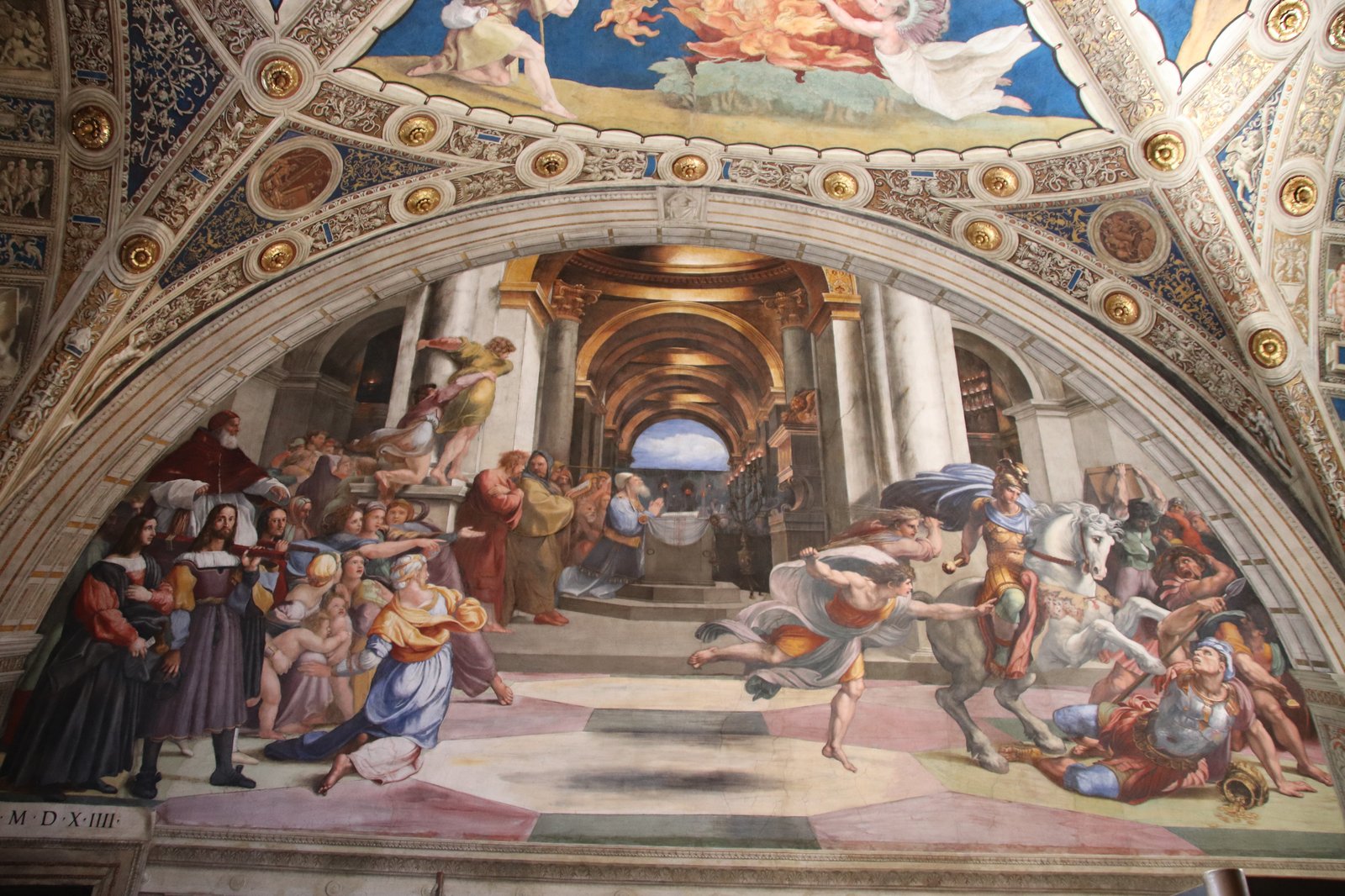
- Expulsion of Heliodorus from the Temple — the Old Testament story of the Syrian general driven out of the Temple treasury by an angelic horseman.
- Mass of Bolsena — a 1263 miracle in which a doubting priest saw the host bleed.
- Liberation of St Peter — the angelic escape from Herod’s prison, painted with a night-scene light effect that’s one of Raphael’s compositional set-pieces.
- Encounter of Leo the Great with Attila — the 5th-century meeting where the pope famously turned the Huns away from Rome.
Parts of the ceiling grotesques predate Raphael and are attributed to Luca Signorelli, Bramantino, Lorenzo Lotto and Cesare da Sesto — worth glancing up before you move on.
Room 3 — Stanza della Segnatura
Frescoed 1508–1511. This is the room. It served under Julius II as a library and private study. Its name comes from the highest court of the Holy See — the Segnatura Gratiae et Iustitiae — which met here in the mid-16th century, where papal documents were signed.
Raphael’s programme covers the three ideals of Renaissance humanism: Truth, Good and Beauty.
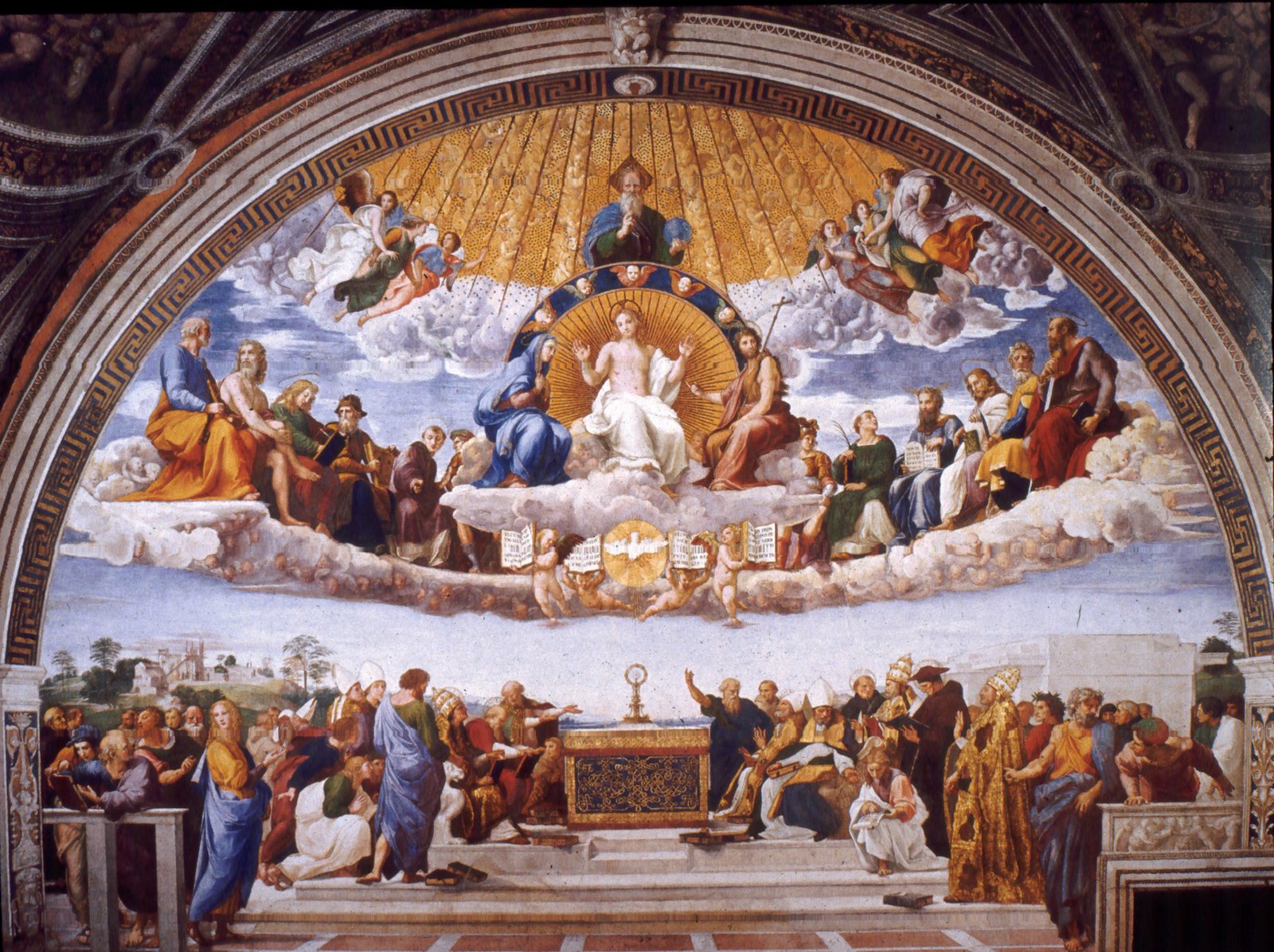
- Disputation of the Most Holy Sacrament — Truth as revelation (theology).
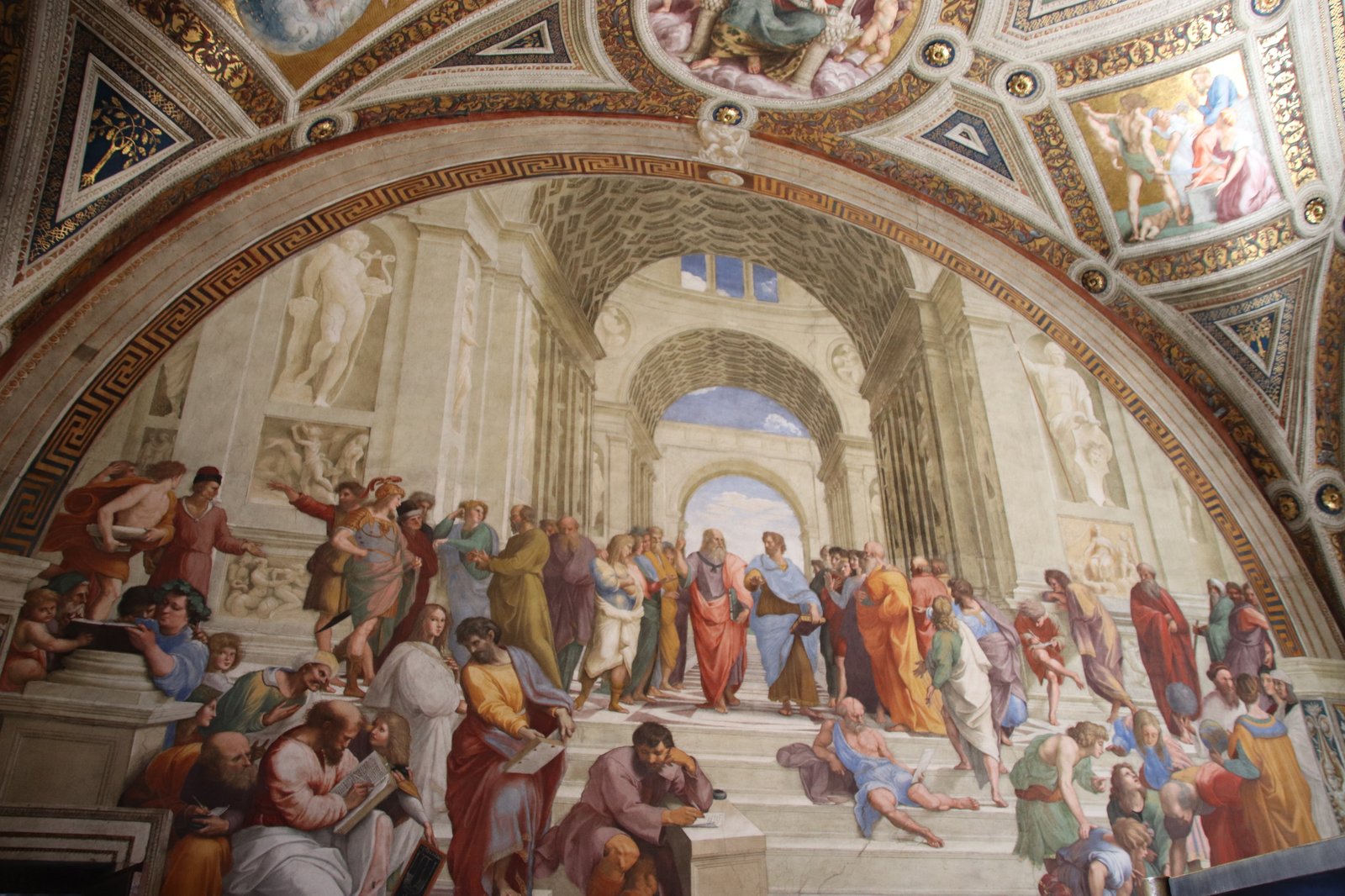
- School of Athens — Truth as reason (philosophy). Its own section below.
- Cardinal and Theological Virtues and the Law — Good.
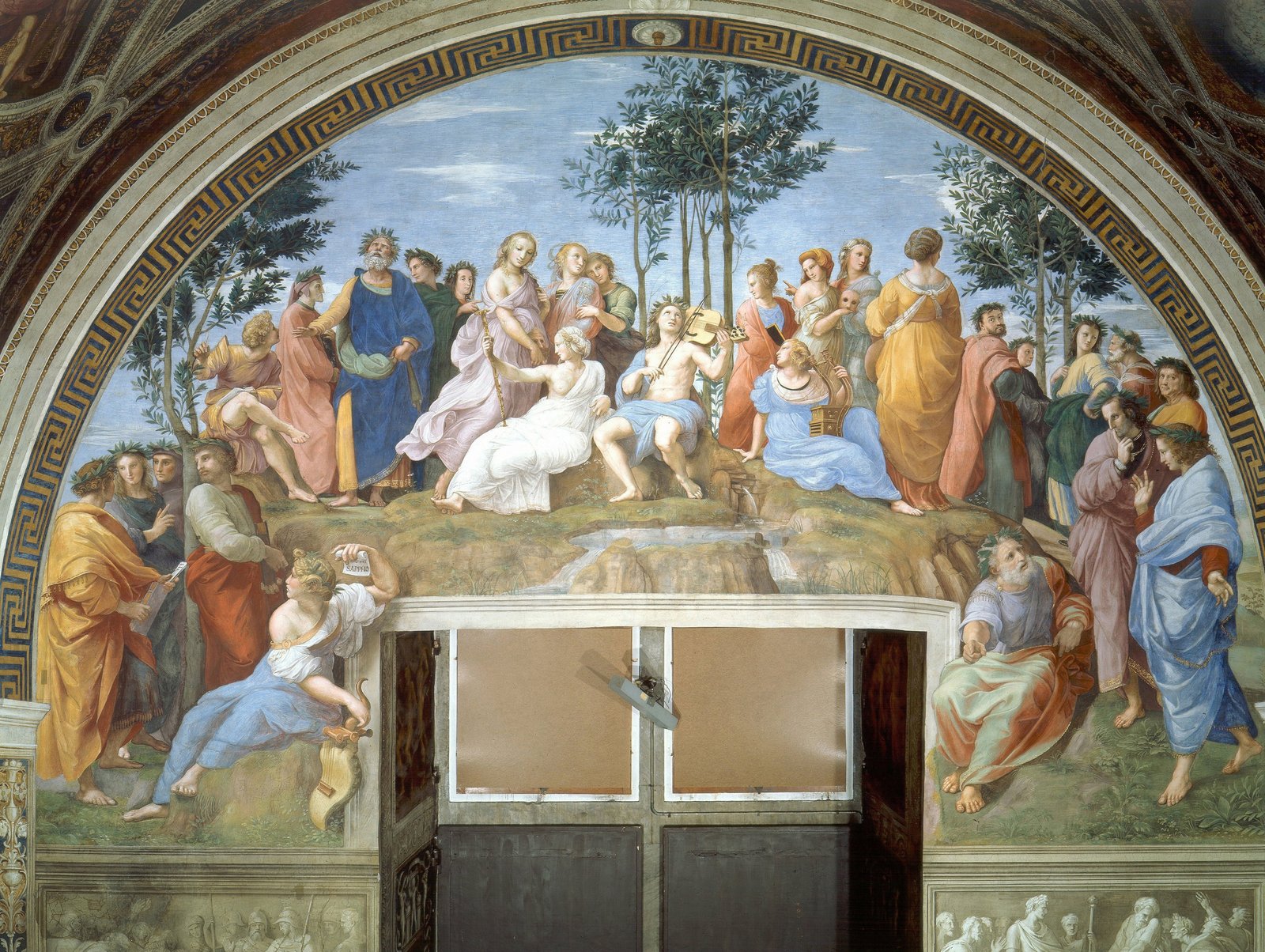
- Parnassus — Beauty. Apollo among the Muses and the great poets.
Room 4 — Stanza dell’Incendio del Borgo (Room of the Fire in the Borgo)
Frescoed 1514–1517, used as Leo X’s dining room after Julius II died and the new pope moved in. All four scenes on the walls reference earlier popes named Leo:
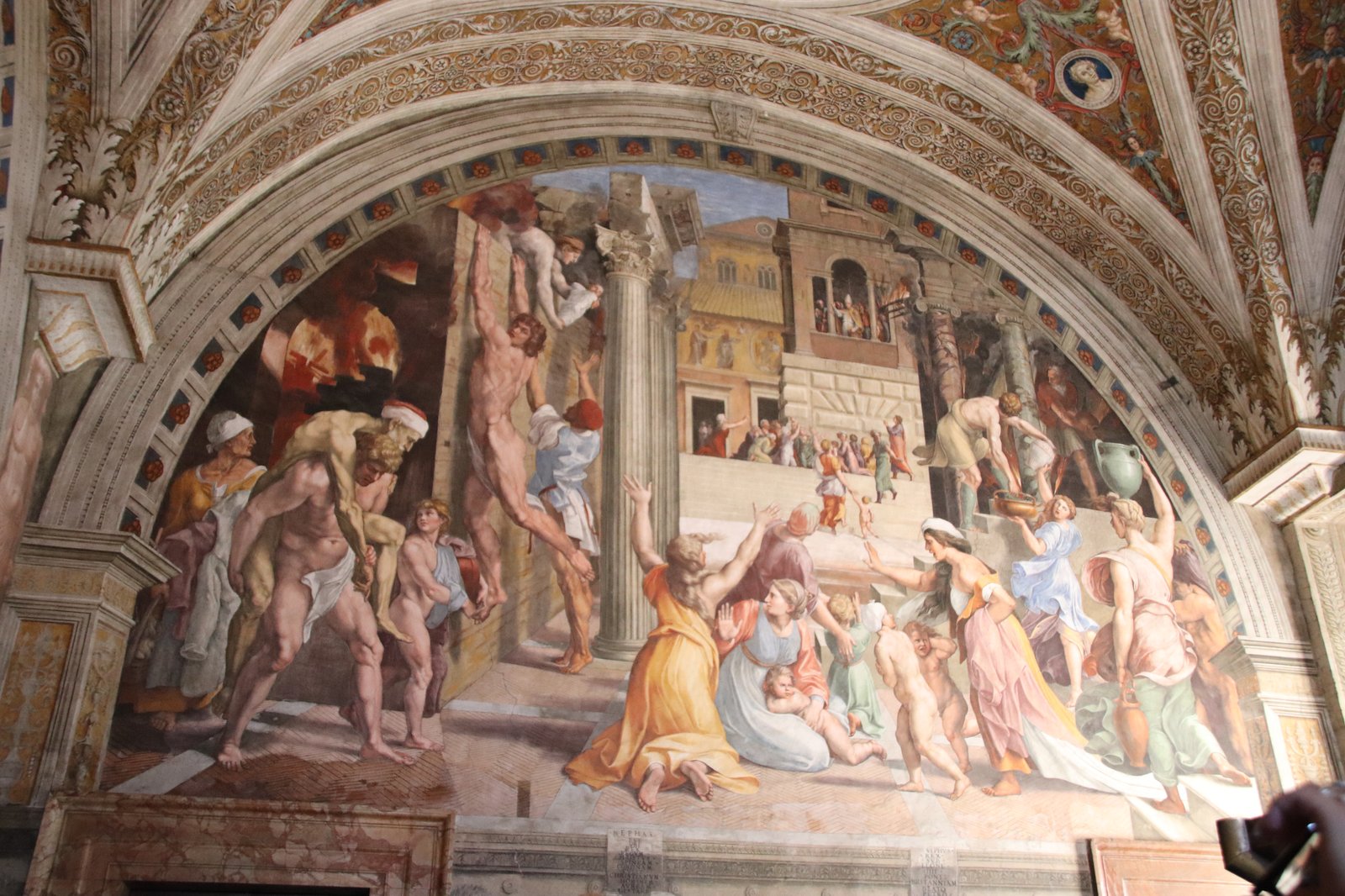
- Fire in the Borgo — Leo IV miraculously stops a fire that threatened St Peter’s in 847 (this gives the room its name).
- Battle of Ostia — Leo IV again, victorious against Saracen raiders in 849.
- Crowning of Charlemagne — Leo III crowns Charlemagne emperor on Christmas Day 800.
- Justification of Leo III — Leo III clearing his name of the charges brought against him.
Raphael designed all four but delegated most of the actual painting to his workshop — by 1517 he was overloaded with commissions across Rome. The ceiling above these four walls was painted by Perugino (Raphael’s own former teacher) in 1508 on Julius II’s commission, and Raphael left it in place out of respect for his master.
The School of Athens
Painted in the Stanza della Segnatura between 1509 and 1511. Fifty-eight figures gathered under a Roman-basilica architecture, all of them philosophers, mathematicians and scientists of antiquity — and quite a few of them are actually portraits of Raphael’s Renaissance contemporaries.
Named figures, per the Vatican Museums’ own description of the fresco:
- Plato — centre, pointing upward, holding his Timaeus.
- Aristotle — beside Plato, holding Ethics.
- Pythagoras — foreground, “intent on explaining the diatesseron”.
- Diogenes — lying on the steps with a dish.
- Heraclitus — the figure leaning on a block of marble, writing on a sheet: a portrait of Michelangelo, who was painting the Sistine ceiling next door as Raphael worked on this. Whether that’s an homage or a tease has been argued for five hundred years.
- Euclid — teaching geometry to pupils in the foreground.
- Zoroaster — holding the heavenly sphere.
- Ptolemy — holding the earthly sphere.
- Raphael’s self-portrait — the young man on the far right with the black beret, looking straight out at you.
The architecture behind the philosophers is worth its own long look. It’s directly modelled on Bramante’s design for the new St Peter’s Basilica — a preview of the church that was being built under the pope’s window as Raphael painted this scene. Renaissance humanism, ancient philosophy, and the papal building programme in one image.
Where the Raphael Rooms sit in your visit
On the standard Vatican Museums route, the sequence is: entrance → Pio Clementino → Gallery of the Candelabra → Gallery of the Tapestries → Gallery of the Maps → Raphael Rooms → Sistine Chapel. You’ll reach the Raphael Rooms about two thirds of the way through the visit.
Practically: if you arrive at the Museums for the 08:00 opening slot and don’t linger heavily, you’ll be in the Raphael Rooms around 09:15 and in the Sistine Chapel by 10:00. If you slow down for the four rooms — which you should — add half an hour.
The four rooms are connected in a linear sequence, so you enter from one end and exit at the other toward the Sistine Chapel stairs. There’s no doubling back. If you missed something, you can’t easily go back for it.
Practical tips
- Photos: Allowed without flash. No tripods, no selfie sticks. The rooms are lit for preservation, not photography, so phone shots will be soft — bring a small camera if you care about image quality.
- Best time to visit: First hour of the day (08:00 opening slot) or Friday evening in season. The Segnatura in particular gets crowded from about 10:30 — everyone stops for the School of Athens.
- Where to stand: For the School of Athens, step to the wall opposite so the perspective works properly. Raphael painted it for eye-level viewing at that distance.
- Look at the ceiling too. The ceilings of the Segnatura and the Heliodorus room have their own dedicated frescoes — not the same programme as the walls. Most visitors never look up.
- Accessibility: The rooms are level and step-free. The Museums have a barrier-free itinerary that includes them; ask staff at the entrance.
FAQ
Do I need a separate ticket for the Raphael Rooms?
No. They’re inside the Vatican Museums and included in the standard Museums ticket.
Which Raphael Room has the School of Athens?
The Stanza della Segnatura — the third room in the standard visitor flow. It’s frescoed with all of Raphael’s most famous scenes: the School of Athens, the Disputa, Parnassus, and the Cardinal Virtues.
How many Raphael Rooms are there?
Four: the Room of Constantine, the Room of Heliodorus, the Stanza della Segnatura, and the Room of the Fire in the Borgo.
When were the Raphael Rooms painted?
Between 1508 and 1524. Raphael himself worked on them from 1508 until his death in 1520. His workshop completed the Room of Constantine after his death from his designs.
Who commissioned the Raphael Rooms?
Pope Julius II, the same Pope who commissioned Michelangelo to fresco the Sistine Chapel ceiling in the adjacent building at the same time.
Is Michelangelo in the School of Athens?
Yes. The figure sitting on the steps leaning on a block of marble, writing on a sheet of paper — that’s Michelangelo as a portrait of the philosopher Heraclitus. Raphael added him after glimpsing the Sistine ceiling in progress.
Is Raphael in the School of Athens?
Yes. The young man on the far right with the black beret, looking straight out at the viewer, is Raphael’s self-portrait.
How long should I spend in the Raphael Rooms?
Thirty to forty-five minutes if you look at the walls and the ceilings properly. Guided tours typically pace at about ten minutes per room. Rushing through all four in fifteen minutes is common but misses most of what makes them worth being there.
Can I take photos in the Raphael Rooms?
Yes, without flash. No tripods, no selfie sticks. Handheld phones and cameras are fine.
Where are the Raphael Rooms located in the Vatican Museums?
Between the Gallery of Maps and the Sistine Chapel, on the standard visitor route. You reach them about two thirds of the way through the museum visit.
Is the Sistine Chapel next to the Raphael Rooms?
Yes. You exit the Room of the Fire in the Borgo and descend a short staircase directly to the Sistine Chapel entrance.
Plan your visit
If you’d rather have a licensed guide walk you through the four rooms with the political and religious context they need — pointing out the Michelangelo portrait in the School of Athens, the Bramante architecture, and the meaning of the Segnatura programme — browse our small-group and private Vatican tours. Skip-the-line entry, licensed English-speaking guides. For a ticket without a guide, Vatican Museums skip-the-line tickets gets you in. See also our Gallery of Maps guide, Sistine Chapel guide, and Vatican Museums hours guide.