Blog

  • Combined Vatican and St Peter’s Tomb Ticket: What You Skip by Buying Separately

    Bernini's Baldachin over the Papal Altar in St Peter's Basilica, directly above the site of St Peter's tomb
    The Papal Altar inside St Peter’s Basilica, standing directly above the tomb — free to view, unlike the excavation itself, which requires the separately booked Scavi tour.

    Search “vatican and st peter tomb combined ticket” and you will land on plenty of pages implying such a product exists. It does not. Not as an official ticket, and not really as a single practical booking either. Understanding why saves you from a wasted afternoon standing at the wrong window.

    Why there is no single ticket for both

    The Vatican Museums run their own booking portal, and it sells four things: entry to the Museums and Vatican Collections, the Vatican Gardens, the Castel Gandolfo Museum Complex, and something called the Necropolis of the Via Triumphalis. St Peter’s tomb is not on that list, because it is not a Museums product. That tomb sits inside the Vatican Necropolis under the basilica, run by the Fabbrica di San Pietro, the office responsible for the basilica itself, not by the Museums administration next door. Its own product page describes the site as “inaccessible and untouched for sixteen centuries beneath the floor of the Constantinian basilica,” and books through a separate “Request a Reservation” form on basilicasanpietro.va. Two institutions, two systems, two confirmations. Nobody bundles them into one purchase, official or otherwise, no matter how the listing on a resale site is worded.

    Some tour operators do sell a Museums ticket and a Scavi booking together as a package, two tickets sold in one transaction rather than a single fused product. That distinction matters when you are comparing prices, because you are still buying two entries to two checkpoints on two clocks, and the operator is simply doing the coordination work you would otherwise do yourself. Read the fine print on any listing that uses the word “combined” before assuming it means what it sounds like it means.

    A necropolis name that misleads

    Here is where confusion sets in even for careful bookers. Open the Museums’ own ticketing page and you will see “Necropolis of the Via Triumphalis” listed as a bookable product, right alongside the Sistine Chapel. It sounds like the tomb. It is not. Via Triumphalis names a separate, pre-Christian Roman burial ground near the Museums entrance and car park, unconnected to St Peter’s grave under the basilica on the far side of the complex. It also closes for roughly six weeks every summer, from mid-July to early September, a detail worth checking before you plan a visit around it at any time of year, since the closure recurs annually on a similar window rather than being a one-off.

    If your goal is the tomb of Peter, ignore anything on the Museums booking site labelled “necropolis.” That listing solves a different itinerary entirely.

    Grottoes are free, the Scavi are not

    A second layer of naming sits directly under the basilica floor. Step into St Peter’s and descend to the Vatican Grottoes, no ticket and no reservation required, and you walk past papal tombs to a spot close to Peter’s resting place. Basilica documentation describes the area this way: “a large archway was opened in the central part of the grottoes, in order to make visible the front of the Confessio with the Niche of the Pallia, the place closest to the tomb of Saint Peter.” Close, but not inside. Grottoes visitors look toward the excavation, not into it. Only the paid Scavi tour, booked through the Fabbrica di San Pietro’s Necropolis product, takes you down into it.

    So the free option and the paid option sit almost on top of each other, separated by a locked door rather than by distance. Plenty of visitors leave the Grottoes assuming they have seen the tomb. They have seen where it is.

    What booking around each other actually buys you

    None of this changes with a bundled purchase. What changes is planning. The Museums and the Basilica operate as separate checkpoints with separate security lines and, notably, separate rules on what you can carry. The Museums’ own visitor guidance is direct about it: “Visitors who continue their tour in the Vatican Basilica are reminded not to leave their baggage in the Vatican Museums.” Whatever you carried through the Sistine Chapel, you carry again through basilica security, and the basilica checkpoint is stricter about bag size and blade-length items than the Museums entrance tends to be.

    Coordinating the two bookings yourself, rather than treating them as one product, is really about sequencing: which entrance you use first, how much walking sits between the two, and whether your Scavi slot leaves you time to see the Museums properly beforehand without rushing the transition. A same-day plan works well. A same-hour plan usually does not, because the walk from the Museums exit round to St Peter’s Square and through basilica security eats more time than the map distance suggests, especially with a queue at either end.

    Timing the day around two entrances

    Vatican Museums hours run, per the official page, “From Monday to Saturday 08.00 a.m. – 08.00 p.m.,” with last entry two hours before that and the galleries themselves closing thirty minutes ahead of the stated time. On “Every last Sunday of the month 09.00 a.m. – 02.00 p.m.,” hours shrink and entry is free, which also means the queues run longer than any other day of the month. The Museums close entirely on a short list of dates each year, including 1 and 6 January, 11 February, 19 March, 1 May, 29 June, 14 and 15 August, 1 November, and 8, 25 and 26 December, plus movable dates such as Easter Monday.

    St Peter’s Basilica itself costs nothing to enter, with hours listed as “From june 1st: from 7.00 am to 8:00 pm.” The Dome is a separate paid climb with its own summer and winter hours. Since Scavi tour groups depart on fixed timed slots set by the Fabbrica di San Pietro, book that first and build the Museums visit around it, not the other way round.

    What the two entries cost

    Museums entry is €20 full price at the door, or €20 plus a €5 online booking fee if you reserve ahead, sometimes marketed as “skip the line.” Reduced admission is €10, plus the same €5 fee online. Entry is free for children under seven, for visitors with a recognised disability of 67% or higher, and on that last Sunday of the month.

    Scavi pricing and scheduling sit entirely with the Fabbrica di San Pietro, through its own reservation request rather than a standard checkout. Rates, minimum age, and how far ahead you need to apply are all set on their side and worth confirming directly when you request a slot, since third-party listings vary and this is not a figure we quote loosely. Treat the tomb booking as the one to sort out first, since it runs on its own request-and-confirm process, then fit the Museums visit and everything else around whatever slot you are given.

    Booking each one without getting misled

    Because there is no official combined product, third-party sites have room to imply one exists, or to sell Museums tickets at a markup dressed up as a bundle. The Museums are unambiguous about their own channel: “The only official site for purchasing tickets online is https://tickets.museivaticani.va.” For the Scavi, the only route is the Fabbrica di San Pietro’s own necropolis page and its reservation form, or a phone call to the Museums information line on +39 06 69883145 if you need to check a Museums-side detail first.

    Book both separately, on purpose, in the right order, and treat any site promising one tomb-and-Museums ticket with a healthy amount of scepticism. Get the sequencing right and the two-checkpoint reality stops being a hassle and just becomes the shape of the day. If you want the logistics handled rather than pieced together across two booking systems, our St Peter’s tomb tickets and tours page lays out how a properly sequenced visit to both actually runs.
  • Roma Pass or a Straight Vatican Ticket: Where the Pass Actually Loses You Money

    Priority entrance to the Vatican Museums, the ticket lane a Roma Pass doesn't unlock
    The priority entrance lane at the Vatican Museums. Buying this ticket, not a citywide pass, is what actually gets you through the priority lane.

    Ask a Rome tour desk whether the Roma Pass covers the Vatican Museums and you’ll get three different answers in the same afternoon. The honest answer is narrower and more useful: nowhere on the Roma Pass’s own list of covered attractions does “Vatican” or “Musei Vaticani” appear, and nowhere on the Vatican Museums’ hours or pricing pages does “Roma Pass” appear either. Two official sites, no cross-mention between them. For an itinerary built around the Vatican, that gap changes the entire calculation.

    What the Roma Pass Actually Costs

    Roma Capitale’s tourism office prices the pass in two versions: “Roma Pass 72 hours – 62,90 €” and “Roma Pass 48 hours – 38,00 €.” Both bundle public transport, so you’re not buying museum access alone. You’re buying a transit pass with a discount card stapled to it. It also includes “free use of the P.Stop network toilets,” a small convenience if you’re out with kids all day. Roma Capitale’s own copy describes coverage of “more than 100 tourist attractions, including museums, monuments, archaeological areas and Experiences,” which is a wide net and a vague one. What isn’t published in plain text anywhere official is how many of those hundred-plus sites are free with the pass versus simply discounted, or what that discount percentage becomes once the free entries run out. Budget the pass on what it clearly delivers: transport, toilets, a broad shortlist of sites. Treat any specific savings figure a tour guide quotes you as a guess, because it isn’t sourced from either official page.

    What a Straight Vatican Ticket Costs

    Pricing at the Vatican Museums carries no such ambiguity. A full entry ticket runs €20.00 without booking. A reduced ticket, for visitors who qualify, costs €10.00 without booking or €10.00 plus a €5.00 fee through the official Skip the Line service online. Students get the same reduced rate: €10.00 at the door, €15.00 booked ahead. School groups pay €5.00 without booking, €7.00 with it. Worth flagging: the pricing page shows that added online fee clearly for the reduced, student, and school tiers, but the full-price tile doesn’t display an equivalent online surcharge in the same way, so don’t assume a specific figure for booking a full-price ticket ahead without checking the page yourself at the time of booking. One line on that page matters more than any of the numbers. “The entry ticket for the Vatican Museums entitles the visit to the Museums and Sistine Chapel solely on the day on which the ticket is issued.” There’s no multi-day validity to weigh against a 48- or 72-hour pass. A Vatican ticket buys one specific visit, and that’s the whole transaction.

    Why the Vatican Doesn’t Show Up on the Pass

    Neither official site states outright that the Vatican Museums are excluded from the Roma Pass network. What can be said is narrower: the pass’s published attraction list doesn’t mention the Vatican Museums once, and the Vatican Museums’ own pricing and hours pages don’t mention the Roma Pass once. Two organisations, run by two different governments, Roma Capitale and Vatican City State, price their own attractions independently. Treat “the pass covers the Vatican” as a rumour until it appears plainly on either official page, because right now it doesn’t.

    The Line-Item Math for a Vatican-Heavy Two Days

    Picture a traveller spending two days in Rome, with the Vatican Museums and Sistine Chapel as the anchor and one or two other paid stops filled in around that. Buying direct, that traveller pays €20.00 for the Vatican Museums, or €15.00 online if reduced-rate eligible, plus whatever single transit rides they need between the hotel and each site. Buying the 48-hour Roma Pass instead means €38.00 up front, none of which touches the Vatican ticket, which still has to be purchased separately at full price. That €38.00 now has to be earned back entirely through transport savings and non-Vatican attractions. When the itinerary is genuinely Vatican-heavy, meaning the Museums and the Basilica area soak up most of one day and leave only an afternoon for something else, the pass is competing against a small basket of alternative spending. Stakes rise further with the 72-hour version: €62.90 gets committed before a single museum door opens, against an itinerary where the most expensive planned stop isn’t on the list the pass covers at all. Run the numbers for your own dates before you buy either one. Two adults doing the same Vatican-anchored two days would pay €40.00 in Vatican tickets between them under the straight-ticket route, against €76.00 for two 48-hour passes that still don’t include those tickets.

    Who Actually Clears the Discount

    Value shows up for a specific kind of traveller: someone staying a full three days, moving by bus and metro constantly, and stacking several paid non-Vatican attractions into that window, the sort of trip where two or three other museums and an archaeological site or two all get ticked off inside 72 hours. For that traveller, the transport bundle alone removes a running tally of single fares, and each covered site chips further away at the €62.90. Families splitting time across several museums with older children, who don’t qualify for the Vatican’s under-7 free entry, sit closer to the pass’s sweet spot too, since every full-price entry the pass absorbs is real money saved rather than theoretical. Groups without a fixed daily route, happy to let the pass’s coverage decide where they go next, tend to get more value than a group with a Vatican-first plan already locked in.

    Who’s Better Off Buying Direct

    If the Vatican Museums are the actual reason for the trip, and everything else is secondary, the straight-ticket route usually wins. A student with valid ID pays €10.00 at the door or €15.00 booked online, a fraction of even the 48-hour pass, without needing to calculate whether enough other visits will break even. A visitor giving one focused day to the Vatican, without a packed multi-site itinerary around it, ends up paying for transport and toilets they may barely use. That logic extends to anyone timing a visit for the last Sunday of the month, when Vatican Museums entry itself is free, with hours running 9:00am to 2:00pm and last entry at 12:30pm, subject to the museum’s own closure calendar. A pass bought to unlock a day that’s already free adds nothing. Solo travellers on a tight two- or three-day city break, with the Vatican as the one big-ticket stop and everything else casual walking and free piazzas, almost always come out ahead paying as they go.

    The Free-Entry Rules Worth Knowing Either Way

    Regardless of which route you take, the Vatican Museums’ free-entry list is short and specific: the last Sunday of each month, children under seven, ICOM and ICOMOS cardholders, and disabled visitors certified at 67% invalidity or above plus one companion. There’s no general discount for under-18s the way some other European museums run it, and no family ticket at the Rome museums themselves. That combination exists only for the Papal Palace at Castel Gandolfo, well outside the city, and shouldn’t be assumed for a Rome-based Vatican visit. If your group includes children who don’t qualify for the under-seven exemption, budget them at full or reduced adult rates rather than assuming a “kids free” policy the Vatican simply doesn’t offer. None of these exemptions have anything to do with the Roma Pass either way, so check them against your own travel dates regardless of which ticket strategy you land on.

    Working out which side of that math you land on before you land in Rome saves an argument at the ticket counter. If the Vatican Museums are the point of the trip, book straight through our Vatican tickets page and put the Roma Pass money toward the days you’re not spending inside the Sistine Chapel.

  • Is Photography Really Banned in the Sistine Chapel? What the Rule Actually Covers

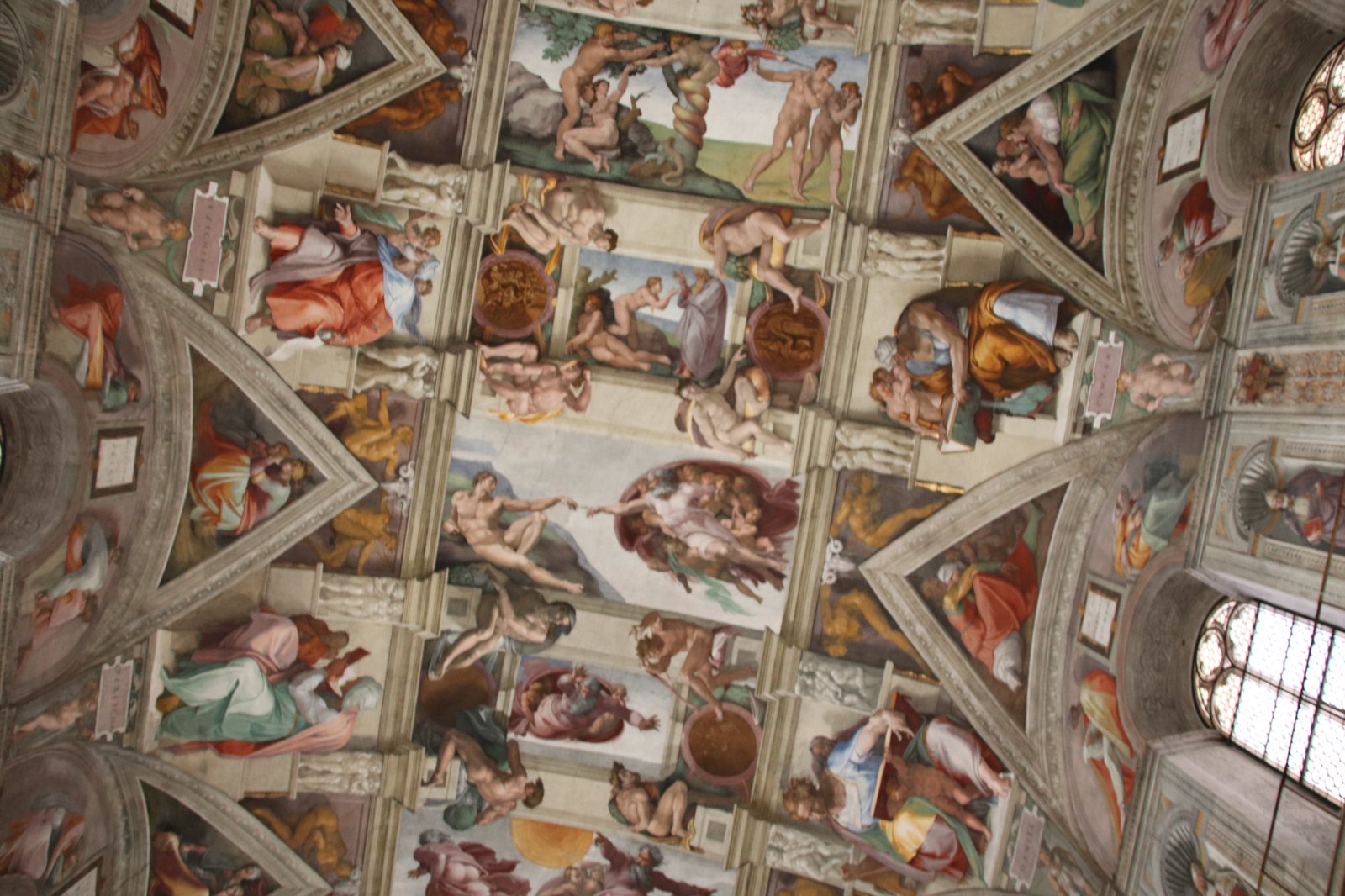
    Wide view of Michelangelo's Sistine Chapel ceiling, the frescoes at the centre of the Chapel's no-photography rule
    Michelangelo’s ceiling frescoes, the artwork the no-photography rule exists to protect. Public domain via Wikimedia Commons.

    You come out of the Gallery of Maps, pass through the Raphael Rooms, turn the last corner, and the room opens up in front of you: grey stone walls, a low wooden bench running along the edges, and Michelangelo’s ceiling somewhere above the noise. Within about ten seconds someone’s phone comes up, and within about fifteen a guard barks “No photo!” loud enough to carry over four hundred whispering visitors. If you’ve read anything about Vatican rules beforehand, this is the point where the confusion usually hits: didn’t the ban only cover flash?

    Flash Photography and All Photography Are Two Different Rules

    Most Vatican Museums galleries allow photography as long as you keep the flash off. Walk through the Raphael Rooms or the Gallery of Tapestries with your phone out and nobody will stop you, provided the flash stays disabled. That’s the rule most guidebooks describe, and it’s accurate everywhere except one room.

    Inside the Chapel, that flash exemption disappears entirely. Photography of any kind, flash or no flash, phone or camera, is off limits inside. One visitor-information site puts it bluntly: “Photography is strictly and absolutely prohibited inside the Sistine Chapel.” The same source separately notes the museum-wide flash rule: “Flash photography is banned in all galleries.” A second site describing the same visit reports that “photos and video are strictly forbidden inside,” while flash elsewhere is treated as its own, narrower issue: “Flash: banned everywhere. Turn off auto-flash on your phone.” Worth flagging: neither the Vatican Museums’ own site nor its official visitor pages spell this out in writing anywhere we could find, so treat the Sistine-specific total ban as consistently reported by independent visitor guides rather than something quoted from museivaticani.va directly.

    That distinction is the whole source of confusion. Somewhere between “no flash” and “no photos in the Chapel,” the two rules get merged in people’s heads, and visitors walk in assuming the same flash-only exemption applies. It doesn’t.

    Why Photography Is Banned At All: A Broadcast-Rights Deal

    The ban isn’t about crowd control or artwork fragility in the way most museum photo rules are. It traces back to money, and specifically to how the ceiling got cleaned. By the late 1970s, centuries of candle soot, varnish and grime had darkened Michelangelo’s colours so badly that generations of viewers had no real idea what the original palette looked like. In 1980 the Vatican committed to a full restoration, and it needed a funding partner.

    According to Wikipedia’s account of the restoration: “In 1980, the decision to undertake a total restoration was taken. Nippon Television Network Corporation of Japan provided major funding of US$4.2 million in exchange for the exclusive reproduction rights.” In return for underwriting the work, the Japanese broadcaster secured something unusual for a museum deal: a monopoly on images of the result. That same source states plainly that “a single company, Nippon Television Network Corporation, had sole photography rights.”

    A separate Wikipedia article on the broadcaster gives a different figure for the same project: “Nippon TV participated in cultural events, such as the restoration of the Sistine Chapel ceiling in 1984, which took 13 years and cost to ¥2.4 billion; it also held two special exhibitions at the Vatican Museums.” Whether that yen figure describes the full restoration cost or something distinct from Nippon’s own contribution isn’t reconciled between the two accounts, and neither is a number to hang your hat on beyond “several million dollars, sourced from a Japanese broadcaster in exchange for exclusive rights.”

    Did the Exclusivity Ever Actually Expire?

    The restoration ran section by section over more than a decade, and the Last Judgement, the last major piece, was finished in 1994. Some reporting since then has suggested Nippon’s exclusive photo rights on each section lapsed three years after that section’s completion, which would put the Last Judgement’s window closing around 1997. That claim comes from a single secondary source rather than a document we could verify directly, so hold it loosely. The same reporting attributes a further claim to the broadcaster itself, that the ban “did not apply to ‘ordinary tourists.’” Interesting if true, but again unverified on a primary record, and it clearly isn’t how the rule is enforced today: general visitors are the exact group being told to put their phones away.

    What is verifiable is simpler. Whatever the original commercial arrangement was and whenever it technically ended, the Vatican Museums kept the no-photography policy in the Chapel long after Nippon TV’s exclusivity would have expired. At this point it functions as house policy for preserving the atmosphere of the room and controlling how images of the ceiling circulate, independent of the original broadcast deal.

    The One Room Even the Conclave Couldn’t Photograph

    It’s worth remembering what else this room does. Every conclave since 1878 has been held inside the Sistine Chapel — it hosted the first one in 1492 too, though a handful of elections in between were held elsewhere, including Venice and Rome’s Quirinal Palace — cardinals sealed in under Michelangelo’s ceiling with every phone and camera confiscated at the door. When Pope Leo XIV was elected in May 2025, the world found out the same way it always does: not through a photo, but through smoke. “White smoke appeared from the Sistine Chapel at 18:07 CEST,” as Wikipedia’s account of the election puts it, “informing the world that a new pope had been chosen.” No camera has ever been allowed to record what actually happens on the floor of that room during a vote. A no-photography rule for tourists looks almost gentle by comparison.

    How Guards Actually Enforce It

    In practice, enforcement is human and immediate rather than automated. Guards are stationed around the Chapel’s perimeter watching for phones and cameras coming out, and they call out the moment they spot one. One visitor-guide site describes it this way: “Guards are stationed throughout the Sistine Chapel and actively enforce the no-photography rule. Cameras and phones are spotted immediately. Violations are called out loudly by guards, which — in the required silence of the Chapel — is conspicuous and uncomfortable.” That last part matters more than it sounds. The Chapel enforces silence as well as no photography, so a guard’s shout tends to draw every head in the room toward whoever triggered it.

    What happens next is usually mundane. The same source notes: “You will be asked to delete the photo. Persistent or deliberate violation can result in being removed from the Chapel and, in serious cases, from the Museums.” Delete-on-the-spot is the routine outcome for a first offence. One other source claims guards may confiscate a memory card in extreme cases, but that’s a single, unverified claim and not something we’d treat as standard policy, or something you should expect on an ordinary visit.

    None of this is subtle. Guards aren’t scanning for hidden phones or reviewing footage after the fact. If you keep your phone in your pocket and your eyes on the ceiling, you won’t hear your name called across the room.

    What to Do With Your Camera Instead

    The practical answer is to front-load your photography. The approach corridors, the Gallery of Maps with its painted regional charts, and the Raphael Rooms directly before the Chapel all allow non-flash photos, so that’s where to get your Vatican Museums shots. Inside the Chapel itself, put the phone away entirely rather than trying to sneak a shot from the hip; you’ll get a firmer scolding for a bad blurry photo than most people get for simply looking around.

    If you want a genuine image of the ceiling for reference or a keepsake, the Vatican’s own bookshop sells official photo books of the restored frescoes, and postcards are sold at several points along the museum route. Both give you a far sharper image than a phone held above your head in a crowd ever will, without the risk of a guard’s raised voice following you out the door.

    Booking Ahead Helps More Than a Camera Would

    Arriving with a pre-booked, timed entry does more for your actual experience of the Chapel than any photo could. It cuts the queue outside St Peter’s Square and gets you into the room with a little more room to breathe before the afternoon crowds build. If you’re planning the visit, our Sistine Chapel tickets page lays out entry times and what else the ticket covers, so you can spend less time worrying about queues and more time actually looking up.

  • Do You Need to Book the Vatican Museums Weeks in Advance? Testing the Advice

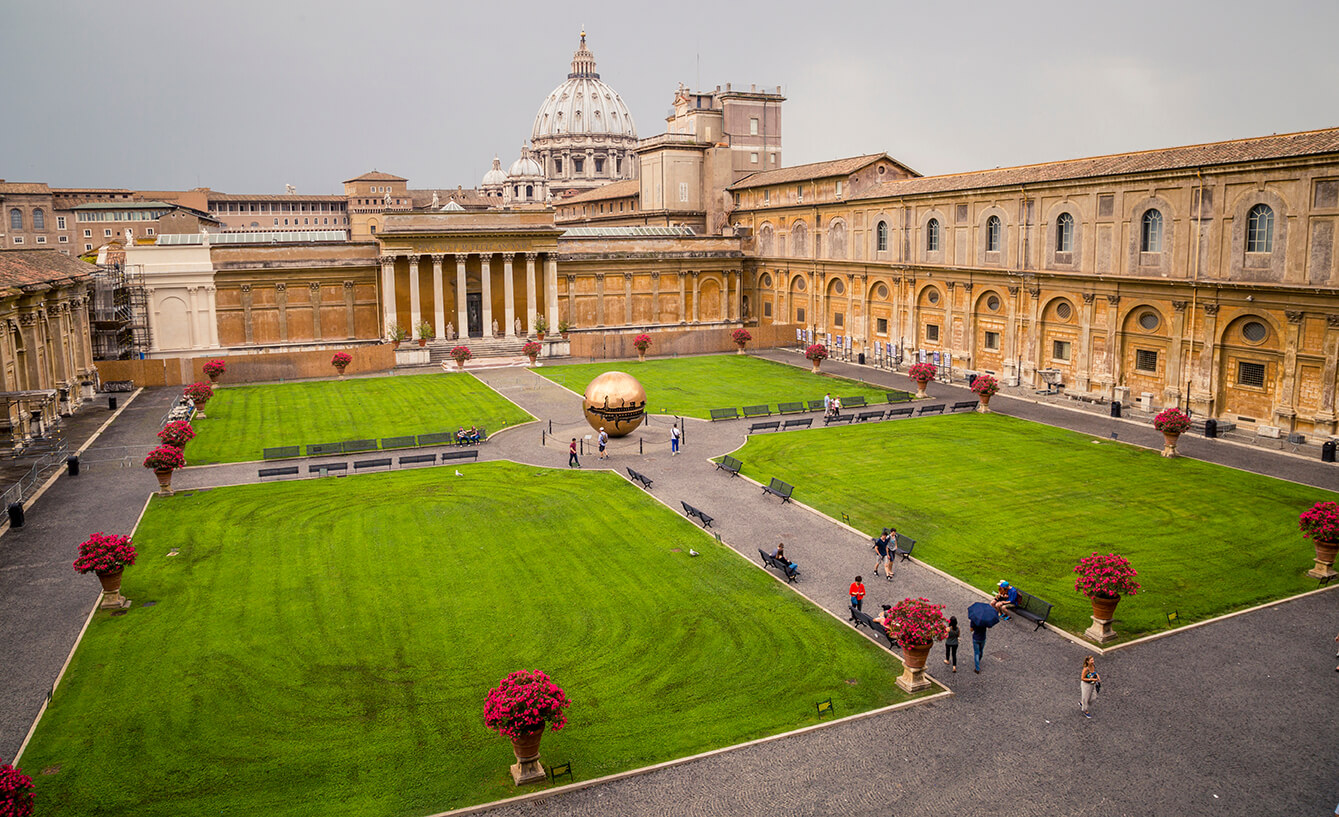
    The Cortile della Pigna in the Vatican Museums, a courtyard on the standard visitor route
    The Cortile della Pigna, one of the open courtyards on the Vatican Museums route. Photo via Shutterstock.

    Type “Vatican Museums tickets” into a search bar and the same warning shows up on page after page: book weeks ahead, or you won’t get in. It sounds authoritative. Nobody links to where it came from. So I went through what the Vatican itself actually publishes about booking and hours, plus closures, and checked it against the parts of that advice that hold up.

    Short version: some of it is real. Some of it is fear dressed up as a rule of thumb.

    What the Vatican Actually Publishes

    Here is the thing nobody quotes: the official ticket page does not state a recommended lead time. Not “book two weeks ahead,” not “book a month out.” What it does publish is a price difference between the two ways of getting in. Full entry is €20 if you buy without booking online, or €25 with online “Skip the Line” booking, which is the €20 ticket plus a €5 booking fee. Reduced and student entry runs €10 without booking, €15 with it. Free entry is “reserved to children below the age of 7,” along with visitors certified 67%-plus disabled and their companion.

    That €5 fee is a service charge for reserving a slot, not evidence of scarcity. Nowhere on the Vatican’s own site is there a stated booking-window length, a sellout percentage, or a “these months fill fastest” table. If a rule like that exists in the ticketing system’s back end, the Vatican has not published it, and I could not verify it independently. Anyone who tells you a specific week count is quoting a guess, however confident it sounds.

    One line is worth remembering regardless of when you book: “Tickets cannot be refunded.” Whatever date you commit to, commit to it deliberately.

    The One Day the Warning Is Completely Right

    There is exactly one day a month when “just show up” genuinely fails, and it isn’t a booking problem at all. On the last Sunday of every month, the Museums open free of charge, 09:00 to 14:00, with final entry at 12:30. You cannot pre-book that slot because it isn’t a paid, timed entry. Wikipedia’s summary of the day is blunt: “It is popular and common for people to wait in line for many hours.”

    That is a real bottleneck, driven by free admission pulling in a crowd all at once rather than by any ticket allocation running out weeks in advance. If your dates happen to land on a free Sunday and you want a predictable morning, book a paid entry on a different day instead of testing that queue.

    The Rest of the Month Runs on a Different System

    Monday to Saturday, the Museums operate on published hours: “From Monday to Saturday 08.00 a.m. – 08.00 p.m.,” with “(final entry 06.00 p.m.)” and thirty minutes built in at the end for visitors to clear the galleries before the doors actually shut. That is a long window. Eight-hour Museums days across six days a week is a different shape of access than a single free Sunday morning, and it changes what “sold out” would even mean.

    I want to be precise about what I can and can’t confirm here. I could not verify month-by-month sellout rates, a daily visitor cap, or how far ahead the booking calendar actually opens — the ticket portal itself is a JavaScript app that returns nothing to a plain fetch, so I couldn’t inspect it directly. What I can say is that no official Vatican source states any of those numbers publicly. Treat any blog post that cites a precise sellout percentage or a daily capacity figure as an estimate, not a Vatican statistic, unless it names a source you can check.

    What Actually Tightens Up in Summer

    If a season feels like it demands more planning, it’s summer, but not for ticket-scarcity reasons. One nearby site closes entirely for weeks: the Castel Gandolfo Papal Palace and gardens shut for the whole of July 2026, plus a further run of dates through August, according to the site’s own published calendar. The Vatican Necropolis under St Peter’s — home to the Scavi tour — is a different case: its published closure list is just the standard Vatican holidays (Sundays, Ferragosto, plus the rest of the dates above), with no month-long summer shutdown on record. Neither is the Sistine Chapel or the main Museums galleries, but Castel Gandolfo is something visitors often try to combine with a Museums day, and it goes dark for a real chunk of high season.

    The papal general audience schedule follows the same pattern. Leo XIV’s 2026 calendar shows audiences on 3, 17 and 24 June, then a gap: nothing listed for the whole of July, before resuming on 5 August. If you were planning a trip around catching a Wednesday audience, summer is the wrong assumption to build on, and that gap has nothing to do with how full the Museums ticket calendar is on any given day.

    The Closures That Actually Matter

    A “weeks ahead” rule is vague. A closure date is not. The Museums’ official closure list is exact: Sundays, except the last Sunday of the month, unless it lands on 29 June; 1 and 6 January; 11 February; 19 March; 6 April; 1 May; 29 June; 14 and 15 August; 1 November; and 8, 25, and 26 December. Today’s date sits just ahead of that mid-August pair — a useful reminder that the closure calendar, not a countdown of weeks, is what actually rules out a date.

    St Peter’s Basilica runs on its own separate hours, currently “From june 1st: from 7.00 am to 8:00 pm,” with the dome open 07:00–18:00 through 25 October 2026 and 07:30–17:00 from late October. If a trip pairs the Basilica with the Museums, check both calendars, not just one.

    So When Should You Actually Book?

    Strip out the guesswork and three things are verifiable, and worth planning around instead of a vague week count.

    First, the closure calendar rules dates out completely, so check it before anything else. A Museums day planned for 15 August, for instance, simply won’t happen — that date is on the official closed list, full stop. Second, the free last Sunday of the month is the one date where turning up without a plan genuinely costs you hours in a queue; every other Museums day runs on timed, paid entry instead. Third, summer’s real friction comes from satellite sites shutting for weeks at a time, the Necropolis and Castel Gandolfo among them, plus a July gap in the papal audience calendar, none of which has anything to do with how quickly Museums slots fill.

    None of that tells you to book in January for a June trip. What it tells you is to pick your date against the closure list first, decide whether a free Sunday queue suits your patience, and then book once, properly, because that ticket won’t be refunded if your plans shift afterward.

    Where the Booking Actually Happens

    The Vatican is explicit about where tickets should be bought: “The only official site for purchasing tickets online is https://tickets.museivaticani.va.” Look-alike domains exist, and the warning is on the Museums’ own page for a reason. A licensed operator selling skip-the-line entry or a guided tour is a legitimate, different product from that official portal — you’re paying for guiding and logistics on top of admission, not for a shortcut around a Vatican rule that doesn’t exist. What neither route changes is the underlying policy: no refunds, and no official published lead time telling you exactly when to click “buy.”

    So: book the free Sunday morning around, not through. Watch the closure list before the calendar countdown. And once a date is locked, treat it as final, because it will be. If you’d rather hand the logistics to someone who checks these dates for a living, our Vatican Museums tickets page lays out the current entry options so you can pick a date and stop second-guessing it.

  • Vatican Gardens Tour vs Museums-Only Ticket: What’s Actually in the Gardens

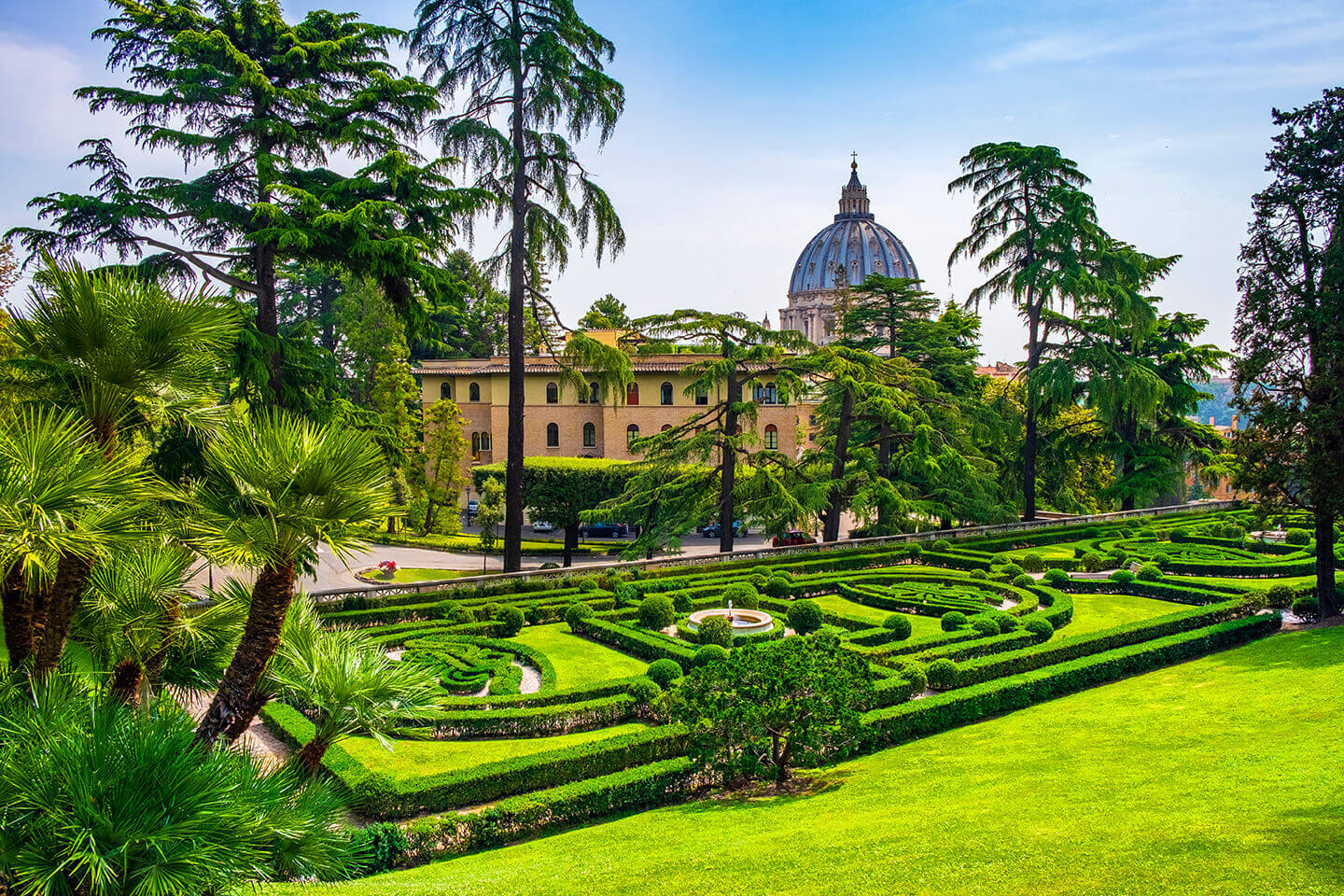
    Vatican Gardens with St. Peter's Basilica dome in the background
    The Vatican Gardens, with the dome of St Peter’s Basilica behind the grounds and fountains.

    Every week a few visitors book the Vatican Gardens tour thinking it unlocks a second wing of the museums, something with paintings or sculpture they’d otherwise miss. It doesn’t. The Gardens ticket gets you onto the grounds behind and beside the Basilica: lawns, fountains, a couple of small buildings, a grotto. No galleries, no additional frescoed rooms, nothing that overlaps with what’s inside the museum halls. That’s not a flaw in the product. It’s just a different product, and knowing that before you book saves you from either disappointment or, more often, from skipping something you’d genuinely have liked.

    What the Gardens ticket actually covers

    The official description is specific about size and content. The Vatican’s own pages put it plainly: “The Vatican Gardens extend over an area of approximately 22 hectares, corresponding to half of the entire territory of Vatican City.” That’s the headline fact worth holding onto, because it tells you what kind of experience this is. Half of Vatican City, by area, is grounds rather than buildings.

    What’s actually out there, according to the official feature list: the Italian Garden, the Fountain of the Eagle, the Fountain of the Zitella, the Casina of Pius IV, a shrine known as Our Lady of the Watch, the Lourdes Grotto, Saint John’s Tower, the Jubilee 2000 Bell, a bronze statue of Saint Peter, and the Square Garden. Read that list again and notice what’s missing: no Raphael Rooms, no Sistine Chapel, no Gallery of Maps, no Egyptian collection. Every item on it is outdoors, a fountain, a monument, a planted garden, or a small standalone building. That absence is the whole answer to whether the Gardens duplicate anything you’d see inside the museums. They don’t.

    Why people expect more than grounds

    The confusion has a fairly obvious source. On the Vatican’s own ticket page, “Vatican Gardens” sits as its own tour category, listed separately from “Museums and Vatican Collections,” from the Papal Palace and Secret Garden of Castel Gandolfo, and from the Necropolis of the Via Triumphalis. Four distinct product lines, sold as four distinct tickets. When someone sees “Gardens” filed next to “Museums” on the same booking page, it’s natural to assume they’re two halves of one larger visit, room and grounds, indoor and outdoor, sold together or at least closely related. They’re not bundled that way. Each is its own admission, and buying one doesn’t imply anything about what the other contains.

    There’s a second layer to the mix-up worth naming directly: Castel Gandolfo. Its ticket is called the “Papal Palace and Secret Garden,” priced separately at €12, and it’s a different property altogether, the former papal summer residence southeast of Rome. If you’ve seen that name mentioned alongside “Vatican Gardens” somewhere online, treat them as unrelated. One is inside Vatican City; the other is a lakeside town about twenty-five kilometres away.

    Who genuinely benefits from adding it

    Given all that, who should actually book the Gardens add-on? A few groups, honestly.

    Anyone who’s already done the museum halls on a previous trip and wants a slower, less crowded morning this time. The interior galleries can mean shuffling through packed corridors even outside peak season; the grounds don’t work that way. Photographers who want the dome of St Peter’s framed against greenery rather than stone corridors get a shot the museum interior simply can’t offer. Families travelling with young children who won’t sit still through room after room of Renaissance ceiling painting often do better outdoors, where there’s space to walk and less pressure to keep quiet. And repeat visitors to Rome who’ve already covered the Sistine Chapel and want to see a part of Vatican City that most tourists never enter at all.

    Who probably shouldn’t bother: a first-time visitor with limited hours who hasn’t yet seen the Sistine Chapel or the Raphael Rooms. If this is your only Vatican visit and time is tight, the interior collections are where the irreplaceable material lives. The Gardens are a pleasant addition once that’s covered, not a substitute for it.

    Booking it without overpaying

    On pricing, some honesty is due: the live Vatican ticket portal is a booking application that doesn’t expose Gardens-specific prices on a static page, so I won’t invent a number here. What I can confirm from the Vatican’s published tariff page is the museums-only figure, which gives you a useful benchmark for what a Vatican ticket generally costs. The full museums entry runs “€ 20.00 (without online booking),” or “€ 20.00 + 5.00 (with booking on the official Vatican Museums website)” for skip-the-line access, so €25 total if you book ahead online. Reduced tickets for students, pilgrimage groups and universities are €10 (plus the €5 booking fee if reserved online). Whatever the Gardens ticket costs at checkout, expect it to be quoted and paid separately from any museums admission, since they’re distinct products rather than one combined pass.

    One more thing worth flagging, because it saves people real money: the Vatican’s own site warns visitors to “beware of potential scams and websites that use domains similar to the official one, which may charge significantly higher prices.” That applies to Gardens bookings just as much as museum tickets. Third-party domains that look official but aren’t will happily mark up a ticket you could get for less through the right channel, so check who you’re actually buying from before you pay.

    Fitting it around the museums

    If you’re combining a Gardens visit with the museum halls in the same day, plan around the museums’ own schedule rather than the other way round. Monday to Saturday the museums run 8:00 AM to 8:00 PM, with last entry at 6:00 PM, and staff enforce a hard cutoff on the way out too: “Visitors are required to leave the halls 30 minutes before museum closing time.” On the last Sunday of the month, hours shrink to 9:00 AM until 2:00 PM with last entry at 12:30 PM, and admission is free that day, except around Easter, June 29th, and the final days of December. Otherwise the museums close on Sundays entirely. Build your Gardens time into whichever end of the day has slack, rather than squeezing it between two other bookings.

    The short version

    The Vatican Gardens tour is grounds, fountains, and a handful of small monuments spread across roughly half the territory of Vatican City. It isn’t a second museum wing, and it was never sold as one; the ticket structure has always kept it as its own category, separate from the halls that hold the Sistine Chapel and the rest of the collections. Buy it for what it is, a quiet green counterpoint to a day spent indoors, and it earns its place. Buy it expecting extra galleries and you’ll come away wondering where the paintings went.

    If you’re still weighing up how to combine the Gardens with the interior collections, or want a guided route through both without the guesswork, our Vatican tours page lays out the options that pair well together.

  • Vatican Museums and Colosseum in One Day: Where the Schedule Actually Breaks

    The Cortile della Pigna in the Vatican Museums, a courtyard on the standard visitor route
    The Cortile della Pigna, one of the open courtyards on the Vatican Museums route. Photo via Shutterstock.

    Every guidebook lists the Vatican Museums and the Colosseum a few kilometres apart, which makes “do both in one day” look like a reasonable ambition. On a map it is. On a Tuesday in April, with real queues and a real metro timetable attached to each step, it rarely survives contact with the clock. Here is where the plan actually holds, and where it quietly falls apart.

    7:30am — the museums, before the day fills up

    The Vatican Museums open Monday to Saturday at “08.00 a.m. – 08.00 p.m.”, per the official hours page, with last entry at 6:00pm. An early-entry booking, timed for roughly 7:30, buys ninety minutes of galleries before the general public crowd arrives through the main entrance. This part of the plan works. Photograph the Gallery of Maps while it is still quiet, reach the Sistine Chapel before the tour groups converge, and you are on schedule for a mid-morning finish.

    The catch is that “mid-morning finish” is doing a lot of work in that sentence. A rushed Sistine Chapel and Raphael Rooms visit takes two and a half hours if you move briskly and skip most of the side galleries. A visit that actually looks at the ceiling takes three and a half. That one-hour gap is the first crack in a same-day plan, and it shows up before you have even left Vatican City.

    10:30am to 11:00am — St Peter’s, or not

    Most itineraries pair the museums with St Peter’s Basilica, since the two sit inside the same walled complex. It is worth deciding in advance whether the basilica is part of this particular day, because its own security queue and dress-code checks can add another 30 to 60 minutes depending on the season. If the Colosseum is the fixed point on the itinerary, the basilica is the piece to cut, not the museums exit time. Trying to keep both is how a 10:30 finish becomes a 12:15 finish.

    The transit gap nobody puts in the brochure

    Assume you leave the Vatican Museums exit, past Giuseppe Momo’s spiral staircase, at 11:00am sharp. The route to the Colosseum runs Metro Line A from Ottaviano or Cipro to Termini, then a transfer to Line B for two stops to Colosseo. Rome2Rio quotes “24 min” for the fastest version of that journey. Colosseumroman.com, describing the same route, is more specific: “Take Metro Line A from Ottaviano to Termini, then transfer to Metro Line B and ride 2 stops to Colosseo. The whole trip takes 25–35 minutes including the transfer and walking at both ends.”

    Treat that as a range, not a guarantee. Twenty-five minutes assumes a train waiting on the platform and no queue at the ticket machine. In practice, walking from the museums exit to Ottaviano station, buying a ticket if you have not pre-loaded a transit card, and covering the platform-to-platform transfer at Termini pushes most visitors closer to 40 minutes door to door. Add a wrong-direction train on Line A, which happens more often than any transit app admits, and an 11:00am departure lands you at the Colosseum somewhere between 11:40 and noon.

    What actually happens at Ottaviano station

    The theory sounds clean: down the escalator, onto Line A, off at Termini, across to Line B, done. In practice, midday trains on Line A run every four to six minutes rather than the two-minute intervals of rush hour, and Termini’s transfer corridor is long enough that “two stops to Colosseo” understates the walking involved. Carrying museum-bought guidebooks, a stroller, or simply not knowing which platform serves which direction adds real minutes that no journey planner counts. None of this makes the metro a bad choice; it is still faster than a taxi through midday traffic near the Vatican. It just means the lower end of that 25-to-35-minute estimate belongs to a visitor travelling light who already knows the station.

    Noon — the Colosseum queue, if you skip the walk-up line

    Whether that arrival time still works depends entirely on how the Colosseum ticket was bought. According to myromelife.com, a travel-guide source rather than the official site, walk-up ticket-office waits run “45 minutes to over 3 hours” during high season, with the same guide recommending 8:45–9:15am arrivals for the shortest queues. Arriving at noon with no ticket in hand is close to the worst possible time slot: past the early rush, but well inside the day’s peak.

    A pre-booked online ticket changes this substantially. Per the same source, online booking carries a small extra fee but is said to “guarantee entry without queuing.” That single decision, made days earlier rather than at the gate, is usually the difference between a same-day plan that works and one that does not. If there is only one booking to get right on this itinerary, it is the timed-entry Colosseum ticket, not the museums slot.

    Worth flagging here: official current Colosseum hours and prices were not independently confirmed for this piece, since colosseo.it was unreachable during research. Treat any specific closing time or euro figure you see quoted for the Colosseum, including the ranges above, as a travel-guide estimate to double-check on the day rather than a fixed fact.

    Early afternoon — where the schedule actually breaks

    By 1:00pm, a visitor who left the museums at 11:00am, hit the transit gap on the slow end, and had a pre-booked Colosseum ticket is walking through the arena with roughly ninety minutes on the clock before the day’s momentum runs out. That is enough time to see the arena floor and the upper tiers without racing. It is not enough time to add the Roman Forum or Palatine Hill, both of which share a ticket with the Colosseum and sit directly next to it. Most visitors who try to add them on the same afternoon end up seeing one at a jog and the other not at all.

    This is the actual failure point. Not the museums, not the metro, but the assumption that a Colosseum ticket automatically includes enough time and energy for the archaeological park attached to it. Two sites in one day, if the connections all go right, is achievable. Four sites — Vatican Museums, St Peter’s, Colosseum, and Forum — in one day is where nearly every version of this plan collapses, usually somewhere around 3:00pm with a visibly tired group and a Forum entrance that closes an hour before sunset.

    A split that actually holds up

    The version of this trip that works reliably puts the Vatican side on one morning and the Colosseum side on another, with the Forum and Palatine attached to the Colosseum day rather than squeezed after it. That frees the Vatican morning to run long if the Sistine Chapel earns it, and frees the Colosseum afternoon to include the Forum without a metro ride bolted onto the middle of it.

    For travellers with only one full day in Rome, a tighter version can still work: museums early entry finishing by 11:00am sharp, a pre-booked timed Colosseum ticket for 12:30 or 1:00pm rather than noon, and no Forum add-on that day. That gives the transit gap enough breathing room to survive a slow train without wrecking the afternoon, and it treats the Colosseum ticket time as the anchor the rest of the day is built around, rather than an afterthought.

    Booking notes worth acting on

    Two things are worth locking in before the day itself. First, the museums’ own scam warning is blunt and worth repeating: “The only official site for purchasing tickets online is https://tickets.museivaticani.va. Please beware of potential scams and websites that use domains similar to the official one.” Second, if the visit happens to fall on the last Sunday of the month, museum hours shrink to “09.00 a.m. – 02.00 p.m.” with free admission and a much larger crowd, which makes a same-day Colosseum pairing considerably harder rather than easier — plan around it or avoid that specific Sunday.

    If the morning is going to be tight regardless, a guided early-entry slot removes at least one variable from the day: no queue to plan around and a route through the galleries built to finish on time. Our Vatican Museums tours are timed with exactly this kind of two-site day in mind.

  • Raphael Rooms or Straight to the Sistine Chapel: What You Lose by Rushing Through

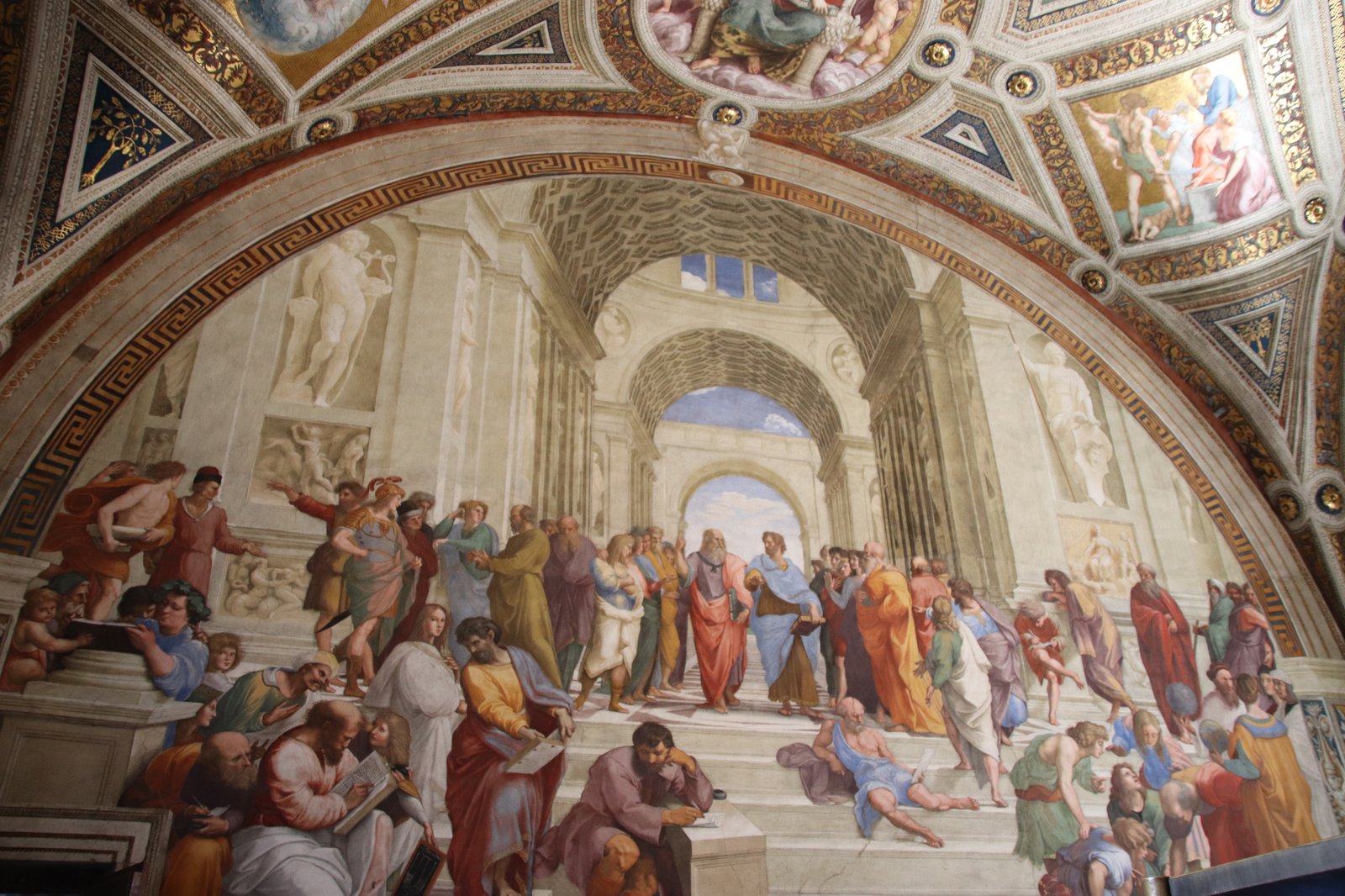
    Raphael's School of Athens fresco in the Stanza della Segnatura, Vatican Museums
    Raphael’s School of Athens, painted for Pope Julius II’s private study before the room became part of the public Vatican Museums route. Public domain via Wikimedia Commons.

    The Raphael Rooms sit directly on the walking route into the Sistine Chapel, and for a large share of visitors that single fact does all the deciding. Five minutes here, forty there. Visitors treat the chapel as the destination and the four rooms before it as a corridor with some old paintings on the walls. That is a mistake worth correcting before you go, because the room most people barely glance at was, for a decade, a working papal study, and the fresco most people photograph without reading is a portrait gallery of people you already know by name.

    A study, not a corridor

    Pope Julius II commissioned Raphael in 1508 or 1509 to redecorate a suite of rooms in the Apostolic Palace that already existed as his personal apartment. Wikipedia’s summary of the commission is direct: Julius II “commissioned Raphael and his workshop [in] 1508 or 1509 to redecorate the existing interiors of the rooms entirely.” Raphael was around twenty-five. He had never worked in Rome. He got the job partly on Bramante’s recommendation and partly because Julius II reportedly could not stand looking at the previous decoration, some of it by artists including Perugino, and wanted it gone.

    The room now called the Stanza della Segnatura was the first one Raphael touched, and its original purpose explains why. Wikipedia describes it as “intended to serve as a study and library for Julius II” — a private working space, not a reception hall. Its four wall frescoes map onto that function almost like labels on shelves: Theology on one wall, Philosophy on the wall facing it, Poetry and Law on the two remaining walls. A Renaissance library organised by subject, painted instead of shelved. It only picked up its current name later, once it became the seat of a papal tribunal called the “Segnatura Gratiae et Iustitiae,” the Signatura of Grace and Justice, by around 1513. So the room you walk through today carries a bureaucratic name from its second life, while the paintings on its walls still describe its first one.

    Backwards, and nobody tells you

    Here is the detail that changes how the whole visit reads. The four rooms are the Sala di Costantino, the Stanza di Eliodoro, the Stanza della Segnatura, and the Stanza dell’Incendio del Borgo. Raphael painted the Segnatura first, from around 1508 to 1511. He moved on to the Eliodoro room, 1511 to 1514, then the Incendio room, 1514 to 1517. He died in 1520, and the Sala di Costantino was finished afterward by his workshop, largely without him, completed between 1520 and 1524.

    Visitors do not walk that sequence. Their route runs the other way. Wikipedia states the effect plainly: “Visitors today enter from the east and proceed westward through the rooms in reverse order from their execution — encountering the most recently completed chamber first.” You meet the room Raphael never personally finished before you meet the room where he was still learning how to paint a papal apartment. Nobody at the entrance mentions this, and a fast-moving group will pass through all four spaces without ever realising the order they are seeing them in has nothing to do with the order they were made.

    Who is actually in the painting

    Inside the Segnatura, on the wall facing the Disputation of the Holy Sacrament, is the room’s best-known work and the one worth stopping for even if you skip everything else. The Vatican Museums’ own description calls it a gathering of “the most famous philosophers of ancient times,” set inside an architectural space inspired by Bramante’s ideas for the new St Peter’s. It rewards being read left to right rather than glanced at whole.

    At the centre, two figures under the arch: Plato, who “points upwards with a finger and holds his book Timeus,” and Aristotle beside him holding his own Ethics, hand extended flat toward the ground. That single gesture pair is the painting’s argument in miniature — one philosopher pointing to abstract forms above, the other pointing to observed reality below. In the foreground, alone on the steps, Pythagoras sits “intent on explaining the diatesseron,” a musical ratio, surrounded by students bent over his notebook. Diogenes the cynic sprawls apart from everyone else, “lying on the stairs with a dish,” indifferent to the company he is keeping. Off to one side, leaning on a block of marble and writing, is a figure the Vatican Museums identifies as a portrait of Michelangelo in the guise of the philosopher Heracleitus.

    That detail is not incidental. The Vatican Museums’ page notes that “Michelangelo was in those years executing the paintings in the nearby Sistine Chapel,” meaning Raphael was painting a tribute to a rival a short walk from where that rival was working, on a ceiling neither of them could have seen finished yet. Two of the defining works of the Roman Renaissance were going up at the same time, a few rooms apart, by two men who by most accounts did not get along. Raphael puts himself in the scene too: at the far right edge, in dark clothing, “on the extreme right with the black beret,” looking straight out at the viewer while everyone else is absorbed in argument. It is the closest thing the room offers to a signature.

    What a rushed pass actually loses

    None of this needs an hour. It needs enough time to stop moving. A group herded through in ninety seconds sees a wall of robed men in a building; a visitor who pauses for even three or four minutes in front of School of Athens sees an argument about how humans know anything, staged as a room full of individuals doing recognisably different things — teaching, arguing, ignoring each other, showing off. That gesture between Plato and Aristotle only means something once you notice both hands. Diogenes only reads as a joke once you have seen how formally everyone around him is behaving. Skip the Raphael Rooms at a jog and none of that lands; you register wall-to-wall paintings and move on to the ceiling everyone told you about.

    There is a second cost specific to the sequence itself. Walking the rooms east to west means your first impression of Raphael in the Vatican is workshop-finished Constantine, not the room the Vatican Museums itself credits as “the first work executed by the great artist in the Vatican” — that line refers to the Segnatura. If you do not know you are walking backwards, you never correct for it, and you leave with the wrong room as your mental anchor for what Raphael actually did here.

    Getting there with time to spare

    The Vatican Museums open Monday to Saturday, 8:00 a.m. to 8:00 p.m., with last entry at 6:00 p.m. and a hard requirement to exit thirty minutes before closing. On the last Sunday of every month the museums open 9:00 a.m. to 2:00 p.m. with admission free and last entry at 12:30 p.m.; every other Sunday they are closed, along with a fixed list of religious and civic holidays through the year. A standard adult ticket is €20.00 at the official price; booking a skip-the-line slot adds a €5.00 booking fee on top. Reduced and student tickets run €10.00, plus the same €5.00 if booked skip-the-line. Whatever you choose, book with intent: the official site states plainly that “Tickets cannot be refunded.”

    Practically, that means building slack into your morning rather than treating the Raphael Rooms as a room to clear on the way to somewhere better. An early slot, before the mid-morning groups arrive, buys you the kind of quiet in which the Segnatura’s four walls actually separate from each other in your memory instead of blurring into one long gallery. If you would rather have someone point out the Plato-Aristotle gesture, the Michelangelo cameo and the self-portrait as you go, rather than hunt for them cold, our Raphael Rooms guide covers the route room by room and is worth a look before you plan the rest of the day.

  • Audio Guide or Live Guide in the Vatican Museums: What Each One Can’t Do

    Vatican Museums gallery corridor leading to the Sistine Chapel
    The gallery corridor leading to the Sistine Chapel, the last stretch where a live guide is still allowed to speak.

    Neither format loses to the other in general. Each one breaks at a specific point in the route, for a specific mechanical reason. Knowing where lets you pick the one that fails you least.

    An audio guide is, in the museum’s own description, “a modern, simple and light MP3 reader that accompanies and guides the visitor along the museum itinerary.” A live guide is a person walking with you, reading the room and adjusting on the fly. Put them side by side and the differences look small. Put them at the threshold of the Sistine Chapel, or in a group of eleven trying to hear one voice over three hundred other groups, and the differences become the whole story.

    The corridor before the chapel is where live narration ends

    Groups walking with a live guide do not get commentary inside the Sistine Chapel itself. The museum states this directly: “Guided tour groups, although equipped with radio headsets, will receive all the relevant art-historical information prior to their entry in the Sistine Chapel.” Whatever your guide is going to tell you about the ceiling, the Last Judgement, or the restoration history, you hear it in the rooms and corridors that lead up to the chapel door, not inside it.

    Practically, this means the final stretch of gallery before the entrance carries more weight than it looks like it should. It is where a guide compresses forty minutes of context into a few. This is the last legal opportunity to speak before the group crosses the threshold. An audio guide has no such cutoff point built into its design that the museum states publicly, so if you are relying on recorded narration you may find yourself still listening as you walk in, or you may not; the official pages we checked do not spell out where, or whether, the museum expects audio units to stop.

    Inside the chapel, both formats hit the same wall

    Once you are through the door, the rule that governs everyone is silence, not format. The museum’s own guidance is unambiguous: “during the visit to the Sistine Chapel visitors are kindly requested to observe absolute silence.” A live guide cannot talk around this. An audio guide, if it were still playing, would be working against the same expectation the moment your earpiece is audible to the person standing next to you.

    Electronics face a separate, harder rule. “In the Sistine Chapel it is forbidden to take photographs or films with any type of electronic equipment,” and specifically, “the use of mobile phones is forbidden in the Sistine Chapel.” Outside the chapel the policy flips: “it is permitted to take photographs, for personal and domestic use only, of the works in all areas of the Vatican Museums, apart from the Sistine Chapel.” So a phone used as an improvised audio player anywhere else in the museum is fine for taking a picture; inside the chapel it is not permitted at all, for any purpose. What that means for the museum’s own MP3 audio-guide units at that same doorway is not stated on the pages we could check, so treat it as a genuine open question rather than a settled answer, and follow the attendant’s instruction at the door rather than the device’s default behaviour.

    The radio headset most visitors never think about

    Live guides working with larger groups do not project their voice across a hall full of competing tour groups. They use a whisper-style radio headset system, and the museum’s own pages disagree slightly on when it becomes compulsory. The general visitor page sets the line at eleven: “For guided group tours with 11 or more participants, the internal hire of radio headset systems is obligatory.” The dedicated radio-headset service page sets it one lower: “The use of radio headsets is obligatory for all tours, including pilgrimages, universities and schools, with 10 or more participants up to a maximum of 20 (30 for school tours).” Two official pages, two numbers. If your group sits right on that edge, expect the museum’s own staff to apply whichever threshold they enforce that day, and don’t be surprised if it’s ten.

    Cost is at least consistent: “the hire cost is € 1.50 for each member of the group (free of charge for the guide),” and “the use of other radio headset systems is not permitted.” That second clause matters more than it looks. A guide cannot bring a personal headset kit as a workaround, and the museum’s system is “reserved exclusively to the guides accredited to the Vatican Museums for the current year.” A live guide without current Vatican accreditation is, mechanically, unable to run a compliant headset tour at all above the threshold, regardless of how good the commentary is.

    What the audio guide physically cannot do

    An MP3 unit plays a fixed track for a fixed room. It cannot answer the question you actually have when you’re standing in front of Laocoön wondering why the arm is a different colour from the rest of the statue, and it cannot skip ahead when your group needs to be somewhere else in fifteen minutes because your entry slot is closing. It does not notice that you’ve stopped walking because you’re staring at something the script never mentions, and it does not adjust its pace when the Gallery of Maps is packed shoulder to shoulder and you can barely see the Danti panels, let alone read the small print that would explain what you’re looking at. Its route is fixed at build time; your actual walk through the museum, weaving around three hundred other groups, is not.

    What the live guide physically cannot do

    A live guide has the opposite failure mode. They cannot speak to you inside the Sistine Chapel, by rule, however good the story they were saving for that moment. Without current Vatican accreditation they cannot legally run the radio headset that makes a large group audible in a loud hall, which means an unaccredited or informally arranged “guide” walking a group of twelve is either breaking the rule or shouting, and neither serves you well. And a live guide is bound to the museum’s clock in the same way you are: halls close thirty minutes before the posted closing time, so a tour that starts late gets compressed on the back end, not extended.

    Timing pressure applies to both

    Opening hours are “08.00 a.m. – 08.00 p.m.” Monday to Saturday, with last entry two hours before that, and a shorter “09.00 a.m. – 02.00 p.m.” window on the free last Sunday of each month. Whichever format you’re using, the museum is explicit that “visitors are required to leave the halls 30 minutes before museum closing time.” An audio guide unit doesn’t care how much of its script you finish; a live guide has to make a judgement call about which rooms to cut if the group is behind. Neither format buys you extra minutes once the closing announcement starts.

    Choosing between them honestly

    If your priority is flexibility, control over pace, and not depending on a stranger’s schedule, the audio guide’s fixed, solitary format suits you, with the trade-off that it can’t answer a follow-up question or read the room ahead of a crowd surge. If your priority is context that adapts to what you’re actually seeing, and getting the art-historical background delivered before the one room where nobody is allowed to speak, a live guide does that better, provided the group size and accreditation line up with what the museum actually permits that day. Neither solves the chapel’s silence rule. Nothing does; that room was designed centuries before either format existed, and it still runs on its own terms.

    If you’d rather have a licensed guide handle the headset logistics, the group-size thresholds and the timing squeeze for you, our Vatican Museums tours page lists the guided formats we run, including the small-group options that stay well under any headset threshold the museum applies.

  • Vatican Museums With Kids Under 10: Why the Standard Route Doesn’t Work

    Family on a guided tour in the Vatican Museums
    A family on a guided tour in the Vatican Museums. Most first-time parents plan for the wrong route length.

    Ask a seven-year-old to look attentively at painted ceilings for four hours and you will lose that battle within forty minutes. Yet the standard Vatican Museums visit, the one printed on most tour itineraries and assumed by most self-guided planners, is built around exactly that: a long, mostly one-directional walk through room after room, ending at the Sistine Chapel. It works for adults who came specifically to look at art. It does not work for a family with a child under ten, and pretending otherwise is how afternoons collapse into meltdowns two-thirds of the way through the Gallery of Maps.

    This is a guide to what actually changes when you shorten the route on purpose, built from the Vatican’s own published visitor policy plus a working operator’s sense of where families run out of patience.

    Why the full route assumes an adult

    The marketed route is not wrong, exactly. It is simply not designed with a small child’s attention span, bladder, or leg strength in mind. It stacks room after room of static visual content with almost no interactive element, asks visitors to stand and read wall text, and saves the single biggest payoff, the Sistine Chapel, for the very end. An adult can defer gratification for two hours. A six-year-old cannot, and by the time you reach Michelangelo’s ceiling, the child who needed the payoff most is already asking to go back to the hotel.

    There is no official figure for how long the standard route takes or how far it covers on foot; the Vatican Museums’ own visitor-advice page gives no duration or distance number at all. Treat any “four hours” or “seven kilometres” claim you read elsewhere, including ours, as a market estimate rather than an official one. What is certain is the shape of the problem: a long corridor-style museum with one major room at the far end, and a young child whose patience runs out well before that room.

    What the Vatican Museums actually offer families

    Credit where it is due. The Museums are set up for families more thoughtfully than their reputation as an endurance test suggests. Their own advice page states plainly: “The Museums are pleased to welcome families with children and strollers in tow.” Staff at the entrance will “show visitors the easiest route and… direct them to dedicated elevators providing easy access to various museum spaces,” which matters a great deal once a stroller meets the first staircase.

    Practical infrastructure exists along the way too. There are “baby changing facilities and a nursing room for breastfeeding mothers,” and “highchairs are provided in some refreshment areas.” Four named courtyards function as built-in rest stops: “Relaxation areas with seats are located along the museum itinerary to enable the visitor to take a break and to rest (Courtyard of the Cuirasses, Courtyard of the Pinacoteca, Square Garden, Courtyard of the Pinecone).” A fifth, the Courtyard of the Carriages, appears on a separate family-facilities page. None of this is secret. Almost none of it gets mentioned in the standard itinerary a family is handed.

    There is also a dedicated Family Audioguide Tour, described on the Museums’ own site as “a fascinating treasure hunt, with special details to discover, mysteries to reveal and riddles to solve” for young visitors. We could not confirm its running time, price, or exact stop list from published material, so book it as a nice-to-have rather than plan your whole day around a duration you have not seen in writing.

    The shortened family route: concrete stops, not a checklist

    Cutting the route is not about skipping the Sistine Chapel. It is about reordering what you see and being ruthless about the long connective galleries that exist mainly to move adult tour groups from one highlight to the next.

    Start early and go straight in. Do not linger through the opening galleries the way a self-paced adult would; walk them at a child’s pace, which is faster than you think when nothing has grabbed their attention yet. Use the Cortile della Pigna, the Courtyard of the Pinecone, as your first proper stop rather than your last. It is outdoors, it is open, and the giant bronze pinecone and the Sphere Within Sphere sculpture give a young child something concrete to look at and talk about, unlike a corridor of tapestries. Let them run a lap of it before you go back inside.

    From there, aim for one or two galleries with real visual punch rather than the full sequence, then move toward the Sistine Chapel while the morning’s patience is still intact. Save the Gallery of Maps for a fast walk-through, not a stop: it is a beautiful corridor for an adult with time, and a very long hallway for a tired six-year-old. If a wall of your itinerary is mostly text panels or repeating similar objects, that is the wall to skip. A shortened family route is not a shorter version of the adult route; it is a different route that happens to end in the same room.

    Use the courtyards on purpose. Plan a break at the Courtyard of the Pinecone or the Courtyard of the Pinacoteca roughly halfway through, even if the group does not feel tired yet. Sitting down for ten minutes before the meltdown, not after it, is the entire trick.

    Timing that respects the closing rule

    Vatican Museums hours run 08.00 a.m. – 08.00 p.m., Monday to Saturday. On the last Sunday of each month the Museums open 09.00 a.m. – 02.00 p.m. with free admission, which sounds attractive until you picture the queue a free Sunday draws; it is not the day to bring a stroller and a toddler who needs a nap.

    One rule matters more for a family than almost anything else on the visitor page: “Visitors are required to leave the halls 30 minutes before museum closing time.” That half hour is not yours to browse in. If your child hits a wall at 6:45 p.m. on a day the Museums close at 8:00 p.m., you already need to be moving toward the exit, not toward one last room. Build your day backward from that hard stop rather than forward from your entry time, and you will not get caught mid-gallery when staff start clearing the halls.

    For most families with children under ten, ninety minutes to two hours inside the Museums is a realistic, enjoyable ceiling, not a compromise. Longer is possible with an easygoing child and a lot of snack breaks. Longer is rarely enjoyable.

    Tickets and the age question

    The Vatican Museums’ published price list lists a full-price ticket at €20 at the door or €25 booked online in advance, and a reduced ticket at €10 at the door or €15 booked online. Free entry applies to “Children below the age of 7.” There is no separate published rate for children aged seven to ten; budget for that age band at the full adult price until you see a distinct child tier in writing, and treat any online listing that promises otherwise with a healthy dose of scepticism until it is confirmed at the ticket office.

    Under-sevens go in free, which is one more reason the youngest children in a family are often the easiest to bring: no ticket cost, and the stroller access described above.

    Feeding a family mid-visit

    Two dining options sit inside the Museums complex. The Self Service corner runs “a special menu for children, rich in authentic and tasty food,” and a Pizzeria offers an alternative if a picky eater refuses whatever the day’s menu is. Both, per the Museums’ own family page, have “comfortable high chairs.” Building a proper sit-down break into a shortened route, rather than pushing through on sheer momentum, is often the difference between a family that leaves happy and one that leaves early and cross.

    If you are pairing this with St Peter’s Basilica

    Many families combine the Museums with St Peter’s Basilica the same day, and it is worth knowing the Basilica runs on its own separate schedule under a different authority, the Fabbrica di San Pietro. From 1 June its published hours are “from 7.00 am to 8:00 pm.” The dome is on its own timetable again: 7:30 a.m. to 5:00 p.m. in winter, 7:00 a.m. to 6:00 p.m. in summer. None of this overlaps automatically with Museums hours, so check both before you build a single-day plan around seeing both sites with a small child in tow.

    A guide who has watched hundreds of families move through this route on the same morning will chop the day differently than a generic itinerary will: shorter museum stretch, real breaks in the courtyards, the Sistine Chapel reached while everyone still has patience for it, and the rest of the plan built around a child’s actual limits rather than an adult’s. If you would rather have someone plan and walk that route with you on the day, our Vatican tours page lists the guided formats set up for exactly this kind of family pace.

  • After-Hours Private Vatican Tour vs a Normal Day Visit, Hour by Hour

    Private after-hours tour group walking through an empty Vatican Museums gallery
    A private after-hours group has the galleries to itself, the difference an evening slot is really selling.

    Two visitors leave Rome the same evening having seen the same rooms. One paid a fraction of what the other did. The question worth answering before you book isn’t which ticket is “better” in the abstract. It’s what each hour of each timeline actually buys you, and whether that specific hour is worth the specific premium attached to it.

    Below are both days, laid out clock-side to clock-side, from arrival to the moment you’re back on the street outside Viale Vaticano.

    7:45 a.m.: the day-visit queue starts forming

    Standard Vatican Museums hours run Monday to Saturday, 8:00 a.m. to 8:00 p.m., with final entry at 6:00 p.m. and galleries cleared thirty minutes before closing. A mid-morning day visitor with a timed ticket typically arrives at security around 9:30 or 10:00, well after the doors have opened, which means walking straight into a museum that’s already busy. Full adult admission is €20 at the door or €25 online, the extra €5 being a “Skip the Line” booking fee rather than a different product.

    This is the baseline every after-hours ticket gets compared against, and it’s a perfectly functional one. Museum rooms don’t change character between opening time and mid-morning; the art on the walls is identical at every hour of the day. What changes is how many people are standing between you and it.

    Evening entry: a locked door and a much smaller group

    An evening private slot works on a different mechanic entirely. Rather than joining the general daytime flow, a private after-hours group is walked in as a defined, licensed-guide-led party, after the museum’s public hours have wound down for the day. Galleries on the way to the Sistine Chapel are, for that stretch, largely yours: no queue snaking around the Belvedere Courtyard, no crowd bottleneck at the entrance to the Gallery of Maps.

    Stated plainly, that’s the entire product: fewer bodies in the same rooms. Whether that’s worth paying for depends on what you actually want out of the visit, and the sections below get specific about where it earns the premium and where it doesn’t.

    9:30 a.m. to midday: the day visitor’s real obstacle course

    By mid-morning on a standard visit, the corridor toward the Sistine Chapel is a slow shuffle rather than a walk. Forty painted panels line the Gallery of Maps, a hallway not built for modern visitor volumes, and it becomes a place you move through rather than stand in. Michelangelo’s ceiling is unchanged from any hour of the day, but seeing it while pressed shoulder to shoulder against other visitors is a materially different experience from seeing it with room to tilt your head back and actually look.

    None of this makes the day visit a bad option. It makes it a busier one. A visitor who wants to move at their own pace, linger in the Raphael Rooms, or simply avoid crowds will feel this stretch of the itinerary the most.

    The empty-gallery hour: where the premium actually earns its keep

    Here’s the stretch where an after-hours slot most clearly outperforms a day ticket: the Gallery of Maps and the approach to the Sistine Chapel, walked without the daytime crush. Photography without obstruction, a guide who can talk at normal volume instead of shouting over a hundred other tour groups, and the physical space to stand in front of a fresco for longer than a few seconds. If there’s a single hour of the day that justifies the cost difference, it’s this one. Quiet corridors are the whole premise, and they deliver on it.

    It’s also worth being honest about where the premium doesn’t do much. Michelangelo’s ceiling, Raphael’s School of Athens, and the Laocoön are exactly the same objects at 9 a.m. and at 7 p.m. A visitor mainly after photographs of specific artworks, rather than a specific atmosphere, gets most of that value from a well-timed day ticket already.

    Basilica hours: the one constant across both timelines

    St Peter’s Basilica sits outside the Museums’ ticketing system entirely and keeps its own schedule: from 1 June, “from 7.00 am to 8:00 pm,” according to the Basilica’s official hours page. That’s true whether your Museums visit was a 9:30 a.m. entry or an evening private tour. Basilica access itself doesn’t run on an after-hours product, so both visitor types generally end up seeing it on the same clock, separately, before or after the Museums portion of the day.

    Dome access follows a seasonal split: 7:00 a.m. to 6:00 p.m. through late October, then 7:30 a.m. to 5:00 p.m. over winter. Weekdays, the guided-tour desk inside the Basilica runs 9:30 a.m. to 5:30 p.m., with last registration at 5:00 p.m., and a shorter Sunday window applies. Anyone folding a dome climb or a desk-booked Basilica tour into either itinerary needs to work around these fixed hours regardless of which Museums ticket they hold.

    Days when neither timeline exists

    Both itineraries assume the Museums are actually open, which isn’t guaranteed on every date. Sundays are closed except for the last Sunday of each month, when admission is free and hours shrink to 9:00 a.m. to 2:00 p.m., final entry 12:30 p.m. On top of that, the Museums close entirely on a fixed list of dates through the year: 1 January; 6 January; 11 February; 19 March; 6 April; 1 May; 29 June; 14 and 15 August; 1 November; 8 December; 25 and 26 December. A private evening slot booked against one of those dates is as unavailable as a standard morning ticket. Checking the calendar first saves a wasted booking either way.

    Closing time: two very different last ten minutes

    On a standard day visit, the last ten minutes before the 6:00 p.m. final-entry cutoff, or the thirty-minute gallery-clearing window ahead of 8:00 p.m. closing, tend to feel rushed: staff moving visitors along, a queue at the exit spiral staircase, the sense of being herded out with everyone else who left their visit too late. An evening private group experiences the opposite. The last ten minutes are usually the quietest of the whole tour, since the museum has effectively already closed to the public and there’s no one left to compete with for a final look at a gallery or a doorway.

    That contrast is a genuine, if small, part of what’s being sold. Being ushered out with a crowd and walking out of an empty building at your own pace are two different endings to the same day.

    What the timeline doesn’t answer

    Two things are worth flagging plainly rather than guessing at. First, whether a distinct official “Vatican Museums by night” product exists as a separate line item from private after-hours tours isn’t something the Museums’ own hours page states, so this isn’t a claim we’re making either way. If you’re offered one, check the specifics against what you’re actually being sold. Second, group-size caps and pricing for private after-hours tours vary by operator, so treat any figure you see quoted elsewhere as that operator’s terms rather than a fixed Vatican rate. One thing is fixed, and worth checking regardless of which ticket you book: the source. The Vatican Museums’ own ticketing page warns visitors to “beware of potential scams and websites that use domains similar to the official one, which may charge significantly higher prices.”

    So which timeline is worth it

    For a visitor whose priority is seeing the major artworks at all, on a reasonable budget, the standard day visit does the job. It’s cheaper, it’s flexible around the rest of a Rome itinerary, and the art doesn’t change after dark. A different kind of visitor wants the atmosphere itself: walking through the Gallery of Maps without another tour group in the frame, hearing a guide at a normal speaking volume, standing under the Sistine ceiling with something closer to silence around them. For that visitor, the evening slot is buying a specific hour that the standard timetable simply doesn’t offer. It isn’t a better version of the same visit. It’s a different visit, sold at a different price, and the clock above shows exactly which parts of the day justify that gap.

    If the empty-gallery hour is the part you actually want, our after-hours private Vatican tour page has the current evening formats and what each one includes.