
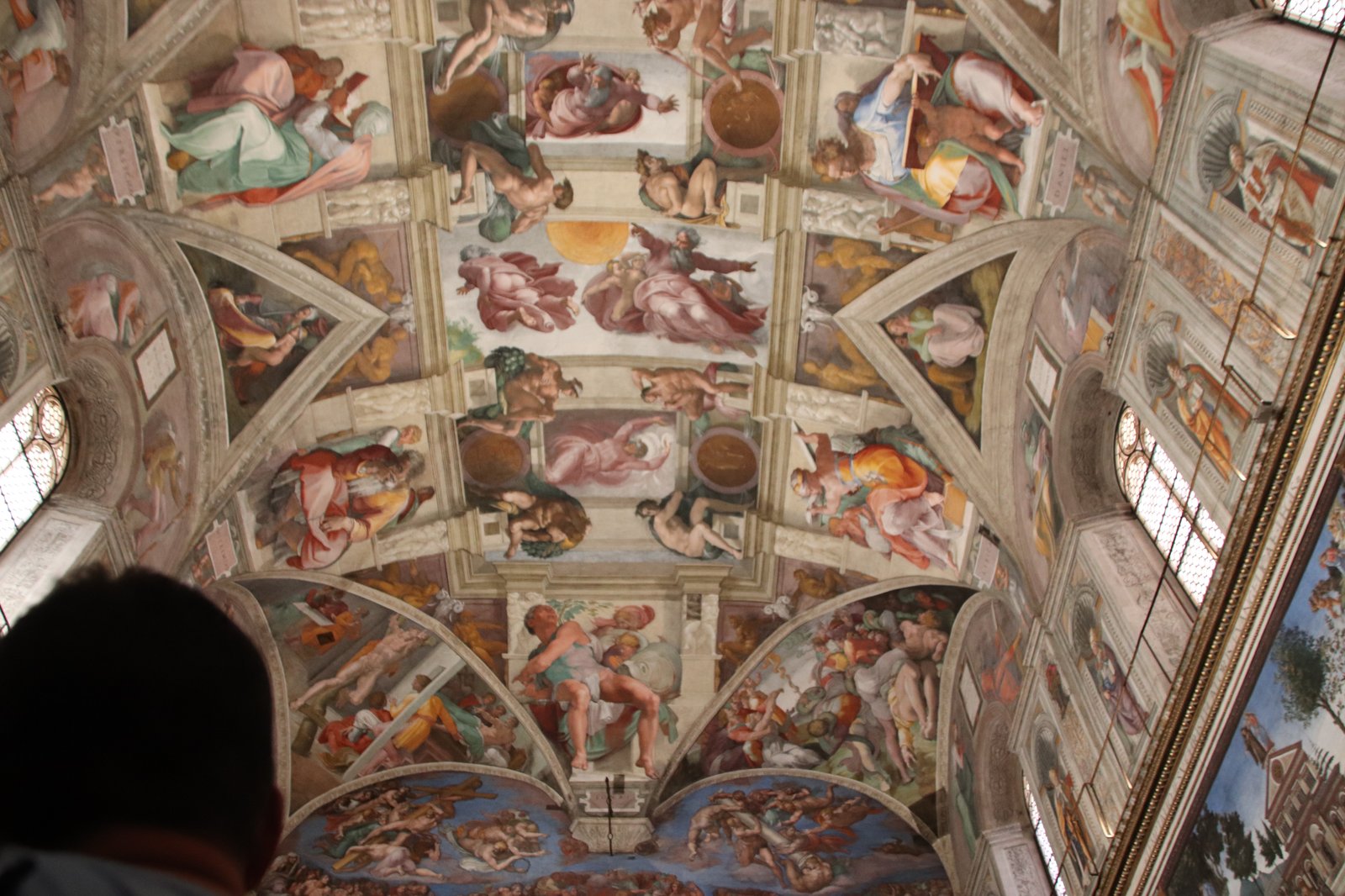
Someone raises a phone. An attendant claps, once, and says silenzio. The phone comes down. By my count this happens roughly twelve times an hour inside the Sistine Chapel on a busy summer day, and by the third or fourth time you have watched it, the ritual stops feeling weird and starts feeling like a well-run church service. That is roughly the intended effect.
The rules inside the Chapel are the strictest in the Vatican Museums. No photography of any kind. No video. No phones held aloft. Voices at a whisper or none at all. What confuses first-time visitors is that these rules are not posted at the door in ten languages. There is a small sign. Nobody reads it. The enforcement mechanism assumes you will find out by watching what happens when someone else forgets.
Why the rules exist
Two reasons, both practical, neither theological.
First, the photography ban is a copyright artifact. Between 1980 and 1994, Nippon Television Network Corporation of Japan funded the fourteen-year restoration of the Chapel’s ceiling and the Last Judgement at a final cost of roughly $4.2 million. In exchange, NTV received exclusive photographic and film rights for three years after the completion of each phase — the Last Judgement rights, for example, expired in 1997. Those windows have long since closed, but the photography ban has stayed. It solves several practical problems at once: it stops the room from being permanently full of people photographing the ceiling instead of looking at it, and it keeps the visit moving at a walking pace. (The often-cited flash-damages-pigments argument is weaker than it sounds; conservation research does not show consumer flash at visitor distances measurably fading paint. Copyright legacy and crowd flow are the actual drivers.)
Second, the silence rule exists because the Sistine Chapel is still a working chapel. The conclave — the College of Cardinals sealed in to elect a new pope — meets exactly beneath the ceiling you are looking up at. The most recent conclave was held in May 2025, following the death of Pope Francis, and elected Pope Leo XIV. Mass is celebrated here at occasional papal liturgies. It is not a museum room that used to be sacred and is now a display. It is a sacred room that is displayed the rest of the year. The whisper rule is downstream of that.
Who enforces the rules
The Sistine Chapel is patrolled by attendants of the Vatican Museums (formally the Directorate of Museums and Cultural Heritage of Vatican City State), not Swiss Guards. By observation, on a typical day between four and six of them are in the room at any moment, distributed along the walls and near the doors, wearing dark suits and museum lanyards. Rotations look to be on a roughly twenty-minute cycle, so nobody in the room ever loses focus. Their job is not to smile or greet you. Their job is to remind the room, gently but continuously, of the ritual it is expected to observe.
Individually they are unremarkable. Collectively they run a room of up to two thousand people at any one time — the design load of the 2014 Carrier HVAC upgrade — with almost no friction. It is one of the more impressive feats of low-key crowd management in Europe.
What actually happens when someone breaks the rule
Watch closely and there is a specific sequence. It plays out roughly the same way every time.
1. A phone comes up. Sometimes to photograph, sometimes to check a message.
2. Within about four seconds, an attendant catches it. Their eye-scan of the room is continuous and they are trained to spot the vertical rectangle of an upheld phone against the horizontal rhythm of shoulders and heads.
3. They clap once — a firm, dry clap, not aggressive, just loud enough to carry across the room. Sometimes the clap is enough on its own. Every head in that quarter of the chapel snaps toward the sound.
4. If the clap has not landed, they add the word silenzio, or no photo, depending on the offence. Occasionally both, in the same breath, in the same tone that a schoolteacher uses on a class that has been warned three times.
5. The phone comes down. In my observation, nine times out of ten this ends the incident. On the tenth, the attendant walks over to the visitor and delivers a short, quiet instruction that other tourists cannot hear. That is the final step. There is no ejection unless someone escalates, which almost never happens.
The whole thing takes ten to twenty seconds and does not disturb the rest of the room. If you are looking up at the ceiling when it happens, you might notice a small ripple at floor level and go back to what you were doing.
What to do instead of taking a photo
The strongest response to a “no photos” rule is to work with it rather than against it. Two suggestions.
Sit down on one of the stone benches integrated into the perimeter walls on the sides and the rear of the chapel. They are unmarked, discreet, and consistently under-used because first-time visitors do not realise they exist. Sitting changes the geometry of the ceiling above you completely. A cinema-seat view of Michelangelo is a different experience from the standing-with-head-tilted-back view most people take away.
Give the room enough time. Ten minutes is a bare minimum. Twenty is when the room starts to reveal its structure — the nine central panels of Genesis, the twelve prophets and sibyls around the borders, the four corner scenes of Old Testament rescues. Fifteen years of Michelangelo’s life went into this room. Fifteen minutes of yours is not a large ask in return.
How the Sistine compares to other rooms
The photography ban does not apply anywhere else in the Vatican Museums. In the Gallery of Maps you can take as many photos as you like. In the Raphael Rooms photography is allowed. In St Peter’s Basilica photography is allowed except during Mass. The Sistine Chapel is the only enforcement zone.
Some first-time visitors interpret this to mean that the Sistine is the most valuable room. It is not the most valuable in any measurable sense — the Vatican Pinacoteca has works by Leonardo, Caravaggio and Raphael that are equally significant. What the Sistine is, uniquely, is a room that has been decided to be treated as sacred first and looked at second. That decision cascades into every rule at the door.
Practical preparation
Before you enter:
- Put your phone into your pocket, not your hand. If it is in your hand, the muscle memory of the last thousand museum visits will raise it. Removing that possibility is easier than resisting it.
- Do not try to sneak a photo of the ceiling on the way out. Attendants stand at both doors. The exit-corridor photo is the classic “gotcha” moment; you will end up deleting the picture in front of a museum staff member with a full room watching. It is nobody’s favourite Vatican memory.
- If you want the ceiling as a keepsake, buy a print at the Museums shop on the way out. The high-resolution photographs from the 1980s Nippon TV shoot are still the best-quality images that exist. A three-euro postcard beats a phone snap in every way that matters.
Inside:
- Walk to the far side wall from the entrance and find a bench. If they are all taken, wait five minutes; there is turnover.
- Whisper only if you have something specific to point out. Silence is the default, not something you owe to a rulebook.
- Look at the wall behind the altar too. The Last Judgement was painted by Michelangelo twenty-four years after the ceiling and it is the room’s other subject, not just decoration. Give it as long as the ceiling.
Book the visit that lets you sit
The only way to have time inside the Chapel is to arrive with time. The 08:00 skip-the-line slot gives you the Sistine at close to nine, when the room is populated but not packed and you can find a bench without waiting. Book that slot on our Vatican Museums & Sistine Chapel skip-the-line ticket. If you want a guide to walk you through the ceiling’s structure while you sit, our VIP early-entrance guided tour combines the same slot with a licensed guide who is very good at pointing without whispering.
For the dress code that gets you through the door, see our Vatican dress code guide. And for the full rundown of hours in 2026, the opening hours page is kept current.