
A young couple at the front of the queue for St Peter’s Basilica opens their bags on the security table. Passports out, phones on the tray, bottles into the bin. A guard glances at the man’s Bermuda shorts, ends just above the kneecap, and says “no.” The couple is redirected off to the side. They walk two hundred metres to a vendor stall on Via della Conciliazione, buy a linen wrap for eight euros, come back, and queue again from the end. Total loss: about forty-five minutes.
This scene plays out several hundred times a day at the Vatican’s three main entrances. Vatican dress code is one paragraph long. Refusals cluster around five or six specific outfit choices. And the rule reads slightly gentler than it is enforced.
What the rules actually say
The Vatican Museums publish a short “Rules of Conduct” that includes this line, verbatim: “Sleeveless and/or low-cut garments, shorts above the knee, miniskirts and hats are not permitted.” Visitors must be “appropriately dressed,” and the code applies “regardless of religion.” That is it. No dress code exists that specifies fabric, length below the knee, footwear, sunglasses, or beach attire — those are personal-tolerance interpretations that guards do not enforce.
St Peter’s Basilica has an internally-published version of the same rule (shoulders and knees covered, no sleeveless, no shorts above the knee, no miniskirts, hats off inside). Dome-climb visitors get the same rule too, since you enter through Basilica security. So does the Sistine Chapel; the code applies at the Museums door and again inside the Chapel.
The rule reads gentler than it is enforced
Here is where first-time visitors get caught. One line in the rule says “shorts above the knee.” In practice, guards at St Peter’s Basilica frequently refuse Bermuda-style shorts on men even when the hem sits at or slightly below the kneecap. There is no formal “long trousers only for men” rule I can point you to; it is an enforcement convention that has hardened over years. If you are a man, long trousers are the only safe choice at the Basilica.
Same rule also says “hats are not permitted.” Enforcement is universal on this one. Baseball caps, sun hats, wide-brim summer hats, all off inside. This is not “hats off during prayer” — it is hats off any time you are inside any of the three sites.
The five outfits that reliably get people refused
In my observation on summer mornings, the five outfits most commonly refused, in roughly descending frequency:
- Men’s tank tops and sleeveless shirts. Same rule as women’s sleeveless — refused at every gate. Same fix: a T-shirt or a light layer over the top.
- Spaghetti-strap sundresses. Classified as sleeveless. Refused at every gate. A scarf over the shoulders is enough to pass, provided it stays on.
- Men’s Bermuda shorts at the Basilica. That knee test is a kneecap-covered-when-standing test. Anything shorter is refused, and even hem-at-kneecap is a coin flip at the Basilica.
- Miniskirts and short skirts. Above-the-knee is the line. A sarong tied over the top is a common fix and is accepted, provided the sarong itself reaches the knee.
- Crop tops and cut-off tanks. Even with a jacket on your arm, if the midriff shows when you walk you will be asked to close the jacket. If you have no jacket, you will be sent to a vendor.
- See-through white shirts. Not named in the written rule, but read as low-cut / immodest by the guards; frequently refused especially for women. A camisole under the shirt fixes it.
Two outfits that surprise people by being accepted: sarongs (accepted as a wrap or over-skirt if they reach the knee) and flip-flops or open sandals (not named in the rules, not enforced).
How the check actually works
There is no separate dress-code booth. That check happens at the security screening you already have to pass anyway. As you place your bag on the X-ray belt, the guard doing the visual scan is also looking at what you are wearing. If they refuse you, they will point off to the side and say “cover” or “no.” You are not given a wrap. You are not offered an alternative. You are politely removed from the queue.
Your timed ticket clock keeps running. Your booking is not rescheduled. If you have a fifteen-minute booking window and you spend twenty minutes finding a vendor and covering up, your ticket may not be honoured when you come back and you may have to buy a new one at the walk-up desk. This is why the seven-euro scarf you buy from the vendor stall is the least stressful three minutes of the entire visit.
What the vendors sell, and what it costs
The scarves, shawls, pashminas and wraps sold from the folding-table stalls on Via della Conciliazione and along Viale Vaticano are a working economy, and the pricing reflects it. Expect five to fifteen euros for a scarf or pashmina. The “cashmere” claims are almost universally acrylic or rayon; the item’s job is to get you past the door once, not to become an heirloom. Some stalls also sell disposable ponchos for wet weather in the two-to-five-euro range.
The Vatican does not provide free wraps at the entrance. Some third-party sources describe a paid disposable-poncho option sold near the Museums entrance (typically €3-5); I have not personally observed it in the way some Roman churches offer paper covers to visitors in shorts, so treat availability as inconsistent. If you are travelling with a small bag and want to skip the vendor step entirely, pack a lightweight scarf and pair of thin long trousers or a maxi skirt in your day bag. Both weigh almost nothing and remove the whole dress-code failure mode from the trip.
The Sistine Chapel enforces the rule a second time
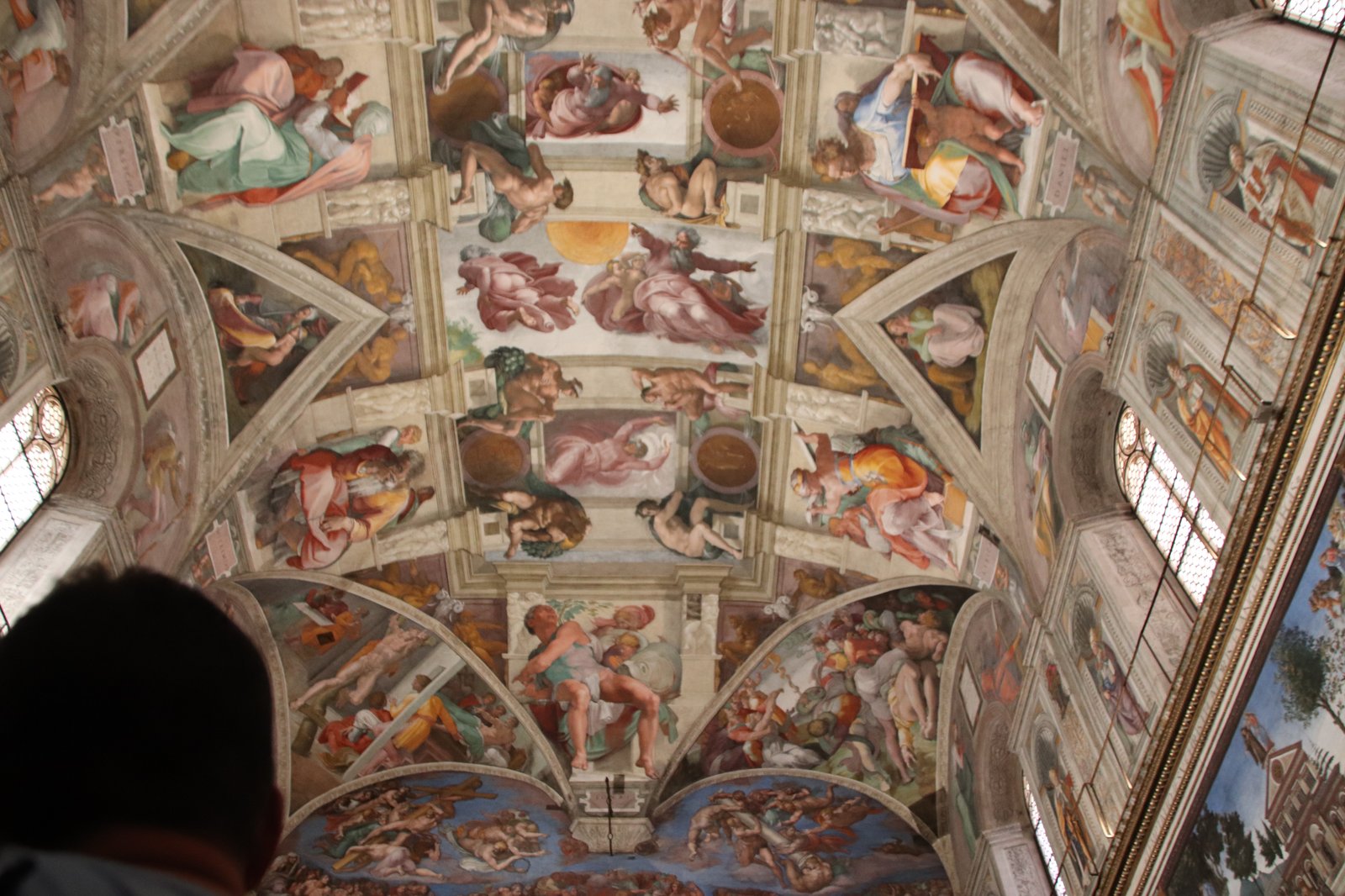
If you got through the Museums door in a borderline outfit and started peeling off a layer as the rooms warmed up, expect a second check inside the Sistine Chapel. The attendants stationed along the walls are watching for bare shoulders and knees, and they will approach quietly and ask you to cover up. Visitors have been escorted out for arriving fully covered at the Museums entrance and stripping down to a tank top by the time they reached the Sistine. It is one enforcement, applied twice.
Children and mobility
The published rule applies “regardless of religion” and does not list an age exception. In practice, small children in shorts and sleeveless dresses are routinely admitted at guard discretion; enforcement is visibly relaxed for young kids and tightens noticeably for teenagers. If you are travelling with an eleven- or twelve-year-old, dress them as you would dress an adult — the visible age at which enforcement kicks in is around then.
I have not found any published dress-code exception or wrap-provision for wheelchair users or visitors with accessibility needs. Enforcement appears to be applied identically, and the Vatican Museums are broadly wheelchair-accessible. St Peter’s Basilica is less so; if you are visiting with someone who uses a wheelchair, the accessible route to the Basilica avoids the Dome climb entirely, which is where the strictest enforcement typically sits.
The Papal Audience gate
The Wednesday Papal Audience in St Peter’s Square runs the same rule — shoulders and knees covered, hats off — and enforcement is at least as strict as at the Museums. Piazza security opens around 07:30 on audience mornings and the same visual scan happens as you enter through the colonnade. Refusal rates are visibly higher here than at the Museums, partly because of the sheer volume of foot traffic and partly because the crowd skews toward summer tourists who did not read the fine print. If you are attending the audience, dress for it the way you would for the Museums.
The three lines to remember
- Shoulders covered. This means no spaghetti straps, no cap sleeves that expose the shoulder joint, no crop tops.
- Knees covered. Kneecap covered when standing, at all three sites. For men at the Basilica, long trousers are the only safe answer.
- Hats off inside. All three sites, all the time.
Everything else — sandals, sunglasses on top of your head, printed t-shirts, the entire shoulder-bag-through-security choreography — is your business. Pack a scarf and long trousers, or bring seven euros for the vendor. The refusal you avoid is worth both.
For the full dress-code guide with day-of-visit tips and printable rules, see our Vatican dress code page. If you are booking around a Wednesday morning, our post on why Wednesday mornings are a bad time to visit the Museums covers the Papal Audience knock-on effects that compound with the stricter dress-code enforcement at the piazza gate.