
Most first-time visitors to the Vatican Museums book a guide specifically for the Sistine Chapel. That is the exact wrong way round. Sistine is the room where a guide is at their weakest. Rooms you walk through on the way to Michelangelo’s ceiling (the Gallery of Maps, the Raphael Rooms, the Pio-Clementine sculpture galleries) are where a licensed human guide is worth their fee and an audio guide is not.
This is an argument the Vatican itself makes, quietly, in a line most visitors do not read.
What the Vatican’s own rulebook says
From the Vatican Museums’ Useful information for visitors page: “Guided tour groups, although equipped with radio headsets, will receive all the relevant art-historical information prior to their entry in the Sistine Chapel.” Also: “During the visit to the Sistine Chapel visitors are kindly requested to observe absolute silence.”
Read those two sentences carefully. Even a paid, licensed tour with radio headsets is not allowed to lecture inside the Chapel. Guides must brief you before you cross the threshold and then stay quiet once you are through the door. Attendants shush audibly and can escort out anyone talking above a whisper.
Which means the money you pay for a guided Sistine visit is really money you pay for a fifteen-minute pre-brief on Michelangelo’s ceiling, delivered in a corridor. That is worth something. It is not worth the premium some tour operators charge for the “Sistine Chapel guided experience.”
The audio guide covers the Sistine perfectly well
The Vatican Museums’ official Audioguide costs €8, is available in twelve languages (including a couple you would not expect — Ukrainian, Korean, Japanese), and runs to roughly three hours of commentary across the standard route. Rent one at the entrance turnstiles in the Courtyard of the Cuirasses, or pre-book with your ticket.
For the Sistine specifically, the audio guide’s Michelangelo track is thorough. It walks you through the ceiling’s nine central Genesis panels, the twelve prophets and sibyls, the corner spandrels, and the Last Judgement on the altar wall. You listen at your own pace, sitting on one of the stone perimeter benches. Nobody around you is being lectured. The room does the work.
What the audio guide cannot do is the specific job a good human guide does elsewhere in the Museums — which is where the argument for spending on one starts.
The Raphael Rooms are where a guide earns their fee
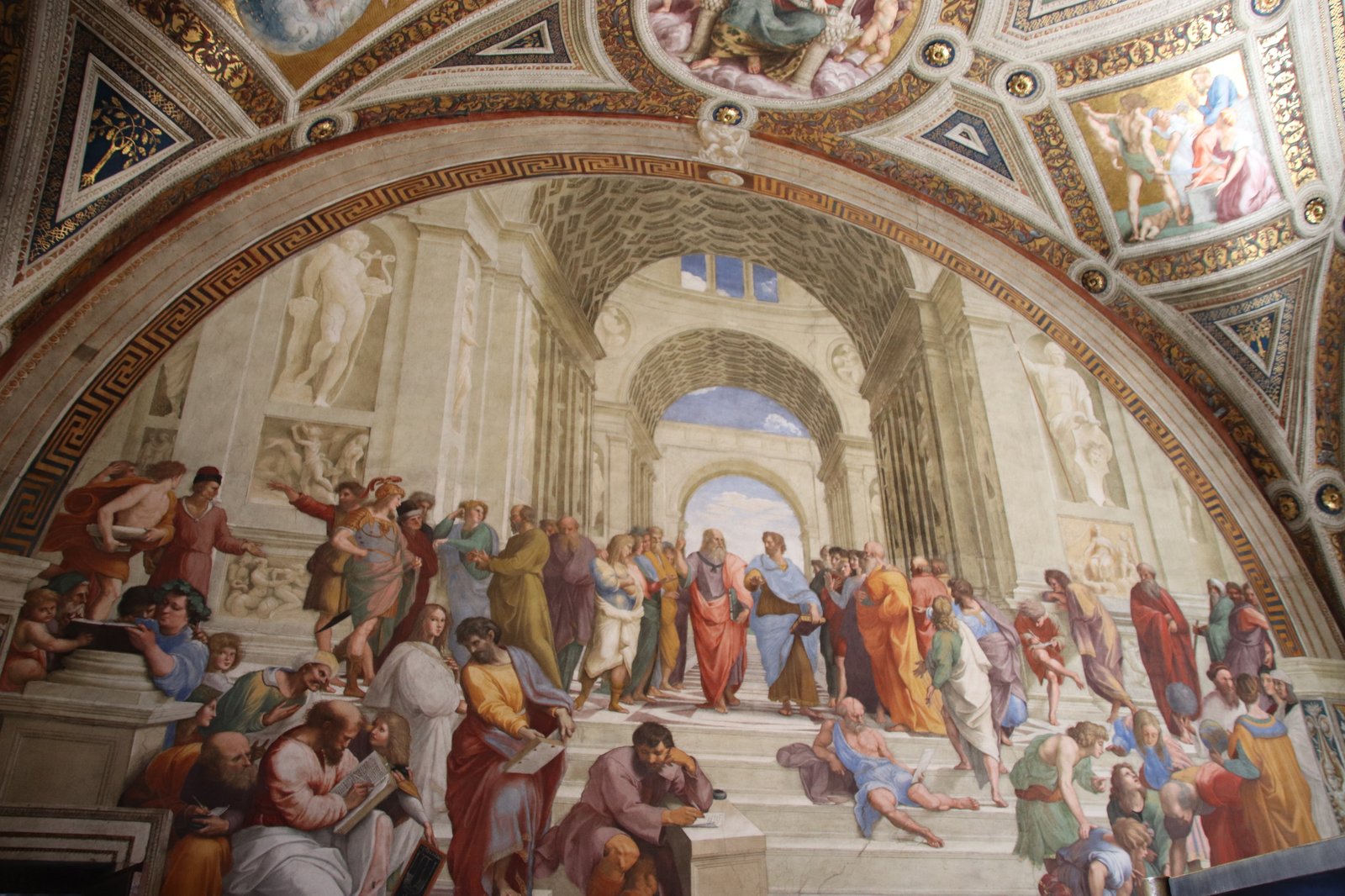
Stanza della Segnatura contains the School of Athens on one wall and the Disputation of the Most Holy Sacrament on the wall opposite. Each fresco is a specific theological or political argument dense with cross-references. Raphael painted Leonardo da Vinci into the face of Plato. Michelangelo is generally accepted to appear as Heraclitus in the foreground of the School of Athens, added after Raphael had seen the Sistine ceiling. Raphael painted himself into the far right in a black beret, watching. The three other rooms — the Stanza di Costantino, the Stanza di Eliodoro, and the Stanza dell’Incendio del Borgo — each hold their own layered arguments.
All of this is legible with an audio guide. But the difference between reading a fresco under a track that walks you through it in five minutes and standing in front of it while a licensed guide points and unpacks the argument at your pace is genuinely large. Raphael Rooms reward being talked at; the Sistine does not, because you are not allowed to be talked at inside.
The Gallery of Maps hides a political argument
Ignazio Danti’s forty frescoed maps between 1580 and 1583 look like decoration. They are not. Pope Gregory XIII commissioned them as a post-Tridentine assertion of Catholic Italy under papal spiritual sovereignty. Maps on the west wall show the territories washed by the Tyrrhenian Sea; on the east, the Adriatic. Eight end panels bracket the room’s argument between naval defence of Christendom (Malta 1565, Lepanto 1571) and papal commercial reach (Genoa, Venice, Ancona, Civitavecchia).
Almost none of this is visible to a first-time visitor without briefing. An audio guide describes what you are looking at. A good human guide explains why it is arranged this way and what point the room is making. Both approaches take about the same amount of time; only one changes what you see.
The Pio-Clementine needs the sequence
Three sculptures in the Pio-Clementine galleries carry the weight of the whole Museums collection: the Laocoön Group, the Apollo Belvedere, and the Belvedere Torso. Each is worth stopping in front of; the sequence — how each influenced the next, and how all three were rediscovered in the Renaissance and shaped Michelangelo’s own thinking — is where a guide provides the value. An audio guide gives you three self-contained tracks. A guide gives you an argument connecting them.
How to spot a licensed guide in 2026
Italy’s tour-guide licensing regime changed in 2024. Law 190/2023 replaced the old patchwork of regional patentini with a single national qualification, and guides who pass are entered in the Elenco Nazionale delle Guide Turistiche maintained by the Ministero del Turismo. The first national exam ran in 2025 with a pass rate under two per cent — around 222 successful candidates from 12,000 who sat the written screening. A second national exam is running in 2026.
In practice, almost every working Vatican guide today holds the older Regione Lazio patentino from before the reform. Legacy licences remain valid and holders were rolled into the national register. What matters for a visitor is the same as it always was: ask to see the badge before you hire. Licensed guides carry an ID card and are legally required to display it while working.
Two signals that a guide is not licensed: they will not show a badge, and they will promise to talk to you inside the Sistine Chapel. A licensed guide knows that neither the rules nor the attendants will let them do that.
What to actually book
The move that reliably makes the Museums worth the ticket price is:
- Book a licensed, group-limited guide for the run from Cortile della Pigna through the Gallery of Maps, the Raphael Rooms, and the walk to the Sistine door. Two hours is enough. The guide’s job is to point, argue, and cross-reference in the rooms where those things are visible.
- Enter the Sistine Chapel silent. Sit on a stone bench along the wall. Listen to the audio guide’s Michelangelo track. Give the room fifteen to twenty minutes. Do not try to combine listening with a running dialogue.
- Do not pay extra for a “Sistine Chapel guided experience.” The Vatican’s own rules mean it cannot be what the marketing implies. What you are paying for is a pre-brief in a corridor, and that pre-brief is delivered on any competent guided tour already.
Our VIP early-entrance guided tour combines the two — a licensed guide walking you through the pre-Sistine rooms, arriving at the Chapel around the time the standard 08:00 slot begins to fill, with the guide going quiet at the door as they are supposed to. If you prefer the pre-brief without the guided walk, the Vatican Museums & Sistine Chapel skip-the-line ticket plus a €8 audio guide from the entrance is the reliable budget answer.
Book the room you can be talked in, not the room you cannot.