
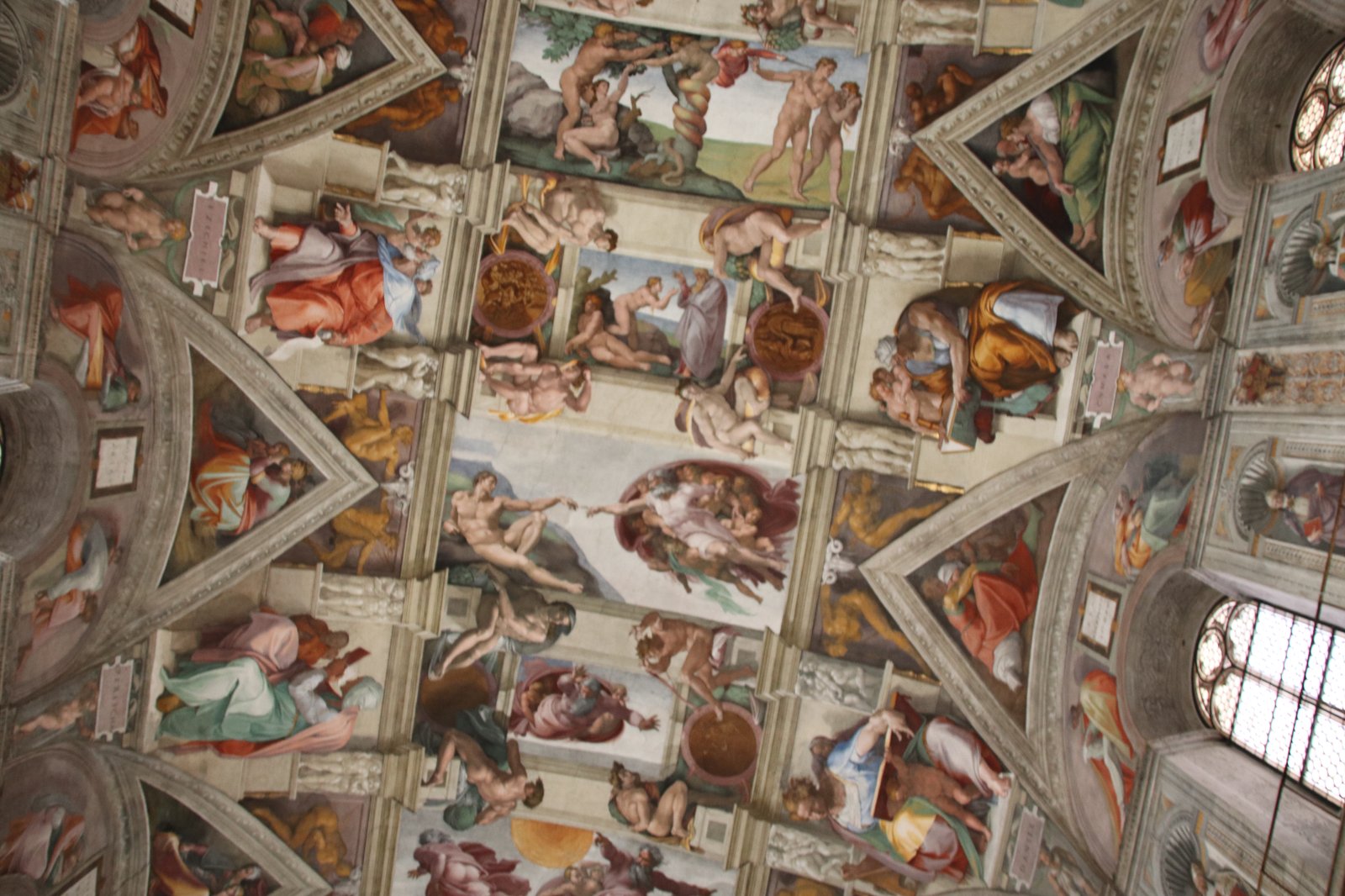
Walk into the Sistine Chapel, stop under the entrance wall, and look up at the far end near the altar. Then look at the panel directly overhead. You are standing at the point where Michelangelo was least sure of himself, staring toward the point where he was most sure of himself, four years later. He painted the ceiling in the reverse order of the Genesis story it tells, and the gap between his first panel and his last is visible if you know where to put your eyes.
A contract for twelve apostles
Pope Julius II commissioned the work, and the surviving contract is oddly modest next to what ended up overhead — the Vatican Museums’ own account of the commission puts it plainly: “On 8 May 1508, the artist signed the contract which foresaw the painting of twelve apostles in the pendentives and ornamental motifs in the rest.” Twelve seated apostles and some decorative filler was the job Michelangelo actually signed up for. What he delivered instead, with Julius’s approval somewhere along the way, was the full Genesis cycle: nine narrative scenes running from the Creation to the drunkenness of Noah, with prophets and sibyls filling the spaces between and ancestors of Christ in the lunettes below. That scope grew mid-project, worth remembering every time a guide describes the ceiling as a single unified plan handed down from day one. It was not. It was renegotiated in the artist’s head as he went.
Scaffolding of his own design
Julius’s architect, Donato Bramante, had proposed scaffolding hung from ropes threaded through holes drilled in the ceiling itself. Michelangelo rejected the design outright and had the builder Piero Roselli construct freestanding scaffolding instead, rising from the floor rather than hanging from the ceiling it was meant to protect. Roselli’s crew also roughcast the plaster surface Michelangelo would paint on. It is a small detail with a large consequence: a hanging scaffold moves and sways as workers shift their weight on it, and painting a fresco on a moving surface at speed is a very different task from painting on one bolted to the floor below.
Starting at the wrong end, on purpose
Here is the detail that makes the ceiling worth reading in order. Michelangelo began at the end of the chapel farthest from the altar, above the main entrance, with a scene that comes last in the biblical story: “Michelangelo soon began his work, starting at the west end with the Drunkenness of Noah.” Wikipedia’s summary of the project puts the logic even more directly: “The work commenced at the end of the building furthest from the altar with the last chronological part of the narrative and progressed towards the altar with the scenes of the Creation.” Read the ceiling from the altar toward the entrance and you get Genesis in order: Creation first, Noah last. Michelangelo painted it the opposite way. His first working day was Noah’s disgrace; his final months were spent on the instant God separates light from darkness.
Painted in the order Michelangelo actually worked, the nine central panels run: the Drunkenness of Noah, the Great Flood, the Sacrifice of Noah, the Fall and Expulsion from Eden, the Creation of Eve, the Creation of Adam, the Separation of Land and Water, the Creation of the Sun, Moon and Plants, and the Separation of Light from Darkness. Read that list backward and it is the Book of Genesis. Read it forward and it is a four-year record of a painter getting better at his own commission, panel by panel, in real time.
Phase one: small figures, crowded frames
Three panels nearest the entrance wall — Noah drunk in his tent, the Flood, and Noah’s sacrifice — are the most densely populated on the ceiling. Among them, the Great Flood is the most crowded, packed with struggling, huddled figures scaled well below the size Michelangelo would later use, refugees crammed onto a rock and a makeshift boat in a composition closer to a battle scene than to the spare, monumental images most visitors expect from this artist. That crowding was not a stylistic choice he stuck with. Working this high above the floor, without having yet seen how a finished panel actually reads from below, he had misjudged the scale. Smaller figures packed tighter felt safer from up on the scaffold. From roughly sixty-five feet down, they read as clutter.
Phase two: figures grow, and Michelangelo learns to trust the drop
By the time he reached the Fall and Expulsion and the Creation of Eve, the correction shows. Wikipedia’s account of the technical shift is specific about the cause: “Michelangelo painted the figures at a larger scale than in the previous section; this is attributed to the artist’s ability to effectively judge the foreshortening and composition from ground level for the first time.” He could finally walk the floor of the chapel, look up at his own finished work, and see what a viewer sees. Fewer figures, held bigger, read more clearly at that height, and every panel after this point commits to the lesson. A firm marker for how far he had gotten by this stage comes from the Vatican Museums’ own record: “Michelangelo completed the first half of the Ceiling, that is from the entrance wall to the Creation of Eve, in August 1510.” Five panels down, four to go, roughly two years into a project that would run four.
Phase three: the Creation panels, at the grandest scale of the ceiling
The Creation of Adam belongs to this final stretch, not to the finale itself. Michelangelo painted it alongside the three remaining panels down at the altar end, in what Wikipedia identifies as the ceiling’s third and boldest phase: “The figures of the third phase, at the east end, were at still grander scale than the second; The Creation of Adam and the other Creation panels were finished at this stage, which took place in 1511.” Fewer figures again, bigger still, and brushwork loosened to match. “As the scale of the work got larger, Michelangelo’s style became broader; the final narrative scene of God in the act of creation was painted in a single day.” Last panel of the nine, nearest the altar, went up that fast. Four years of practice, compressed into a single day’s work.
Finished by Halloween, and Mass said the next morning
Whole ceiling was done by 31 October 1512, and the Vatican Museums’ record of the finish is unusually precise about how we know it: “The work must have been completed by 31 October 1512, as the Pope celebrated Mass in the Chapel on 1 November.” A pope does not say Mass under scaffolding, so the last board must have come down the day before. Modern restoration work carried out between 1980 and 1994 gave scholars a way to check this whole phase-by-phase story against physical evidence rather than guesswork: conservators counted the individual giornate, the day-sized patches of fresh plaster a fresco painter completes in a single working session, and the pattern of those patches lines up with the progression described above. “This thesis is supported by the discovery during the modern restoration of the exact numbers of the giornate employed in the frescoes.” Plaster does not lie about how fast or slow a hand was moving across it.
What to actually compare, overhead
Skip the guidebook instinct to stare only at the Creation of Adam and move on. Start instead at the entrance wall, directly beneath the Drunkenness of Noah and the Flood, and count how many bodies are crammed into that space. Then walk the length of the chapel toward the altar and stop under the Creation of Adam. Two figures, held at a scale you can read clearly from the floor, arms almost touching across an empty field. That gap, from a crowd of small huddled bodies to two enormous ones with room to breathe between them, is four years of a working painter solving a problem he did not fully understand on day one. It is a more honest way to look at the ceiling than treating it as one flawless vision delivered whole.
Bring binoculars or a zoom lens if you can. Hours are straightforward: “From Monday to Saturday 08.00 a.m. – 08.00 p.m.,” with “final entry 06.00 p.m.” On the last Sunday of each month it opens free of charge, “Every last Sunday of the month 09.00 a.m. – 02.00 p.m.,” though that slot draws the heaviest crowds of the month and gives the least room to stand still and compare panels. A quieter weekday morning suits this kind of looking far better than a free Sunday does.
If you would rather have a guide point out the Noah-to-Adam progression in person, without spending the visit hunting for it yourself, our Sistine Chapel tickets page lists the entry formats and guided options currently running.