
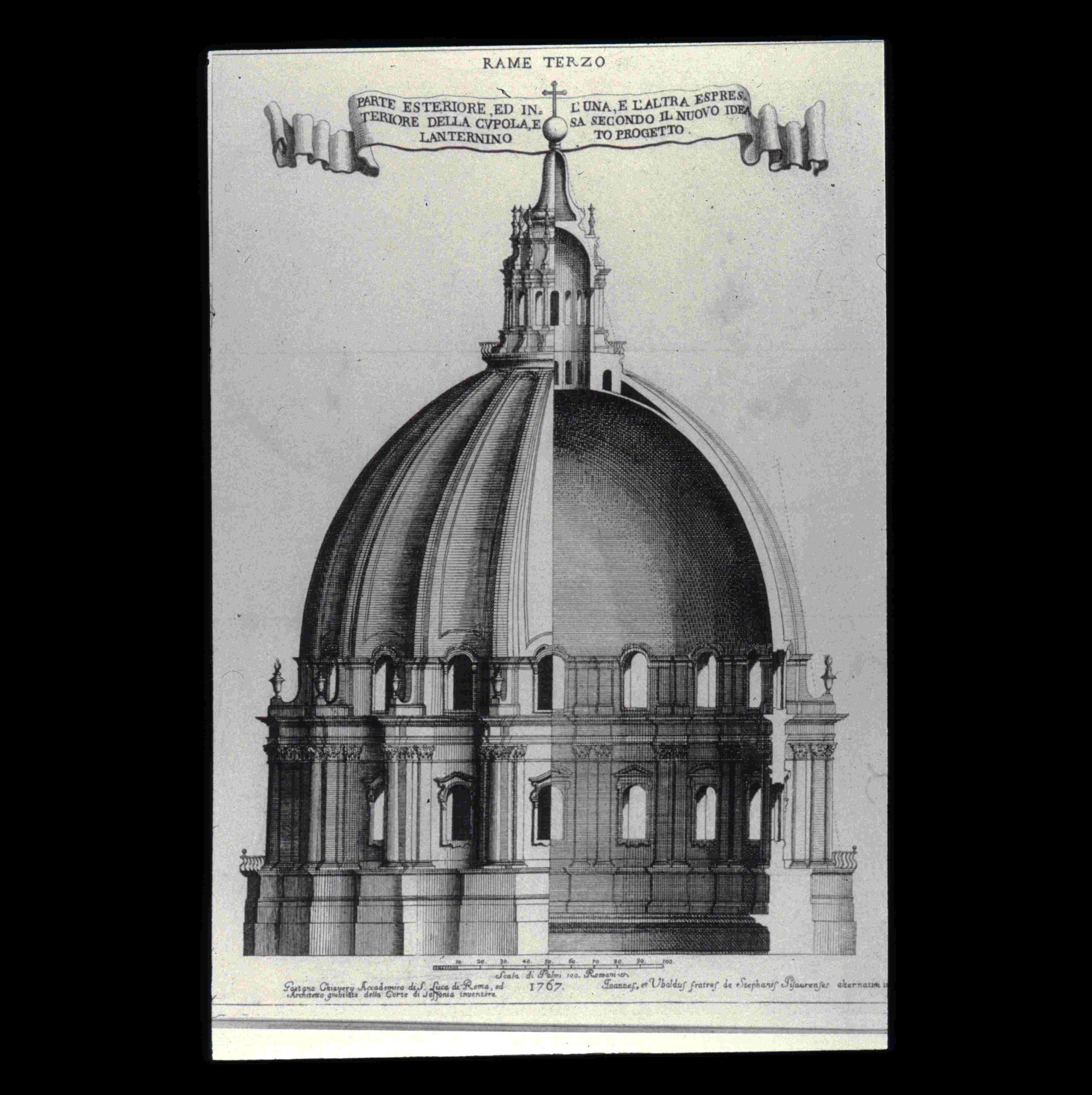
Every guide standing under the dome of St Peter’s says some version of the same line: Michelangelo designed this. It is not false, but it is not the whole shape of the truth either. Michelangelo drew the plan, argued for it against a papal bureaucracy for seventeen years, and died before a single course of the dome itself rose above the drum. What visitors actually look up at today was finished by another architect, working from an altered wooden model, twenty-six years after Michelangelo was in the ground. That steep, pointed profile you photograph from the piazza is not quite the curve he left behind.
What Michelangelo actually finished
Michelangelo took over as chief architect of New St Peter’s around 1547, inheriting a project that had already ground through Bramante, Raphael and Antonio da Sangallo the Younger, each with a different plan and a different set of half-built piers. He didn’t start from nothing. Wikipedia’s account is precise on this point: “Michelangelo redesigned the dome in 1547, taking into account all that had gone before.” He simplified Sangallo’s overbuilt scheme, strengthened the piers, and settled on a single unified dome plan that would guide construction for the rest of the century.
He worked on it for the better part of two decades, into his late eighties, and he did not live to see it built. He died on 18 February 1564. By then the drum, the tall cylindrical base the dome sits on, was complete. The primary sources are direct on this: “Michelangelo died in 1564, leaving the drum of the dome complete, and Bramante’s piers much bulkier than originally designed, each 18 m across.” Nothing above the drum existed yet. What visitors picture as “the dome,” the great curved shell that shapes the skyline of Rome, was still just drawings, a wooden model, and an engraving.
Five years of almost nothing
What happened immediately after Michelangelo’s death is the part most walking tours skip, because not much did happen. His assistant, Jacopo Barozzi da Vignola, took over the practical work, and Pope Pius V appointed Giorgio Vasari specifically to police the site and make sure nobody drifted from Michelangelo’s intentions. Vasari knew the plans as well as anyone alive. It didn’t matter much. As the record puts it: “Despite Vignola’s knowledge of Michelangelo’s intentions, little happened in this period.” Construction stalled for the better part of two decades after the master’s death, not because anyone rejected his vision, but because nobody with the will or the money pushed it forward.
That changed in 1585, when Pope Sixtus V appointed Giacomo della Porta as architect, with Domenico Fontana assisting. Sixtus reigned only five years, and the building “advance[d] at a great rate” in that window. Della Porta and Fontana are the two names actually responsible for turning Michelangelo’s drawings into standing masonry.
The model that got altered
Here is the detail that the flattened version of the story leaves out entirely. Michelangelo left behind a large wooden model, the way Sangallo had before him. Della Porta did not build from it unchanged. He altered it, in his own hand, before construction of the dome shell began in 1588. That change was not cosmetic tinkering; it went to the fundamental shape of the thing. In the words of the sourced account: “Giacomo della Porta subsequently altered this model in several ways. The major change restored an earlier design, in which the outer dome appears to rise above, rather than rest directly on the base.” Della Porta pushed the profile toward something steeper and more pointed, closer in silhouette to Brunelleschi’s dome in Florence than to a lower, more hemispherical curve resting flush on its drum.
A separate Wikipedia entry on della Porta himself confirms the same shift from the architect’s side of the record: he “made a noticeable change in the bend curvature of Michelangelo’s projected design, building the dome steeper, similar to the Brunelleschi model.” Two independent article threads, describing the same alteration from opposite directions, agree on the mechanics of what changed.
What actually stayed the same
It is worth being precise here, because it would be easy to overcorrect into a different flattened story: that della Porta redesigned the whole dome from scratch. He didn’t. Its drum, the tall ring of paired Corinthian columns the dome rests on, was Michelangelo’s, finished under his own supervision before he died. Most of what della Porta touched after that was decorative rather than structural. The sourced list is short: “the adding of lion’s masks over the swags on the drum in honour of Pope Sixtus and adding a circlet of finials around the spire at the top of the lantern, as proposed by Sangallo.” Lion’s masks and finials are ornament. The curvature of the outer shell is engineering. Only one of those two categories changes how the dome carries its own weight, and it is not the lion’s masks.
Who actually deserves the credit
Even the profile change has a contested author, and it is worth sitting with the ambiguity rather than resolving it for a cleaner headline. Some scholars have floated the idea that Michelangelo himself, in his final days, reverted to the steeper, more pointed form, meaning the change could still trace back to his own late judgment rather than a later architect’s correction. But the more heavily cited account runs the other way. Historian Lees-Milne credits della Porta with the decision outright, recording that della Porta told Sixtus V directly that Michelangelo “was lacking in the scientific understanding of which he himself was capable.” That is a striking thing for one architect to say about another to a reigning pope, and it reads less like modesty than like a man staking a professional claim on the dome’s final form.
Whichever version is closer to the truth, the plain fact remains that della Porta and Fontana are the two names on the finished structure. As one source summarises it: “Della Porta and Fontana had the merit of the technical execution of a firm that sanctioned an important stage of technological advances at the end of the sixteenth century.” The dome that exists today reached completion under their supervision in 1590, the drum under Michelangelo’s in 1564. Twenty-six years and two architects, not one continuous hand.
What you are actually looking at
The engineering behind the finished shape is worth knowing before you crane your neck at it. The dome is built from two brick shells, the outer one carrying sixteen stone ribs, twice the number Brunelleschi used in Florence but far fewer than Sangallo had originally proposed for St Peter’s. Its ovoid shape, rising steeply rather than sitting as a flat hemisphere, matters structurally as well as visually: it “exert[s] less outward thrust than does a hemispherical dome, such as that of the Pantheon.” That steeper profile, the same one della Porta pushed for over Michelangelo’s flatter alternative, is doing real mechanical work, not just aesthetic work. It is holding up 136.6 metres of brick and stone over your head, the tallest dome anywhere in the world, standing on a drum framed by sixteen pairs of Corinthian columns roughly fifteen metres each.
Start to finish, the whole basilica took a hundred and twenty years: construction “began on 18 April 1506 and was completed on 18 November 1626.” Michelangelo worked on it for less than a fifth of that span, and none of his years overlapped with the dome actually rising.
Standing under it now
None of this makes the official framing wrong to use as shorthand. The basilica’s own booking site for the dome climb still describes the visit as a chance “to experience Michelangelo’s extraordinary vision,” and in the broad sense that’s fair. That much is his. The proportions, the drum, the basic ambition, all Michelangelo’s own decades of argument with popes and rival architects. What changed after 1564 was narrower and more specific than most retellings suggest: not the drum, not the basic footprint, but the exact bend of the curve rising above it, decided by a second architect who was willing to say, to a pope’s face, that he knew something Michelangelo didn’t.
If you want to see the join between the two men’s work rather than just the finished silhouette, it helps to have someone point out where to look, since nothing on site marks the line between Michelangelo’s drum and della Porta’s shell. Our Vatican guides page covers the options for building that kind of detail into a basilica visit, including routes that take in the dome. Once you know where one architect’s work ends and the other’s begins, you stop seeing a single unbroken masterpiece and start seeing a hundred-year argument that happened to end in stone.