Blog

  • Is the VIP Early Entrance Tour Worth the Extra Cost Over Standard Skip-the-Line?

    Guide leading a VIP early entrance group through the Vatican Museums
    A guide leading a VIP early entrance group at the Vatican Museums, ahead of the public crowd.

    Every operator selling Vatican tickets, including us, will tell you the early entrance is worth it. That is what we sell. So take this from the other direction: is the extra cost actually buying you something measurable, or is it buying you a feeling of exclusivity that a normal 9am skip-the-line slot delivers almost as well for less money?

    The honest answer sits somewhere in the middle, and it depends heavily on what you value on the day. Below is what you are actually paying for, what the Vatican’s own published hours confirm, and where the early slot genuinely earns its premium versus where it doesn’t.

    What the Vatican Museums actually publish about opening times

    Start with the facts that are not in dispute. The Vatican Museums’ own hours page states general admission runs “08.00 a.m. – 08.00 p.m.” Monday to Saturday, with “final entry 06.00 p.m.” On the last Sunday of most months, hours shrink to “09.00 a.m. – 02.00 p.m.” with “final entry 12.30 p.m.” and free admission. Whatever time slot you book, staff ask visitors to “leave the halls 30 minutes before museum closing time,” which matters more than people expect on a crowded afternoon when you are still three galleries from the Sistine Chapel at 7:45pm.

    The published general opening is 8am. A separately branded early-access product that gets you in before the main doors open is a real thing operators sell, ourselves included, but the exact minutes-before-opening figure and inclusions vary by provider and by season, so treat any specific “90 minutes early” claim, including ones on our own pages, as a description of that particular tour rather than a Vatican-stated fact.

    What you’re actually buying with an early slot

    Strip away the marketing and an early entrance product is selling three things: a head start on the queue, a guide who walks a fixed early-access route before the general public is let in, and fewer bodies between you and the ceiling for the first stretch of the visit. It is not selling a different museum. You still walk the same corridors, see the same Raphael Rooms, and stand under the same Sistine Chapel ceiling everyone else does later that morning.

    The value case rests entirely on how much that head start is worth to you. If you are a photographer who wants a clear sightline to the Belvedere Torso without three strangers in frame, it is worth a lot. If you mainly want to see the ceiling and don’t mind sharing the room, it is worth much less. There is also a practical middle case: parents managing a stroller and two tired kids often value the shorter, calmer route more than the extra minutes of solitude, simply because navigating a packed corridor with a pram is its own kind of exhausting.

    Where standard skip-the-line already solves the real problem

    Here’s the part operators tend to skip past: the walk-up queue outside the Museums entrance is the actual pain point for most visitors, and a standard skip-the-line ticket already removes it. You are not standing outside in the sun for an hour either way, early or standard. A skip-the-line booking at 9am gets you through security and into the galleries with the entrance-gate wait solved, at €25 for a full adult ticket against the official walk-up price of €20.

    What a 9am slot does not solve is internal crowd flow once you’re inside. By mid-morning, tour groups converge from multiple directions and the Sistine Chapel in particular fills in from all sides at once. That congestion is the thing an early slot is actually addressing, not the front-gate queue, and it is worth being precise about which problem you are paying to skip.

    Photo conditions: the honest, unverified part

    You’ll see plenty of claims online about exactly how much emptier the galleries are at 7:30am versus 9am, often with a specific percentage attached. We are not going to manufacture a number here. No official source publishes hourly crowd density for the Sistine Chapel, and we have not independently measured it ourselves this season, so any figure you see quoted, including from us in other contexts, should be read as an estimate rather than data.

    What we can say with confidence, because it follows from how the building works rather than from a survey, is simpler. Fewer tour groups have entered by the earliest slots than will have entered by mid-morning. The gap between an early slot and a standard 9am slot narrows the later into the standard window you actually go. A 9am entry sees a noticeably thinner Sistine Chapel than an 11am entry does, purely because fewer coach groups have arrived yet. Whether that 9am room is meaningfully thinner than what an early-access group saw ninety minutes earlier is the part nobody has actually measured for you, and we would rather say that plainly than invent a percentage to make the sell easier.

    The money question

    Official pricing gives you the floor: €20 walk-up or €25 online skip-the-line for a full adult ticket, with reduced rates at €10 and €15 for eligible students and pilgrimage groups. Early-access and VIP products sit above that floor because they bundle a guide, a fixed pre-opening route, and smaller group handling, not because the Sistine Chapel ceiling itself costs more to look at before 8am.

    If your budget is tight and your main goal is simply getting inside without a walk-up queue, standard skip-the-line at 9am does that job at a lower price. It is, in plain terms, the cheaper way to solve the one problem every visitor actually shares: not standing outside for an hour. If you want a guided route, a smaller group, and the best crowd conditions the museum offers on any given day, the early product is closer to what it promises, even without a precise number attached to how much better those conditions are. Neither is objectively the smarter buy. They are solving different problems at different prices, and the right call depends on which problem is yours.

    Who should actually pay the premium

    Serious photographers, anyone visiting during a peak season week, and travellers who specifically dislike crowds get the clearest return on an early slot. A guide who has already walked that route a thousand times also tends to move a group efficiently past the corridors nobody lingers in, saving time that a self-guided 9am visitor often loses to backtracking or a wrong turn toward the Gallery of Tapestries instead of straight through to the Sistine Chapel.

    Families with young children, visitors on a tighter budget, or anyone whose main goal is simply seeing the Sistine Chapel and the Raphael Rooms without an outdoor queue are usually well served by standard skip-the-line, particularly on an off-peak weekday or outside the busiest months. A toddler does not care how empty the room is. A parent juggling snacks and a stroller cares more about not rushing.

    Neither choice is a mistake. The early product buys a materially calmer first hour and a fixed guided route before the doors open to everyone else. Standard skip-the-line buys you the same museum, the same ceiling, and the same frescoes, minus the walk-up queue, at a lower price and with more flexibility on timing.

    One thing to check before you book either

    Whichever slot you choose, confirm your date isn’t one of the fixed closure days: the Museums are shut on regular Sundays (aside from the last Sunday of the month), plus a list of fixed dates including January 1 and 6, February 11, March 19, April 6, May 1, June 29, August 14–15, November 1, and December 8 and 25–26. Booking an early-entrance tour on a day the Museums are closed is a mistake nobody wants to discover at the gate, and it happens more often than you’d think around the November 1 and December closures in particular.

    If a calmer first hour and a guide walking you through the galleries ahead of the crowd sounds worth the difference, our VIP early entrance guided tour lays out exactly what’s included and what time you’d need to be at the gate.

  • Small Group Tour vs Large Group Tour at the Vatican: What Changes Besides Price

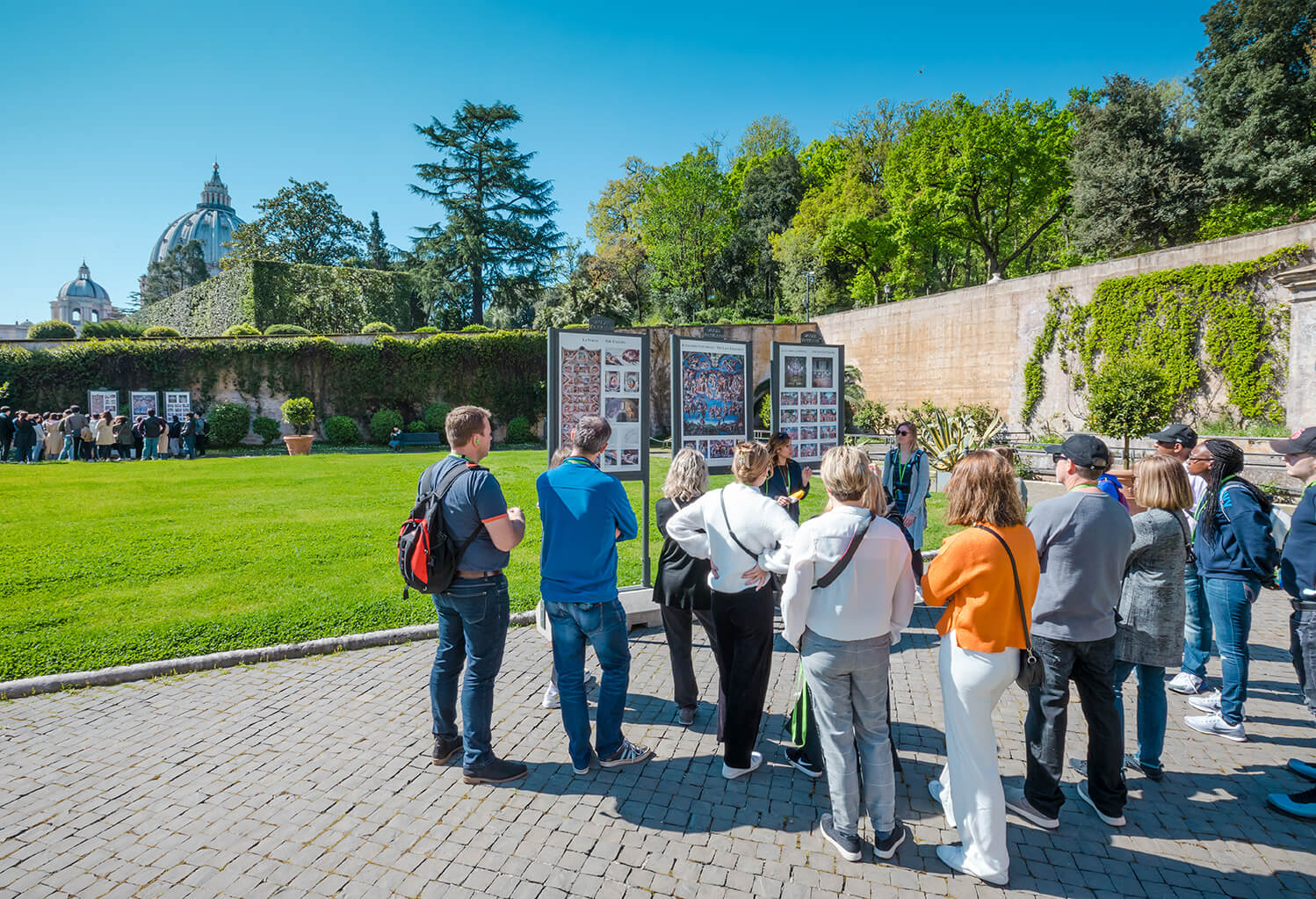
    A small group on a guided tour inside the Vatican Museums
    A small group on a guided tour inside the Vatican Museums. Below ten people, a guide can talk directly rather than over a shared radio channel.

    Ask most people what separates a small group tour from a large one at the Vatican and they will guess at price, maybe flexibility, maybe how early you have to show up. Those differences are real, but they are not the ones you actually notice once you are inside. The one that changes your morning sits on the Vatican Museums’ own visitor-services page, and it kicks in at a specific headcount: ten.

    The rule that draws the line

    Vatican Museums policy states plainly that “the use of radio headsets is obligatory for all tours, including pilgrimages, universities and schools, with 10 or more participants up to a maximum of 20 (30 for school tours).” Below ten people, nothing forces a group onto shared audio equipment. At ten, it becomes mandatory. That single number is the real fork between what gets marketed as a “small group” tour and what gets marketed as a “large group” one, and it has little to do with the price tiers tour operators set.

    What a group under ten sounds like

    A guide leading eight or nine people rarely needs a microphone. They talk at roughly the volume you would use across a dinner table, and the group stays close enough to hear it over the general noise of a gallery — a loose semicircle, often within arm’s reach. That proximity does double duty. You can see exactly where a guide is pointing on a ceiling fresco, and you can ask a quiet follow-up question without stepping out of the group or waiting for a pause. Nobody has an earpiece to remove first.

    It also means the guide adjusts on the fly in a way that is harder with a microphone. Someone at the back mishears a name, and the guide simply repeats it a beat louder, without breaking the flow of the sentence. A gallery attendant walks through the group with a cart, and the guide pauses mid-thought rather than talking over a channel that everyone is still wearing. None of that is dramatic. It is the ordinary give and take of a small conversation, which is a different thing from a broadcast, even a short-range one.

    Crossing into radio territory

    Once a group reaches ten, the guide clips on a transmitter and everyone else collects a receiver and earpiece from the desk in the entrance hall before the visit starts. Other systems are not an option: “the use of other radio headset systems is not permitted,” so this is not a case of bringing your own earbuds. It has to be the Vatican-approved kit, rented for the day. The hire is not free either — “the hire cost is € 1.50 for each member of the group (free of charge for the guide).” Across twenty people that is a real add-on, small next to the ticket price but not nothing, and it is charged per person rather than folded into a flat group rate.

    There is also a queue built into that handoff. Twenty earpieces need to be switched on, tuned to the right channel and fitted before the group can move, and someone in the party is usually still adjusting theirs a few steps into the first gallery. A sub-ten group skips that entirely; the tour simply starts walking. It is a small delay in absolute terms, a few minutes at most, but it sits right at the start of the visit, before anyone has warmed up to the pace of the museum.

    Standing distance stops being about hearing

    Here is the part the Vatican does not spell out, though it follows directly from the rule: once audio no longer depends on proximity, physical distance from the guide changes what it means. In a sub-ten group, staying close is how you hear anything at all. In a headset group, you can drift several steps away for a clearer look at a fresco and still catch every word. For sightlines that is often an improvement. What it changes is the texture of the interaction — pointing something out quietly, catching a guide’s eye to signal you are lost, asking something without keying up over the whole channel. Those are the small, low-friction exchanges a tight cluster makes easy and a spread-out radio group makes slightly more deliberate. This is a mechanical consequence of the ten-person threshold rather than a rule the Vatican states outright, but it is the part that actually changes how a tour feels once the earpiece goes in.

    The chokepoint before the Sistine Chapel

    Group size shows up again, more bluntly, at the physical bottleneck leading down into the Sistine Chapel. The corridor narrows, the stairs take people one or two abreast, and every visitor ahead of you sets the pace for everyone behind. A group of nine clears that funnel in roughly the time it takes nine people to file through single file. A group of twenty takes something closer to double that, because more bodies need to pass the same width of doorway at the same rate. None of this gets announced anywhere; it is simple arithmetic. Smaller groups’ guides can often time the approach more precisely as a result, walking the group up to the chokepoint just as it clears rather than joining a queue that is still stacking up.

    Inside the chapel itself, most guides stop narrating altogether — the space is meant to be experienced quietly, and attendants actively discourage talking. That evens things out between group sizes for the few minutes you are actually standing under the ceiling. The gap reopens the moment the group steps back out into the corridor and the guide picks the commentary up again, at which point a group of twenty is once more slower to regroup into earshot than a group of nine.

    Why “small group” gets marketed below ten in the first place

    Tour operators did not invent the ten-person line, but plenty of them plan around it. A tour capped comfortably under that threshold never touches the headset requirement at all, which is one reason operators advertising “small group” Vatican tours tend to keep numbers well under the Vatican’s own cap rather than just under twenty. Exact caps vary by operator and are worth checking on the specific listing rather than assumed, but the pattern is consistent: staying under ten is what keeps a tour on the direct-conversation side of the rule, not just a marketing choice about intimacy.

    What this means when you are booking

    None of this makes a large group tour the wrong choice. It costs less per person for a reason, and for plenty of visitors the trade — a slightly longer file through the narrow stretches, a shared radio channel instead of a guide’s raised voice — is easy to accept. What is worth knowing before you book is that the real difference is not “small” versus “large” as marketing labels. It is which side of ten people your group lands on, because that is the number the Vatican itself uses to decide whether your group talks directly or over an earpiece.

    If you would rather not work out where your group sits relative to that threshold, look for a small group tour that stays well clear of the twenty-person cap. Our 11:00am Vatican Museums small group tour caps at 12 people — small enough that the guide can talk in a normal speaking voice for most of it, though at that size a booking can still land on the headset side of the ten-person line depending on the day’s numbers.

  • Official Vatican Tickets vs Tour Operator Tickets: What the Price Difference Actually Buys

    Licensed guide explaining artworks to a small group inside the Vatican Museums
    A licensed guide mid-explanation in the Vatican Museums — the part of a tour-operator ticket that the museum’s own online booking does not include.

    The Vatican Museums sell their own tickets online for €25.00, and the difference between that price and what a tour operator charges is usually somewhere between one and a hundred euros, depending entirely on what is bundled in. Both are valid, both get you through the door, and neither is a scam by default. The confusion comes from not knowing which specific thing you’re paying extra for on any given listing, so this is a line-by-line look at what actually changes hands for the markup, and the cases where the official site alone does the whole job.

    What the official site sells you, exactly

    Start with the baseline, because every comparison needs one. On museivaticani.va, full entry costs €20.00 without online booking or €25.00 booked online, and that €5.00 gap is the museum’s own “Skip the Line” booking fee, not a tour-operator markup. Reduced tickets run €10.00 walk-up or €15.00 online, and students pay the same reduced rate. Refund policy is stated without hedging: “Tickets cannot be refunded.” Standard tickets are valid “solely on the day on which the ticket is issued,” so a missed slot is a lost ticket, not a rescheduled one.

    That €25.00 buys a fixed time slot, a QR code, and priority entry through the group turnstile ahead of the walk-up line. It does not buy a person who explains what you’re looking at, a fallback if your flight is delayed, or a hand through security if the line backs up on a Jubilee-year Saturday. Those are the three things tour operators are actually selling, in varying combinations, and the price moves with how many of the three are included.

    The security warning worth repeating

    Before anything else, one fact from the museum’s own site matters more than any comparison table: “The only official site for purchasing tickets online is https://tickets.museivaticani.va.” The same page adds a direct warning: “Please beware of potential scams and websites that use domains similar to the official one, which may charge significantly higher prices.” That line isn’t aimed at licensed operators selling guided tours under their own name and branding. It’s aimed at lookalike domains built to resemble the Vatican’s own booking page, charging inflated prices for nothing beyond the identical ticket you’d get for €25.00 direct. A reputable operator will never claim to be the Vatican or the official ticketing site. If a listing implies otherwise, that’s the one to walk away from, regardless of price.

    Item one: the guide

    This is the biggest single component of most markups, and the easiest to evaluate honestly. A licensed guide walks you through the collection in a chosen order, explains what’s in front of you, and answers questions on the spot. For someone who wants context on the Raphael Rooms or the Sistine ceiling without reading up beforehand, that’s real value, and it’s the one item on this list that the museum’s own €25.00 ticket genuinely does not include.

    It’s also the item to be most specific about before booking. “Guided tour” can mean a fully private guide for your party alone, a small group capped around six to ten people, or a large group of thirty-plus following a raised umbrella through a crowded gallery, straining to hear a radio headset over everyone else’s. Museum rules apply directly to that last format: “For guided group tours with 11 or more participants, the internal hire of radio headset systems is obligatory.” Ask which format you’re booking before you pay, not after.

    Item two: skip-the-line entry

    Here’s where honesty matters most, because this is the item most oversold. The Vatican Museums’ own online ticket already includes priority entry for €5.00 over the walk-up price. A tour operator’s “skip the line” claim is only worth a real premium if it’s skipping a different, longer line than the one your own €25.00 ticket avoids, for instance a dedicated guided-group entrance during the museum’s busiest hours, or a combined entry that also clears St Peter’s security separately. If a listing’s entire pitch is “skip the line” and the price sits far above €25.00, ask what specific queue it’s skipping that the museum’s own booking fee doesn’t already handle. Sometimes the answer is a genuinely faster group lane. Sometimes the answer is nothing beyond the €5.00 you’d have paid anyway.

    Item three: group access and early or after-hours slots

    Some formats simply aren’t available through the standard consumer booking flow at all: early-entry mornings before the public 08:00 opening, or evening access after the regular 8:00 p.m. close on Mon–Sat. Those slots exist because operators or the museum itself allocate a fixed, separately-managed capacity to them, walking a smaller number of people through galleries that are otherwise packed by mid-morning. If seeing the Sistine Chapel with fewer people around it is worth something to you specifically, that premium is buying an actual scarce resource, not a service you could replicate for free with better timing.

    Item four: cancellation flexibility

    This is the quietest value item and the one people forget to price in. The museum’s own policy is blunt: “Tickets cannot be refunded.” Buy direct and your travel changes, your ticket is gone. Most tour operators sell some form of free cancellation or date-change window, commonly 24 to 48 hours ahead of the slot. For a firm, unchangeable itinerary, that flexibility is worth nothing and you should book direct. For a trip with any moving parts (connecting flights, a family member who might get sick, a schedule still being finalised) that flexibility can be worth more than the markup itself, because a €25.00 non-refundable ticket you can’t use is a €25.00 loss, full stop.

    When the official site alone is genuinely enough

    Book direct when your dates and times are fixed and confirmed, when you’re comfortable navigating the museum layout on your own or with a map and an audio guide, and when you don’t need the schedule flexibility a cancellation window provides. A solo traveller or a couple with a settled itinerary, visiting outside the most congested midday windows, loses very little by booking the €25.00 online ticket directly and walking in on their own. The collection is the same collection either way; nobody sells a better version of the Sistine ceiling.

    Booking direct also makes sense for the last Sunday of each month, when the museums open “09.00 a.m. – 02.00 p.m.” with free admission, since that specific slot isn’t something a paid ticket product bundles anyway. It’s a separate, free access window with its own rules and its own crowding pattern.

    When a guide or a tour package earns its price

    Choose a guided or bundled option when any of these apply: you want the context and the storytelling delivered by a person rather than pieced together yourself, you’re travelling with children or a group where herding matters more than saving fifteen euros, your schedule has real uncertainty and non-refundable pricing is a genuine risk, or you specifically want an early-entry or after-hours slot the standard booking flow doesn’t offer at any price. In each of those cases, you’re not paying more for the same product. You’re paying for a different product entirely, one the museum’s own online ticket was never designed to provide.

    How to read any listing before you book

    Three questions filter almost every option correctly. First, does the listing claim to be the official Vatican site, or does it clearly identify itself as a separate operator? Second, exactly what does the price include beyond entry: a guide, a specific time slot the standard ticket doesn’t offer, or a cancellation window? Third, is the markup proportional to what’s actually bundled, or is it charging premium money for a service the museum’s own €5.00 booking fee already covers? A markup that maps to a real, named service is a fair transaction. A markup that maps to nothing beyond vague “skip the line” language deserves a second look.

    None of this makes one option universally right. It makes the price difference legible, which is the part most listings leave out. If you’d rather see the current formats side by side, guided and self-guided, before deciding which one matches your trip, our Vatican tickets page lays out the options with what each one includes.

  • Vatican Museums vs Galleria Borghese: Which One Wins Your Only Free Morning in Rome

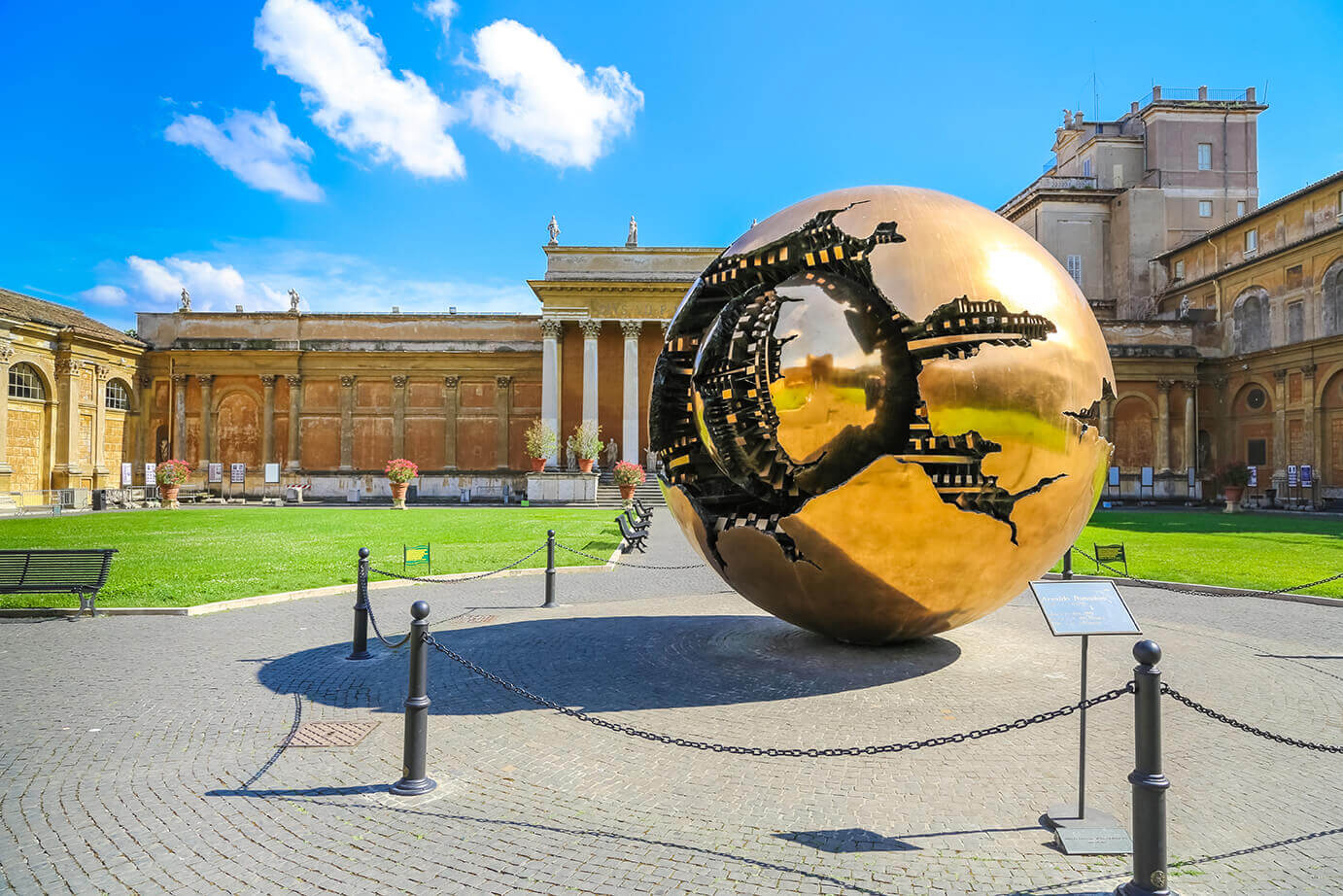
    The Cortile della Pigna in the Vatican Museums, a courtyard on the standard visitor route
    The Cortile della Pigna, one of the open courtyards on the Vatican Museums route. Photo via Shutterstock.

    Everyone tells you to book Galleria Borghese. It’s smaller, it’s calmer, it has Bernini’s sculptures at eye level instead of a fresco you’re viewing through fifty phone screens. All of that is true, and none of it answers the question that actually matters if you have one morning in Rome and a flight or a train to catch by early afternoon: which museum gets you in, through, and out with the least wasted time and the biggest single payoff?

    Honestly, the answer depends less on which collection is better and more on how each place is built to process a visitor who shows up without months of planning. Borghese wins on comfort. It does not automatically win on your morning.

    Booking is the real gatekeeper, not the art

    Galleria Borghese runs entry in fixed two-hour blocks: 9 to 11am, 11am to 1pm, 1 to 3pm, 3 to 5pm, and 5 to 7pm, with no admission after 5pm. Each block caps at 360 people, and booking is not optional. A mandatory reservation fee of €2 applies to every ticket on top of admission. Miss your slot and you don’t get in that day, full stop — there’s no queue to join instead, because the whole point of the system is that there is no queue.

    Vatican Museums entry is looser. Full-price entry is €20 without booking, or €20 plus a €5 booking fee through the only official ticketing channel, tickets.museivaticani.va. You can, in principle, turn up and buy at the door. In practice that’s a bad idea on any day with a cruise ship in port, but the structural point stands: the Vatican doesn’t lock you into a closed two-hour cell the way Borghese does. If your flight gets delayed by forty minutes, a Vatican ticket for later that morning is usually still workable. A Borghese slot that starts at 9am is not.

    For a first-timer piecing together a Rome trip without a travel agent, that difference is the whole game. Borghese punishes any schedule slip severely. The Vatican punishes you with a longer queue, which is unpleasant but recoverable.

    What a single morning actually buys you at each

    Say you have three hours, door to door. At the Vatican Museums, that’s tight but workable: you can move through the Gallery of Maps, the Raphael Rooms, and the Sistine Chapel, then walk the roughly fifteen minutes around the Vatican walls to St Peter’s Basilica before your window closes — it’s a separate entrance and security line, not a continuation of the same ticket, but close enough to fit into one morning. Vatican Museums hours run Monday to Saturday, 8am to 8pm, with visitors required to leave the halls thirty minutes before closing, so a 9am arrival gives you a genuinely full working morning.

    At Borghese, three hours is more than the ticket allows. You are inside for exactly one two-hour block. Staff clear the building between blocks, so lingering past your window isn’t an option the way it sometimes is at larger sites. That’s fine if the Borghese collection is your whole reason for being in Rome. It’s a poor match if you were hoping to also see St Peter’s, grab lunch near the Trevi Fountain, and still make an early afternoon train.

    Crowding: the numbers nobody advertises

    Borghese’s 360-person cap per block sounds restrictive, and it is, by design. That’s the entire appeal: you’re never sharing a room by Bernini with a tour group of forty. Vatican Museums crowd control makes no equivalent promise. Sistine Chapel crowds in particular can feel closer to a packed metro platform than a chapel through the mid-morning hours, once the day’s independently booked visitors have arrived.

    If crowd density inside the room is your priority over anything else, Borghese is simply the calmer experience, and no amount of clever timing at the Vatican fully closes that gap. What timing can do is move you out of the Vatican’s worst hour. Arriving at opening, or booking a guided entry that gets you inside before the general public streams in, changes the Sistine Chapel from a crush into something you can actually look at.

    Borghese isn’t actually the safer bet

    Here’s where the popular advice gets it backwards. Because Borghese’s booking window is so rigid, a first-timer who hasn’t planned weeks ahead is more likely to find every slot sold out than to find a spare seat. Vatican Museums access, by contrast, almost always has some way in on short notice, even if it means paying the door price or joining a guided group that has pre-purchased access.

    For someone asking “which one wins my only free morning,” the practical answer is often: whichever one you can still book. If you’re reading this three days before you fly and Borghese shows nothing available for tomorrow morning, the debate is already over.

    Payoff per minute spent

    Borghese rewards patience and a slower eye. Bernini’s Apollo and Daphne, carved so the marble drapery seems to move, deserves five unhurried minutes that a packed room rarely permits elsewhere in Rome. It’s a museum built for looking closely at a small number of extraordinary things.

    Vatican Museums mornings reward a different quality: volume and scale. In one visit you pass through Raphael’s School of Athens, the forty painted map panels of the Gallery of Maps, and Michelangelo’s ceiling, then walk straight into the largest church in Christendom. Nothing else in Rome compresses that much major art into one continuous route. If your idea of a good use of a single morning is seeing as much of Rome’s peak artistic output as physically possible, that density is hard to beat.

    So which one wins?

    If your morning is genuinely the only block of free time in your entire Rome visit, and you also want to see St Peter’s Basilica, the Vatican Museums usually make more sense as the single stop. The booking is more forgiving, the closing morning slot runs long enough to be worthwhile, and the basilica is roughly a fifteen-minute walk from the exit, around the Vatican walls, rather than a separate outing across town.

    Choose Borghese instead if the crowd itself is what would ruin the morning for you, if you’ve already seen the Vatican on a previous trip, or if you booked your slot the moment you knew your travel dates. Its two-hour ceiling stops being a limitation once you’ve planned around it in advance.

    Neither museum is the wrong choice. The wrong choice is assuming the popular advice applies to your specific morning without checking whether the booking window actually fits your schedule.

    Making the Vatican half of the morning easier

    If the Vatican Museums come out ahead for your circumstances, the next decision is how you get through the door. A door-price ticket at 9am on a Tuesday in low season is fine to buy on arrival. A door-price ticket at 9am in high season, or on any Saturday, is a gamble against a queue that can eat your whole morning before you’ve seen a single fresco. A guided small-group tour that includes pre-booked entry removes that risk entirely and adds context on the Sistine Chapel and Raphael Rooms that’s easy to miss moving through alone. You can see the current Vatican Museums tour options and pick a start time that leaves room for St Peter’s afterward.

  • Guided Tour or Self-Guided Ticket: How to Actually Decide for the Vatican Museums

    A licensed guide explaining artworks to a small group inside the Vatican Museums
    A licensed guide explaining artworks in the Vatican Museums — one of the two paths this guide compares.

    Every planning article on the Vatican Museums lands on the same conclusion: get a guide, always, no exceptions. It is easy advice to give and hard to argue with in the abstract. It is also wrong for a meaningful share of visitors, and repeating it without qualification does readers a disservice. A guide is not automatically better than a self-guided visit. It is better for some people, in some conditions, and worse for others. This piece gives you the actual variables to weigh instead of a slogan.

    Why the blanket advice falls apart

    The “always get a guide” line usually rests on one true observation: the Vatican Museums are enormous, the Sistine Chapel ceiling rewards context, and a good guide can turn a wall of frescoes into a story you actually remember. All correct. What the advice skips is that a guided-tour ticket puts you inside a group. Official rules cap it at a defined size — “Each accredited tour guide can have a maximum of 20 visitors” — so you are moving at the pace, and on the schedule, of up to nineteen strangers. If you want to linger in the Gallery of Maps for ten minutes because the ceiling actually stops you, a group tour will not let you. If you have ninety minutes total and want the greatest hits with zero decision-making, that same structure is exactly what you need. Same product, opposite value depending on who you are.

    Three questions to ask before you book

    Skip the philosophy and answer three practical questions. Your time budget, your interest level, and your crowd tolerance will point you to an answer faster than any article can.

    How much time do you actually have? Under two hours means you need someone making decisions for you, because working out the fastest route from the entrance to the Sistine Chapel on your own, in a building with roughly seven kilometres of galleries, eats the clock. Half a day or more changes the calculus entirely; you can afford to get lost in the Pinacoteca or double back to the Raphael Rooms.

    How interested are you in the art itself, versus in having seen it? Neither answer is wrong, but they lead to different formats. If you want the Laocoön explained rather than just photographed, a live guide earns their fee. If you are here for the Sistine Chapel and a reasonable dose of everything else, a self-paced audio guide covers most of that ground for far less money and no group to keep up with.

    How do you feel about walking with strangers? Some travellers like the social framing of a tour group and the reassurance of not getting lost. Others find nineteen other people between them and the art actively irritating. Be honest about which one you are before you spend the money.

    The case for a live guide

    A licensed guide is the right call when your interest in the art is real rather than dutiful, when you are travelling with people who ask questions, or when your schedule is tight and you would rather someone else made the routing decisions. Guides connect rooms that otherwise look unrelated — why the Stanza della Segnatura sits next to the Sistine Chapel, why Raphael was painting one while Michelangelo worked on the other a few doors down — and they answer the follow-up questions an audio track cannot. The trade-off is the one above: you move as part of a group, on a group’s schedule, and you cannot linger past the point the guide has budgeted for that room. If that sounds like a fair exchange for what you get in return, book the guide.

    The case for going self-guided

    A self-guided visit works well for repeat visitors, for people who read ahead and know roughly what they want to see, and for anyone who values control over their own pace more than narration. The middle ground here is worth knowing about: the Vatican’s own audio guide costs “8.00 euro”, runs “Over 3 hours in the company of a truly special guide to the discovery of the artistic treasures of the Pope’s Museums”, and covers “More 400 audio comments” in twelve languages (“Italian, English, French, German, Spanish, Japanese, Korean, Chinese, Russian, Portuguese, Ukrainian, Polish”). That gets you real context without a group around you and without a fixed pace. For under ten euro on top of your entry ticket, it closes most of the gap between fully unguided and a live human.

    What either option actually costs

    Entry itself is identical either way. Full price is “20.00 euro (without online booking)”, or “20.00 euro + 5.00 (with booking on the official Vatican Museums website)” if you skip the line — a total of €25. Reduced tickets run “10.00 euro” at the walk-up rate, plus the same €5 booking fee online. Children under seven, visitors with a certified disability of 67% or more, and everyone on the last Sunday of the month enter free. We could not confirm an official euro price or fixed duration for the live guided-tour ticket itself in time to publish it here, so treat any number you see quoted elsewhere with some scepticism and check the current rate before you book. What we can say with confidence is the structural difference: a guide adds a person and a schedule to your visit, while the audio guide and self-guided route add neither.

    One rule that applies to both

    Whichever you pick, the ticket itself works the same way. Since the 2024 rules update, every ticket is nominative — the Museums introduced “the nominative ticket, accompanied by thorough checks of the holder’s identity” specifically to stop resale and bot-purchased tickets, and that check applies whether you booked a guide or not. Your ticket is also good for one day only: “The entry ticket for the Vatican Museums entitles the visit to the Museums and Sistine Chapel solely on the day on which the ticket is issued. Tickets cannot be refunded.” Buy for the date you mean to go, and bring photo ID that matches the name on the booking.

    A worked example

    Say you have three hours on a Tuesday morning, you have never been before, and you would rather not queue. Book the timed-entry ticket online and add the audio guide at the door. You get skip-the-line access, three hours of narration at your own pace, and the freedom to spend twenty minutes in the Sistine Chapel instead of the five a group tour might allow. Now change one variable: say you are travelling with your in-laws, none of whom read the audio guide box before switching it off, and you have ninety minutes before a lunch reservation. Book the guide. The value there is not the extra facts, it is that someone else is now responsible for getting a distracted group of six through the highlights on time.

    Practical notes for the day itself

    Regular hours run “08.00 a.m. – 08.00 p.m.” Monday to Saturday, with last entry at 6:00pm and a hard requirement to be out of the galleries thirty minutes before closing. On the last Sunday of most months the Museums open free of charge from “09.00 a.m. – 02.00 p.m.”, last entry 12:30pm, with optional guided tours by reservation — a good option if your budget is tight and your patience for crowds is not, since free entry days draw more people, not fewer. Every other Sunday, plus a list of Italian public and religious holidays through the year, the Museums are closed outright, so check the calendar before you build a day around this visit. And whichever format you choose, the Sistine Chapel itself asks the same thing of every visitor regardless of ticket type: silence, out of respect for the space and the people around you.

    If you have read this far and landed on “a guide, for my specific trip,” we run small-group and private options through our Vatican tours page, sized and timed for exactly the kind of visit described above.

  • The Immaculate Conception Holiday and Rome’s December Crowd Surge

    The Cortile della Pigna in the Vatican Museums, a courtyard on the standard visitor route
    The Cortile della Pigna, one of the open courtyards on the Vatican Museums route. Photo via Shutterstock.

    Ask a Roman what December 8 means and you will not hear “Christmas markets.” You will hear ponte — bridge — the word Italians use for a public holiday that falls close enough to a weekend to justify stringing four days together and leaving town. December 8 itself is a fixed date on the calendar, and it is genuinely a national public holiday: “The feast of the Immaculate Conception (L’Immacolata Concezione) is an Italian public holiday celebrated annually on December 8,” as timeanddate.com puts it plainly. Schools close. Government offices close. Half the city treats it as the unofficial ignition switch for the Christmas season, and the other half uses the long weekend to get out of the city entirely. If you are visiting Rome around this date, both of those facts matter more to your itinerary than any tree-lighting ceremony.

    What actually happens on December 8

    A genuine papal tradition attaches to the day, and it has nothing to do with St Peter’s Square. Continuing a custom kept by his predecessors, the Pope makes a public visit to the Column of the Immaculate Conception in Piazza di Spagna, at the foot of the Spanish Steps, for an “Atto di venerazione all’Immacolata.” In 2025, Pope Leo XIV’s version of the day ran on a specific schedule: he “departed the Vatican at 3:30 p.m.,” stopped first at the Church of the Holy Trinity on Via Condotti to greet local merchants, then proceeded to the plaza for the veneration itself. It is a short, dignified event, and it draws a real crowd to a part of Rome that is already dense with holiday shoppers on any December afternoon.

    That single fact reshapes how the day should be planned. If your trip includes the afternoon of December 8, expect the Spanish Steps and the surrounding shopping streets to be substantially busier than usual, road closures included, well before the ceremony itself begins.

    The correction most guides skip: the Vatican Museums are closed

    Here is the detail that catches visitors out every year. Simply put, the Vatican Museums are not open on December 8. Museivaticani.va’s official 2026 calendar lists closures on “8, 25 and 26 December” and “1 and 6 January.” That is not a maybe, and it is not a reduced-hours day — it is a full closure, the same category as Christmas Day. Anyone building a Rome itinerary around a December 8 Museums visit needs to move it, either earlier in the week or into the days that follow.

    On the days the Museums are open, hours run Monday to Saturday from “08.00 a.m. – 08.00 p.m.” with last entry two hours before close, at 6:00 p.m. The last Sunday of the month is different: “09.00 a.m. – 02.00 p.m.,” with free admission, unless that Sunday collides with a handful of exceptions that do not apply to a normal December Sunday. Tickets bought at the door run “€ 20.00 (without online booking)” for full entry, or “€ 20.00 + 5.00 (with booking on the official Vatican Museums website)” if reserved ahead; reduced tickets are “€ 10.00 (without online booking),” plus the same €5 booking fee online. In a month when holiday volume lengthens the queue, that fee buys a fixed entry slot instead of an open-ended wait, worth more during a bridge weekend than the €5 itself.

    What stays open when the Museums do not

    St Peter’s Basilica is governed separately from the Museums, and it is not on the Museums’ closure list. It is customarily open to visitors on December 8, which makes it the default fallback for anyone whose Museums plan just fell through. Nave entry stays free, and security screening is the only real bottleneck, and on a holiday afternoon that screening line can run long simply because everyone else has had the same idea. If your itinerary was Museums-then-Basilica, flip the order that week, or better, move the Museums half to a different day and keep the Basilica for the 8th.

    Winter hours for the Dome and the Pétros ení digital experience run on their own schedule too: “(26 October 2025 – 28 March) 7.30am – 5pm,” per the Basilica’s official hours page, an hour earlier than the Dome’s own summer window of “7.00 – 18.00” (7:00 a.m. to 6:00 p.m.). The Basilica nave itself keeps longer hours, open until 8:00 p.m. from June, but that figure is for the nave, not the Dome climb. Treat the Dome-specific hours as the reliable anchor for planning a same-day climb in December.

    The tree and the crèche: not on the 8th

    A persistent assumption is that the St Peter’s Square Christmas tree and Nativity scene go up on December 8, timed to the holiday. They do not. In 2025 the unveiling happened a week later: “In a public ceremony on Monday evening, December 15, Sr. Raffaella Petrini, President of the Governorate of Vatican City State and Archbishop Emilio Nappa, Secretary General, inaugurated the Nativity scene and switched on the lights of the Christmas tree,” according to the Vatican’s own news office. That display then runs through 11 January, the Feast of the Baptism of the Lord, which gives it a much longer life than the single evening of its opening ceremony. No exact 2026 date has been announced yet, so anyone building a trip specifically around the lighting should watch for the official date rather than assuming it lines up with the 8th, and should not plan an early-December visit expecting to find the tree already up.

    What this means practically: a visitor arriving on or just after December 8 will find St Peter’s Square dressed for the holiday in spirit, with lights appearing on nearby streets and shopfronts, but the Vatican’s own tree and crèche are very likely still a week or so away. If seeing the finished display matters to you more than the date itself, aim for the third week of December instead.

    Why the crowd texture is different from summer

    Summer crowds in Rome are driven by tourists on a fixed window: hot days, long queues, a visitor base that is largely foreign and moving through a checklist. Early December is a different animal. Layer onto the foreign visitor traffic a wave of Italians using the ponte to travel domestically, families doing the first big round of Christmas shopping, and a papal ceremony pulling a local crowd into one piazza, and the congestion clusters unevenly rather than spreading across the city the way summer crowds do. Certain neighbourhoods feel genuinely packed, while others feel close to empty by comparison.

    There is also a rhythm shift worth knowing about. Italians travelling for the ponte tend to arrive Friday evening or Saturday morning and leave Sunday night or Monday, which means the pressure on trains, popular restaurants, and central hotels peaks around the weekend itself rather than building steadily across the whole week. A visitor arriving mid-week, before the Friday rush, gets a noticeably calmer city than one who lands on the Saturday of the bridge.

    Building a December 8 week around this

    Treat the 8th itself as a Basilica-and-piazza day rather than a Museums day, since the Museums simply are not an option. If the papal veneration at Piazza di Spagna interests you, plan to be in that area by early afternoon and expect the surrounding streets to be slow going. Push any Sistine Chapel or Raphael Rooms visit either to the days before the 8th or to the back half of the week, when the ponte crowd has largely gone home and the Museums are back to their normal Monday-to-Saturday hours. And if the tree-lighting ceremony itself is the draw rather than the general Christmas atmosphere, hold that part of the trip for closer to mid-December, once an official date is confirmed, rather than betting on the 8th.

    None of this requires a complicated schedule, just an awareness that Rome in early December runs on a genuinely different clock from Rome in July. For a group that wants the Museums handled with a fixed entry time and a guide who already knows which days to avoid, our Vatican tours page lays out the current December formats, so the closure on the 8th becomes a scheduling detail rather than a surprise at the door.

  • All Saints’ Day, November 1: The Autumn Closure Tourists Miss

    The Cortile della Pigna in the Vatican Museums, a courtyard on the standard visitor route
    Inside the Vatican Museums: the Cortile della Pigna, on the standard visitor route. Photo via Shutterstock.

    Every year a handful of visitors walk up to the Vatican Museums entrance on 1 November and find the gate shut. Staff there are used to it. The Museums keep a short, fixed list of closure dates that has nothing to do with the calendar shifting year to year, and All Saints’ Day sits right on it, alongside Christmas and Epiphany, as well as the Feast of Saints Peter and Paul.

    In 2026 the date lands on a Sunday, which makes the closure almost invisible as a “gotcha”: the Museums are shut on ordinary Sundays anyway, so nobody arrives expecting to get in. The useful version of this article is really about the years when 1 November falls on a Tuesday or a Thursday, an ordinary weekday when a family assumes the doors will be open because nothing about the date looks special to them. That is when the wasted morning happens. Below is what actually applies for this specific November, plus the pattern worth remembering for any year.

    Why 1 November is closed, officially

    All Saints’ Day is one of the fixed annual closure dates published on the Museums’ own hours page, which lists “1 November” among a short set of dates the Museums shut regardless of the day of the week. The full list also covers 1 and 6 January, 11 February, 19 March, 6 April, 1 May, 29 June, 14–15 August, plus 8 December and 25–26 December. These are not Italian public holidays in general; they are the specific dates the Vatican Museums, as their own institution, choose to close. A shop across the road in Rome can be open on 1 November while the Museums are shut, which is exactly the kind of mismatch that catches visitors out.

    Because 1 November 2026 is a Sunday, it is also worth knowing the separate Sunday rule: the Museums close every Sunday of the year except the last Sunday of each month, and even that exception drops away if the last Sunday coincides with Easter, 29 June, or the Christmas period. Whichever rule you apply here, weekday-holiday or ordinary Sunday, the result for 1 November 2026 is the same closed door.

    What is actually open near the Vatican that day

    St Peter’s Basilica sits under a different authority than the Museums (the Fabbrica di San Pietro, not the Musei Vaticani), and it is not on the Museums’ closure calendar at all. Its published hours run from 7 a.m. to 8 p.m. from June onward, and guided-tour timing simply shifts on Sundays and Vatican holidays rather than closing outright. Treat this as a strong likelihood rather than a guarantee for 1 November specifically, since the Basilica does not publish a line that names that date directly. If you turn up at the Museums gate and find it shut, walking the few hundred metres to St Peter’s Square is the sensible next move rather than standing at a closed entrance re-reading a ticket confirmation.

    The dome climb runs on its own seasonal hours too. For the winter schedule that covers late October through late March, the cupola is open 7:30 a.m. to 5 p.m., which gives you a genuine half-day alternative if the Museums are off the table.

    Two things worth knowing before you plan around them: the Vatican Gardens and the Necropolis of the Via Triumphalis are “always closed on Sundays and public holidays,” so neither is a fallback on 1 November regardless of which rule closes the main Museums that year. Build your morning around the Basilica and the square, not around a garden tour you assume must still be running.

    Booking around the closure without losing the trip

    The fix is almost always a one-day shift, not a cancelled visit. Monday 2 November 2026 reopens on normal hours, 8 a.m. to 8 p.m. with last entry at 6 p.m., and exit from the galleries starts thirty minutes before closing, so plan a late-afternoon visit to finish by roughly 7:30. If your itinerary already has Monday earmarked for something else, most multi-day Rome trips have enough slack to swap two half-days without much disruption; it is a smaller fix than most travellers assume when they first see the closed sign.

    If you specifically want a free-entry day and don’t mind planning a few weeks out, the last Sunday of November 2026 falls on the 29th, with free admission from 9 a.m. to 2 p.m. and last entry at 12:30 p.m. Worth naming honestly: free Sundays are the single most crowded slot on the Museums’ calendar, busier by a wide margin than a normal paid weekday morning, so it solves the closure problem while creating a queue problem. Anyone prioritising a calm visit over saving on admission should book a weekday instead.

    The scam-site trap that follows every closure date

    Closure confusion is exactly the moment third-party ticket resellers profit from panicked rebooking. The Museums’ own site is blunt about this, stating plainly that the only official site for purchasing tickets online is tickets.museivaticani.va and warning visitors away from lookalike domains charging inflated prices. If you are rebooking in a hurry after finding the gate shut, that pressure is precisely when a scam link looks tempting. Slow down and check the domain before entering any payment details, whichever site you use.

    A short checklist for 1 November trips

    If your Rome dates include 1 November in any year, run through this before you land:

    Check whether that year’s 1 November falls on a weekday or a Sunday; the closure applies either way, but a weekday closure is the one that actually surprises people who assumed the Museums operate like a normal Tuesday attraction. Book the Museums for a different day in your itinerary rather than leaving it as a same-day walk-up. Keep St Peter’s Basilica and the dome climb as your 1 November plan B, since neither sits on the Museums’ closure list. Skip the Vatican Gardens and Necropolis that day; both close on Sundays and public holidays without exception. And confirm you are on tickets.museivaticani.va, not a third-party site, if you end up rebooking under time pressure.

    None of this requires a change of destination, only a change of date. Most visitors who plan around the fixed closure list barely notice it cost them anything.

    If you would rather hand the calendar-checking to someone who tracks these dates for a living, our Vatican Museums tickets page books entry for a day the galleries are actually open, with the closure dates already worked around for you.

  • Does Lent Actually Thin Out the Vatican Crowds?

    The Cortile della Pigna in the Vatican Museums, a courtyard on the standard visitor route
    The Cortile della Pigna, one of the open courtyards on the Vatican Museums route. Photo via Shutterstock.

    Every March, someone in a Rome travel forum repeats the same line: book your Vatican visit during Lent, because the crowds thin out before Easter. It sounds reasonable. Fewer people take beach holidays in February. Tourism guides love a shoulder-season tip. In practice, nobody who repeats this advice has actually checked what fills the Vatican Museums in the weeks before Easter, and the answer is not empty galleries.

    Where the “quiet Lent” idea comes from

    The logic runs like this: Lent is a penitential season, Easter tourism spikes are well known, and the six or seven weeks in between must be a dip. It is the kind of assumption that works for beach resorts and ski towns, where demand really does follow the sun and the snow. Vatican Museums attendance does not run on that calendar. It runs on a mix of pilgrimage, education and Catholic feast days, and none of those three slow down for Lent. If anything, Lent is when two of them speed up.

    Pilgrim groups do not pause for Lent

    Lent is not a quiet season for Catholic pilgrimage; it is a season built around it. Parishes, dioceses and religious associations from across Italy and abroad schedule Rome pilgrimages specifically to fall within Lent, so that the trip itself becomes part of the spiritual preparation for Easter. A coach group visiting for Stations of the Cross, a papal audience and a Vatican Museums tour in the same week is a normal Lenten itinerary, not an outlier. These groups book months ahead, arrive at fixed times, and move through the collection in blocks of thirty or forty, which is very different from the thinner trickle of independent travellers you get in a genuinely low season like late January.

    School trips land squarely inside this window

    Anyone who has stood in the Vatican Museums queue on a Tuesday morning in March knows the sound before they see it: a wall of school uniforms and teacher whistles. Italian and other European school trips (“gita scolastica” season) cluster heavily in spring, and Lent sits right in the middle of that stretch. A single school can bring sixty or eighty students through the entrance in one wave, and on a weekday morning in March you can expect several such groups moving through the galleries at once, not one. This is the piece the “quiet Lent” advice consistently misses: it treats the Vatican like a beach town, when a large share of its visitor traffic is institutional and calendar-driven rather than weather-driven.

    What actually does affect the crowd, according to the Vatican’s own hours

    None of this is guesswork about opening times, because those are published. The Vatican Museums run Monday to Saturday, 08:00–20:00, with last entry at 18:00. “Visitors are required to leave the halls 30 minutes before museum closing time,” and the official 2026 calendar repeats the point in capitals: “EXIT FROM THE GALLERIES STARTS 30 MINUTES BEFORE CLOSING TIME.” That thirty-minute wind-down applies every open day of the year, Lent included, and it is one of the few crowd variables that never moves.

    Sunday is the other fixed variable. Ordinary Sundays are closed, with one exception: the last Sunday of each month, when entry is free from 09:00 to 12:30 and the museums shut at 14:00. Free entry pulls a genuinely large crowd, and if a Lenten last-Sunday falls in your travel window, that single morning will be busier than almost any weekday around it. Easter Sunday itself is excluded from this free scheme, so do not plan around it expecting a bargain.

    Closures worth knowing before you book a Lent 2026 trip

    The 2026 calendar lists specific closure days that sit inside or near the Lenten stretch: 11 February (Wednesday), 19 March (Thursday, the feast of St Joseph), and 6 April (Monday, Easter Monday). Building a visit around one of those dates by accident is the most common way an otherwise well-planned Lent trip goes wrong, so check the date against the calendar before you commit to a hotel booking, not after.

    Separately, the Vatican Gardens and the Necropolis of the Via Triumphalis follow their own rule, stated plainly on the official calendar: “THE VATICAN GARDENS AND THE NECROPOLIS OF THE VIA TRIUMPHALIS ARE ALWAYS CLOSED ON SUNDAYS AND PUBLIC HOLIDAYS.” If a Lenten weekend break is your plan and the gardens are on your list, build the visit around a weekday.

    The Papal Audience adds another layer, not a quieter one

    A general audience with Pope Leo XIV draws its own crowd to St Peter’s Square, entirely separate from the Vatican Museums queue, and the two often overlap on the same morning simply because both sit inside a pilgrim’s itinerary. Tickets themselves cost nothing; the Vatican states plainly that audience tickets are “always free of charge,” booked through the Prefecture of the Papal Household for lay visitors. Free tickets remove one filter that keeps attendance down elsewhere, and a Lenten pilgrimage itinerary is exactly the kind of trip built to include an audience. We are not going to pretend to know the exact weekly schedule or whether it changes during Lent; what we can tell you is that when an audience does fall on your visit day, expect the square and the surrounding streets to be busy well before the Museums even open.

    Not every week of Lent is the same

    There is a real pattern hiding inside the “quiet Lent” myth, and it is worth separating from the myth itself. The first fortnight after Ash Wednesday tends to run lighter than the weeks leading straight into Holy Week, simply because pilgrimage groups schedule their trips to land close to Easter rather than at the start of the penitential season. A visit in late February can feel noticeably calmer than one in the final week of March, even though both fall inside Lent by the calendar. Treat “Lent” as a six-week block and you will misjudge it; treat it as a slope that steepens toward Palm Sunday and you get much closer to what actually happens on the ground.

    Weekday choice matters as much as week choice. Coach pilgrimages and school groups both tend to book Tuesday through Thursday, when hotel rates in Rome are lower and coaches face less restricted access around the city centre. A Monday morning, by contrast, often has thinner group traffic simply because fewer operators build their itineraries around it. None of this is published Vatican data; it is the pattern a Rome-based operator sees season after season, and it is offered here as observation rather than statistic.

    So does Lent actually thin the crowds out

    Not in any way you would notice standing in line. The honest answer is that Lent swaps one kind of crowd for another. You lose some of the casual midweek tourist traffic that a truly quiet month like late January gets, but you gain parish pilgrimage groups running to a fixed Easter-prep schedule and a heavy concentration of school trips, and those two together can fill a Tuesday morning as thoroughly as a July one. Closures, the Sunday rule and the thirty-minute gallery wind-down apply regardless of season, so none of them count as a Lent-specific advantage. If your goal is genuinely fewer people around you, the lever that works is not choosing March over June. It is choosing an early entry slot before the coach groups and school buses arrive, which is a scheduling fix rather than a seasonal one.

    If a Lent 2026 trip is already on your calendar, plan the entry time first and the season second: our Vatican tours are built around early access windows that get you into the galleries before the pilgrim groups and school parties fill them.

  • Vatican Museums in Winter: Why 4pm Already Feels Like Closing Time

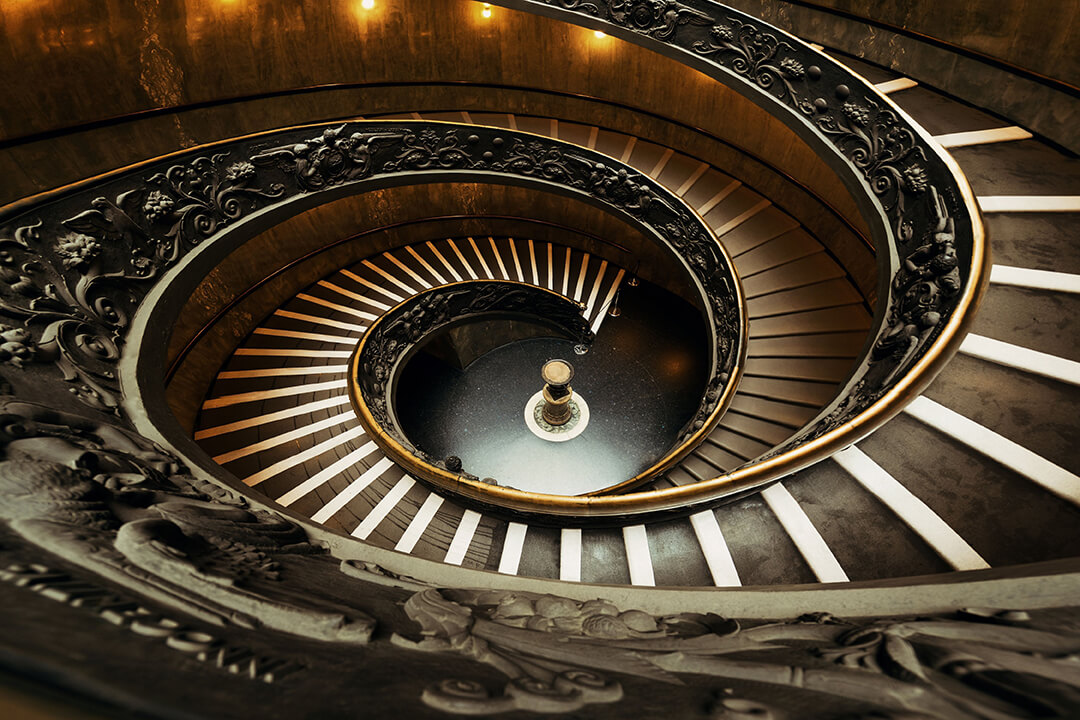
    Giuseppe Momo's spiral staircase at the Vatican Museums exit
    Giuseppe Momo’s double-helix staircase, the last thing most visitors see on the way out of the Vatican Museums — a useful image to hold in mind when you’re planning a winter afternoon here.

    The Museums Aren’t Actually Closing Earlier

    Ask around in December and someone will tell you the Vatican Museums cut their hours for winter. They don’t. Official opening runs Monday to Saturday “08.00 a.m. – 08.00 p.m.”, per the current museivaticani.va hours page, and that holds true whether you’re visiting in July or January. Final entry is 6pm, year-round. Nothing on the printed schedule shifts because the calendar says November, and no member of staff at the gate is going to tell you otherwise.

    What shifts is the light. Walk into the Galleria delle Carte Geografiche at half past three in June and you’ll find it flooded with sun. Try the same clock time in late December and the room already reads like early evening. Nothing about the building has changed. Its skylights simply catch a lower, weaker sun for fewer hours, and that gap between the printed schedule and the felt experience is the entire premise of a winter visit here: hours stay full-length, but the day inside them shrinks.

    Half an Hour Nobody Warns You About

    One rule does compress your afternoon, and it applies every day of the year, not just in winter. Museivaticani.va states it plainly: “Visitors are required to leave the halls 30 minutes before museum closing time.” On a normal 8pm close, gallery staff start moving people out around 7:30pm, well before the building itself locks its gates. Plan a summer visit against the printed 8pm closing and this rule will still catch you out at least once. Come in winter, when the light has already gone soft an hour earlier than that, and the 7:30 sweep feels less like a formality and more like confirmation that the day is genuinely over.

    Where the Light Runs Out First

    Several of the Museums’ best-known corridors lean heavily on daylight pouring through overhead skylights rather than on artificial spotlighting alone. Take the Gallery of Maps: forty painted panels along a barrel-vaulted corridor, lit from above by a run of windows set into the ceiling rather than by wall-mounted fixtures. On a bright winter morning, that gallery still glows. By mid-afternoon, once the sun has dropped low enough that direct light stops reaching the glass, the same corridor takes on a flatter, dimmer quality no amount of foot traffic changes. Sculpture galleries built around courtyards and clerestory windows behave the same way. None of this is a malfunction, nor is it unique to any one room. It is simply what a centuries-old building, lit in part by the sky, looks like once the sky has less to give.

    Photographers feel this earliest. A shot of a fresco or a marble bust that reads crisp and warm at ten in the morning can look grey and flat by three, purely because of how the light through the roof has changed angle. If pictures matter to your visit, front-load the galleries that depend on skylights and save the more evenly lit, artificially spotlit rooms for later in the day.

    The Dome Keeps a Different Clock

    If you want proof that the Vatican does adjust hours seasonally somewhere, look at the climb up St Peter’s Dome rather than the Museums next door. Basilicasanpietro.va lists a genuine winter window, “26 ottobre 2025 – 28 marzo”, during which the Cupola runs “7.30 – 17:00”: opening half an hour later and closing a full hour earlier than its summer schedule of “7.00 – 18.00”, which applies from “29 marzo 2026 – 25 ottobre 2026”. That’s a real, documented seasonal cutback, unlike anything on the Museums’ own calendar. It belongs to the Dome climb specifically, and the exact dates get reset every year, so treat any given month as a guide rather than a guarantee before you book a slot.

    The Other Early Finish: Last Sunday of the Month

    There is one day when the Museums genuinely close early, and season has nothing to do with it. On the last Sunday of every month, admission is free and hours contract to “09.00 a.m. – 02.00 p.m.”, with final entry at 12:30pm. It’s the one slot on the calendar where an early finish is official rather than a trick of the light, and it draws a correspondingly large crowd for a correspondingly short window. Not every last Sunday counts, either: Easter Sunday, June 29, December 25 and 26, and December 31 are all excluded, so check the specific date against the calendar before building a visit around it.

    Days the Museums Don’t Open at All

    Winter also carries its own run of closure dates worth marking before you book anything. Between November and February, the Museums close entirely on November 1, December 8, December 25, December 26, January 1, January 6 and February 11, in addition to every Sunday apart from the free last one. None of these dates is a secret; they’re all published on the official closure calendar. Even so, they trip up more winter itineraries than the fading light ever does, mostly because visitors from abroad assume a public holiday means shorter hours rather than no hours at all.

    Timing a Winter Day So You’re Not Rushed

    If daylight in the skylit galleries matters to you, enter as close to the 8am opening as your schedule allows. Morning light holds its strength through the Gallery of Maps and the sculpture courts well past midday in winter, and crowds are thinner before ten. An afternoon visit still works if morning isn’t possible; just plan around the 30-minute hall-clearing rule rather than the printed closing time, and treat 7:30pm, not 8pm, as the real deadline on a full-length day. Anyone continuing on to St Peter’s Basilica afterward should note its separate hours, “dalle ore 7:00 alle ore 20:00” with last entry “entro le ore 19:15”, and budget extra time for the security line, which can run long regardless of season.

    None of this requires memorising a second calendar. A quick check of the day’s opening and closing times before you set out, paired with a pace that treats the last ninety minutes as wind-down rather than prime viewing, is usually enough to stop a December afternoon here from feeling cut short. For the full current schedule, including how it interacts with public holidays, see our Vatican Museums hours guide.

  • What Happens at St Peter’s When the Pope Travels Abroad

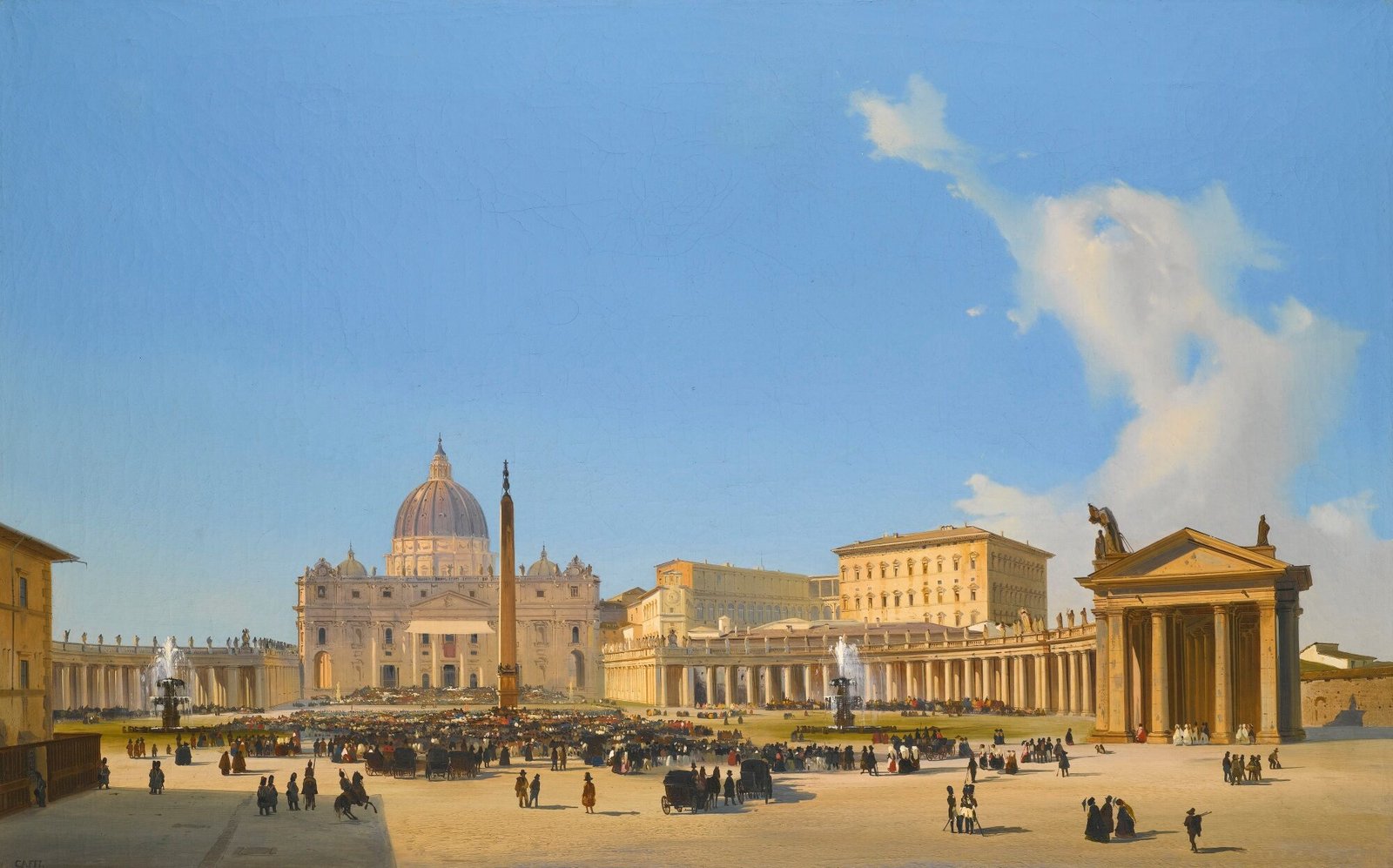
    Ippolito Caffi's painting of crowds awaiting a Papal Audience at St Peter's, the tradition that still fills the square most Wednesdays
    Ippolito Caffi’s painting of crowds awaiting a papal audience at St Peter’s — the same scene repeats most Wednesday mornings the Pope is in Rome, and does not happen at all on the weeks he isn’t. Public domain via Wikimedia Commons.

    A guide walks up to the barrier on Via della Conciliazione at eight in the morning, ticket stubs in hand, and a family from Ohio asks the obvious question: will they see the Pope today? Some weeks the answer is straightforward. Other weeks it is no, because Leo XIV is in another country and the Wednesday audience simply is not happening. What surprises most visitors is what does not change on those weeks: the Basilica stays open on its usual schedule, the Museums run their normal hours, and a scheduled tour goes ahead exactly as booked. Only a narrow slice of the Vatican experience actually depends on the Pope being in Rome.

    St Peter’s Basilica and the Museums Keep Their Own Hours

    St Peter’s Basilica and the Vatican Museums are administered separately from the papal liturgical calendar. Run through the Governorate, the Museums publish a fixed weekly rhythm: Monday to Saturday from 8:00am to 8:00pm, last entry at 6:00pm. On the last Sunday of most months they open 9:00am to 2:00pm with free entry and a 12:30pm final entry, excluding Easter Sunday, 29 June, and both 25–26 December and 31 December. Every other Sunday the Museums are closed, along with a short list of fixed holidays through the year. None of that calendar bends around a trip abroad. Overseen by the Fabbrica di San Pietro rather than the Museums administration, the Basilica sets its own opening hours; its own site posted a notice titled “New opening hours for St Peter’s Basilica” earlier this year, and one page there lists hours “From june 1st: from 7.00 am to 8:00 pm.” Basilica hours are worth checking directly before a visit, since they have shifted more than once in 2026 for reasons that have nothing to do with papal travel.

    So a St Peter’s Basilica visit when the Pope is not in Rome looks, mechanically, almost identical to any other week. You queue for security on the south side of the square, you walk the nave, you find Michelangelo’s Pietà in the first chapel on the right. What vanishes from the itinerary is the chance of a glimpse of Leo XIV himself, and everything that comes attached to it.

    What Actually Stops: The Wednesday General Audience

    The General Audience is the weekly event most tied to the Pope’s physical presence, and it is the one that simply cannot happen if he is somewhere else. Held most Wednesdays, usually in St Peter’s Square or the Paul VI Audience Hall depending on weather and season, it follows a set format built around a catechesis, greetings by language group, then a closing blessing. That week’s listing, dated 5 August 2026, records it plainly: “General Audience of 5 August 2026 – Catechesis. The Documents of the Second Vatican Council.” That entry sits in a run that had a real gap earlier in the year: audiences were held on 17 and 24 June, none appear for the whole of July, then the series picked back up on 5 August. Some of that summer gap is the Vatican’s routine August recess rather than travel specifically, but the underlying mechanic is the same either way. No Pope physically present in the square means no audience that week.

    Leo XIV’s longest journey of the year makes the clearest example: eleven days across four African nations. Its listing on the Vatican’s travel calendar reads “Apostolic Journey of the Holy Father to Algeria, Cameroon, Angola and Equatorial Guinea (13–23 April 2026).” That stretch runs from a Monday to a Thursday and swallows two Wednesdays entirely: 15 April and 22 April, both of which fall outside Rome. A shorter trip does not necessarily cost a visitor anything, though. The September journey to France, held under the heading “Apostolic Journey of the Holy Father to France and Visit to the Headquarters of the United Nations Educational, Scientific and Cultural Organization (UNESCO) (25–28 September 2026),” ran Friday to Monday and never touched a Wednesday at all. Whether a given trip empties out a General Audience depends entirely on which weekday it happens to straddle.

    Sunday Angelus Doesn’t Necessarily Stop, It Moves

    Where the Wednesday audience disappears outright, the Sunday Angelus (or Regina Caeli during the Easter season) behaves differently. It kept running weekly through the same stretch that cancelled the General Audience, with entries logged across four Sundays in July and two more in early August. More tellingly, the Vatican’s own calendar labels one April entry “Angola apostolic journey Regina Caeli,” dated 19 April, which fell squarely inside that eleven-day African trip. Leo XIV still delivered the Sunday address that week; he simply delivered it from Angola instead of the window above St Peter’s Square. For a visitor standing in the square itself, the practical result is identical to a week without any papal presence at all, but the underlying mechanic is worth knowing. The Angelus travels with the Pope far more often than the Wednesday audience does.

    Why the Square Feels Different During a Travel Week

    None of this changes what the Basilica or the Museums look like inside. What changes is the crowd pattern outside. On a normal audience Wednesday, the barriers along Via della Conciliazione fill early with people holding free tickets, coach groups from parishes across Europe, and a noticeably higher concentration of clergy and religious sisters than any other day of the week. Strip the audience out of a Wednesday and that particular crowd simply does not form; the square still has its usual tourist volume, but the dress-coded, ticket-holding audience crowd that Caffi painted centuries ago is absent for that week. Anyone booking a Wednesday specifically hoping to combine a Basilica or Museums visit with a glimpse of the Pope should check the Vatican’s own audience calendar for that exact date rather than assuming Wednesday guarantees an audience.

    Buying Tickets Around a Travel Week

    Ticket availability for the Museums and guided tours does not tighten or loosen because of a papal trip; demand is driven by season and day of week, not by whether Leo XIV happens to be in Rome. One thing does not change, and is worth repeating regardless of the calendar: where to buy. Vatican Museums’ own guidance warns visitors about “potential scams and websites that use domains similar to the official one, which may charge significantly higher prices” (paraphrased from the site’s ticketing notice). Official tickets run through tickets.museivaticani.va, and anything that looks close to it but isn’t should be treated with suspicion, travel week or not.

    A trip abroad thins out one specific slice of a Vatican visit and leaves the rest untouched. If a Wednesday glimpse of the Pope matters to your plans, check the current audience calendar before you book. For everything else, from the Pietà to the dome to the Sistine Chapel ceiling, our St Peter’s Basilica tickets and tours page covers the guided options that run on the Basilica’s own schedule, independent of where Leo XIV happens to be that week.