
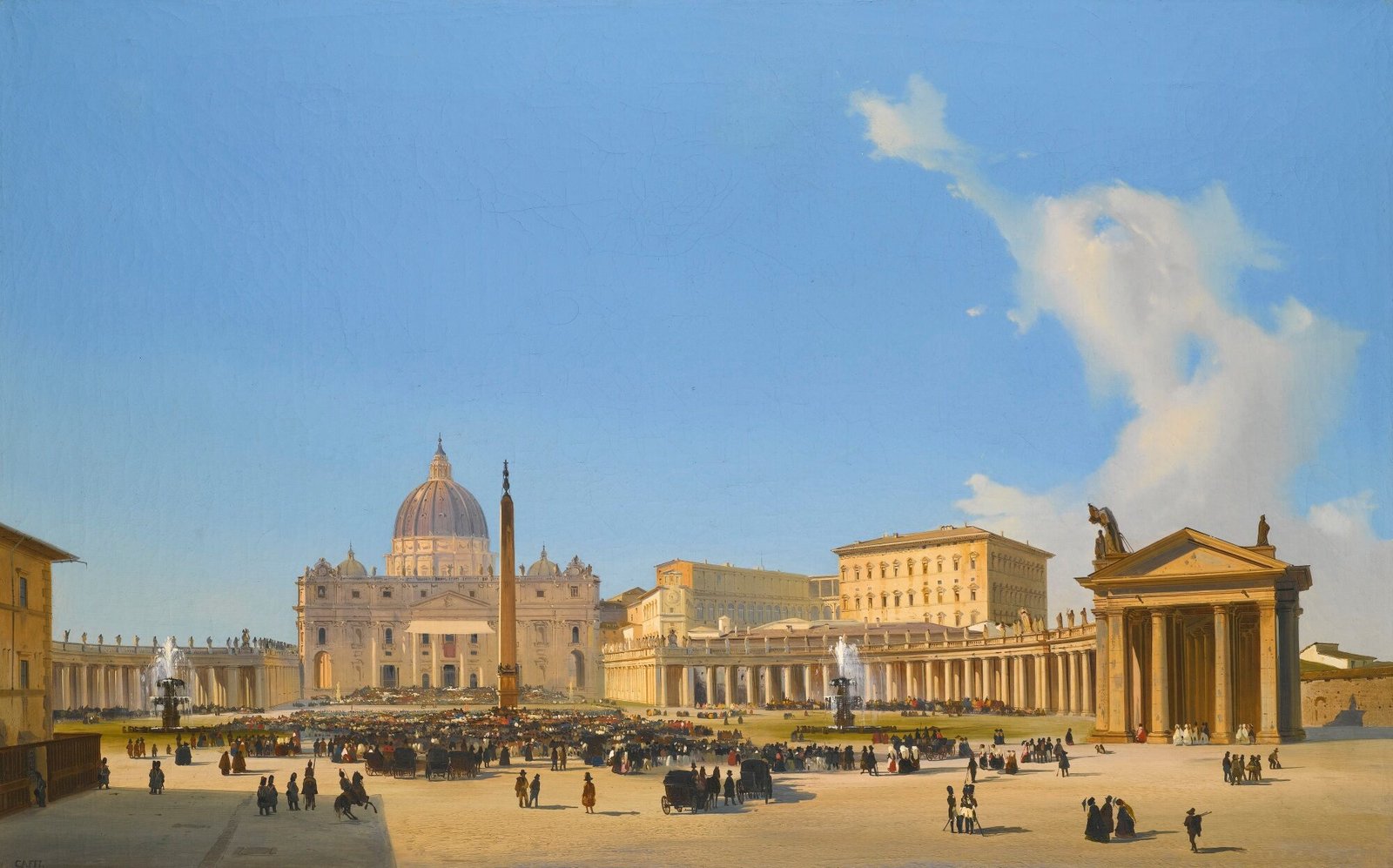
Rome closes for very few days a year, and June 29 is one of them. Shops pull down their shutters, offices empty out early, and the city marks the Solemnity of Saints Peter and Paul, its two patron saints, with the hush usually reserved for mid-August. Walk through the centre that morning and it can feel like a Sunday dropped into the middle of the week. Cross into Vatican City and the closure follows you: the Vatican Museums shut their doors for the same feast, while St Peter’s Basilica and the square outside it become the busiest place in Rome.
A Roman holiday the Vatican shares
June 29 is a civic and religious holiday for the city of Rome, tied to the feast of its two patron saints. It is also, officially, a closure day on the Vatican Museums’ own calendar: the two institutions mark the same date rather than running on separate clocks. This is the detail worth knowing before building a June itinerary: a date that reads as a dead day for sightseeing in the historic centre is also a dead day for the Sistine Chapel and the Raphael Rooms, once you cross the line at St Peter’s Square.
Why the Museums are closed
The Vatican Museums publish a short, fixed list of annual closures: January 1 and 6, February 11, March 19, April 6, May 1, June 29, August 14 and 15, November 1, and December 8, 25 and 26, according to the Museums’ own hours page. June 29 — the Solemnity of Saints Peter and Paul — is on that list by name, not an exception to it. The Museums do not run their standard Monday-to-Saturday hours that day; the Sistine Chapel, the Raphael Rooms and the rest of the galleries are shut, the same as on Christmas Day or the Feast of the Assumption. If a Sistine Chapel visit is booked for June 29, it needs to move to a different date.
A Mass that reshapes St Peter’s Square
What does happen on June 29 is liturgical, and it happens outdoors. The Solemnity of Saints Peter and Paul brings a papal Mass in St Peter’s Square, celebrated this year by Pope Leo XIV, elected in May 2025 as the successor to Peter the feast itself commemorates. Tens of thousands of people can gather for it, filling the piazza in front of the basilica the way they do for Easter or a canonisation. That crowd builds around the square and the basilica doors; it has nothing to do with the Vatican Museums, which are simply closed for the day rather than disrupted by the Mass.
Pallium day, reworked since 2015
Traditionally, June 29 is also when newly created metropolitan archbishops receive the pallium, a woollen band worn over the shoulders that marks their office. As one account of the feast puts it, “newly created metropolitan archbishops receive from the pope the primary symbol of their office, the pallium.” For decades that meant kneeling in front of the pope in St Peter’s on the day itself. Pope Francis reworked that arrangement in January 2015: from then on, “the pallia will be blessed on the feast of Saints Peter and Paul in Saint Peter’s Basilica; the metropolitan archbishops, however, will receive those pallia in a separate ceremony within their home dioceses from the hands of the Apostolic Nuncio.” The blessing stayed in Rome; the actual conferral moved to each archbishop’s own cathedral, months or years apart from June 29 itself. Exactly how the ceremony runs under Pope Leo XIV wasn’t something we could pin down to a primary source at the time of writing, so treat the specifics as worth checking closer to any visit built around the feast.
What it means for basilica access
From June 1, St Peter’s Basilica runs longer hours: “from june 1st: from 7.00 am to 8:00 pm,” according to its own hours page, with the dome open 7:00am to 6:00pm through late October. The basilica’s official schedule does not spell out a separate closure or restricted window for June 29 itself. What it can’t fully capture is what a papal Mass for tens of thousands of people does to the practical business of getting inside a working church that morning: queues reroute around barriers, seating areas for the Mass occupy ground normally open to visitors, and security screening slows to match. None of that is published in advance as a fixed rule, so the honest answer is to expect a disrupted morning near the basilica on the feast, not to expect a specific hour-by-hour schedule.
Crowd mechanics: where to go when
Here is the practical split. The Vatican Museums, entered from Viale Vaticano on the north side of the walls, are closed for the day — there is no version of June 29 where a Sistine Chapel visit happens as planned, so move that booking to the day before or after rather than hoping for an exception. St Peter’s Basilica stays open on its own schedule and is the part of the visit to treat with caution for a different reason: if the plan is to see the basilica interior rather than attend the Mass, mid-afternoon, once the liturgy has wrapped up and the crowd has thinned, tends to work better than a 9am arrival. Anyone actually curious about the ceremony itself should simply go and watch from the square; it is a public Mass, not a closed event, and standing at the edge of a crowd that size is its own kind of Rome experience.
Timing around the free Sunday
One more wrinkle worth knowing about: the Vatican Museums open free of charge on the last Sunday of most months, and the Museums’ own hours page flags the feast as a factor in that calendar, noting that the free Sunday “does not coincide with Easter Sunday, 29* June Sts. Peter and Paul.” In practice this means the free-entry Sunday can be adjusted in months where it would otherwise land on or near the feast. If a visit is built specifically around that free admission, it is worth a direct check of the current month’s schedule before travelling, rather than assuming the last Sunday works the same way every year.
Planning the day
The short version: June 29 shuts down civic Rome and the Vatican Museums together, so a Sistine Chapel or Raphael Rooms visit booked for that day needs to move — to the day before, the day after, or any date that isn’t one of the Museums’ fixed closures. St Peter’s Basilica and the square outside it are the other complication, where a papal Mass for the city’s patron saints redraws the morning’s foot traffic for a few hours; save a basilica visit for the afternoon if the Mass itself isn’t the point. Plan the Museums around the feast rather than on it, and June 29 becomes a logistics note rather than a wasted trip. For a Museums entry that skips the ticket-office queue on whichever day the visit lands, it’s worth booking ahead through Vatican Museums tickets before you go.