
At 7:40 a.m. Viale Vaticano is a queue, a coffee cart, and a stone wall taller than it looks in photos. First thing you notice is the wall. It is the actual boundary of the Vatican, brick faced with travertine, unmarked, and up to twelve metres high. If you have a timed skip-the-line ticket for the 08:00 slot, you stand about halfway down the block from a gate marked Musei Vaticani. That queue is around fifty people this morning, which is normal for a Wednesday in July. Others already there have print-outs and phones held ready and, universally, more layers than they will need.
The doors open at 08:00. First-slot ticket holders inside the queue are through security within a few minutes.
The security queue is the actual filter
Everyone talks about the ticket queue: the long snake outside on Viale Vaticano that skip-the-line ticket holders leapfrog. Fewer people mention that beyond the ticket gate is a security screening identical to any airport: coats and belts and cameras in bins, X-ray, walk through, collect. On a busy morning this can take twenty minutes even for the first slot. This one takes eight.
Compound advantage of the first slot: the guards are fresh, the line is short, and nobody in front of you has forgotten they were carrying a Swiss Army knife.
08:12: the atrium, and the first mistake most people make
Past security, you are in a wide two-storey atrium with a floor of black-and-white marble tile and a set of very impressive escalators. Escalators go up. Everybody takes them up. This is fine.
The first mistake most people make is going straight through the atrium and into the Cortile della Pigna, the Pinecone Courtyard, without looking around. There is a cloakroom on your left; if you have anything larger than a small handbag, it is mandatory. There are also the museum’s only real toilets before the 90-minute stretch through the galleries. Go now.
On the way out I always look up at the ceiling of the atrium, which most people do not, because most people are already thinking about the Sistine Chapel. The ceiling is a Baroque conceit: painted architecture that pretends the roof is much higher than it is. It is not the highlight of the visit. It is the first hint that this place has been designed for one moment sixty minutes from now, and every other room is at some level a stage for it.
08:20: the Pinecone Courtyard
The Cortile della Pigna is an open-air rectangle roughly the size of a suburban swimming pool complex. Down one end is the enormous bronze pinecone from which the courtyard takes its name, a Roman piece cast in the first or second century that once decorated a fountain near the Baths of Agrippa. In the middle is the Sphere Within Sphere, a modern bronze sculpture by Arnaldo Pomodoro. Those two objects are a thousand years and about forty metres apart, and this is not a mistake. The whole Vatican Museums are structured around this exact rhythm: ancient objects placed next to Renaissance placements of ancient objects next to modern reflections on the whole apparatus. If you notice nothing else this morning, notice that.
Also: this is the last outside air you will breathe for over an hour. Take a minute here.
08:30: the Egyptian and Etruscan galleries (skip most of them)
The standard route through the Vatican Museums begins with the Museo Gregoriano Egizio and the Museo Gregoriano Etrusco. They are not small collections. If you spent an unhurried hour in each, you would still be here for the museum’s closing announcement. On a first visit, walk. There is a Roman mosaic of an unswept floor (asaroton oikos) on the way, a joke of a mosaic that pretends to be crumbs and fish bones on the ground (look for it, it takes ten seconds), and then continue.
This is the section a competent guide will move you through quickly, and the section a bad guide will bury you in. If you are self-guided, do not feel obliged to read each label. Mission of the first hour: arrive at the Sistine Chapel reasonably alert.
08:45: the Gallery of Maps
The next thing that happens is that you turn a corner and are inside a hall a hundred and twenty metres long, gilded ceiling to floor, with a series of forty large frescoed maps of Italy on the walls and a barrel-vaulted ceiling that appears to be paved in gold. This is the Galleria delle Carte Geografiche, painted by Ignazio Danti and his workshop in 1580–1583.
People stop here. Even bored teenagers stop here. On a first slot morning you will have the corridor almost to yourself for a few minutes, small windows of unphotographed emptiness that will not repeat for the rest of the day. Whatever your photograph strategy is, this is where it earns its keep. By 10 a.m. the Gallery of Maps is a bottleneck.
Two details worth knowing: the maps on the west wall are the territories washed by the Tyrrhenian Sea, and on the east wall those washed by the Adriatic. And the ceiling above your head is not one composition. It is dozens of small scenes, each linked to the map below it, showing miracles or historical events that happened in that region.
09:00: the Raphael Rooms
You emerge from the Gallery of Maps into a series of four smaller rooms that are, room-for-room, some of the most consequential paintings in Western art. These are the Raphael Rooms: private papal apartments frescoed by Raphael and, after his death in 1520, by his workshop between 1508 and 1524.
Stanza della Segnatura is the third room in the visit sequence. It contains the School of Athens on one wall and the Disputation of the Most Holy Sacrament on the wall opposite. Every art history undergraduate can tell you the philosophers of the School of Athens by number. Fewer people know that Raphael painted himself into the far right of the fresco, watching the argument, wearing a small black beret. See if you can find him. It is the sort of thing this room rewards.
The Raphael Rooms take fifteen or twenty minutes even at a walk. This is the point in the first hour when the visit shifts from architecture to argument: each fresco here is a specific theological or political statement, and being told what the argument is transforms the experience. If there was ever a moment to have an audio guide on, this is it.
09:20: the door before the Sistine Chapel
You leave the Raphael Rooms via a stairwell down and a short corridor, and you find yourself in front of a plain wooden door. There is a guard next to it. The guard is enforcing silence.
The Sistine Chapel is not signposted the way famous rooms usually are. There is no dramatic threshold announcement. Just a door and a guard and a sign saying Cappella Sistina. This is by design. You are supposed to walk in unprepared and look up.
09:22: the ceiling
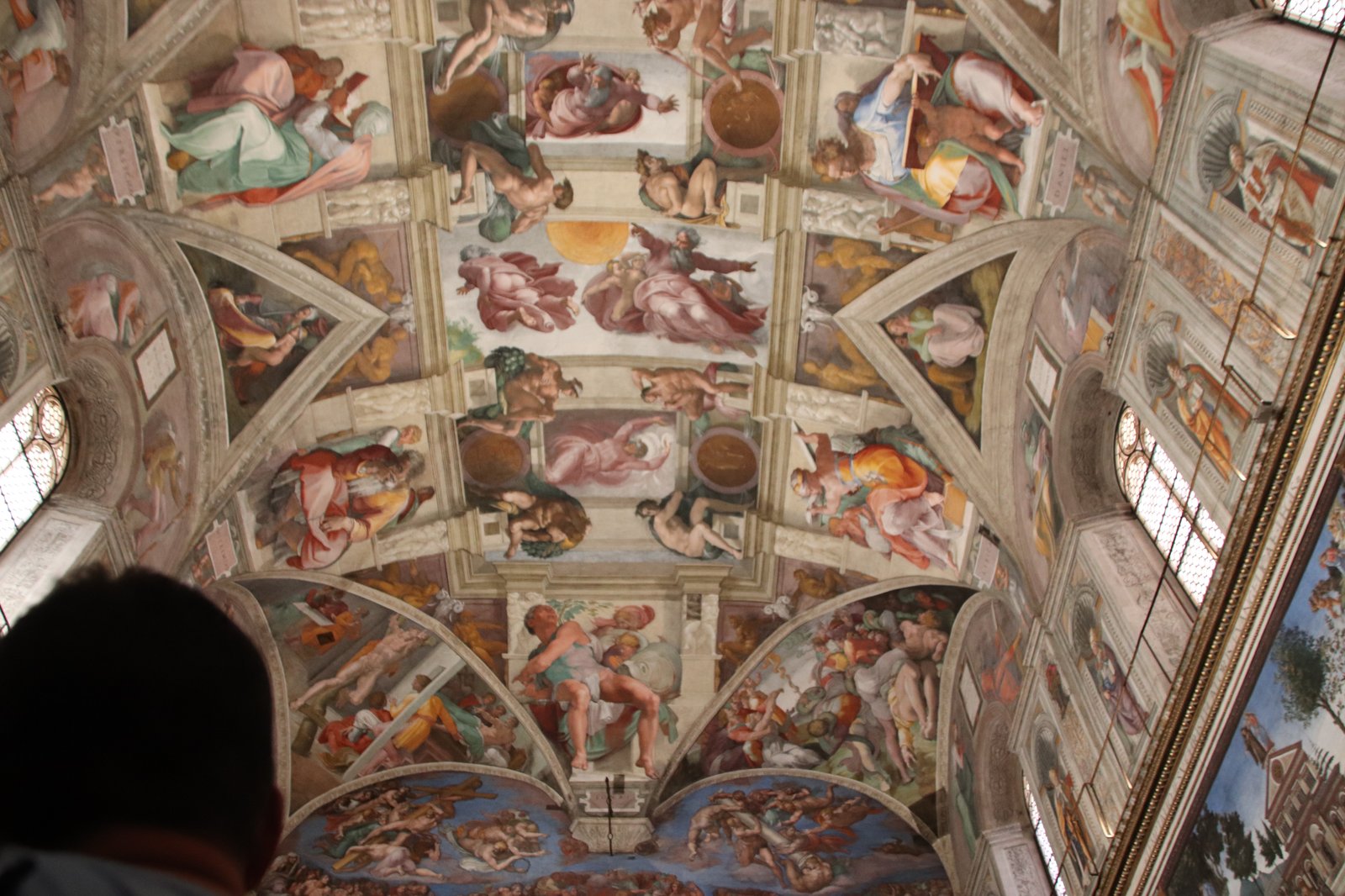
The first thing to know is that the Sistine Chapel is smaller than you expect. It is a rectangular room forty metres long and thirteen metres wide, a footprint roughly twice a tennis court. Michelangelo painted every square metre of the vaulted ceiling between 1508 and 1512, and returned twenty-four years later to paint the Last Judgement on the wall behind the altar. The chapel’s proportions are said to echo those the Old Testament gives for Solomon’s Temple, a claim popular in tour tradition though disputed by some scholars.
On a first-slot morning you can find a bench along the side wall. Benches are numbered, discreet, and mostly ignored. Sit down. Look up. Give yourself ten minutes minimum.
The rules inside are absolute and unnervingly well-enforced: no photography, no video, no phones held up, no talking above a whisper. When someone in the room raises a phone, the attendant says "silenzio!" and "no photo!" in the same breath, and every time in my experience, the guilty party puts the phone away. This works because the room is designed to intimidate a little. It is doing its job.
09:35: back into the world
You leave the Sistine Chapel one of two ways. If you are on the standard route, you turn right through a heavy curtained doorway and walk fifteen minutes through more galleries, downstairs, past a shop, and back into the atrium. If you are with a guide whose tour includes St Peter’s Basilica, there is a small door in the corner of the Sistine that leads through a private passage directly into the Basilica, a shortcut that saves the twenty-minute walk around the wall and the security queue at St Peter’s Square.
Either way, you have been inside for about ninety minutes. You have looked at somewhere between one and three per cent of what the Vatican Museums contains. And you have been to the Sistine Chapel almost alone. That is the last time until the room closes at 18:00 that this will be possible.
Practical notes for tomorrow morning
- Book the 08:00 slot. Any later, the compound advantage evaporates. That skip-the-line ticket only skips the outside ticket-office queue. You still queue at security, so being at the front helps twice over.
- Eat something before you arrive. There is a cafeteria inside, but the first two hours are not when you want to sit down.
- Wear layers. Some galleries are cold. Sistine, packed with bodies later in the day, is not.
- Check the 2026 hours before you go. The museum is closed most Sundays, and Wednesday mornings are the Papal Audience which does not affect the Museums directly but does affect the metro station and the walk from St Peter’s Square.
- The Sistine Chapel dress code is enforced at the door: shoulders and knees covered. Full detail in our dress code guide.
The rest of the visit, whatever else you see after the ninety-minute mark, will be quieter than the first hour was intense. That is the design. Get to the Sistine before nine-thirty; the rest of the day is yours.