
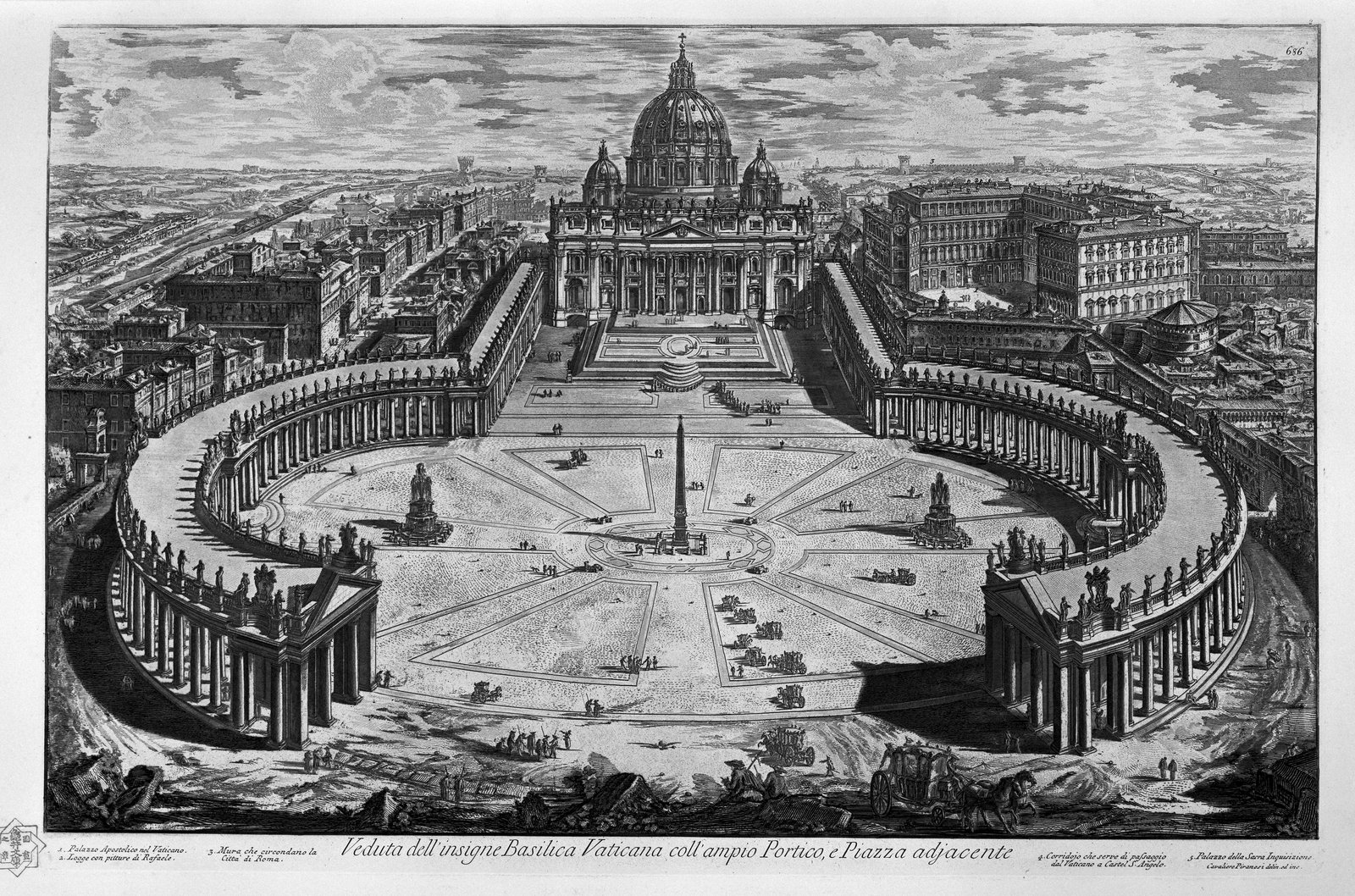
Just before 09:30 on a Wednesday morning in St Peter’s Square, the crowd of ticketed pilgrims quiets, and eyes turn toward the Arch of the Bells on the left side of the Basilica facade. A moment later the white Popemobile emerges, moves slowly into the piazza, and begins a circuit through the seated sections. The next ten minutes are the most concentrated part of the whole audience: babies handed up, blessings given, the pope working the crowd before he takes his seat at the sagrato and the catechesis begins.
Most guides describe the Papal Audience in schedule terms. What follows is the mechanics: what happens step by step, in what order, and how to prepare.
Getting a ticket
Audience tickets are free. Since early 2025 the Prefecture of the Papal Household has run an online request form at eventi.pontificalisdomus.va, which supplements the older fax and email channels. Requests should go in at least two weeks ahead, and groups over ten need to reserve well earlier than that. Tickets are collected the day before or early the morning of the audience at the Bronze Door under the right-hand colonnade.
American pilgrims are typically routed through the Bishops’ Office for United States Visitors to the Vatican at the Pontifical North American College. That office handles requests at visitorsoffice@pnac.org and can be a faster route than the general Prefecture form.
05:30 to 07:30 — the pre-dawn queue
If a good seat matters to you, arrive far earlier than you think you need to. Security screening at the piazza entrances typically opens around 07:30 for a 10:00 audience. Pilgrims who want front-area seats begin queueing at the barriers around Via della Conciliazione from about 06:30 or earlier. This is not a hyperbole for a lively summer Wednesday; the front rows within each ticketed section fill within minutes of gates opening.
Bring water, a hat, and a light layer. Rome mornings from June through September can be twenty degrees by 07:00 and thirty by 11:00; the plastic chairs sit in direct sun once it clears the colonnade.
07:30 to 09:00 — security and the scramble
Security opens at 07:30 and gates close around 09:00. Screening is airport-style: bag scan, metal detector, walk through, collect. Dress code enforcement is stricter here than at the Museums door: shoulders and knees covered for both sexes, no shorts of any length for men, hats off. Vatican Gendarmerie and Italian police handle the approach cordon; ushers and stewards inside the piazza direct crowd flow into the ticketed sections but do not assign seats.
Within each section, seating is first-come first-served. Tour groups do not get automatic priority over individuals. Only four categories have reserved zones: newlyweds within two months of their wedding (sposi novelli), the sick and disabled, a boxed VIP area beside the papal canopy, and clergy in cassock. Each of those requires a separate request through the Prefecture.
09:30 — the Popemobile appears
White Popemobile emerges from the Arch of the Bells at the left side of the Basilica facade at around 09:30, and that is the moment the audience actually begins for most of the crowd. It works a slow loop through the aisles between the seated sections, stopping frequently. Reported circuit lengths vary between about twenty and thirty minutes depending on the crowd size and the number of stops.
Two things happen during this circuit that most first-time attendees do not know to expect:
- Babies handed up. Papal ushers walk alongside the Popemobile and select infants from the aisles to pass up to the pope, who kisses or blesses them briefly before handing them back. There is no formal request procedure. What works is being close to the aisle with a small child visible; ushers do the selection. This practice has continued under Leo XIV, who took the name Leo after his May 2025 election following the death of Francis.
- Individual greetings from the aisle. Pilgrims along the aisle who catch the pope’s eye will sometimes be greeted directly, occasionally handed something to sign or bless, occasionally spoken to briefly in whatever language works. This is not scheduled and no rule guarantees it, but it happens throughout the circuit.
10:00 — the audience proper begins
By roughly 10:00 the Popemobile has completed its circuit and Leo XIV is seated at the sagrato in front of the Basilica facade under a small awning. Format from that point runs a well-established sequence:
- A short Scripture reading, in Latin or Italian.
- The pope’s Italian catechesis. In 2026 this has been a series on the documents of the Second Vatican Council: Dei Verbum and Lumen Gentium were the completed cycles earlier in the year; Sacrosanctum Concilium is the live cycle running into July.
- Multilingual summaries and greetings to pilgrim groups from designated multilingual clerics of the Secretariat of State. Standard rotation: French, English, German, Spanish, Portuguese, Polish, Italian, plus Arabic (a permanent part of the sequence since October 2012).
- The Pater Noster sung in Latin by the whole assembly.
- The Apostolic Blessing, not to be confused with the Urbi et Orbi which is reserved for Christmas, Easter, and immediately after a conclave.
The whole thing concludes close to 11:00.
The blessing at close, and what it covers
At the closing Apostolic Blessing, longstanding practice holds that any religious articles you are carrying — rosaries, medals, crucifixes, holy cards, prayer books — are blessed if you hold them up during the blessing itself. Absent family members named in your intention are also included. No 2026 formal guidance from the Prefecture has altered this.
If you brought objects specifically for blessing, hold them visible during the Apostolic Blessing and not before. The blessing at the end covers this; earlier segments of the audience do not.
After the audience
Leo XIV typically greets the VIP and sick sections briefly at the sagrato after the closing, then withdraws into the Basilica or the Apostolic Palace. He does not linger in the general crowd. Piazza dispersal is fast — the space substantially clears within thirty to forty-five minutes, though the immediate exits and the walk to Ottaviano-San Pietro metro can be crowded for roughly the first hour.
If your day includes the Vatican Museums after the audience, expect thicker security queues at the Museums entrance for the same reason. The Museums do not close for the audience but the surrounding foot traffic peaks at exactly the moment the piazza clears.
When the audience is not held
Two windows to know about:
- Most of July and part of August — audiences are typically suspended for the summer when the pope moves to Castel Gandolfo. Wednesdays in this window do not have a General Audience in Rome.
- Any Wednesday the pope is travelling — apostolic journeys, hospitalisations, or major state functions can cancel a single audience. Announcements come through vatican.va and the Prefecture’s mailing list.
Between October and Easter the audience moves indoors to the Paul VI Audience Hall behind the left arm of the colonnade — same format, roughly six thousand seats instead of the piazza’s ~50,000 seated capacity (up to ~80,000 with standing overflow on Easter-adjacent Wednesdays), no Popemobile circuit through the crowd. If you have a choice, the outdoor summer audience is the more atmospheric of the two.
For the current 2026 opening calendar including which Wednesdays fall inside the audience season, see the Vatican Museums opening hours 2026 guide. If you are planning around a Wednesday and expect to combine the audience with a Museums visit, our post on why Wednesday mornings are a bad time to visit the Museums covers the knock-on effects that compound with audience day.