Stand in front of the Transfiguration in the Pinacoteca long enough and the two halves of the canvas start to argue with each other. Above, a weightless Christ hovers over Mount Tabor between Moses and Elijah, bathed in a light that has nothing to do with the sun. Below, a crowd of apostles gestures in confusion around a possessed boy nobody can help. It reads like two different paintings glued together, because in a sense the man who painted it never got the chance to reconcile them. Raphael died before he could finish the bottom half, and the picture that hangs in Sala VIII today carries that interruption inside it.
A Commission From the Vice-Chancellor
The painting began as a rivalry. Cardinal Giulio de’ Medici, who would later become Pope Clement VII, was in late 1517 the sitting pope’s vice-chancellor and the archbishop of Narbonne, and he wanted an altarpiece grand enough for Narbonne cathedral. Wikipedia’s account of the commission puts it plainly: “By December 1517, the latest date of commission, Cardinal Giulio de Medici…was also the Pope’s vice-chancellor.” He didn’t commission just one painting. He asked Sebastiano del Piombo to paint a companion piece, the Raising of Lazarus, for the same French cathedral, and historians have long read the pairing as deliberate pressure: give Raphael a rival to outpace and he’ll work faster.
The Vatican Museums’ own account of the picture gives its painting span as 1516 to 1520, which already tells you something. Four years is a long time for an artist who, a decade earlier, had covered entire papal apartments in fresco at a clip that still startles art historians. This one didn’t move at that pace, and it never reached Narbonne at all.
A Painting Built in Two Layers
What makes the Transfiguration unusual isn’t just its size, at 410 by 279 centimetres of tempera grassa on wood. It’s that Raphael fused two separate Gospel episodes into one frame. Upper register: the Transfiguration itself, Christ ascending in light on the mountain with Moses and Elijah beside him and three apostles shielding their eyes below. Lower register: the scene that follows in the Gospel text, back at the foot of the mountain, where the remaining apostles try and fail to cure a boy possessed by a demon until Christ descends to do it himself. Two moments, two moods, one canvas. Nobody had painted the pairing quite this way before, and once you notice it you can’t unsee the seam running through the composition’s middle.
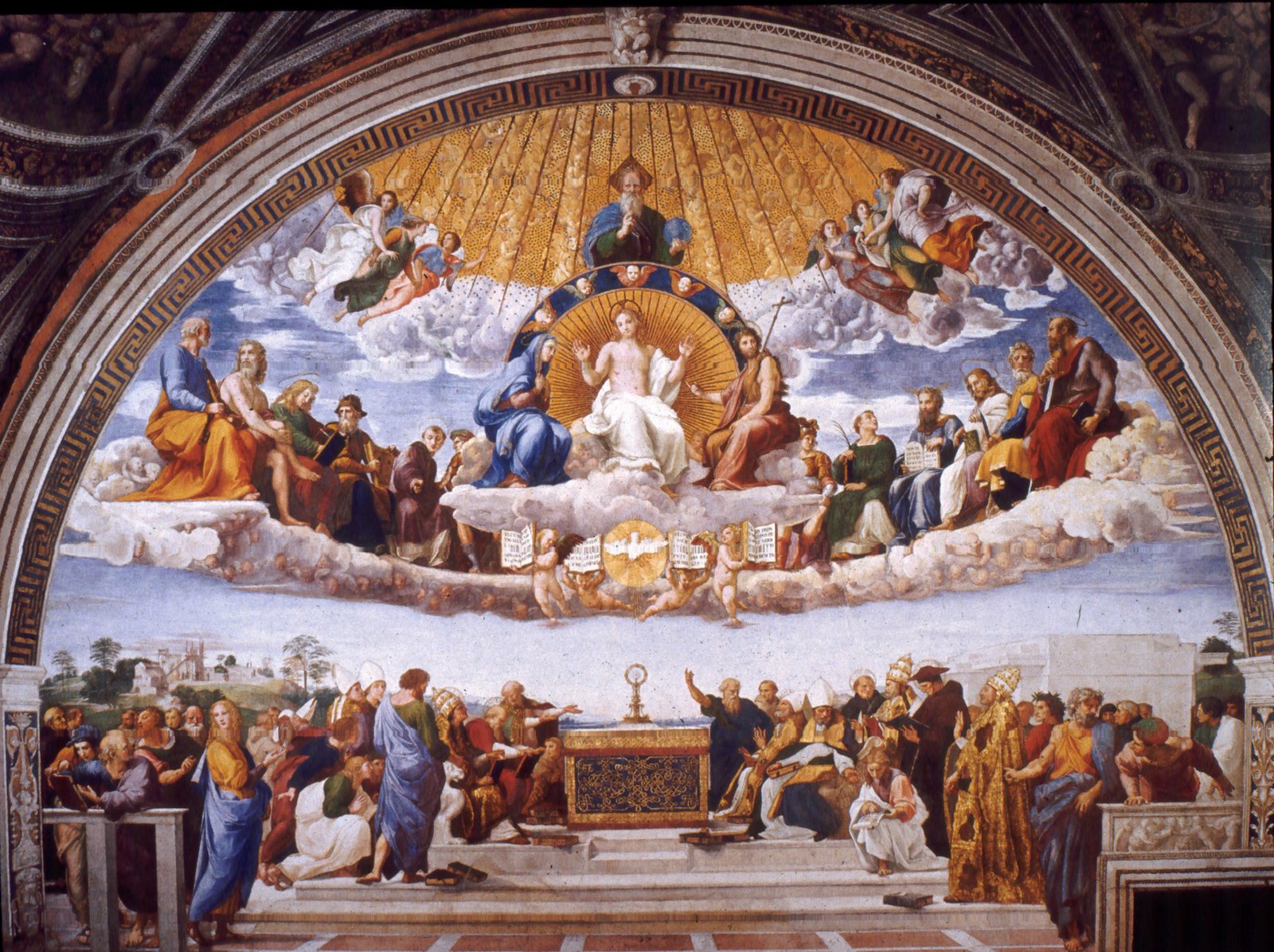
It’s worth knowing that Raphael had built compositions on this heaven-above, chaos-below logic before. In the Stanza della Segnatura, his Disputa stacks a serene celestial court over an animated group of theologians arguing on the ground. The Transfiguration pushes the same idea further and darker, because by the time he was working on it, the lower half had become a genuine race against his own mortality rather than a formal device.
Still Unfinished in Advent, 1519
We know almost exactly how far behind schedule the painting was, because Sebastiano’s Raising of Lazarus reached a checkpoint that Raphael’s picture missed. Pope Leo X formally inspected Sebastiano’s finished companion piece on Sunday, 11 December 1519, the third Sunday of Advent. Wikipedia’s summary of that inspection notes the contrast directly: “When Sebastiano del Piombo’s work was officially inspected in the Vatican by Leo X on Sunday, 11 December 1519, the third Sunday of Advent, The Transfiguration was still unfinished.” Four months later, Raphael would be dead. The gap between that Advent Sunday and Good Friday is the entire remaining runway he had to close the distance, and it wasn’t enough.
Good Friday, 1520
Raphael died in Rome shortly after 10pm on 6 April 1520, Good Friday, at the age of thirty-seven. Apollo Magazine’s account of his final hours states the time and date without ambiguity: “Raphael died shortly after 10pm on 6 April 1520 – Good Friday – at the age of 37.” He had been the most sought-after painter in Rome for over a decade, running a workshop of dozens of assistants, and he left behind an altarpiece with its lower half still visibly incomplete under the paint layers, a fact confirmed centuries later when conservators finally looked closely enough to tell.
The Painting at His Bier
What happened next is the detail that gives this painting its afterlife as a story, not just an object. Raphael’s body was laid out in his house in the Borgo, and the unfinished Transfiguration was placed at the head of his catafalque, where it stayed for roughly two days while Rome came to pay respects. Apollo Magazine’s description is spare and exact: “His body was laid out on a bier beneath his final painting, the Transfiguration.” Popular retellings often go further and describe the panel being carried above his coffin through the streets to the Pantheon, and that image has stuck because it’s a genuinely striking one. It’s worth being careful here, though. His house is where the well-documented part happened; the precise choreography of the funeral procession itself, whether the painting was physically carried through the streets or displayed separately near the body during the funeral mass, is thinner ground. Tradition holds the two were joined that day. Historians can point to the house display directly.
He was buried in the Pantheon, a resting place he is said to have requested himself, among the emperors and the gods of a building older than the Church that now used it.
Who Actually Finished the Painting
For centuries the story went that Raphael’s pupil Giulio Romano completed the Transfiguration after his master’s death, filling in the unfinished lower register from Raphael’s designs. It’s a tidy story, and largely wrong. Restorers who cleaned the painting between 1972 and 1976 got close enough to the surface to settle the question with paint itself rather than legend, and what they found reassigned nearly the whole canvas back to Raphael. As the record of that cleaning puts it: “The cleaning of the painting from 1972 to 1976 revealed that assistants only finished some of the lower left figures, while the rest of the painting is by Raphael himself.” So the confusion, the gesturing, the desperate crowd around the possessed boy in the lower half, almost all of it came from Raphael’s own hand, worked right up against the deadline his death imposed. Only a handful of figures on the lower left belong to someone else.
Giorgio Vasari, writing decades later in his Lives of the Artists, called it Raphael’s finest work, describing it in terms that later writers have quoted as “the most famous, the most beautiful, and the most divine” painting Raphael ever produced. Vasari wrote with his own biases and occasional embellishments, so treat the superlative as a contemporary’s verdict rather than settled fact, but it tells you how quickly the painting’s reputation calcified after the artist’s death made it impossible to finish anything else.
From Narbonne’s Loss to the Pinacoteca
Cardinal de’ Medici never sent the painting to Narbonne. He kept it in Rome instead, and it was installed over the high altar of San Pietro in Montorio, where it stayed for nearly three centuries. Napoleon’s forces took it to Paris in 1797 under the Treaty of Tolentino, part of the wholesale removal of Italian art that followed the French campaigns. It came back to Rome in 1816, after the Congress of Vienna forced restitution, and entered Pope Pius VII’s newly formed Pinacoteca, where it remains, now displayed in Sala VIII among the museum’s other altarpieces.
If you want to see it, the Vatican Museums are open Monday to Saturday from 08:00 to 20:00, with last entry at 18:00, and on the last Sunday of the month from 09:00 to 14:00 with free entry and last entry at 12:30. Every other Sunday the museums are closed, along with a handful of religious holidays through the year. The Pinacoteca sits toward the end of the standard visitor route, well past the Sistine Chapel, which is one reason so many visitors miss it entirely on a rushed morning.
Raphael’s own painted rooms elsewhere in the museums tell a different chapter of the same career, finished at speed rather than cut short by it, and our guide to the Raphael Rooms covers how to see them without losing half your visit to the crowds around the School of Athens.