
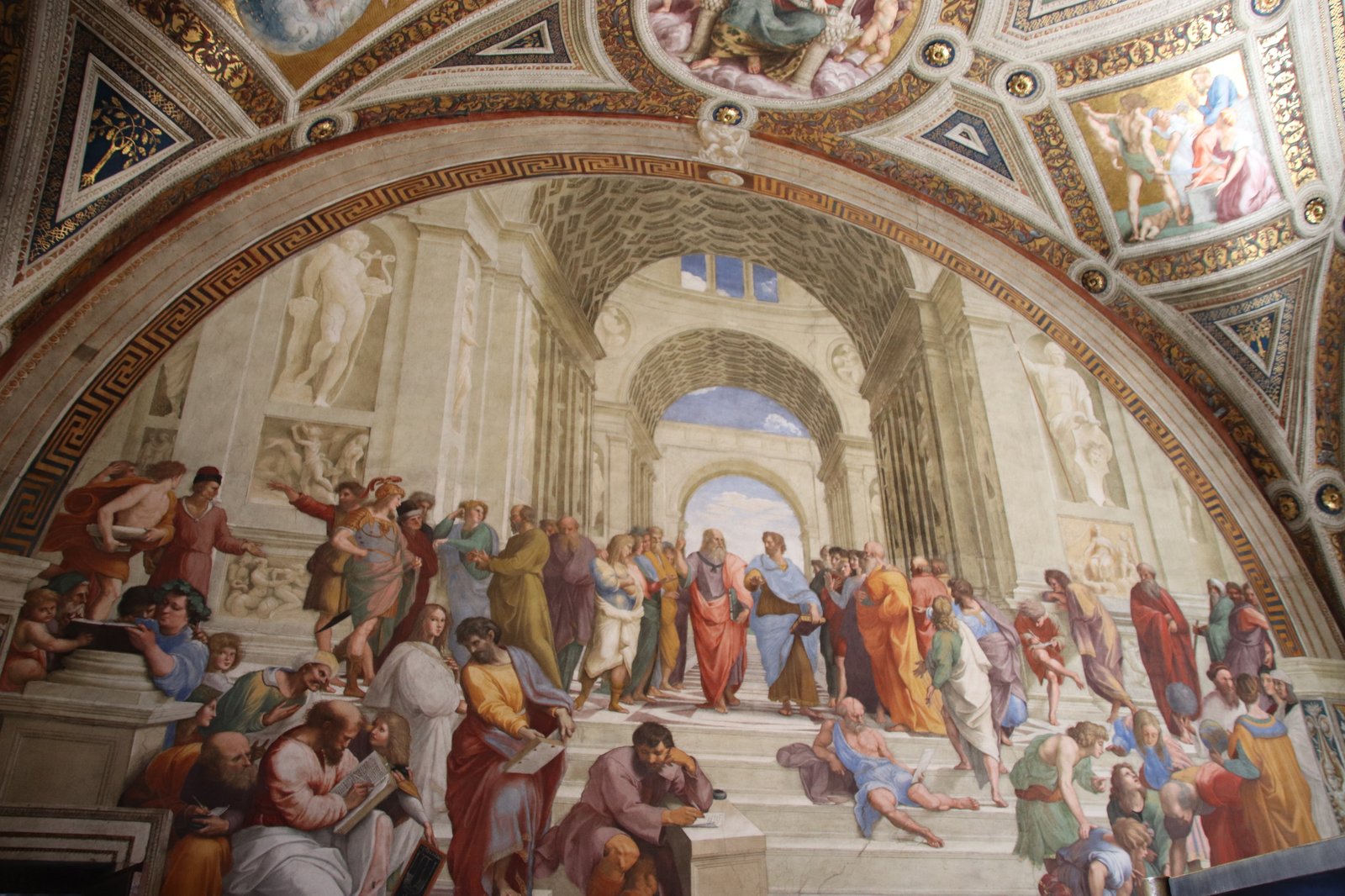
I have stood in front of Raphael’s School of Athens three times, at eighteen, thirty, and fifty-five, and each time I have looked at a different painting. Nothing on the wall has moved. Raphael finished the fresco in 1511 and it has held its position on the east wall of the Stanza della Segnatura ever since. Yet the room is not the same twice, and the fresco is not the same on a return, and this small unsettling fact is one of the reasons I keep going back.
This is a short essay about that. If you have never been, some of what follows may sound abstract. If you have been once, some of it may sound familiar. If you have been three times, you already know.
At eighteen
The first visit was on a student trip, in a hurry, in an unhelpful red audio guide, in shoes that were the wrong shoes for the day. Memory of that room: smaller than the photographs suggested, hotter, darker in the corners. Standing in front of the fresco, I was surprised that I could see any of the individual faces at all, because the reproductions I had studied looked crisper than what my eye was actually taking in from a distance of six metres in a room full of other students on other trips.
What I fixed on that first time were the two central figures under the arch. Plato on the left, older, white-bearded, pointing his index finger up. Aristotle on the right, holding a book, hand extended horizontally with the palm facing down. My audio guide told me these were about the theory of forms versus empirical knowledge and I nodded along, half-hearing, because the philosophy course I would take the following year had not yet started and I did not have the vocabulary to hold any of it. The painting was interesting because I had been told it was interesting. I did not disagree; I just did not have my own reason yet.
I looked for four minutes and left, and if you had asked me afterwards to name a single specific detail I remembered, it would have been the temperature of the room and the shoes.
At thirty
The second visit was on my own initiative, twelve years later, on a trip to Rome that had been booked to give myself space after a difficult job change. I had my own philosophy degree by then and, more usefully, a working sense of what it was for. I had also learned that Leonardo da Vinci is a widely-accepted candidate for the face of Plato — long hair, beard, features that match Leonardo in his late fifties, sketched in by Raphael as an homage. So this time I was not looking at Plato. I was looking at Leonardo standing in for Plato, and that changes what the pointing hand means.
I noticed other things I had not seen before. Diogenes lying half-clothed on the steps, reading, indifferent to the whole gathering above him. The pair of astronomers on the far right, holding the celestial and terrestrial globes, and beside them a beardless young man in a black beret looking directly out of the painting at me. That is Raphael. He painted himself in. Once you have seen him you cannot un-see him, and once you have registered that he chose to stand in that particular corner rather than any other, the composition rearranges around him.
What I could not shake at thirty was Heraclitus. Not because I knew anything about him then, but because there is a figure in the front-centre foreground, leaning on a block of marble, brooding, writing, isolated from the group. He does not look like anyone else in the room. My guidebook told me this figure was added after the rest of the fresco was largely finished, and that it is generally accepted to be a portrait of Michelangelo, drawn in after Raphael had seen the first half of the Sistine ceiling, unveiled on 14 August 1511. That face is grave and heavy in a way no other face in the room is.
At thirty I read that as art-historical detail. At fifty-five I would read it differently.
At fifty-five
The third visit was booked on the way home from a funeral. Not a specific plan; I had a Rome layover and I moved my flight to give myself the morning. I went in with the 08:00 slot, walked the standard route quickly through the Egyptian rooms and the Gallery of Maps, and found the Stanza della Segnatura at 09:15 with about a dozen other visitors distributed along the walls.
Plato and Aristotle were still under the arch. The pointing hand still pointed up; the horizontal hand still hovered above the empirical world. I had spent three decades taking sides between the two attitudes and had arrived at the unfashionable answer that both had been mostly right and mostly incomplete, and that the argument was worth having again in every generation because the two impulses do not resolve.
Raphael still watched me from his corner. I nodded at him.
What arrested me this time was Heraclitus. Michelangelo, leaning on marble, alone, writing. He does not participate in the conversation happening above him. He is not in dialogue with Plato or Aristotle or Pythagoras or Euclid. He is doing his own work, at a slight distance from the group, and the group appears to have accepted this. At eighteen I had not seen him. At thirty I had seen him as a piece of art-historical trivia. At fifty-five I recognised him.
The painting had not changed. What had changed was that I had done my own work at a slight distance from the group for long enough to know what that looks like from the outside.
What you carry in changes what you see
The obvious moral is that the Stanza della Segnatura rewards a return visit. That is true and boring. The less obvious one is that the room seems to be arranged specifically for return visits — not because Raphael planned for me to come three times, but because the fresco holds more information than any single visit can absorb, and the information is calibrated to different life stages of the same viewer.
Plato and Aristotle are on the wall for the eighteen-year-old. Diogenes and the pointing hands are for the thirty-year-old. Heraclitus is for the fifty-five-year-old. Somewhere in the composition there is almost certainly a figure who will speak specifically to me when I am seventy, and I do not yet know which one.
The Disputa is on the opposite wall of the same room, begun in 1509 slightly before Raphael started work on the School of Athens. Turn around from the fresco you came for and it is there. I have never really looked at it. That is next visit’s problem.
Some practical notes for a return visit
If you are coming back to the Raphael Rooms specifically, the route is unchanged. Modern visitor sequence takes you through the four rooms in order: Stanza di Costantino, Stanza di Eliodoro, Stanza della Segnatura, Stanza dell’Incendio del Borgo. The Segnatura is the third room. The School of Athens is on the wall opposite the door you enter through, so you cannot miss it and there is no queue for a specific vantage point.
Two things I have learned about the second and third visits that I did not know on the first:
- Go with time. The Raphael Rooms take fifteen or twenty minutes at a walk. On a return, budget forty-five. Sit down in the Stanza della Segnatura if you can find a spot on the bench along the wall. Look, then look at what you are noticing yourself notice.
- Read one thing before you go. One book, or one long essay, on a specific figure in the fresco. Not a general overview; a specific figure. The next visit’s rearrangement will be more legible if you have a hook to hang the change on.
For the full breakdown of what is in each of the four Raphael Rooms and the standard visit sequence, see our Raphael Rooms guide. For the ticket that gives you the whole route including the Sistine Chapel, our Vatican Museums & Sistine Chapel skip-the-line ticket is the standard 08:00 option.
Come back in five years. The room will be here, and it will not be the same room.