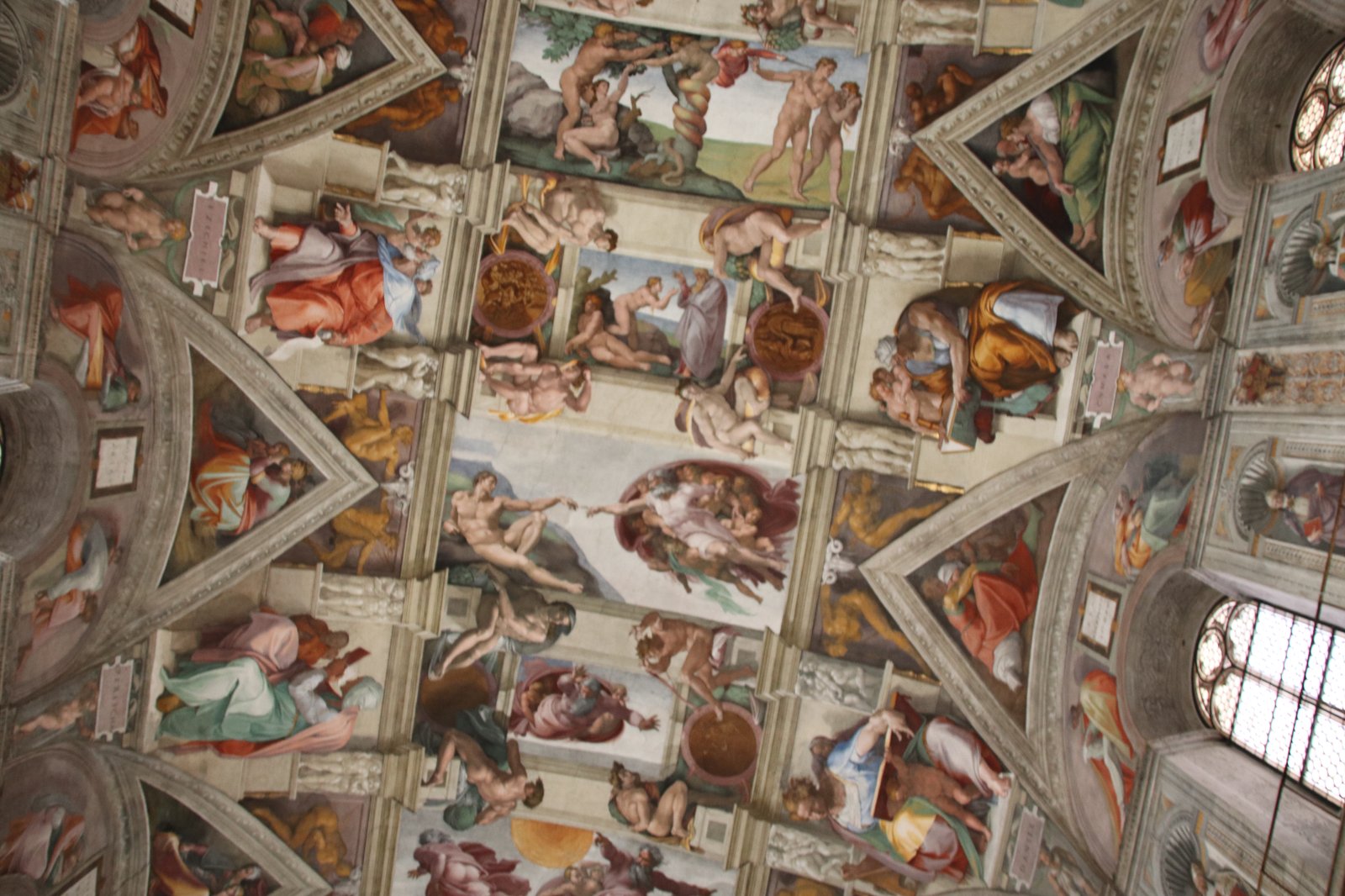
Stand under the Sistine Chapel ceiling today and a guide will eventually say some version of the same sentence: this was not always this bright. That much is true. What comes next, usually delivered as settled fact, is that a Vatican-sponsored cleaning in the 1980s and early 1990s stripped away centuries of Michelangelo’s own shading and left the frescoes looking cartoonish. That claim has had thirty years to calcify into common knowledge. That claim deserves a harder look than it usually gets.
A claim that will not die
Ask around and you will hear a version of it from people who have never read a conservation report: the restorers scrubbed off Michelangelo’s final layer of shadow, the layer he added in dry plaster after the wet fresco had set, and what tourists see now is a flattened, candy-coloured imitation of the original. It is a tidy story. It also skips past what conservators actually found on the ceiling and why they removed it, and it treats a genuine, well-documented scholarly argument from the 1980s as though it were still unresolved. It mostly is not.
What the project actually was, and was not
The restoration now argued about ran in stages. Preliminary tests began in 1979. Lunette sections above the windows were cleaned first, from June 1980 to October 1984. Work on the main ceiling vault finished in December 1989, and the whole ceiling, together with Michelangelo’s Last Judgement on the altar wall, was unveiled by Pope John Paul II on 8 April 1994. That fourteen-year project is the one this controversy is about.
A separate campaign followed: cleaning the fifteenth-century wall frescoes below the ceiling, by artists including Botticelli and Perugino. That phase was approved in 1994 and unveiled in December 1999. It is a different job with a different set of painters, and popular writing about “the Sistine restoration” often blurs the two together. Keep them apart, because the colour argument is almost entirely about the ceiling and the Last Judgement, not the wall cycle.
What Colalucci’s team actually scraped off
Chief restorer Gianluigi Colalucci and his team documented what five centuries had deposited on the plaster. Candle smoke, burned in the chapel for public Masses and conclaves since the 1500s, had left a film of soot and amorphous carbon across the whole ceiling. Earlier restorers, working long before modern conservation science, had rubbed animal fat and vegetable oil into the surface to mask salt staining, and that oil had itself darkened with age. Crystalline saltpetre had bloomed on the plaster in patches. On top of all that sat layers of glue-varnish, applied during previous restoration campaigns in roughly 1625 and again in 1710 to 1713, that had gone cloudy and yellow over three centuries.
None of that is Michelangelo’s paint. It is grime, old varnish, and other restorers’ fixes, and removing it is what a cleaning is supposed to do. Whether the ceiling was dirty was never really the dispute. It was about whether, underneath all that soot and varnish, some of what looked like Michelangelo’s own final touches had been scraped away along with it.
Critics who said stop
That question had a real, named opponent, not an anonymous internet grumble. Columbia art historian James Beck, who founded the watchdog group ArtWatch International, argued publicly and repeatedly that the cleaning was too aggressive, and he later co-wrote a book on the dispute, Art Restoration: The Culture, the Business and the Scandal, with Michael Daley in 1995. Beck put his objection memorably: “In the rhetoric of this conversation, they say that the previous restoration was no good — now we’re going to make a really good one. It’s like having a facelift. How many times can people go through one without their poor faces looking like an orange peel?”
He was not alone in raising the alarm while the work was still in progress. New York dealer Ronald Feldman organised a petition asking John Paul II to halt the cleaning, signed by fifteen artists, including Robert Motherwell and Andy Warhol. The petition made the New York Times. It did not stop the project, and the Vatican’s own restoration team continued to defend its methods against Beck’s objections for years afterward.
Funding and photographs behind the cleaning
One detail rarely makes it into the popular version of the story: Nippon Television Network Corporation of Japan funded the restoration with a $4.2 million grant, in exchange for exclusive rights to photograph and reproduce the work as it happened. New York Times critic Michael Kimmelman noted in 1991 that some of the loudest criticism was fed by Nippon TV’s own reluctance to release its documentation photographs, which were the clearest available evidence of exactly how the cleaning had been done. Outside scholars arguing about whether too much had been removed were, for long stretches, arguing without access to the images that would have settled the argument fastest.
A different verdict: colour restored, not invented
Set against Beck’s warning is the judgement of scholars who worked from the restored ceiling itself rather than from memory of the grimy one. University of Victoria art historian John Osborne told Queen’s Quarterly in the late 1990s that “every book on Michelangelo will have to be rewritten” because of what the cleaning revealed about his palette and technique. Pope John Paul II, at the 1994 unveiling, put it in more devotional terms: “Lovers of art and beauty have then given proof of their sensitivity by their concrete and remarkable contribution towards the restoration of the Chapel’s original bright colours.” Neither of those is proof that Beck was wrong on every point. Conservators today generally accept that some retouching by later hands was, in places, removed along with the grime it was covering. But the dominant material stripped from that ceiling was soot; old animal-fat dressing; saltpetre; and darkened varnish, not Michelangelo’s brushwork, and the bulk of independent art-historical opinion since 1994 has sided with the restorers on the broad question of what the colours underneath actually were.
Judging it yourself, standing under it
You do not have to take either side’s word for it. That ceiling is still there, and you can test the argument yourself if you know where to look. Compare a figure lit head-on, like the Libyan Sibyl near the altar end, against one of the darker corner pendentives, where restorers left sections deliberately uncleaned decades ago as reference patches against which the rest of the work was checked. That contrast is the whole dispute in miniature.
Vatican Museums hours run Monday to Saturday, 08:00 to 20:00, with last entry at 18:00, and the halls clear thirty minutes before closing, so plan around that if you want unhurried time under the ceiling rather than a last-minute rush. On the last Sunday of most months entry is free from 09:00 to 14:00, last entry 12:30, though that exception does not apply when the date falls on Easter, 29 June, or the Christmas period, and the museums close entirely on a set list of religious and civil holidays through the year. Early in the day, before tour groups stack up in the Sistine Chapel itself, is the easiest window for actually studying the paint rather than shuffling past it.
Bring the argument with you rather than a verdict. Look at where the colour sits warm and where it sits cool, notice how the shadow falls differently on figures Michelangelo painted at different points in the four years he spent on the scaffolding, and decide for yourself whether what you are seeing looks scrubbed flat or simply cleaned. Most visitors who go in expecting a ruined ceiling leave surprised by how much modelling and shadow is still there once you know where to look.
If you would rather spend that morning looking at the ceiling than standing in a queue for it, our Sistine Chapel tickets get you past the entrance line so you can start comparing those panels for yourself.