
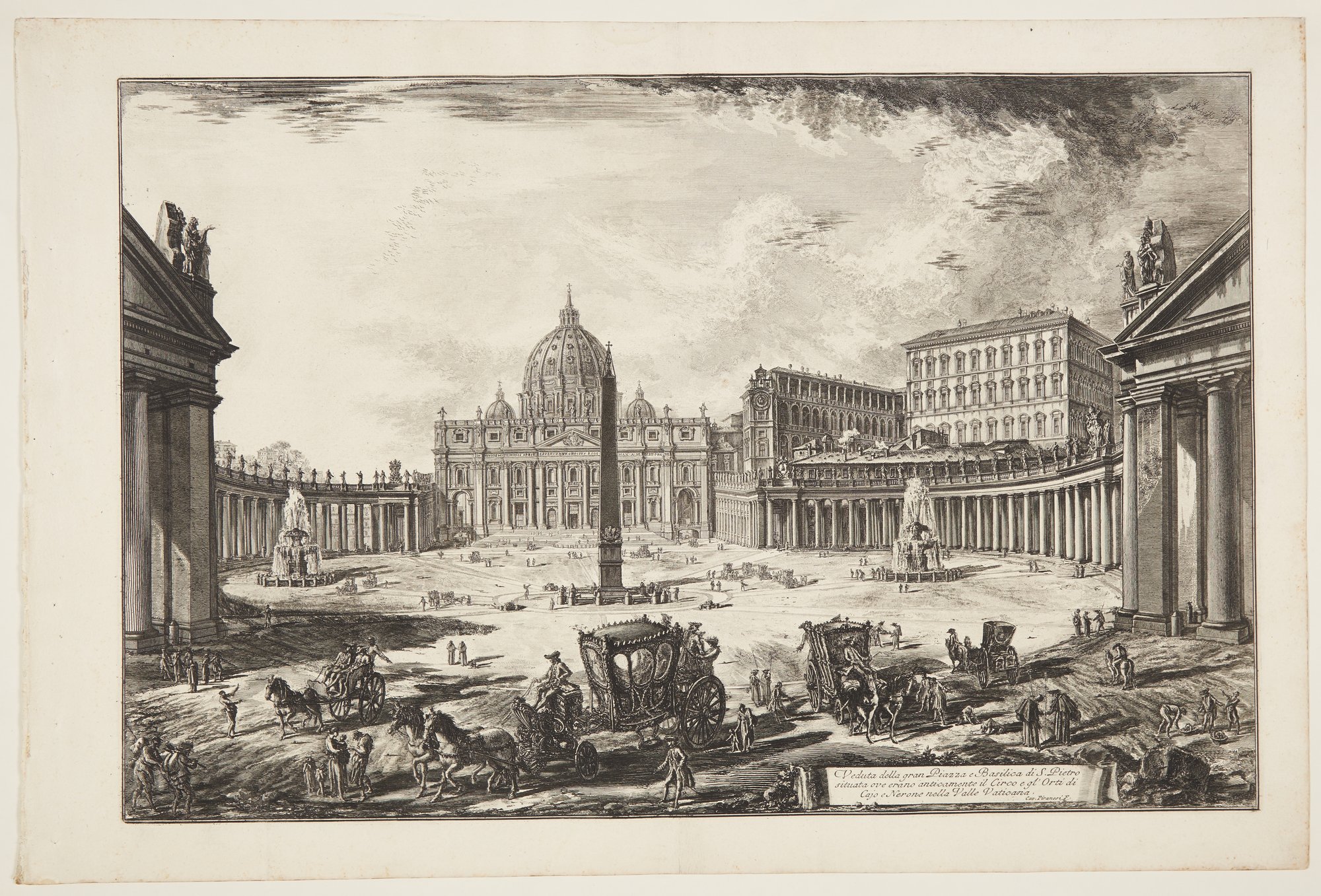
Most visitors cross St Peter’s Square looking up, at the dome or the colonnade, and never look down. That is a mistake, because the paving under their feet is doing something the facades are not: it is telling the time. Around the base of the obelisk at the centre of the square, stone markers set into the ground turn the whole monument into an instrument for reading the sun. This post is only about that one thing.
An obelisk that was never built to tell time
Nothing about the obelisk’s origin has to do with astronomy. It is a red granite shaft, 25.3 metres tall on its own, brought up to almost 40 metres once you count the bronze cross and the base it stands on. It started life in Heliopolis, Egypt, and Emperor Caligula shipped it to Rome in AD 40, where it first stood in the Circus of Nero, on roughly the spot where St Peter’s Basilica now rises. For over 1,500 years it stood a short distance from where you find it today.
Moving it to the centre of the square was a sixteenth-century engineering job, not an ancient one. Architect Domenico Fontana relocated it on 10 September 1586, at Pope Sixtus V’s order, covering a distance of only 260 metres but requiring “thirteen months of preparatory work, 800 men, 160 horses and 45 winches.” It has stood upright ever since: “the only ancient obelisk in Rome that has never fallen,” a distinction none of the city’s dozen or so other obelisks can claim.
Why a plain shaft makes a good sundial
A vertical shaft with a flat, level surface around its base is, mechanically, all a sundial gnomon needs to be. As the sun moves through the sky, the obelisk casts a shadow whose tip traces a path across the pavement. At true solar noon, the shadow falls due north, and its length that day depends on the sun’s height, which changes with the season. Track where the shadow’s tip lands at noon across a full year and you have marked out, in stone, the sun’s annual cycle through the zodiac. That is exactly what happened here, more than two centuries after Fontana raised the shaft.
The zodiac stones, added in 1817
The record is specific about the date and the mechanism: “In 1817 circular stones were set to mark the tip of the obelisk’s shadow at noon as the sun entered each of the signs of the zodiac, making the obelisk a gigantic sundial’s gnomon.” Walk the paving on the right day and you are standing where the noon shadow once fell for that particular stretch of the calendar. Who specifically drew up the 1817 scheme is not something we can confirm from the sources checked for this piece, so treat any guide who names a designer with a pinch of caution.
What is confirmed is the mechanism, and it is worth sitting with for a moment: nobody built a separate sundial in St Peter’s Square. Someone looked at an object already standing there for over two centuries and worked out how to read it.
The compass rose and the paving lines
Zodiac stones are not the only marking cut into the square. A compass rose is centred on the obelisk, and further out again: “the actual foci are marked in the paving by roundels of stone six or seven metres beyond the outer ring of the compass rose centred on the obelisk, on either side.” Stand on one of those roundels and look at the colonnade curving away from you: the four rows of columns line up into a single row, an optical trick that only works from that exact spot.
The rest of the ground is not left as bare cobblestone either. As the record puts it, “the paving is varied by radiating lines in travertine, to relieve what might otherwise be a sea of setts.” Some of those lines connect to the sundial markers, others are purely decorative, and from ground level the distinction between the two is not always obvious. That is part of why the whole system goes unnoticed: it reads as ordinary paving pattern until you know what to look for.
Finding the markers on the ground
Start at the obelisk’s base and work outward in a slow circle. Zodiac stones sit close in, arranged around the shaft at roughly equal spacing. Beyond that, the compass rose forms a wider ring, and the paired roundels marking the colonnade’s optical foci sit further out again, on the north-south axis through the obelisk. None of it is roped off or labelled, which is exactly why it survives as a genuine discovery rather than a marked attraction: you have to know to look down.
There is no fee to walk the square and no ticket required to see any of this. St Peter’s Square is a public piazza, open to anyone, separate from the Vatican Museums’ own admission and hours, which apply only inside the museum buildings themselves.
Seeing it as part of a wider visit
Ten minutes at the obelisk’s base, done properly, changes what the rest of the square looks like. The colonnade stops being background scenery and becomes a piece of geometry keyed to two stone roundels you can stand on. The paving stops being texture and becomes a calendar. If you are building a Vatican day around the Museums or the Basilica, it is worth arriving early enough to give the square that ten minutes before the crowds thicken, rather than treating it as a walkway between the two. For help putting a full Vatican visit together around that timing, our Vatican tours page lays out the guided options that make room for it.