
Every guide in Rome has fielded the question of whether Michelangelo designed the Swiss Guard’s uniform, and more than a few have answered yes. He didn’t. Swiss Guard uniform design history is a shorter and stranger story than the myth: the red, dark blue and yellow stripes you see outside St Peter’s today were drawn up in 1914 by a Swiss army officer named Jules Repond, working from Renaissance paintings rather than as one.
A myth that sticks
Here is the popular version: Pope Julius II asked Michelangelo to design the Guard’s dress, and Michelangelo, needling his patron, sketched something deliberately clownish that reads to modern eyes as harlequin stripes. It’s a tidy story, with a grudge and a famous name attached, and it has no evidence behind it. Aleteia states it plainly: Michelangelo “was certainly not a fashion designer,” and attributing the design of the Swiss Guard’s uniform to him “is but a widespread myth.” Rome guide site myromelife.com is equally direct: “There is no historical document attributing the design to Michelangelo.”
No sketch survives. No payment record exists. Nobody in Michelangelo’s own century appears to have connected him to the uniform at all, which suggests the myth is a later invention rather than a rumour he ever had to deny in his lifetime.
Meet the actual designer
Commandant Jules Repond, who led the Pontifical Swiss Guard from 1910 to 1921, is the officer behind the uniform worn today. Patrons of the Vatican Museums, which has funded restoration work on the Guard’s historic wardrobe, gives a precise date: the redesign was “officially introduced on November 22, 1914 by Swiss Guard Commander of the Corps Colonel Jules Repond,” delivered as “a set of 154 pieces according to a sixteenth-century model.” Repond wasn’t inventing a costume from a blank page. He was standardising a look the corps had worn in inconsistent, patched-together forms for centuries, and doing it deliberately in a sixteenth-century idiom rather than his own Edwardian one, at a moment when uniforms across Europe were being formalised for parade as much as for combat.
What Repond actually looked at
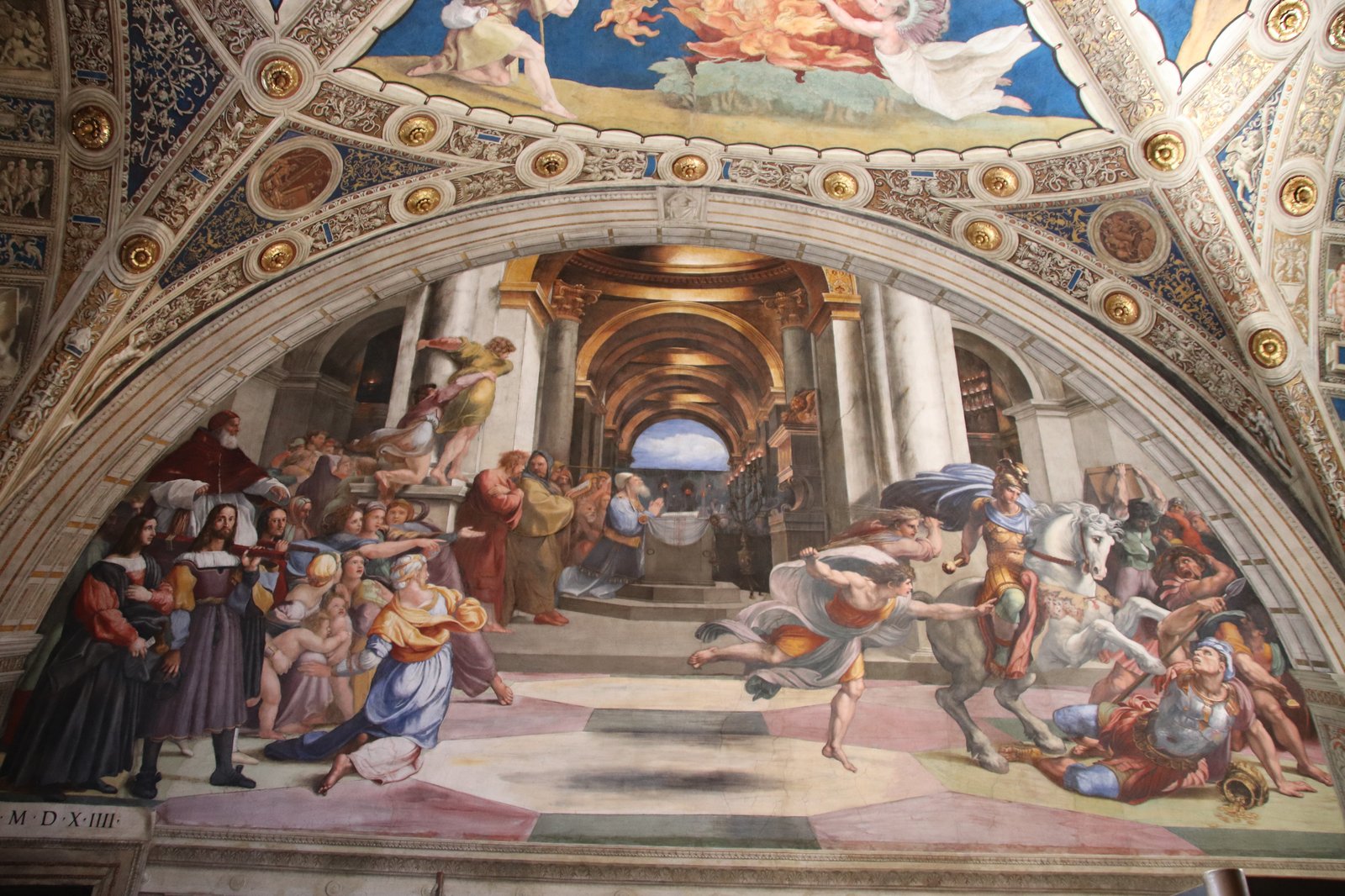
Paintings were his source material, and here the record gets genuinely uncertain about which paintings mattered most. Patrons of the Vatican Museums points to Raphael’s Mass at Bolsena, from around 1512, where “Raphael represented a group of four Swiss Guards” in loose, colourful knee-length trousers over a tunic and doublet. Aleteia instead highlights the Expulsion of Heliodorus from the Temple, painted in roughly the same years, where a single Guard appears dressed in plain black and coffee-umber — evidence, in that reading, that the modern tricolour scheme simply didn’t exist yet in Raphael’s day. A third fresco, painted decades later by Jacopo Coppi in 1577, is described by Aleteia as “considered the precursor of today’s three-colored uniform.” Sources disagree on the specific canvas but agree on the underlying method: Repond assembled a sixteenth-century look out of sixteenth-century evidence, an early-twentieth-century reconstruction rather than a single costume any one Renaissance artist ever drew up whole.
Where the colours come from
Heraldry, not whimsy, explains the stripes. Aleteia’s account is specific: “the colors blue and yellow are said to have been chosen to represent the Della Rovere coat of arms of Julius II, and the red was later added to represent the Medici coat of arms of Leo X.” Patrons of the Vatican Museums tells a near-identical story but credits a different Medici pope for the red addition, Clement VII rather than Leo X. Both men were Medici popes, so the coat of arms itself checks out under either name; which specific pontiff gets the credit is one of the few loose threads still hanging in an otherwise well-documented history. What both accounts agree on is the mechanism: two papal families, two colour contributions, folded into one uniform across the early sixteenth century, decades before anyone had cause to formalise it into a single sanctioned pattern.
Reading the uniform, piece by piece
Watch the bronze doors on an ordinary weekday and you’ll see the plain-duty version: a red, dark blue and yellow striped tunic, a black beret, white gloves, and a halberd carried more as a badge of office than a working weapon. Ceremonial duty adds the pieces most tourists photograph — a morion helmet, silver rather than black, topped with an ostrich-feather plume, and a wide ruff collar that turns a soldier into something out of a portrait. Halberds are the oldest continuous element of the whole kit: guards have carried one on Vatican duty since the corps was founded in 1506, four centuries before Repond ever opened a sketchbook. Colour and cut may be a twentieth-century invention dressed up as Renaissance, but the weapon in a Guard’s hand genuinely is Renaissance, unbroken.
Still hand-built, more than a century later
Watching a Guard stand still in the heat, it’s easy to miss how much tailoring sits behind that stillness. Each uniform is still assembled from the same 154 separate pieces Repond specified in 1914, a figure corroborated independently by Patrons of the Vatican Museums and by the Wikipedia entry on the Guard’s dress. Exact labour hours and fitting counts vary between secondary sources and aren’t pinned to one authoritative account, so treat any specific number you hear on a walking tour with mild caution. Uncontested is the simpler part: this is a made-to-measure garment cut fresh for each recruit, not resized from an old set or bought off a rack, which is part of why a newly sworn-in Guard’s uniform still looks crisp next to a veteran’s.
For a visitor, the practical payoff sits on the ground rather than in the workshop. No two Guards fit their stripes identically. A black versus silver helmet tells routine post from ceremonial duty at a glance. And a halberd in a Guard’s hand predates every other piece of the outfit by roughly four hundred years, a small detail that outlasts the myth about who supposedly drew the rest of it.
None of this — the Repond redesign, the borrowed Medici colours, the 154 hand-cut pieces — is obvious from a quick look across St Peter’s Square. If you’d like it pointed out in person, alongside the Raphael frescoes that fed into the design, our Vatican tours spend real time in the Raphael Rooms where that history hangs on the wall rather than sitting on a plaque.