By the time you reach the end of the Vatican Museums, you have earned a certain glaze. Three or four hours of galleries, a hundred marble faces, the Sistine Chapel’s silence and the guards saying “shh” over the murmur of a thousand people trying to whisper at once. You come down a ramp, you round a corner, and there it is: shelves. Postcards. Rosaries in boxes. A wall of umbrellas with the Sistine ceiling printed on them. Nobody announces it. It just happens, the way the last ten minutes of a long flight happen, and you are standing in a shop before you have decided whether you meant to.
The shape of the last room
I want to be careful here, because it is easy to overstate what I actually know about the building. What I know from walking it, repeatedly, with groups: the descent from the Sistine Chapel funnels you toward retail space before it funnels you toward the street. Whether that is a deliberate architectural choice or simply where the available square footage happened to be, I cannot tell you with certainty, and neither can most of the guides who will assure you otherwise. What I can tell you is that it works, in the sense that a lot of tired people who had no intention of buying anything leave with a tote bag.
Museum management does not pretend the visit is unstructured. The official rule is blunt about it: visitors are required to leave the halls 30 minutes before museum closing time. That is not a suggestion for latecomers, it is a clock built into the day itself, and it tells you something about the whole enterprise. This is not a building where you wander until you get bored. It is a route, timed, with a beginning and an end that someone else decided on. The gift shop, wherever exactly it sits in the plan, is just the last beat of that choreography rather than an accident bolted onto it.
What is actually for sale
Categories on the Vatican’s own store site read plainly enough: sculptures, publications, gift ideas, prints and posters, accessories, home decor. Reproductions of things you just saw, mostly, scaled down to fit a suitcase. A resin Pietà. A print of the ceiling you got a crick in your neck looking at. Rosary sets in presentation boxes, blessed or not depending on which shelf. None of it is trying to be subtle, and none of it needs to be, because the audience walking past has just spent an afternoon inside the actual object the postcard is copying.
I have watched people who spent the entire visit resisting the gift-shop instinct — no photos of the ceiling, no interest in the museum map, arms folded through the Raphael rooms — stop dead in front of a shelf of small metal medallions near the end. It is not that the shop is persuasive. It is that four hours of intensity needs somewhere to land, and a €12 medallion is a cheap, portable way to end the day with something in your hand.
The staircase that isn’t quite what people call it
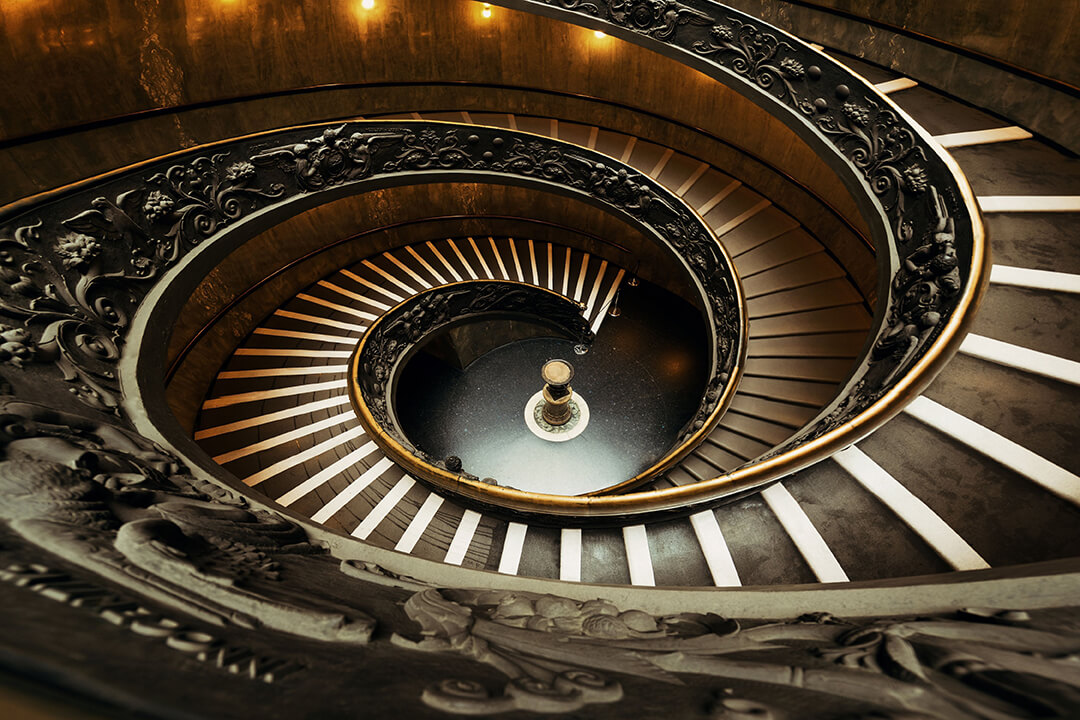
Most visitors leave past Giuseppe Momo’s spiral staircase, the double helix everyone photographs and half the internet calls “Bramante’s staircase.” It is not, strictly. Momo designed it in 1932; the real Renaissance staircase attributed to Bramante is a separate, older structure elsewhere in the complex, and the two get conflated constantly in guidebooks and on Instagram captions. What Momo built functions, in the words of its own description, as a stepped ramp rather than a true staircase — a continuous spiral you can descend without ever quite feeling like you are taking stairs, which is either an elegant piece of engineering or the last gentle nudge downward before the shop, depending on your mood that day.
It is worth pausing on it regardless of what it is called. A wide, sunlit double coil, two ribbons of iron balustrade twisting past each other down four storeys, wide enough that two lines of visitors descend without touching. It is the kind of thing that photographs beautifully and empties a crowd efficiently, and those two facts are probably not unrelated.
Why the exit works the way it does
In 2024 the Vatican Museums took 6,825,436 visitors, second only to the Louvre among the world’s art museums. A number like that changes what “exit” means. You are not one person leaving a small gallery at your own pace. You are one unit in a continuous flow of thousands, moving through a fixed sequence of rooms toward a fixed set of doors, on a schedule the museum enforces down to the half hour. Retail at the end of that flow is not really a marketing decision so much as a logistics one: it gives the crowd something to do while it thins out, a soft buffer between the intensity of the Sistine Chapel and the sudden ordinariness of the street outside.
I do not think that makes it cynical, exactly. Museums have sold reproductions of their holdings for as long as there have been museums, and a print of a fresco you cannot photograph properly anyway is not a bad souvenir. What strikes me more is how honestly it reveals the whole day for what it was: not a wander, but a route. You entered through a specific gate at a specific hour, moved through rooms in an order set by someone else’s floor plan, and left through a door timed to a clock you did not set. The shop is just the part of that route where the choreography finally shows itself.
Practical notes if you would rather skip it
There is no way to avoid walking past the retail area entirely; it sits on the standard route out. But you can shorten your exposure to it. Do not browse on the way in, if you enter that way for your group. Know before you arrive whether you actually want a souvenir, so you are not making that decision standing in a queue with a resin Pietà in your hand and a tour bus waiting. And remember that tickets, once bought, are non-refundable — the museum’s own policy is explicit that tickets cannot be refunded — so plan your day, including how much time you want to give the exit, before you commit to a ticket window.
If you are booking in advance, the official full-price ticket runs €20.00 without online booking, or €20.00 plus a €5.00 booking fee if you reserve on the Vatican’s own website. Reduced tickets for students and pilgrimage groups are €10.00, or €10.00 plus €5.00 online. Whichever you choose, build in a little slack at the end of your visit rather than timing it to the minute — the last thing you want, thirty minutes before closing, is to be rushed past Momo’s staircase by a guard while you are still deciding whether you want the umbrella.
The last ten minutes as a kind of honesty
Under Pope Leo XIV, the first pope to have been born in the United States, the museums continue to run on the same institutional logic they always have: enormous holdings, enormous crowds, a route designed to move both through efficiently and safely. The gift shop at the end is not separate from that logic. It is the moment the logic stops pretending to be invisible. Every other room asked you to look. The last one asks you to remember, and offers to sell you the means to do it.
None of this needs to sour the visit. It is worth going in with your eyes open, the same way it is worth knowing the hours, the closure days, and the fact that you will be moved along well before the doors actually shut. If you want the fuller picture of how to plan the day around all of it, from entry time to what to see before you are funnelled toward the exit, our Vatican Museums guides lay out the route in more detail than any shop display ever will.