Parents ask about strollers more than almost any other logistics question we get, and the honest answer is that it depends which part of the museums you mean. Some stretches are wide open and genuinely stroller-friendly. Others narrow into single-file corridors or drop down a flight of stairs with no ramp in sight. Knowing which is which before you queue up saves you from folding a pram in a crowd of four hundred people.
There is no official published stroller policy handed out at the door, and no sign banning them outright either. What decides whether you’re pushing or carrying is the architecture itself: some of this building is a nineteenth-century museum extension with wide flat floors, and some of it is a sixteenth-century papal apartment that was never meant to take wheels.
Where strollers are genuinely fine
The route from the entrance through the Pinecone Courtyard, the Gallery of Maps and most of the long picture galleries is paved and wide enough for a standard pram. Staff are used to seeing them here and won’t wave you off. If your child is likely to nap through the walk, this stretch is where it happens — the corridors are long, the pace is steady, and the noise is more of a murmur than a roar.
Lightweight umbrella strollers cope best on this route. Anything with a large wheelbase or a bulky frame becomes a liability the moment the crowd thickens, which it will, particularly from mid-morning onward. If you’ve packed a jogging stroller for the trip, this is the section where it earns its keep and the last section where it will.
Where they stop working
The Raphael Rooms are the first real pinch point. The doorways between them are original, centuries old and not built with wheels in mind. You can usually get a folded stroller through if someone carries the child, but pushing one through in a moving queue is impractical.
The Sistine Chapel is the hard stop. There is no stroller access into the chapel itself, and the final approach involves stairs. A staff-operated wheelchair lift covers that stretch, but it’s for accessibility needs, not a general stroller shortcut. This is also where security checks tighten and staff are actively managing crowd flow, so a stroller becomes an obstacle rather than a convenience right at the point where the museums are busiest.
The stairs problem in general
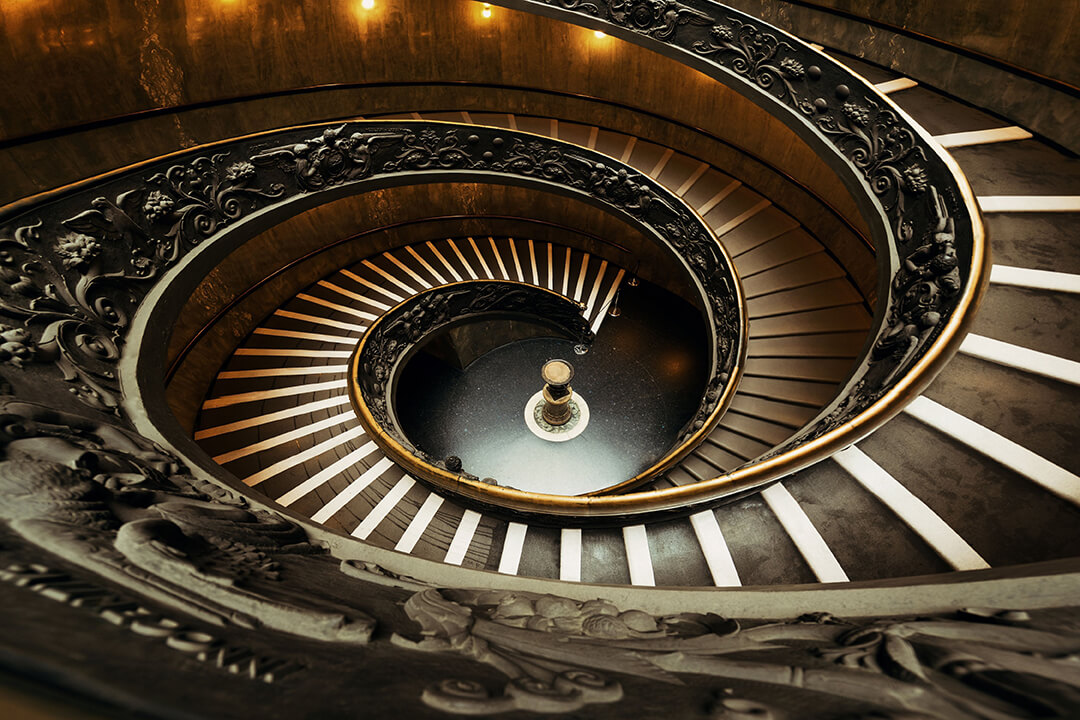
Vatican Museums staircases are not a single design. Some sections use ramps or gentle slopes; others, like the exit route past Giuseppe Momo’s spiral staircase, are stairs with no wheeled alternative built into the historic structure. Assume that any staircase you meet along the way is stairs only unless you can see a ramp running beside it. Don’t rely on finding a lift — they exist for accessibility needs but aren’t set up as a general stroller shortcut, and during peak hours they’re often reserved for wheelchair users.
This catches out families who assume the whole complex was renovated to a single modern standard. It wasn’t. A museum this old grew in stages over five centuries, and each stage kept its own floor levels. A ramp solving one step can still leave you facing three more a few metres later, so treat every staircase on its own terms rather than assuming the last one you found tells you anything about the next.
What parents actually do at the bottleneck
Most families we see solve this the same way: one adult carries the child in a soft carrier or on a hip for the fifteen or twenty minutes it takes to clear the Raphael Rooms and the Sistine Chapel, while the other folds and carries the stroller. If you’re travelling with two adults, this splits cleanly. Travelling solo with a toddler is harder, and a soft carrier that folds into a bag is worth packing even if you plan to push a stroller for most of the visit.
A second, simpler option: leave the stroller folded against a wall in a low-traffic side gallery just before the Raphael Rooms, carry the child through the chapel, and collect it on the way back out through the same corridor if your route allows it. This only works if you’re confident about doubling back, so check your ticket type before you commit to it.
Cloakroom and storage options
The museums have a cloakroom near the entrance where bulky items, including strollers, can usually be left for the duration of your visit. This removes the carrying problem entirely but means your child either walks the whole route or rides on a shoulder. For toddlers who tire quickly, weigh this against how long your ticket slot gives you — a private or early entrance tour moves faster than a general admission morning, which matters when you’re managing a tired child on foot.
Timing makes the difference more than gear does
An early entrance, ideally the first hour after opening, changes this whole calculation. Corridors that are impassable with a pram at midday are simply quieter at 8am, and the Sistine Chapel stairs are far easier to negotiate with a child on your hip when there isn’t a wall of tour groups behind you. If strollers are a real concern for your visit, booking the earliest available slot does more for you than any packing decision.
What to bring instead of a full-size stroller
A compact umbrella stroller that folds one-handed, or a soft structured carrier for children under three, covers almost every situation the museums throw at you. Skip the all-terrain or double strollers entirely — there is nowhere in the complex where the extra size earns its keep, and several places where it becomes the reason you’re stuck. Pack the carrier even if your child mostly walks; tired legs at the two-hour mark are common, and a carrier folds flat into a bag in a way a stroller never will.
Nappy changes and short breaks
There are baby-changing facilities near the main restrooms inside the complex, but they’re not on every corridor, so plan a stop before you commit to the Sistine Chapel run. Once you’re in the sequence of Raphael Rooms leading to the chapel, doubling back for a change is awkward and slow given the one-way crowd flow most days enforce. A quick check before that point costs you two minutes; needing one in the middle of it costs considerably more.
If you’re weighing up entrance times or want a slot with shorter queues before the Sistine Chapel crush builds, you can compare Vatican Museums tickets and pick an early entry that gives a stroller-carrying family more room to move.