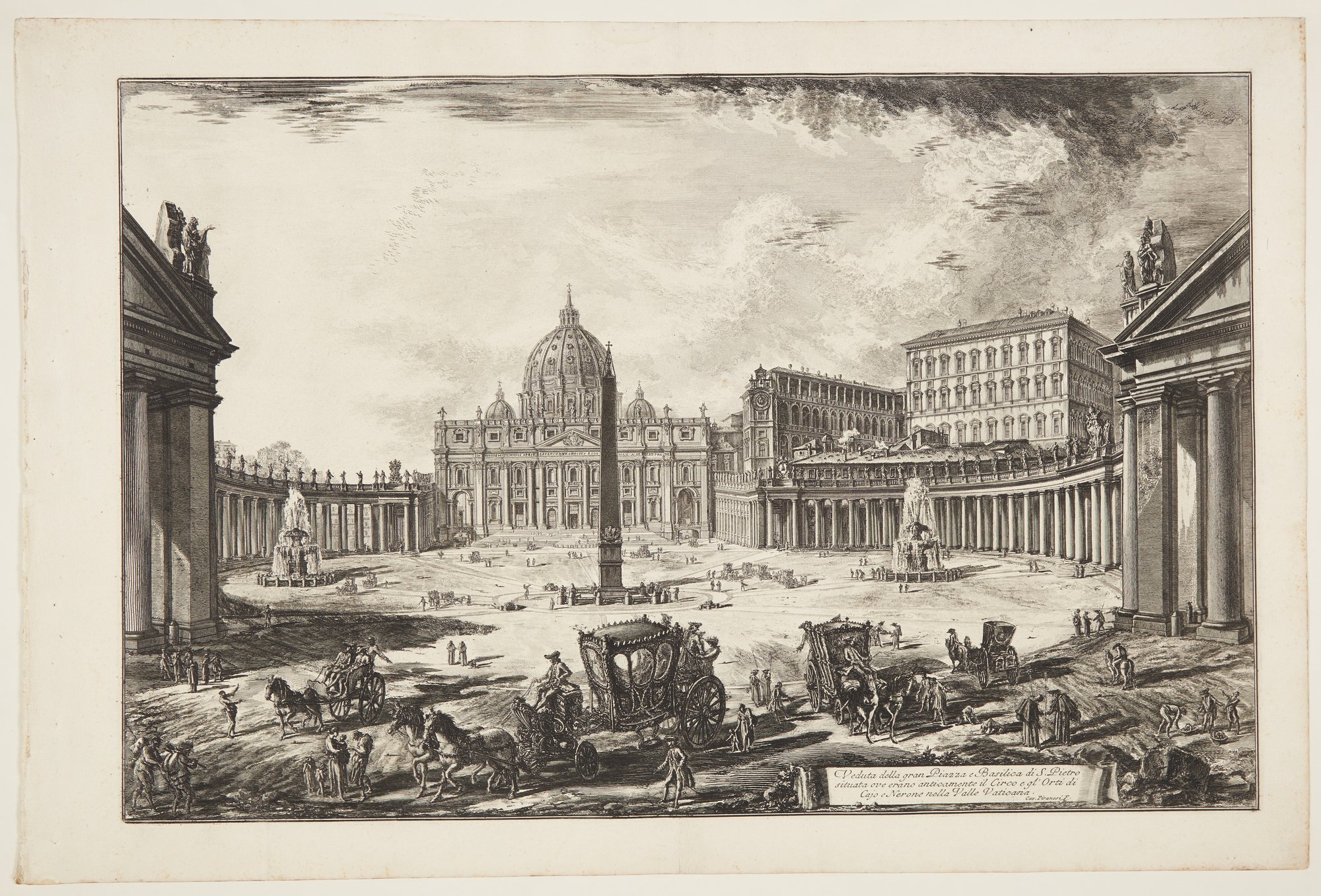
Stand at the center of St Peter’s Square and you are standing next to the oldest object in Vatican City by a margin of more than a thousand years. Everything around it, Bernini’s colonnade, Maderno’s facade, even Old St Peter’s before it, came later. The plain granite shaft at the heart of the piazza was already ancient when Julius Caesar was alive. It carries no cross carved by a Christian hand and no hieroglyph naming a pharaoh. It simply arrived, by way of a Roman emperor’s private racetrack, and stayed.
A monument with no name on it
The obelisk was quarried in Egypt, and tradition, going back to Pliny the Elder, places its origin at Heliopolis, the sun-worship center near modern Cairo. That much is generally accepted. What is unusual is what the stone doesn’t say. Every other standing Roman obelisk carries hieroglyphic inscriptions naming the pharaoh who raised it and the god it honored. This one is blank. As one Vatican reference site puts it, it is “the only one devoid of hieroglyphics, but with Latin inscriptions” — the Latin came fourteen centuries after the Egyptian carving would have. Whether the hieroglyphs were erased at some point or the obelisk was simply never inscribed is not something anyone can say with confidence. Either way, a granite giant that has stood in the middle of the Roman Catholic Church’s main square since the sixteenth century cannot be tied by name to the ruler who commissioned it.
The shaft alone runs a little over 25 metres. With its base, pedestal and the bronze cross now fixed to its tip, the whole assembly rises close to 40 metres above the paving stones. Weight is where the sources start to disagree: some put it at 320 tons, others closer to 330, and the figure of roughly 350 tons that gets repeated in guidebooks and on tour buses isn’t pinned down by any of the primary references. Call it somewhere in the 320-to-350-ton range and you’re on solid ground. Nobody has weighed it on a scale, obviously, and estimates this old carry a margin of error that no single number quite captures.
Caligula’s circus
The obelisk came to Rome under the emperor Caligula, sometime around 37 or 40 AD depending on which account you follow; the surviving records don’t let you pick one date over the other with certainty. What is clear is where it went once it arrived. Caligula erected it in the spina, the low central barrier of a private chariot-racing circus he built on the west bank of the Tiber, on ground that would later be called the Circus of Nero after Claudius completed it and Nero, who succeeded Claudius two reigns after Caligula, made it his own. That circus sat immediately beside a hillside necropolis, the same burial ground that, per longstanding tradition, held the grave of the apostle Peter.
For more than fifteen centuries the obelisk stood there, a few dozen metres from where Old St Peter’s Basilica would eventually rise beside it, watching over a track where, in the mid-first century, early Christians were reportedly executed as spectacle under Nero. It is a strange piece of continuity: a pagan monument to a sun god, planted next to a killing ground that a persecuted faith would later claim as sacred, and then adopted, centuries on, as that faith’s own centerpiece.
A pope decides to move it
By the 1580s the obelisk was still standing roughly where Caligula had put it, but it was no longer in front of anything that mattered. The new St Peter’s Basilica, under construction since 1506, was rising on a different axis, and the obelisk sat off to one side, disconnected from the piazza taking shape in front of the church. Pope Sixtus V decided to fix that. He wanted the obelisk, this ancient, weathered, un-Christian column, planted dead center of the new square, and he wanted it topped not with whatever pagan ornament it had originally carried but with a cross.
Moving a 300-plus-ton stone column 260 metres without breaking it, in an age before hydraulics or steel cable, was not a small engineering request. Sixtus put the job to the architect Domenico Fontana, working with the astronomer Ignazio Danti, and Fontana treated the whole operation as a demonstration piece as much as a construction job. He later published his own account of it, “Della transportatione dell’obelisco Vaticano e delle fabriche di Sisto V,” in 1590 — part technical record, part victory lap.
The machine that lifted a granite tower
The mechanics were, by any standard, audacious. A timber scaffold tower was built around the obelisk, tall enough to enclose the whole shaft, anchored by a forest of ropes running to capstans on the ground. One Wikipedia account of Fontana’s career sums up the scale bluntly: “This feat of engineering took the concerted effort of 800 men, 160 horses and countless pulleys and metres of rope.” Other sources give slightly different figures, closer to 900 men and 70-odd horses working somewhat fewer winches, and the discrepancy is a reminder that even a well-documented sixteenth-century project didn’t leave behind a single tidy number everyone agrees on. What both versions agree on is the order of magnitude: hundreds of men and well over a hundred horses, working in coordinated silence.
That silence was enforced by decree. Fontana knew that a shout at the wrong moment, a horse startled mid-pull, could snap a rope under a load of that mass and send the half-raised obelisk crashing. So a strict no-noise rule was imposed on the crowd gathered to watch, on pain of death by some accounts. The work of tipping the obelisk from horizontal to vertical and setting it onto its new pedestal ran across roughly four and a half months in 1586, following well over a year of preparatory groundwork.
“Water on the ropes!”
The most famous moment of the whole operation almost wasn’t in the plan at all. As the obelisk neared vertical, the hemp ropes, stretched to their limit under the strain, began to smoke and fray from friction. Tradition holds that a sailor from Bordighera named Benedetto Bresca broke the silence rule and shouted the warning that saved the job. As Wikipedia records it: “During the move, there was a famous cry by sailor Benedetto Bresca: Acqua alle funi (‘Water on the ropes!’), in order to avoid breaking the ropes that were about to give in under the great weight of the obelisk.” Water was thrown on the fraying ropes, they held, and the obelisk settled onto its base intact. As reward, Sixtus V is said to have granted Bresca’s hometown the privilege of supplying the palm fronds used at the Vatican for Palm Sunday each year, a custom the town of Bordighera still keeps.
Consecrating a pagan stone
Once the obelisk stood upright in the square, Sixtus V made sure nobody mistook it for a leftover relic of paganism left standing by accident. The pope had it stripped of an ancient bronze ball that had capped it since Roman times, an object popularly rumoured, without any real confirmation, to hold the ashes of Julius Caesar or the emperor Trajan. When it was finally opened, it was empty. That ball now sits in the Capitoline Museums, moved there in 1848. In its place, Sixtus V installed a bronze cross reputed to hold a fragment of the True Cross, and had the base carved with a formal Latin inscription consecrating the whole monument to Christianity.
“SIXTVS V PONT MAX / CRUCI INVICTAE / OBELISCVM VATICANVM / AB IMPVRA SVPERSTITIONE / EXPIATVM IVSTIVS / ET FELICIVS CONSECRAVIT / ANNO MDLXXXVI PONT II” — “Sixtus V, Pontifex Maximus, consecrated to the invincible cross the Vatican obelisk, expiated of impure superstition, in the year 1586, the second of his pontificate.” Later inspections of the cross reportedly turned up no actual relic fragment, despite indulgences granted at the time that implied one was there. It is worth treating as legend rather than settled fact, much like the ashes said to have once sat in the bronze ball below it.
Standing in the square today
None of this history announces itself when you walk into the square today. The obelisk simply stands there, plain grey granite against the theatrical curve of Bernini’s colonnade, doing double duty as a sundial gnomon: the paving around its base is marked with the signs of the zodiac and the hours, so its shadow tells the time on a clear day. Most visitors photograph it and move on toward the Basilica steps without registering that it predates the religion whose central square it now anchors by well over a thousand years.
If you time a Vatican Museums visit around it, the practical detail worth knowing is that “visitors must vacate exhibition areas 30 minutes before museum closing time,” per the museums’ own posted hours, so plan your obelisk stop for the square itself, which is open air and unticketed, rather than folding it into the last half hour of a museum visit. The Museums run 08:00 to 20:00 Monday to Saturday, with last entry at 18:00.
A guide who has walked past that obelisk hundreds of times can point out the zodiac markings, the Bresca inscription tucked into the base, and the line of sight Fontana engineered between it and the Basilica facade, details that are easy to miss on your own in a crowded square. If you want that context built into your visit rather than pieced together afterward, a guided Vatican tour is where it comes together, alongside the Museums and the Sistine Chapel the obelisk now quietly faces.