The Vatican Museums are more accessible than most first-time visitors expect, and the parts that are not accessible are more clearly bounded than most guides admit. Almost the entire standard route — Pinacoteca, Gallery of Maps, Raphael Rooms, and the Sistine Chapel itself — is reachable in a wheelchair via a mix of ramps, lifts, and one dedicated wheelchair lift into the Sistine. Free admission for visitors with certified disability plus a companion is Vatican policy in writing. Two things are not accessible and it is worth naming them up front: the Scavi Necropolis tour below St Peter’s, and the final 320 steps of the Dome climb above it.
Here is the specific route to plan for.
Free admission for visitors with certified disability
Verbatim from the Vatican Museums’ accessibility page: “The Vatican Museums offer free entry to all disabled visitors with certified invalidity of at least 67%. For visitors who are not self-sufficient, free entry is also extended to a companion.”
How it works in practice: “The free entry tickets are issued upon presentation of a certificate of invalidity at the Special Permits and/or Welcome Desk desks in the hall of the Museums.” This means the free tickets cannot be booked online — you present documentation in person on arrival. Foreign disability documentation (UK Blue Badge, EU parking permit, national disability ID stating the visitor is registered disabled) is generally accepted as meeting the Italian legal threshold, though the Vatican itself does not publish a foreign-document policy. Bring the original certificate, not a photocopy, and a photo ID matching the name on it.
Getting in: the entrance and welcome desk
Vatican Museums have a single public entrance on Viale Vaticano, and it is step-free via a ramp. On arrival, do not queue at the standard ticket lanes — go directly to the Special Permits or Welcome Desk in the entrance hall on the left as you clear security. The desk is staffed by Guard Corps (Vigilanza) who will issue the free tickets and hand you an orientation for the accessible route.
Ask specifically for the “visit itinerary without barriers,” which is the Vatican’s own name for its step-free path. Guard Corps staff will walk you through the first turn if you ask.
Wheelchairs on free loan
From the Museums’ accessibility page, again verbatim: “The Vatican Museums offer free wheelchair hire from the cloakroom (subject to availability).” The cloakroom sits just past security in the entrance hall.
Two practical notes:
- Free loan requires photo ID at the cloakroom and often a small deposit; both are returned on wheelchair return.
- “Subject to availability” is real. On peak summer mornings the loaner fleet is out by 09:30. Arrive early or bring your own.
Electric wheelchairs and mobility scooters
The Museums accept these, with one important caveat. Verbatim: “The Museums are accessible also to visitors on mobility scooters and with electric wheelchairs. However, due to space limitations, access or use are not permitted in some museum areas. In this case, the visitor will be invited to transfer to a traditional wheelchair, which may be hired free of charge in the entrance hall.”
The specific area where this comes up most often is the Sistine Chapel wheelchair lift, which has a footprint limit around 76 × 104 cm. If your scooter exceeds that, staff will hold it for you at the top of the lift and hand you a loaner for the Sistine visit itself.
Inside the Museums: the step-free route
The accessible visit follows the same one-way sequence as the standard tour, but via ramps and lifts:
- Ground-level entry hall → escalator (with lift alternative to the right) up to the atrium.
- Cortile della Pigna (the Pinecone Courtyard) is accessible at ground level from the atrium; the terraces around it are not, but you do not need them.
- Egyptian and Etruscan galleries are largely accessible with a few narrow sections; the standard route skips most anyway.
- Gallery of Maps: fully accessible along the 120 m corridor.
- Raphael Rooms: reached via a lift; all four rooms are step-free once inside.
- Sistine Chapel: accessed via a dedicated wheelchair lift near the standard entrance. Staff will escort you past the rope line. Standard practice on the way out is to return the same way and back-track to the Museums entrance; the group-only door into the St Peter’s narthex is not reliably available to individual wheelchair visitors (and recent reports say it now requires pre-registration and a fee even for tour groups). Plan to exit via Viale Vaticano and enter the Basilica separately via the piazza.
The Pinacoteca (picture gallery), which is a detour off the standard route, is also fully accessible and worth including if you have the time — it houses works by Raphael, Caravaggio, and Leonardo.
Bypassing the Momo staircase
Every non-accessible visitor exits via the famous double-helix staircase Giuseppe Momo designed in 1932. It has no accessible route down it — it is a spiral of steps. There is a signed lift alternative back to the entrance hall; any Guard Corps officer will walk you to it if you ask. Total detour: perhaps three minutes. You exit onto the same Viale Vaticano forecourt as everyone else.
St Peter’s Basilica: accessible entrance
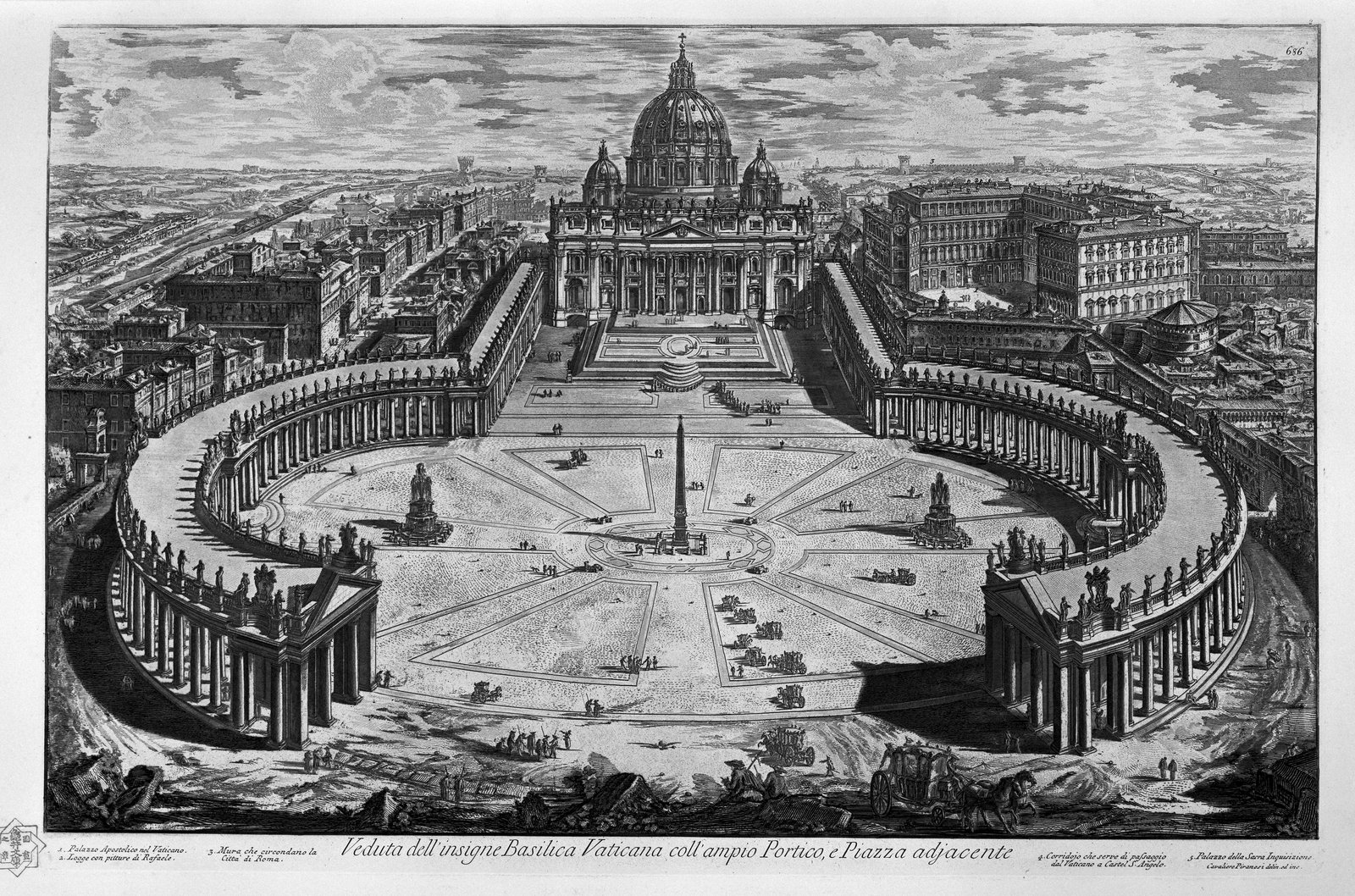
The Basilica’s own FAQ, verbatim: “St. Peter’s Basilica is accessible to visitors with disabilities through ramps and elevators.” The Vatican does not publish which side of the piazza the accessible entrance is on, but in practice it is under the right-hand (south) colonnade as you face the facade.
The route: a mechanised ramp handles the colonnade step-up, an elevator lifts you from the piazza level to the atrium level, and a further ramp inside the portico brings you into the church itself. Wheelchair visitors and one companion use a dedicated security screening lane that is separate from the main queue. On a busy summer midday the main queue can be 90 minutes; the accessible lane is closer to 15 to 30 minutes. It is a separate line, not a bypass of the metal detector — everyone clears security including wheelchair users.
Accessible toilets are by the cloakroom just after security. There are none deeper inside the church, so plan the visit accordingly.
Dome climb: accessible to the roof terrace only
From the Basilica’s Dome FAQ, verbatim: “Yes, a lift is available to take you up to the terrace level, from where you must continue on foot by climbing 320 steps.” And: “There are 551 steps in total to reach the top of the Dome. Using the lift, it is reduced to 320 steps.”
Which means: a wheelchair visitor can take the elevator to the roof terrace itself and see the exterior view of Michelangelo’s cupola from the roof gallery, but cannot climb the further spiral to the lantern. The Vatican itself flags this: “The ascent to the Dome is physically demanding due to the presence of steps, narrow spaces and steep inclines. The visit is not recommended for people with heart or respiratory conditions, vertigo, claustrophobia or mobility difficulties, or for pregnant women.” The roof terrace itself is broadly flat and worth the ticket price for the view alone.
The two things that are not accessible
Named up front so nothing surprises you on the day:
- The Vatican Necropolis (Scavi) tour under the Basilica. Verbatim from the official Necropolis FAQ: “No, unfortunately, the Vatican Necropolis is not accessible for people with disabilities due to steps at both the entrance and exit, as well as the uneven ancient pavement dating back to the first three centuries.” Same page also warns: “The underground Necropolis may have altered temperature and humidity conditions. Visitors with specific physical conditions or claustrophobia are advised against visiting.”
- The Papal Grottoes (Grotte Vaticane, the free crypt below the Basilica floor). The Fabbrica does not publish a specific accessibility statement for the Grottoes. In practice access is inconsistent — the direct staircase from the Basilica floor is step-only; there is a side courtyard route with ramps but it is not always available. Treat as not reliably accessible: ask a Vigilanza officer on the day, and if the Grottoes are closed to wheelchairs that day, the papal tomb sight-lines are readable from the Confessio balustrade on the Basilica floor.
Blue-badge parking around the Vatican
No public parking exists inside Vatican City itself. Rome city rules govern the streets immediately outside. Holders of an Italian CUDE (Contrassegno Unico Disabili Europeo) or any equivalent EU or UK Blue Badge may:
- Park free in yellow-striped disabled bays.
- Park free in blue-striped paid bays when yellow bays are full.
- Enter ZTLs (limited-traffic zones) provided the badge holder is in the vehicle and the badge visibly displayed.
Foreign (non-Italian) Blue Badge holders should register their plate and badge with Roma Servizi per la Mobilità (romamobilita.it) before entering the ZTL, or an automatic camera will issue a fine. The closest paid-parking streets to the Museums (Via Leone IV and Via Sebastiano Veniero) generally include some yellow-striped disabled bays; verify current bay locations on Roma Mobilità’s interactive map before your trip. For the Basilica, Via della Conciliazione is the main approach street and disabled bays exist somewhere along it and in the Borgo side streets, but exact locations shift; check Roma Mobilità’s interactive map before your trip. Verify the specific location on Roma Mobilità’s interactive map before your trip.
What to bring, and what to ask for
- Original disability certificate or Blue Badge, plus photo ID matching the name on it.
- Arrival before 09:00 if you want a loaner wheelchair — they run out on peak mornings.
- Ask for the “visit itinerary without barriers” at the Welcome Desk — that is the Vatican’s own name for the accessible route.
- Dress code applies as normally: shoulders and knees covered at all three sites (Museums, Basilica, Sistine); hats off inside. For details, see our Vatican dress code guide.
For the standard 08:00 ticket that gets you into the Museums early (before the accessible lift queue lengthens), our Vatican Museums and Sistine Chapel skip-the-line ticket is the standard route. Note that free-admission tickets for visitors with certified disability are issued in person at the Welcome Desk and cannot be pre-booked online.