
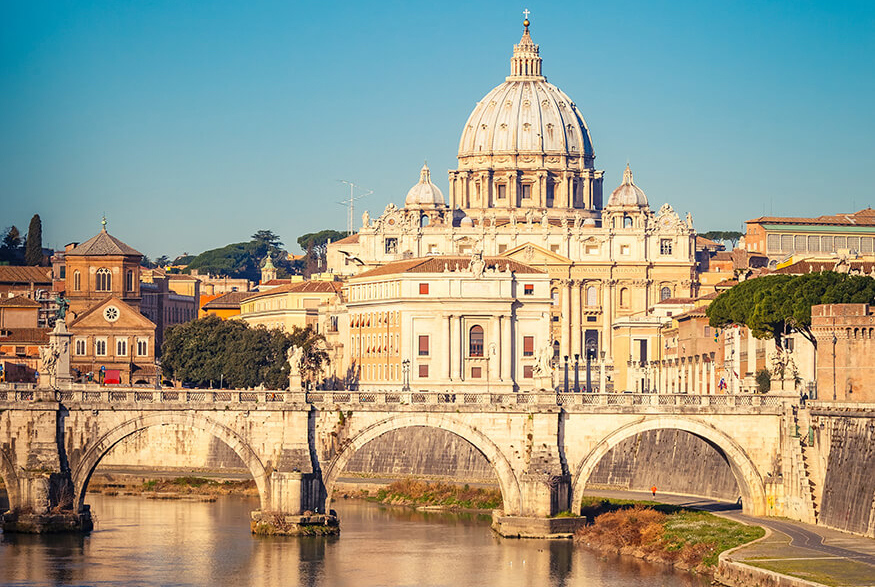
Every visitor who queues in St Peter’s Square eventually walks through one of the basilica’s great bronze doors. Almost none of them notice the smaller, working entrance tucked into the left aisle, under the monument to Pius VIII. That door leads to the sacristy: the part of the basilica complex built not for crowds but for the clergy who run it, and for the treasury of relics and vestments kept behind it. It has its own history, its own architecture, and a set of rules that have nothing to do with the ones printed on your ticket.
Where the Door Actually Is
You will not find the sacristy entrance by scanning the facade from the square. It sits inside the basilica itself. In the left aisle, under the monument of Pius VIII, is the entrance to the sacristy, and from there the space opens into a main sacristy that is octagonal, decorated with eight columns brought from Hadrian’s Villa in Tivoli. From that octagonal room, ten further rooms fan out to house the Treasury of St Peter’s. None of this is visible from outside. You walk past a monument most people photograph without reading, and the working half of the basilica begins on the other side of it.
A Building Commissioned in 1776
The structure standing there today is not part of the original Renaissance basilica. In 1776, Pope Pius VI commissioned the architect Carlo Marchionni to design the current sacristy building. That result stands on the south flank of the basilica, inside Vatican City proper — a distinct addition grafted onto Bramante and Michelangelo’s church nearly two centuries after the dome went up. It reads less like an afterthought and more like a second, smaller building doing a very different job: storage, vesting, and administration, rather than worship on the grand scale the nave was built for.
What’s Actually Behind the Door
Marchionni’s building holds three distinct sacristies: the Sacristy of the Canons, the Sacristy of the Beneficiaries, and the Common Sacristy. These are functional rooms, used by the clergy attached to the basilica for exactly what their names suggest, not spaces designed with a tour group in mind. A separate part of the same structure houses the Treasury of St Peter’s, the collection of liturgical objects, vestments, and relics tied to the basilica’s history. It is worth being clear-eyed about this: most of the building is administrative and liturgical space that happens to be old and well-built, not a gallery. Of the whole building, only the Treasury section was ever meant for public eyes.
Treasury Museum, Currently Closed
The Sacristy of the Beneficiaries today forms part of the museum route through the Treasury, a route established in 1975 by Pope Paul VI. As of this writing, though, that route is not open. The basilica’s own site states plainly that due to the continuation of work on the new layout, the Treasury Museum will be temporarily closed. No reopening date has been announced. If you were planning your visit specifically around the Treasury, hold off on that part of the plan; the rest of the basilica is unaffected, and visitors can still enter the basilica without a reservation, from the ordinary entrance in St Peter’s Square. Older guides that quote a Treasury ticket price or a set of seasonal hours are describing a version of the museum that, for now, does not exist. Skip those numbers until the Fabbrica publishes new ones.
Not the Same as the Main Doors
It helps to separate two things that get conflated: the sacristy door and the basilica’s public entrances. Access to the basilica begins with security checks run by the Italian State Police, and those checkpoints sit in the right hemicycle of St Peter’s Square, facing the church, with at least four other gates on the same side handling the queue. That is the route every visitor uses, sacristy-bound or not. That door under the Pius VIII monument is not a separate way in from outside; it is an internal threshold, reached only after you have already cleared security and walked into the nave. Think of it less as another entrance to the complex and more as a door between two different jobs the same building does.
Whose Jurisdiction This Is
The basilica and its sacristy fall under the Fabbrica di San Pietro, the Vatican body founded in 1523 by Pope Clement VII. Its remit covers the conservation and maintenance of St Peter’s Basilica and exercising vigilance over its sacred character and the organisation of visitors. That is a different chain of command from the Vatican Museums next door, which run the picture galleries and the Sistine Chapel under their own administration. Mauro Gambetti has served as archpriest of the basilica, and president of the Fabbrica, since February 2021. If a rule about the sacristy or the Treasury seems to contradict something you read about the Museums, that is usually why: two institutions, two sets of hours, two sets of decisions.
Practical Notes for Visitors
From 1 June, the basilica opens from 7:00 am to 8:00 pm. The Vatican Museums run on a separate schedule entirely: Monday to Saturday from 8:00 am to 8:00 pm, with last entry at 6:00 pm, and on the last Sunday of the month from 9:00 am to 2:00 pm, with last entry at 12:30 pm and free admission. The Museums close on ordinary Sundays and on a long list of Vatican holidays through the year. None of these hours currently apply to the Treasury, which stays shut regardless of what time you arrive. Build your morning around the basilica and, if it interests you, the Vatican Museums proper, and treat any Treasury visit as a bonus to check for on the day rather than something to plan around.
If you would rather have someone else handle the queueing and the timing while you focus on the building itself, our St Peter’s Basilica tickets and tours cover the basilica entry end to end, sacristy closures and all.