
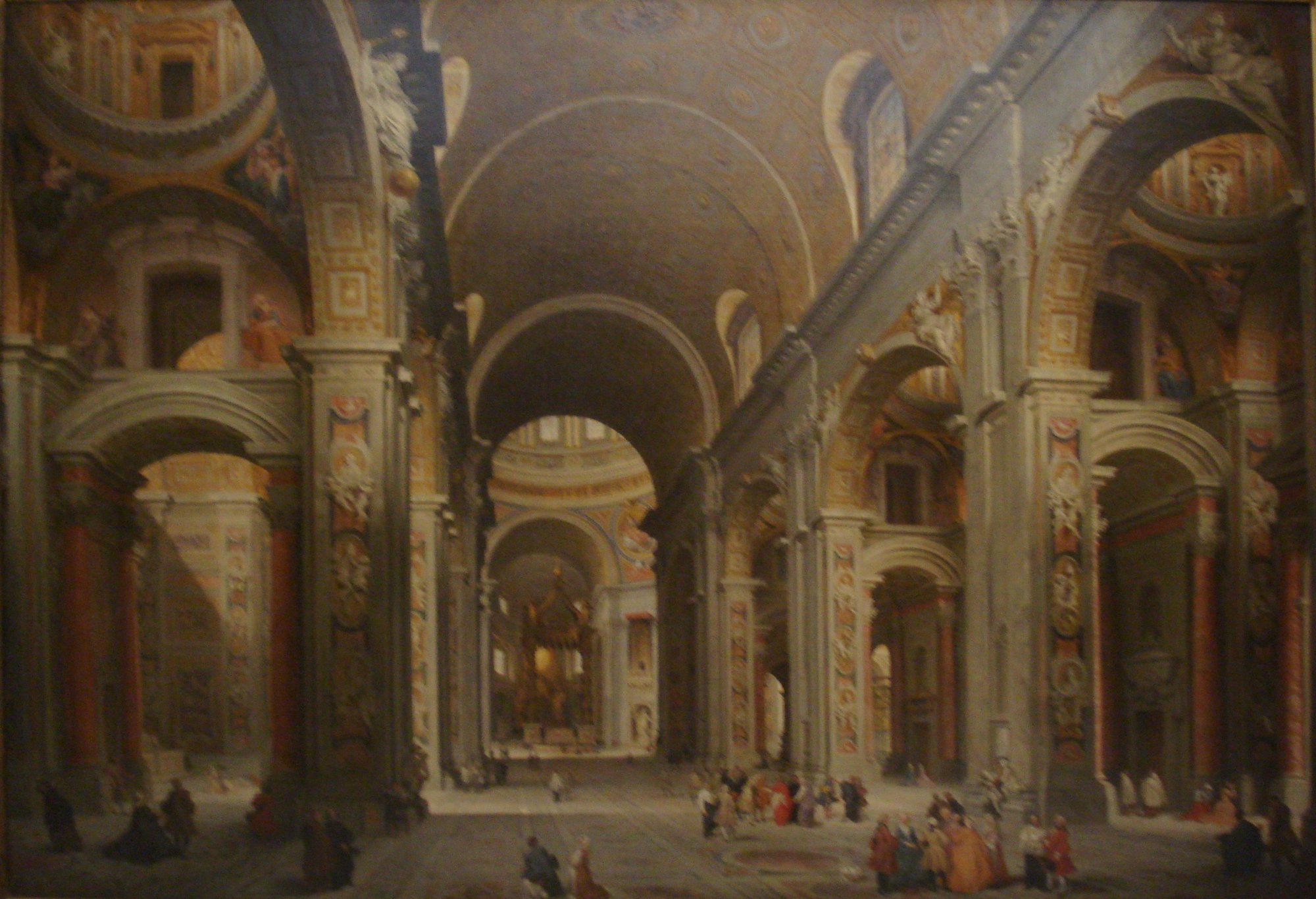
Stand under Michelangelo’s dome and look at the four enormous piers holding it up. Each one has a niche the size of a small chapel, and in each niche stands a marble giant roughly four and a half metres tall. Most visitors photograph the statues and move on toward the Baldachin or the Pieta. Few realise that each of these four figures marks a specific relic, tucked into a hidden loggia carved directly into the stone above the statue’s head.
One pier, one relic, one giant statue
The pairing is deliberate and it has stayed fixed since the 1600s. As Wikipedia’s entry on the basilica puts it: “Set into the niches of the dome’s four gargantuan support piers are colossal statues representing the four major holy relics believed to be held in the basilica: St. Longinus with his spear, St. Helena with the True Cross, St. Veronica with her veil, and St. Andrew, whose skull was possessed by the Vatican until the 20th century.”
Four sculptors, all working in the same decade, produced the figures: Gian Lorenzo Bernini carved Longinus, Andrea Bolgi carved Helena, Francesco Mochi carved Veronica, and François Duquesnoy carved Andrew. Bernini’s statue was the anchor of the scheme and the one that finished first, in 1638. It “sits in the north-eastern niche in the crossing of St. Peter’s Basilica,” diagonally opposite Helena, with Veronica and Andrew filling the remaining two corners.
St Longinus and the Holy Lance
Bernini’s Longinus grips the spear that, according to tradition, pierced the side of Christ on the cross. His arms are flung wide and his robes seem to catch a gust of wind that isn’t there, one of Bernini’s signature tricks for making static stone feel like a frozen instant.
The relic itself has a stranger history than the statue. In 1492, Sultan Bayezid II sent a lance to Pope Innocent VIII, reportedly to pressure the pope into keeping Bayezid’s rival brother Cem in captivity. Rome was not the only city claiming a Holy Lance; competing versions existed in Paris, Nuremberg and Armenia, and doubts about authenticity go back to the object’s arrival. Whatever its true origin, the Vatican’s lance “has never since left Rome, and its resting place is at Saint Peter’s Basilica in a loggia carved into the pillar above the statue of Saint Longinus.”
St Helena and the True Cross
Across the crossing from Longinus stands Bolgi’s Helena, mother of the emperor Constantine and, by tradition, the woman who located the True Cross in Jerusalem in the fourth century. She holds a large cross and looks upward, completed between 1629 and 1639. The pier behind her is understood to hold a fragment of the cross she is credited with finding, though the exact size of the fragment and the precise chain of custody that brought it to this specific pier are not details we could confirm from primary sources, so we won’t invent them here.
St Veronica and the veil nobody quite sees
Mochi’s Veronica is the most dynamic of the four, caught mid-stride with the cloth billowing in her hands as though she is running to show it to someone just out of frame. Her relic is the veil said to bear the imprint of Christ’s face after she wiped it on the road to Calvary. It rests in “the chapel that lies behind the balcony in the southwest pier supporting the dome,” roughly above the statue.
Once a year, on Passion Sunday, “three canons carry the heavy frame out on the balcony above the statue of St. Veronica holding the veil.” Anyone hoping for a clear glimpse of a face will be disappointed. Even from that balcony, “from this limited view no image is discernible and it is only possible to see the shape of the inner frame.” A nineteenth-century observer who examined the cloth up close described only “two large, faint rust-brown stains,” with any facial features “so vaguely drawn as to be nearly impossible” to make out. Wikipedia’s summary is blunt about it: “the provenance of this image is uncertain.” A 2025 display took place on 6 April; we couldn’t confirm the exact 2026 date at time of writing, so check the basilica’s own calendar closer to Lent if that ritual is what draws you.
St Andrew, the pier with no relic left inside it
Duquesnoy’s Andrew leans on the diagonal cross associated with his martyrdom, sculpted between 1629 and 1633 and installed in its niche by 1640. For centuries the pier behind him held the apostle’s skull, given to Pope Pius II in the fifteenth century and, in Wikipedia’s words, “enshrined in one of the four central piers of St. Peter’s Basilica in the Vatican.”
It isn’t there anymore. “In September 1964, Pope Paul VI, as a gesture of goodwill toward the Greek Orthodox Church, ordered that the one relic of Saint Andrew held in Vatican City be returned to Patras.” The handover was formal: “Cardinal Augustin Bea, head of the Vatican’s Dicastery for Promoting Christian Unity, led a delegation that presented the skull to Bishop Constantine of Patras on 24 September 1964.” The statue still stands in its niche and the pier is still one of the four naming the crossing, but the relic that gave it meaning has been in Greece for six decades now. What, if anything, occupies that loggia today isn’t something we found documented, so we’re leaving it an open question rather than guessing.
What you can actually see from the nave floor
None of the four loggias is open to casual visitors as far as we could confirm, so the statues do most of the storytelling. Walk the full circuit of the crossing and you’ll notice how each figure’s pose points toward its relic: Longinus reaching outward with the spear, Helena raising the cross skyward, Veronica running with the veil, Andrew resting against his X-shaped cross. Bernini’s Baldachin sits in the middle of the four piers, so the whole arrangement is visible in one sweep if you stand roughly beneath the dome and turn slowly.
If you’re planning around opening times, the basilica runs from 7am to 8pm from 1 June, though off-season hours outside that window weren’t separately confirmed on the official site, so it’s worth checking before an early or late visit. The dome climb itself keeps its own seasonal schedule, currently 7:30am to 5pm through late March 2026 and shifting to 7am–6pm from late March. None of this touches the Vatican Museums’ hours, which run Monday to Saturday from 8am to 8pm with final entry at 6pm, a separate ticket and a separate queue entirely.
A detail worth pausing for
Most people walk past all four piers on their way to somewhere else, usually the Pieta or the tomb beneath the altar. Knowing what’s supposedly inside changes the pace of that walk. You start reading the statues as labels rather than decoration, and the empty loggia behind Andrew becomes a small footnote in twentieth-century diplomacy rather than just another niche.
If you’d rather have someone point out the piers, the loggias and the rest of the basilica’s layout in person, our St Peter’s Basilica tickets and guided tours cover the crossing along with the dome, the grottoes and the Pieta on the same visit.