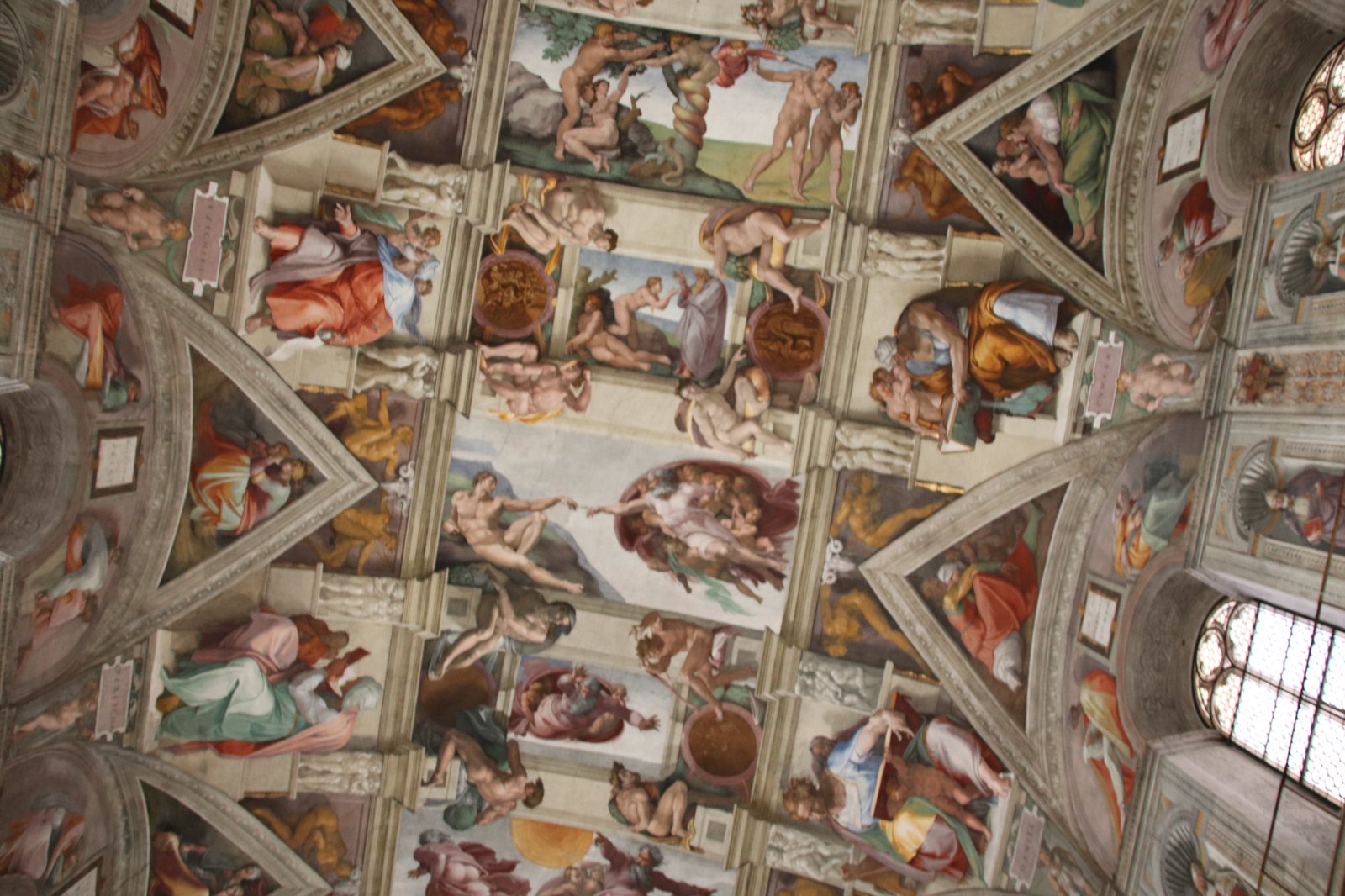
You come out of the Gallery of Maps, pass through the Raphael Rooms, turn the last corner, and the room opens up in front of you: grey stone walls, a low wooden bench running along the edges, and Michelangelo’s ceiling somewhere above the noise. Within about ten seconds someone’s phone comes up, and within about fifteen a guard barks “No photo!” loud enough to carry over four hundred whispering visitors. If you’ve read anything about Vatican rules beforehand, this is the point where the confusion usually hits: didn’t the ban only cover flash?
Flash Photography and All Photography Are Two Different Rules
Most Vatican Museums galleries allow photography as long as you keep the flash off. Walk through the Raphael Rooms or the Gallery of Tapestries with your phone out and nobody will stop you, provided the flash stays disabled. That’s the rule most guidebooks describe, and it’s accurate everywhere except one room.
Inside the Chapel, that flash exemption disappears entirely. Photography of any kind, flash or no flash, phone or camera, is off limits inside. One visitor-information site puts it bluntly: “Photography is strictly and absolutely prohibited inside the Sistine Chapel.” The same source separately notes the museum-wide flash rule: “Flash photography is banned in all galleries.” A second site describing the same visit reports that “photos and video are strictly forbidden inside,” while flash elsewhere is treated as its own, narrower issue: “Flash: banned everywhere. Turn off auto-flash on your phone.” Worth flagging: neither the Vatican Museums’ own site nor its official visitor pages spell this out in writing anywhere we could find, so treat the Sistine-specific total ban as consistently reported by independent visitor guides rather than something quoted from museivaticani.va directly.
That distinction is the whole source of confusion. Somewhere between “no flash” and “no photos in the Chapel,” the two rules get merged in people’s heads, and visitors walk in assuming the same flash-only exemption applies. It doesn’t.
Why Photography Is Banned At All: A Broadcast-Rights Deal
The ban isn’t about crowd control or artwork fragility in the way most museum photo rules are. It traces back to money, and specifically to how the ceiling got cleaned. By the late 1970s, centuries of candle soot, varnish and grime had darkened Michelangelo’s colours so badly that generations of viewers had no real idea what the original palette looked like. In 1980 the Vatican committed to a full restoration, and it needed a funding partner.
According to Wikipedia’s account of the restoration: “In 1980, the decision to undertake a total restoration was taken. Nippon Television Network Corporation of Japan provided major funding of US$4.2 million in exchange for the exclusive reproduction rights.” In return for underwriting the work, the Japanese broadcaster secured something unusual for a museum deal: a monopoly on images of the result. That same source states plainly that “a single company, Nippon Television Network Corporation, had sole photography rights.”
A separate Wikipedia article on the broadcaster gives a different figure for the same project: “Nippon TV participated in cultural events, such as the restoration of the Sistine Chapel ceiling in 1984, which took 13 years and cost to ¥2.4 billion; it also held two special exhibitions at the Vatican Museums.” Whether that yen figure describes the full restoration cost or something distinct from Nippon’s own contribution isn’t reconciled between the two accounts, and neither is a number to hang your hat on beyond “several million dollars, sourced from a Japanese broadcaster in exchange for exclusive rights.”
Did the Exclusivity Ever Actually Expire?
The restoration ran section by section over more than a decade, and the Last Judgement, the last major piece, was finished in 1994. Some reporting since then has suggested Nippon’s exclusive photo rights on each section lapsed three years after that section’s completion, which would put the Last Judgement’s window closing around 1997. That claim comes from a single secondary source rather than a document we could verify directly, so hold it loosely. The same reporting attributes a further claim to the broadcaster itself, that the ban “did not apply to ‘ordinary tourists.’” Interesting if true, but again unverified on a primary record, and it clearly isn’t how the rule is enforced today: general visitors are the exact group being told to put their phones away.
What is verifiable is simpler. Whatever the original commercial arrangement was and whenever it technically ended, the Vatican Museums kept the no-photography policy in the Chapel long after Nippon TV’s exclusivity would have expired. At this point it functions as house policy for preserving the atmosphere of the room and controlling how images of the ceiling circulate, independent of the original broadcast deal.
The One Room Even the Conclave Couldn’t Photograph
It’s worth remembering what else this room does. Every conclave since 1878 has been held inside the Sistine Chapel — it hosted the first one in 1492 too, though a handful of elections in between were held elsewhere, including Venice and Rome’s Quirinal Palace — cardinals sealed in under Michelangelo’s ceiling with every phone and camera confiscated at the door. When Pope Leo XIV was elected in May 2025, the world found out the same way it always does: not through a photo, but through smoke. “White smoke appeared from the Sistine Chapel at 18:07 CEST,” as Wikipedia’s account of the election puts it, “informing the world that a new pope had been chosen.” No camera has ever been allowed to record what actually happens on the floor of that room during a vote. A no-photography rule for tourists looks almost gentle by comparison.
How Guards Actually Enforce It
In practice, enforcement is human and immediate rather than automated. Guards are stationed around the Chapel’s perimeter watching for phones and cameras coming out, and they call out the moment they spot one. One visitor-guide site describes it this way: “Guards are stationed throughout the Sistine Chapel and actively enforce the no-photography rule. Cameras and phones are spotted immediately. Violations are called out loudly by guards, which — in the required silence of the Chapel — is conspicuous and uncomfortable.” That last part matters more than it sounds. The Chapel enforces silence as well as no photography, so a guard’s shout tends to draw every head in the room toward whoever triggered it.
What happens next is usually mundane. The same source notes: “You will be asked to delete the photo. Persistent or deliberate violation can result in being removed from the Chapel and, in serious cases, from the Museums.” Delete-on-the-spot is the routine outcome for a first offence. One other source claims guards may confiscate a memory card in extreme cases, but that’s a single, unverified claim and not something we’d treat as standard policy, or something you should expect on an ordinary visit.
None of this is subtle. Guards aren’t scanning for hidden phones or reviewing footage after the fact. If you keep your phone in your pocket and your eyes on the ceiling, you won’t hear your name called across the room.
What to Do With Your Camera Instead
The practical answer is to front-load your photography. The approach corridors, the Gallery of Maps with its painted regional charts, and the Raphael Rooms directly before the Chapel all allow non-flash photos, so that’s where to get your Vatican Museums shots. Inside the Chapel itself, put the phone away entirely rather than trying to sneak a shot from the hip; you’ll get a firmer scolding for a bad blurry photo than most people get for simply looking around.
If you want a genuine image of the ceiling for reference or a keepsake, the Vatican’s own bookshop sells official photo books of the restored frescoes, and postcards are sold at several points along the museum route. Both give you a far sharper image than a phone held above your head in a crowd ever will, without the risk of a guard’s raised voice following you out the door.
Booking Ahead Helps More Than a Camera Would
Arriving with a pre-booked, timed entry does more for your actual experience of the Chapel than any photo could. It cuts the queue outside St Peter’s Square and gets you into the room with a little more room to breathe before the afternoon crowds build. If you’re planning the visit, our Sistine Chapel tickets page lays out entry times and what else the ticket covers, so you can spend less time worrying about queues and more time actually looking up.