
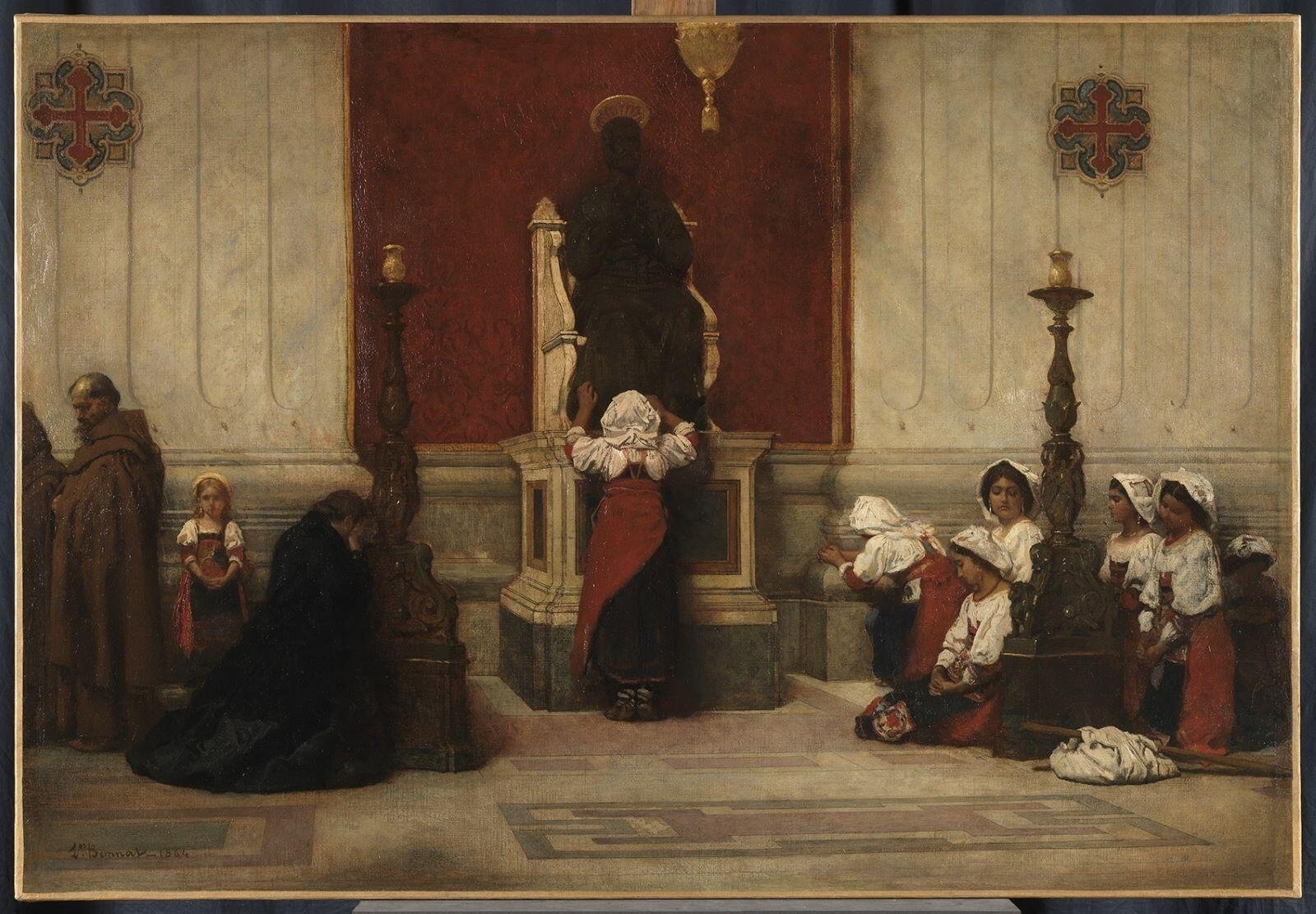
Stand near the crossing of St Peter’s Basilica for ten minutes and you will watch a queue form without anyone organising it. A visitor steps up to a seated bronze figure, reaches for its right foot, presses a hand or a pair of lips to the metal, and moves on. The next person is already waiting. Look closely at that foot and you will notice something odd: the toes are not quite toe-shaped any more. They have been smoothed into soft, rounded lumps, the bronze polished bright by contact in a way the rest of the statue never sees.
A gesture that predates the tour groups
This is not a habit that started with modern tourism. According to stpetersbasilica.info, “in the Middle Ages pilgrims who reached Rome, touched and kissed the foot of the statue and prayed to St. Peter asking that he be merciful and open the gates of heaven for them if they died during the pilgrimage.” A journey to Rome in that period was slow and rarely cheap, and it carried real risk along the way. Plague took travellers. So did bandits, and so did roads that simply gave out underfoot. Touching the foot of the man holding the keys to heaven was not a photo opportunity. It was insurance, offered in the one currency a medieval traveller actually had: physical contact with something holy.
That gesture never stopped. It simply picked up momentum, generation after generation, until it became one of the most reliable rituals inside the basilica. As stpetersbasilica.info puts it plainly: “Pilgrims who come to the Basilica traditionally touch and kiss its foot, so that it is literally worn thin.”
Whose statue is it, really?
The seated figure everyone reaches for shows St Peter enthroned, right hand raised in blessing, left hand holding the keys. For centuries it has been credited to the sculptor and architect Arnolfo di Cambio, active in Rome and Florence in the late 1200s, with a traditional dating of around 1300. The attribution rests partly on style: the “‘antique’ modules that are present, such as the so-called ‘snail’ curls of the hair and the beard are found in famous Arnolfian works,” notes stpetersbasilica.info.
But the dating is genuinely contested, not just a footnote. The same source records that “some scholars have attributed it to Arnolfo di Cambio (1245–1302), but others believe that it is a V century casting” — meaning a bronze roughly eight centuries older than the Arnolfo attribution would suggest. Nobody has settled the question with certainty. What both camps agree on is simpler and more human: whoever cast it, people have been touching that same right foot for a very long time.
Why bronze wears the way it does
Bronze is not soft. It is an alloy of copper and tin, hard enough to hold a sharp casting edge for centuries indoors. That is exactly why the wear on the statue’s foot is worth pausing over: it is not decay, corrosion, or age doing the work. It is friction, applied by an enormous number of hands and lips, spread across an enormous number of years.
Skin oils and the mild abrasion of repeated contact remove a few atoms of metal at a time — an amount too small to measure in any single touch, but cumulative across millions of visits. The basilica itself confirms the outcome rather than the mechanism: “On this ancient bronze statue, St. Peter has his right toes worn down by centuries of pilgrims who traditionally touch the foot.” A second passage describes the same effect from a different angle: “His right foot protrudes from the previously mentioned base, which is worn by the kisses of the devout.” The base is worn too, not only the toes — a detail that tells you the contact point has shifted slightly over the centuries as the crowd around it changed.
Why the right foot specifically
The statue sits with its right foot extended slightly forward, protruding from the base in a way that puts it within easy reach of anyone standing beside the pedestal. That physical accessibility, more than any specific instruction, is probably why the right foot became the target rather than the hand or the robe. A gesture repeated by enough people settles into the path of least resistance — the part of the sculpture a person can reach without climbing over a barrier or asking permission.
Finding it inside the basilica
The statue stands inside St Peter’s Basilica itself, near enough to the main flow of visitor traffic that almost nobody who does a full circuit of the interior misses it. You do not need a guide to find it; you need only follow the small, constant cluster of people pausing to touch something at knee height. If you arrive early, before the midday crowds build, you can usually get close enough to see the wear pattern clearly rather than glimpsing it over someone’s shoulder.
Planning the visit
From 1 June, the basilica opens “from 7.00 am to 8:00 pm,” which gives a long window to time your visit around quieter hours — mid-morning on a weekday tends to be calmer than the early afternoon rush. If you are combining the basilica with the Vatican Museums on the same day, note that the Museums run “08.00 a.m. – 08.00 p.m.” Monday to Saturday, with the last entry two hours before closing, and that “visitors are required to leave the halls 30 minutes before museum closing time.” The Museums close on ordinary Sundays, opening instead on the last Sunday of the month for free entry between 9am and 2pm, so build your itinerary around that pattern rather than around a normal weekend.
Basilica entry itself is free, though guided access and skip-the-line arrangements make the visit considerably smoother during the busiest months of the year, when the queue outside can run long before the doors even open.
Standing before that bronze foot, worn smooth by a thousand years of the same small gesture, is one of those moments where St Peter’s stops feeling like a monument and starts feeling like a place people have actually lived their faith in, one touch at a time. If you want to see it for yourself without losing half the morning to a queue, our St Peter’s Basilica tickets and tours are a straightforward way to get inside and find it.