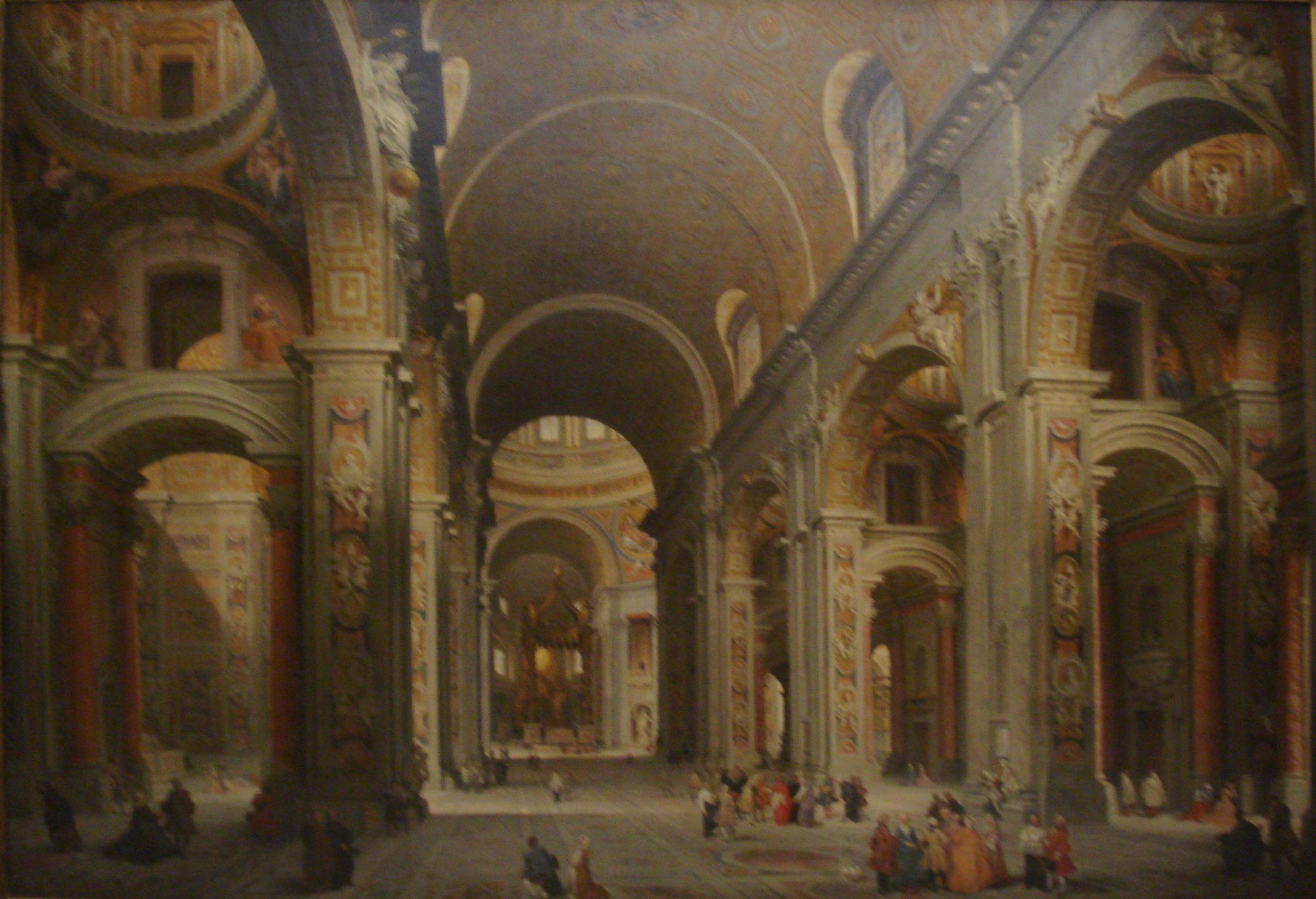
A guide stops the group about ten metres short of a gilded iron gate, waves a hand toward it, and keeps walking. No one in the group gets a photo of what’s behind it. That gate, a few chapels down the right aisle, past the Pieta, is the Chapel of the Blessed Sacrament, and it is the one part of the basilica you cannot simply wander through with a tour group. You can look. Entry is a different matter.
A gate Borromini designed, not Bernini
It is easy to assume the wrought-iron grille sealing the chapel is Bernini’s work, since almost everything else gilded in this building is. It isn’t. Francesco Borromini designed the gate, an architect better known for the twisting geometry of San Carlo alle Quattro Fontane and for his lifelong professional rivalry with Bernini. His grille carries bronze decorative elements, including the coat of arms of Pope Urban VIII, and it does a job a velvet rope elsewhere in the basilica does not: it physically closes the space to casual foot traffic.
Bernini’s tabernacle, borrowed from Bramante
Bernini’s contribution sits inside the gate rather than across it. The gilded bronze tabernacle, or ciborium, on the chapel’s altar was designed and executed by Gian Lorenzo Bernini between 1673 and 1674, near the end of his career. He modelled it on Donato Bramante’s Tempietto di San Pietro in Montorio, the small circular temple on the Janiculum hill that marks the traditional site of St Peter’s crucifixion. Shrinking a freestanding building into a tabernacle small enough to sit on an altar was a deliberate echo, not an accident of scale. Bernini was quoting the beginning of the story on an object built for its most sacred moment.
The one painting in a basilica of mosaics
Nearly everything that looks like a painting inside St Peter’s is a mosaic copy, reproduced in tiny coloured tesserae because oil paint doesn’t survive the basilica’s damp for long. This chapel is the exception. Its altarpiece, the Holy Trinity by Pietro da Cortona, painted between 1628 and 1631, is the only oil-on-canvas painting left in the entire building. On the right-hand altar wall hangs a mosaic copy of Domenichino’s Ecstasy of Saint Francis, which follows the basilica’s usual convention instead. Stand in front of both and you can see the difference in surface immediately: one has the sheen of pigment, the other the faint grid of glass tile.
“Only those who wish to pray may enter”
A sign posted at the chapel spells out the rule in plain terms: “Only those who wish to pray may enter.” The Blessed Sacrament is “exposed here for the continuous adoration of the faithful,” which is why the space functions less like a museum room and more like a working chapel that happens to sit inside one of the most visited buildings on earth. One visitor’s account describes it as a space that “is roped off, and behind a curtain,” with an attendant nearby to manage who comes in, particularly when the basilica gets busy. No posted timetable of adoration hours turned up in our research; the continuous-adoration wording is the closest thing to an official schedule.
Why groups get steered around it
Licensed guides don’t take tour groups through the Blessed Sacrament chapel, and the reason tracks the signage rather than any published Vatican policy on group routing. A chapel reserved for people who came to pray isn’t a stop on an itinerary built for forty people with earpieces and a running commentary. Guides route around the gate the same way they’d route around a side altar where a Mass is in progress: not because a rule forbids it in writing, but because the purpose of the space makes the choice obvious. Point it out from ten metres, explain what’s behind the gate, and move on to the next chapel: that’s the pattern on nearly every guided walk through the basilica. If you want to actually go in, go alone, go quietly, and go to pray rather than to look.
When to actually see it
From 1 June 2026, St Peter’s Basilica has kept new hours, open daily from 7:00 a.m. to 8:00 p.m. with last admission at 7:15 p.m. Early morning is genuinely early: the doors open well before most Rome hotel breakfasts do, and the first hour inside is the calmest the nave gets all day. The dome keeps separate hours, 7:30 a.m. to 5:00 p.m. through 28 March 2026 and 7:00 a.m. to 6:00 p.m. from 29 March, but that’s a climb up a different staircase entirely and has nothing to do with the chapel at ground level. If your visit lands on a Wednesday, check whether a papal general audience is scheduled first; the square fills fast on those mornings, and the calmer basilica visit is usually the afternoon instead.
What to look for once you’re past the gate
If you do go in to pray, or you’re simply standing at the grille looking through it, three things reward a slow look: Borromini’s ironwork itself, which is finer up close than it reads from ten metres away; Bernini’s tabernacle catching whatever light reaches that corner of the basilica; and Pietro da Cortona’s Trinity, the one canvas in a building otherwise built out of stone and glass. It’s a small room by St Peter’s standards, and that’s rather the point. Everywhere else in the basilica is designed to be seen by thousands of people at once, with sightlines planned around crowds moving through in one direction. This one room was designed to be used by a single person at a time, kneeling, with nobody behind them checking a watch.
Most of the basilica’s other highlights don’t come with a locked gate, and seeing them properly still benefits from going early with a plan rather than joining whichever queue happens to be shortest. If you’re mapping out a visit that covers the dome, the grottoes, and the rest of St Peter’s without losing half a morning to lines, our St Peter’s Basilica tickets and tours page lays out the options.