Visitors ask our guides the same question almost every day: where exactly is John Paul II buried? The honest answer takes a minute to explain, because his body has been in three different spots since 2005, and two of them sit in completely different parts of the building. Get this wrong and you can spend twenty minutes wandering the underground Grottoes looking for a tomb that isn’t there anymore. Here is where he actually rests today, how to walk there directly, and why the Grottoes keep tripping people up.
Where John Paul II Is Buried Today
John Paul II’s tomb is on the main floor of St Peter’s Basilica, inside the Chapel of St Sebastian, along the right aisle near Michelangelo’s Pieta. Wikipedia’s own summary of his life is blunt about it: he was “Buried … Chapel of St. Sebastian, St. Peter’s Basilica.” There is no staircase to climb down, no separate ticket, and no underground passage involved. You reach it the same way you reach the Pieta, walking at ground level from the main entrance.
Two Moves in Six Years
The tomb’s current location is the end point of a short, well-documented sequence. John Paul II died in April 2005 and was first entombed in the Vatican Grottoes, the underground chambers beneath the nave. He stayed there for six years. On 29 April 2011, days before his beatification, his casket was exhumed from the Grottoes. As Wikipedia’s account of the beatification puts it, “the casket in which he was interred was exhumed and placed before Saint Peter’s tomb” so pilgrims could venerate it during the ceremony. Three days later, on 2 May 2011, the casket was sealed in its final resting place: “the casket was reinterred in the Chapel of St Sebastian,” under what is now called the Altar of St Sebastian.
So the tomb moved twice: from the Grottoes to the main altar area for a few days, then permanently into the Chapel of St Sebastian. Anything you read that stops at “he’s in the Grottoes” is describing where he was between 2005 and 2011, not where he is now.
Grottoes or Chapel of St Sebastian? Don’t Confuse Them
This is where most confusion happens, and it’s understandable. The Vatican Grottoes are real, they’re open to visitors, and they genuinely do hold papal tombs, ninety-one of them according to Wikipedia’s entry on the site, which describes the Grottoes as “a series of underground chambers and chapels located under part of the nave of St. Peter’s Basilica.” Older guidebooks and search results written before 2011 still point readers there for John Paul II, because that was accurate for six years. It just isn’t accurate now.
A separate related site, the Vatican Necropolis (also called the Scavi), sits even deeper, below the Grottoes, and holds the excavated tomb of St Peter himself. It requires its own advance reservation and is a different experience entirely from either the Grottoes or the Sebastian chapel. If a tour or a website is trying to sell you Necropolis access to see John Paul II, that’s the wrong product for that stated goal.
Finding the Chapel from the Basilica Entrance
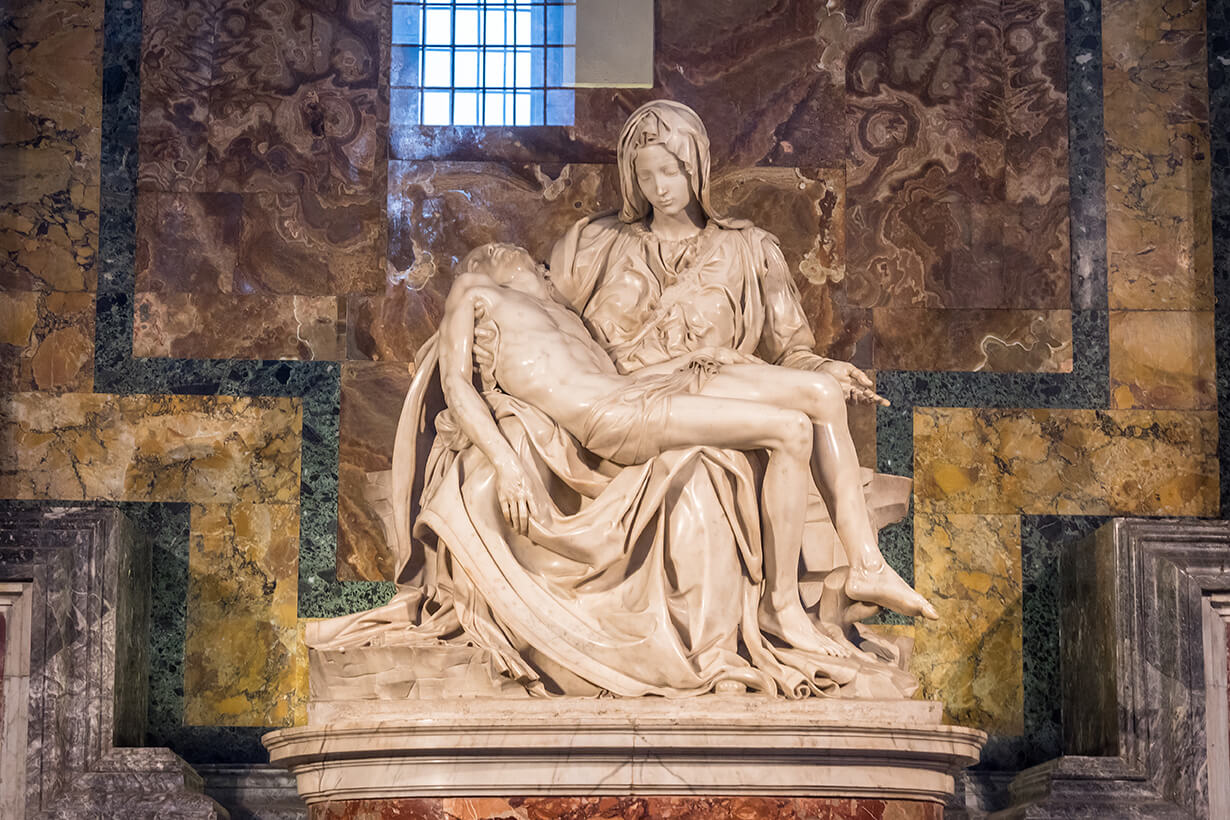
Once inside the Basilica through the main entrance and security screening, keep to the right-hand side of the nave rather than heading straight up the center aisle toward the papal altar. Michelangelo’s Pieta, behind its glass screen, is the landmark everyone recognizes, and it sits early along that right aisle. The Chapel of St Sebastian is a short walk further along the same side. Look for the altar itself rather than a freestanding monument; the tomb is set into the floor beneath it, marked with a simple inscription, not a raised sarcophagus you can walk around.
What You’ll Find at the Altar
Unlike the Pieta, which draws a constant crowd pressed against the barrier, the Sebastian chapel tends to be calmer, partly because so many visitors still walk past it toward the Grottoes staircase looking for the wrong tomb. Flowers are usually left near the altar, and it’s common to see people pause quietly rather than take photos. Treat it as an active place of prayer rather than a monument stop on a checklist; Mass is still said in the Basilica’s side chapels, and this one is no exception.
Basilica Hours vs Museums Hours — Don’t Mix These Up Either
St Peter’s Basilica and the Vatican Museums are two separate sites with two separate schedules, and the tomb sits in the former. The Basilica’s own site states that “from June 1st, the Basilica is open from 7:00 am to 8:00 pm,” though we couldn’t confirm whether that window shifts later in the year, so check the current posting before you go rather than relying on a fixed rule.
The Vatican Museums, home to the Sistine Chapel, run on an entirely different clock: “08.00 a.m. – 08.00 p.m.” Monday to Saturday, with “final entry 06.00 p.m.,” and on the “last Sunday of the month 09.00 a.m. – 02.00 p.m.” with free entry, according to the Museums’ own hours page. That page also warns that “the only official site for purchasing tickets online is https://tickets.museivaticani.va.” None of this governs the Basilica or the tomb; if your plan is the tomb alone, you don’t need a Museums slot at all.
Planning the Visit
Go early if you can. The Basilica fills up through the late morning as Museums visitors finish the Sistine Chapel route and cross over to St Peter’s Square, and by midday the nave gets loud and the queue for security screening lengthens. Arriving close to opening gives you a quieter walk past the Pieta and a few minutes of relative calm at the Sebastian chapel before the crowds catch up. Note that the reigning pope today is Leo XIV, elected in May 2025, so the Basilica remains a working church with an active liturgical calendar, not a static museum; occasional closures for ceremonies do happen, and staff at the entrance will redirect you if the nave is temporarily off-limits.
If you’d rather skip the guesswork on timing and entry altogether, our St Peter’s tomb tickets and tours are built around getting you inside efficiently and pointed straight toward the right aisle, so you spend your time at the tomb itself rather than working out which staircase not to take.