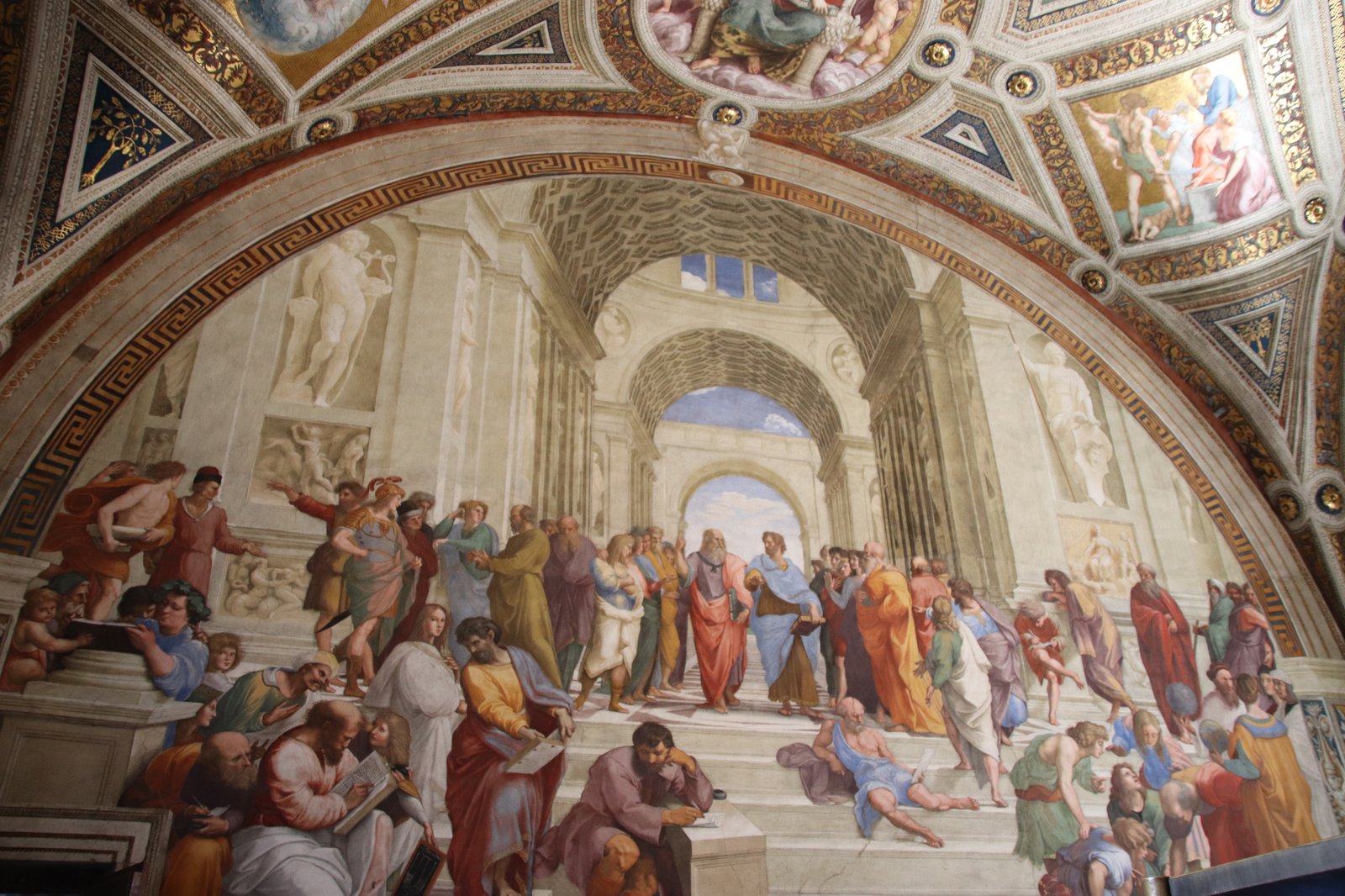
The Raphael Rooms sit directly on the walking route into the Sistine Chapel, and for a large share of visitors that single fact does all the deciding. Five minutes here, forty there. Visitors treat the chapel as the destination and the four rooms before it as a corridor with some old paintings on the walls. That is a mistake worth correcting before you go, because the room most people barely glance at was, for a decade, a working papal study, and the fresco most people photograph without reading is a portrait gallery of people you already know by name.
A study, not a corridor
Pope Julius II commissioned Raphael in 1508 or 1509 to redecorate a suite of rooms in the Apostolic Palace that already existed as his personal apartment. Wikipedia’s summary of the commission is direct: Julius II “commissioned Raphael and his workshop [in] 1508 or 1509 to redecorate the existing interiors of the rooms entirely.” Raphael was around twenty-five. He had never worked in Rome. He got the job partly on Bramante’s recommendation and partly because Julius II reportedly could not stand looking at the previous decoration, some of it by artists including Perugino, and wanted it gone.
The room now called the Stanza della Segnatura was the first one Raphael touched, and its original purpose explains why. Wikipedia describes it as “intended to serve as a study and library for Julius II” — a private working space, not a reception hall. Its four wall frescoes map onto that function almost like labels on shelves: Theology on one wall, Philosophy on the wall facing it, Poetry and Law on the two remaining walls. A Renaissance library organised by subject, painted instead of shelved. It only picked up its current name later, once it became the seat of a papal tribunal called the “Segnatura Gratiae et Iustitiae,” the Signatura of Grace and Justice, by around 1513. So the room you walk through today carries a bureaucratic name from its second life, while the paintings on its walls still describe its first one.
Backwards, and nobody tells you
Here is the detail that changes how the whole visit reads. The four rooms are the Sala di Costantino, the Stanza di Eliodoro, the Stanza della Segnatura, and the Stanza dell’Incendio del Borgo. Raphael painted the Segnatura first, from around 1508 to 1511. He moved on to the Eliodoro room, 1511 to 1514, then the Incendio room, 1514 to 1517. He died in 1520, and the Sala di Costantino was finished afterward by his workshop, largely without him, completed between 1520 and 1524.
Visitors do not walk that sequence. Their route runs the other way. Wikipedia states the effect plainly: “Visitors today enter from the east and proceed westward through the rooms in reverse order from their execution — encountering the most recently completed chamber first.” You meet the room Raphael never personally finished before you meet the room where he was still learning how to paint a papal apartment. Nobody at the entrance mentions this, and a fast-moving group will pass through all four spaces without ever realising the order they are seeing them in has nothing to do with the order they were made.
Who is actually in the painting
Inside the Segnatura, on the wall facing the Disputation of the Holy Sacrament, is the room’s best-known work and the one worth stopping for even if you skip everything else. The Vatican Museums’ own description calls it a gathering of “the most famous philosophers of ancient times,” set inside an architectural space inspired by Bramante’s ideas for the new St Peter’s. It rewards being read left to right rather than glanced at whole.
At the centre, two figures under the arch: Plato, who “points upwards with a finger and holds his book Timeus,” and Aristotle beside him holding his own Ethics, hand extended flat toward the ground. That single gesture pair is the painting’s argument in miniature — one philosopher pointing to abstract forms above, the other pointing to observed reality below. In the foreground, alone on the steps, Pythagoras sits “intent on explaining the diatesseron,” a musical ratio, surrounded by students bent over his notebook. Diogenes the cynic sprawls apart from everyone else, “lying on the stairs with a dish,” indifferent to the company he is keeping. Off to one side, leaning on a block of marble and writing, is a figure the Vatican Museums identifies as a portrait of Michelangelo in the guise of the philosopher Heracleitus.
That detail is not incidental. The Vatican Museums’ page notes that “Michelangelo was in those years executing the paintings in the nearby Sistine Chapel,” meaning Raphael was painting a tribute to a rival a short walk from where that rival was working, on a ceiling neither of them could have seen finished yet. Two of the defining works of the Roman Renaissance were going up at the same time, a few rooms apart, by two men who by most accounts did not get along. Raphael puts himself in the scene too: at the far right edge, in dark clothing, “on the extreme right with the black beret,” looking straight out at the viewer while everyone else is absorbed in argument. It is the closest thing the room offers to a signature.
What a rushed pass actually loses
None of this needs an hour. It needs enough time to stop moving. A group herded through in ninety seconds sees a wall of robed men in a building; a visitor who pauses for even three or four minutes in front of School of Athens sees an argument about how humans know anything, staged as a room full of individuals doing recognisably different things — teaching, arguing, ignoring each other, showing off. That gesture between Plato and Aristotle only means something once you notice both hands. Diogenes only reads as a joke once you have seen how formally everyone around him is behaving. Skip the Raphael Rooms at a jog and none of that lands; you register wall-to-wall paintings and move on to the ceiling everyone told you about.
There is a second cost specific to the sequence itself. Walking the rooms east to west means your first impression of Raphael in the Vatican is workshop-finished Constantine, not the room the Vatican Museums itself credits as “the first work executed by the great artist in the Vatican” — that line refers to the Segnatura. If you do not know you are walking backwards, you never correct for it, and you leave with the wrong room as your mental anchor for what Raphael actually did here.
Getting there with time to spare
The Vatican Museums open Monday to Saturday, 8:00 a.m. to 8:00 p.m., with last entry at 6:00 p.m. and a hard requirement to exit thirty minutes before closing. On the last Sunday of every month the museums open 9:00 a.m. to 2:00 p.m. with admission free and last entry at 12:30 p.m.; every other Sunday they are closed, along with a fixed list of religious and civic holidays through the year. A standard adult ticket is €20.00 at the official price; booking a skip-the-line slot adds a €5.00 booking fee on top. Reduced and student tickets run €10.00, plus the same €5.00 if booked skip-the-line. Whatever you choose, book with intent: the official site states plainly that “Tickets cannot be refunded.”
Practically, that means building slack into your morning rather than treating the Raphael Rooms as a room to clear on the way to somewhere better. An early slot, before the mid-morning groups arrive, buys you the kind of quiet in which the Segnatura’s four walls actually separate from each other in your memory instead of blurring into one long gallery. If you would rather have someone point out the Plato-Aristotle gesture, the Michelangelo cameo and the self-portrait as you go, rather than hunt for them cold, our Raphael Rooms guide covers the route room by room and is worth a look before you plan the rest of the day.