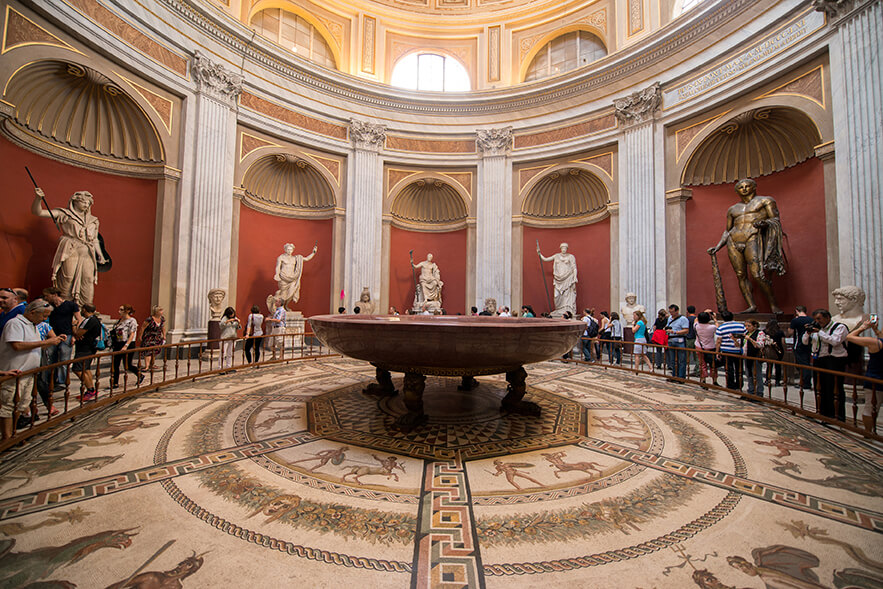
Most people who reach the Baptistery Chapel in St Peter’s Basilica are not really there. They are near the exit, mentally already outside, and the last thing that stopped them was Michelangelo’s Pietà a few chapels back. A red stone basin the size of a small bathtub sits under its own cupola in the left aisle, and it gets glanced at, not looked at. That is a shame, because the object itself has one of the odder biographies of anything in the building.
What you are actually looking at
The centrepiece of the St Peter’s Basilica Baptistery Chapel is a basin cut from red porphyry, a stone the Romans reserved for emperors because it was harder to quarry and more expensive to work than almost anything else available to them. According to stpetersbasilica.info, it is “a rich bowl in red porphyry measuring 4×2 meters” — large enough that it reads less like church furniture and more like something salvaged. It has, in a sense, been salvaged twice.
A font carved from someone else’s tomb
The stone did not start life as a baptismal font. Porphyry basins this size were almost never quarried new for a purpose this modest; they were recut from older imperial objects, and this one is no exception. stpetersbasilica.info describes it as having been “previously used as the cover of the sarcophagus of Emperor Otto II,” the Holy Roman Emperor who died in Rome in 983. Other material from the same source describes the stone as “believed to derive from the tomb of Emperor Hadrian (Castle San Angelo).”
Those two claims are not the same claim, and nothing found while researching this piece ties them together into one clean chain of ownership. The likeliest reading is that the porphyry passed through more than one reuse: quarried and worked in antiquity, possibly associated with Hadrian’s mausoleum, later recut as a sarcophagus lid said to have covered Otto II, and later again cut down to the basin now sitting in the chapel. Treat the imperial pedigree as plausible and well attested by this one source family, not as a single settled fact. What survives every version of the story is the plainer claim: the font was repurposed from an ancient Roman sarcophagus lid, not carved for the job it now does.
Carlo Fontana’s “suffered project”
The chapel around the font is a later addition to the Basilica. Architect Carlo Fontana (1634–1714) was commissioned in 1692 to design it and, per stpetersbasilica.info, “completed it in 1698.” The same source notes that “the work was realized after a suffered project,” a polite way of saying an earlier, more expensive design got rejected before Fontana’s version went ahead. Six years between commission and completion is not fast, even by the standards of a building that took over a century to finish.
What Fontana added on top of the ancient basin is where the real craftsmanship sits. A gilded bronze cover, made by Giovanni Giardini to Fontana’s design, carries an Agnus Dei motif and a medallion of the Holy Trinity. Sculptors Lorenzo Ottoni and Michel Maille also worked on the chapel’s decoration. None of it is easy to appreciate from four steps away on the way to the doors, which is exactly the problem this piece is about.
The mosaics above your head
Three mosaic altarpieces finished around 1722 fill the chapel, reproducing paintings by Carlo Maratta, Giuseppe Passeri, and Andrea Procaccini. St Peter’s is full of mosaics standing in for paintings too fragile to survive centuries of candle smoke and humidity, and these three are no exception. They sit under an elliptical cupola, a shape distinct from the domes over the Basilica’s larger chapels, which gives the whole space a self-contained feel rather than an extension of the nave.
Why almost nobody stops
The general shape of a Basilica visit explains a lot here. Visitors typically enter through the main doors, encounter the Pietà almost immediately in the first chapel on the right, then loop through the nave, past Bernini’s baldachin and toward the apse, before the standard route brings them back along the far aisle toward the exit. The Baptistery Chapel sits in that left aisle, and for many visitors it lands somewhere in the final stretch of the walk, after the emotional high point of the visit has already happened and before the doors are close enough to see.
None of that is an official sequence with a number attached to it, and this piece will not pretend otherwise. What can be said with more confidence is simpler: attention inside a building this large is a finite resource, and a basin under a side cupola is competing with a dome by Michelangelo and a sculpture by Michelangelo for whatever is left of it by the time a visitor reaches the left aisle.
Seeing it properly
Basilica entry itself carries no ticket, which is part of why so many visitors treat the building as a quick stop rather than a destination in its own right; check current basilica opening times locally before you go, since this piece cannot confirm exact clock hours for the Basilica against a live source. The neighbouring Vatican Museums, a separate ticketed institution, run Monday to Saturday “08.00 a.m. – 08.00 p.m.” with “final entry 06.00 p.m.,” and on the last Sunday of most months from “09.00 a.m. – 02.00 p.m.” with “final entry 12.30 p.m.” and free admission, exceptions applying around Easter, 29 June, and the Christmas period.
If you want the Baptistery Chapel to register as more than a red smear on the way out, give it thirty deliberate seconds rather than an accidental glance: find the bronze lid, find the Agnus Dei on it, then look up at the mosaics before you leave. It takes less time than reading this paragraph and it is the only part of the visit almost nobody else bothers with.
For a guided walk through the Basilica that actually slows down for corners like this one, rather than sprinting from the Pietà straight to the doors, our St Peter’s Basilica tickets and tours page lists the guided formats running through the rest of 2026.