
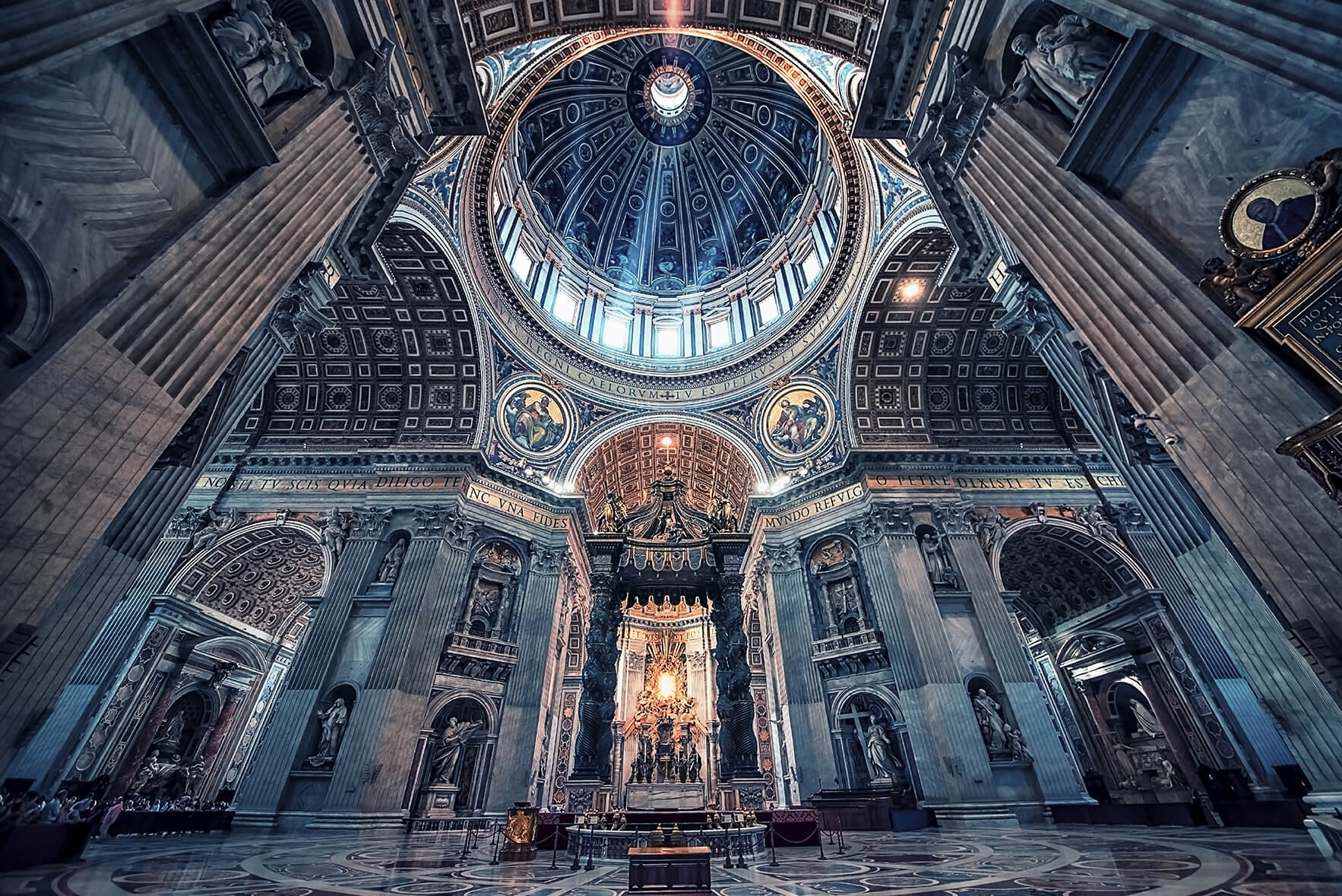
Stand at the crossing of St Peter’s Basilica, under Michelangelo’s dome, and you will see a small crowd doing something odd. They are not looking up at the ceiling or across at the bronze canopy overhead. They are looking down, at a sunken horseshoe of marble ringed by a low balustrade, lit by rows of small gold lamps that never seem to go out. Almost nobody reads the plaque. Most people just stop, lean on the rail for a moment, and move on without knowing what they were looking at.
That sunken space is the Confessio, sometimes called the Niche of the Pallia. It sits directly in front of the papal high altar, under Bernini’s baldachin, at the exact centre point of the basilica. Everything about its position is deliberate. Everything under your feet at that spot is the reason the entire building exists where it does.
What the word “confessio” actually means here
In early Christian architecture, a confessio is not a booth for confession. It is the space built around and above a martyr’s grave, marking the place where that person “confessed” their faith by dying for it. St Peter’s has one because the basilica was built, in the fourth century and then rebuilt from the sixteenth, directly on top of an existing Roman-era burial site believed since antiquity to hold the apostle’s grave. That grave came first, and the high altar sits exactly on top of it for that reason alone. A building this size grew up around a fixed point in the ground, not the other way round.
What you see today, a sunken niche with a curved double staircase and bronze grille, dates to the early seventeenth century, when Carlo Maderno redesigned this part of the church for Pope Paul V. Pilgrims could descend a few steps and kneel closer to the site than the raised floor of the nave allowed.
The eighty-nine lamps
Ring the balustrade and look closely: gilt-bronze oil lamps have burned there continuously, day and night, since the seventeenth century — eighty-nine of them by the traditional count, though the exact number on any given day shifts slightly depending on whether the papal altar’s portable platform is in place over part of the niche. They are not decorative in the ordinary sense. An ever-burning lamp at a saint’s tomb is an old liturgical gesture, older than the current basilica, meant to say that veneration here does not pause for opening hours or seasons. That is one reason the space glows faintly gold even when the rest of the crossing sits in shadow, and it is usually the first detail visitors notice before they work out what they are looking at.
The kneeling pope who used to be in the niche
For a century and a half, the niche itself held a marble statue of a pope kneeling in prayer, facing the tomb rather than facing the nave: Pius VI, carved by Antonio Canova, one of the sculptor’s last works, after that pope died in French custody during the Napoleonic period. In 1979, Pope John Paul II had the statue moved down into the grottoes below, so that a new opening could let visitors on the grottoes route look directly onto the tomb the statue had spent so long facing. It is still there today, kneeling toward Peter’s grave from a few metres closer than the crossing above. Placing a pope permanently turned away from the congregation and towards the grave was, in its original spot and in its current one, a deliberate way of putting the entire papacy in a posture of prayer at the source of its own authority. Every pope since Peter is, in the Church’s own account, occupying a chair that traces back to this exact spot.
Why it’s also called the Niche of the Pallia
That second name comes from a specific object, not a general idea. A pallium is a narrow band of white wool, worn over the shoulders by archbishops as a sign of their office and their connection to Rome. Before a newly appointed metropolitan archbishop receives his pallium, the woollen bands are traditionally kept in a box near this spot, close to the tomb, so that they can be said to have rested at the grave of the apostle before being sent out to a diocese somewhere else in the world. Its second name is simply a record of that custom, still referenced on the Feast of Saints Peter and Paul each 29 June, when new pallia are blessed.
What’s actually underneath
Here is the part almost nobody realises while they are standing at the rail. This sunken niche is not the grave itself. It is a marker built several metres above the grave, and the real site sits deeper still, below the current basilica floor entirely.
Excavations begun under Pope Pius XII in 1940 uncovered a Roman-era necropolis running underneath the whole nave, a street of family tombs cut into the hillside long before Constantine’s church was built over it in the fourth century. Directly beneath the high altar, archaeologists found a small second-century monument, a modest aedicula built against a red-painted wall, which ancient tradition and the surrounding graffiti connect to the burial of Peter. Bones recovered near that monument were examined for decades before the Vatican, in 1968, announced its conclusion that the relics were consistent with an apostolic-era male burial at that spot. Not every historian accepts that identification as settled, and the Vatican itself has always spoken of it with more nuance than headlines usually allow, but the archaeological sequence, the ancient graffiti, and the layout of the space are well documented and can be seen for yourself.
You cannot see any of that from the crossing above. That necropolis and the aedicula within it sit under the current floor, reachable only on a separate, pre-booked excavations tour known as the Scavi, capped at small group sizes and run by the Vatican’s own office, not by the general basilica visit. What you get for free, just by walking up to the balustrade, is the marker: the lamps, the kneeling statue, and the geometry of a building that was planned around a single unmarked grave two thousand years ago.
How to actually look at it
Approach from either side aisle rather than pushing through the centre of the crossing, where the crowd around the baldachin is thickest in the late morning. Early entry, before the basilica fills up after nine, gives the clearest view down into the niche without a row of heads in front of you. Look for two things in order: the ring of ever-burning gilt-bronze lamps at balustrade height, and the bronze grille set into the marble that marks the point closest to the tomb the general public can reach without a separate booking. (The kneeling Pius VI that once faced the tomb from this niche was moved down to the grottoes in 1979 — that’s where to find him now.) Once you know what each element is doing, the pause everyone makes at that rail stops being a mystery and starts being the point of the whole visit.
If you want the fuller picture, including the necropolis beneath the Confessio and the rest of the basilica’s major sightlines, it is worth booking ahead through our St Peter’s Basilica tickets and tours before you go, since the Scavi office in particular books out days in advance.