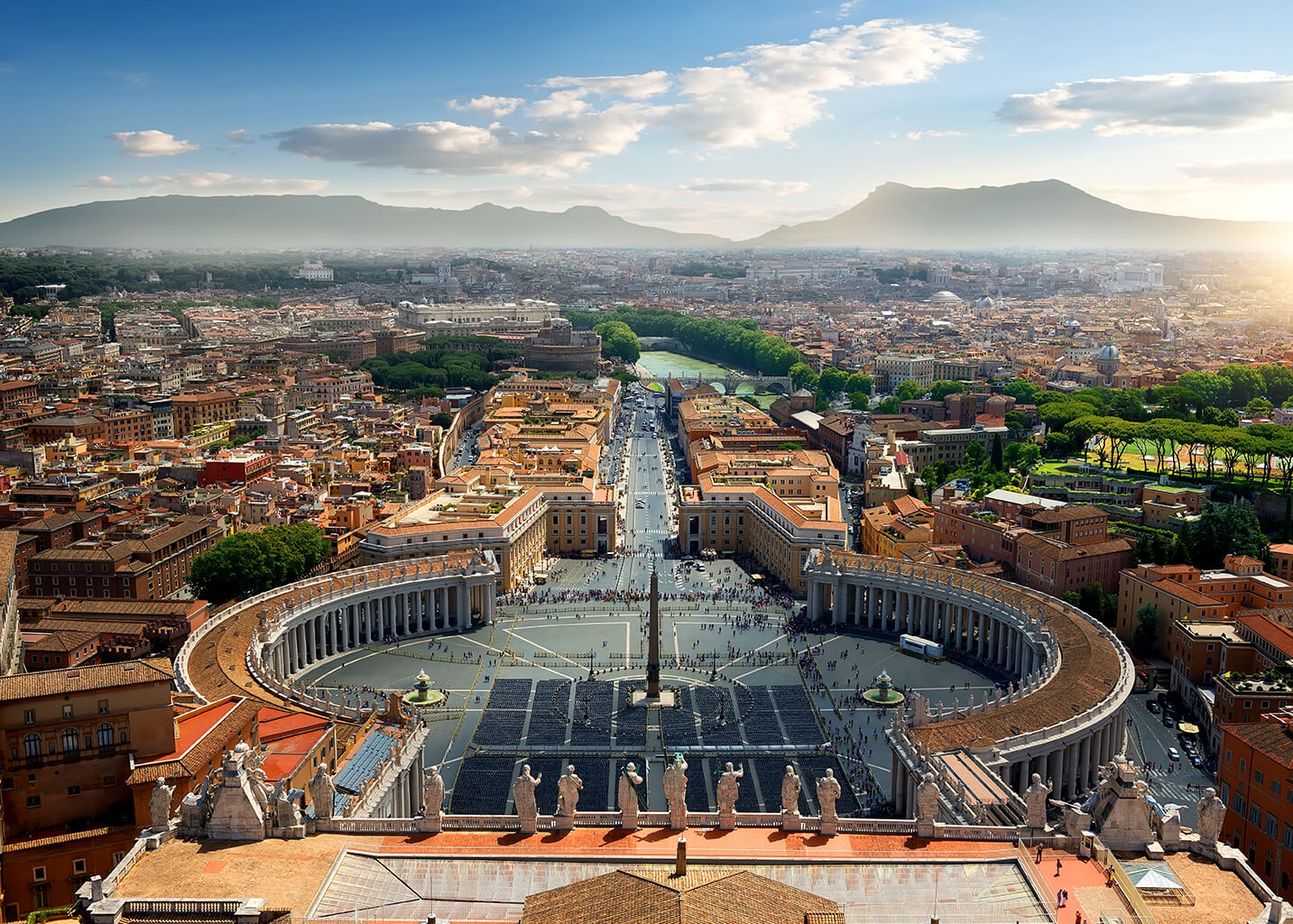
Nobody warns you that the climb has three distinct moods. Guidebooks flatten it into a single number, 551 steps, as if the walk were one uniform slog from ground floor to lantern. It isn’t. There’s a stretch you can skip with a lift, a stretch where you wander a flat terrace and forget you’re climbing at all, and a final stretch where the building itself leans into you and won’t let you stand up straight. Knowing which is which changes how you plan the visit, and it changes how the last twenty minutes feel in your legs.
One thing worth clearing up before you start: the Dome is ticketed and run separately from the Vatican Museums. It’s sold through booking.basilicasanpietro.va, managed by the Fabbrica di San Pietro, not through museivaticani.va. That matters for hours. Dome hours and Museums hours are not interchangeable, and mixing them up is the single most common planning mistake we see.
Two ticket types, one starting point
The official product page lists two options: “The Dome with lift” and “The Dome with stairs.” Both include the same thing once you’re inside — a “Visit to the inner Ring and outer Ring of the Dome” — plus entry into the Basilica itself, scheduled before or after the climb “based on visitor flow” rather than at a fixed time. The difference between the two products is entirely in stage one. Pick lift and you skip the first block of stairs. Pick stairs and you don’t. Either way, the last stretch is identical for everyone, which is the part most people underestimate.
Exact current pricing isn’t something we’ll pin down here, since the official booking page loads its fares dynamically and third-party sites quote figures that disagree with each other by a wide margin. Check the price at booking.basilicasanpietro.va when you book rather than trusting a number you saw on a blog.
Stage one: the lift, or the first 231
From the ticket desk, you’re routed toward the base of the Basilica’s roofline. If you bought the lift ticket, this part takes under two minutes: a slow, crowded elevator ride that deposits you on the roof terrace with almost no sense of having climbed anything. If you bought the stairs ticket, you’re on your feet for 231 steps of a fairly ordinary stone staircase, wide enough for two-way traffic, well lit, with landings every so often where slower visitors pause. It’s unglamorous. Think office-block stairwell, not cathedral.
This is the stage that gives the ticket its name, and it’s also the only stage where the two products genuinely diverge. Everything after this point is on foot no matter which ticket you’re holding.
The roof terrace: a pause you don’t expect
Both routes converge here, at roof level, and the change in atmosphere is abrupt. You step out of a stairwell or an elevator car and you’re suddenly outdoors, on a flat expanse of roof with statues at eye level instead of far overhead. There’s a gift shop up here, restrooms, a water fountain, and a small refreshment stand — genuinely useful if you’ve timed your visit for midday heat. Most visitors treat it as a breather, and it functions as one: nothing about crossing the terrace resembles climbing.
This is also where the inner Ring opens off to one side, the gallery inside the Basilica’s own dome that looks straight down into the nave, with the mosaics and the tiny figures of visitors crossing the floor a long way below. It’s worth five minutes on its own, and it’s easy to miss if you’re focused on getting to the top.
Stage three: 320 steps that never let up
From the terrace, a small door marks the start of the real climb. This is the part the lift ticket can’t get you out of: “the remaining 320 steps to the top must be completed on foot in any case,” as one dedicated dome-visiting site puts it. There is no shortcut past it, no second elevator, no option to turn back once the queue behind you has formed on a staircase built for one direction of traffic.
What makes this stretch feel so different from stage one is the shape of it. St Peter’s dome is built as a double shell — an inner dome and an outer dome with a walkable gap between them — and the final staircase runs inside that gap, spiralling upward as the two shells converge toward the lantern. One source describes it precisely as “an increasingly narrow spiral staircase between the inner and outer dome shells.” The word “increasingly” is doing real work there. At the bottom of this stretch the passage feels almost normal. By the last few flights, the outer wall has tipped inward enough that you’re leaning your shoulder against sloped stone just to keep moving, and the handrail on the inner side curves with a slightly different radius than the one you’re gripping. Taller visitors duck. Anyone carrying a bag switches it to the side away from the wall.
It isn’t dangerous so much as disorienting, the way a spiral staircase in a lighthouse is disorienting: your inner ear starts registering the turn before your eyes fully process it. Visitor-info sites describe the overall climb as “physically demanding due to the presence of steps, narrow spaces and steep inclines,” and that phrase earns its place squarely in this final third. The first two stages are mild. This one is the reason the ticket carries a health advisory at all.
Who should sit this one out
The same advisory turns up, in near-identical wording, across most visitor-information pages: the climb is “not recommended for people with heart or respiratory conditions, vertigo, claustrophobia or mobility difficulties, or for pregnant women.” Treat that as sound general guidance rather than a verbatim Vatican regulation, since nobody checks a medical form at the door. But it’s accurate to what stage three demands. A narrow, spiralling, sloped staircase with a one-way flow of foot traffic is a poor place to discover a fear of tight spaces, and there’s genuinely nowhere to sit down once you’re inside the shell.
What’s waiting at the lantern
The dome tops out at 136.6 metres, the tallest in the world, and Michelangelo’s double-shell design is precisely what makes that height survivable structurally and walkable practically. The final steps open onto a narrow walkway ringing the lantern, with Rome laid out in every direction: the straight line of Via della Conciliazione behind you, the Vatican Gardens off to one side, St Peter’s Square directly below with its colonnades reading as two curved arms from this height. It’s windier up here than the terrace, and there’s less room to linger, since the walkway is narrow and the queue behind you is still climbing.
Planning the visit around the hours
As of today’s schedule, the Dome runs on summer hours, 7am to 6pm, a window that holds through 25 October 2026 before reverting to the winter schedule of 7:30am to 5pm. The Basilica itself keeps longer hours in summer, “from 7.00 am to 8:00 pm” from the 1st of June — worth knowing if your dome ticket schedules Basilica entry for after the climb rather than before. Because dome tickets bundle Basilica entry, the standard Vatican dress code applies throughout: shoulders and knees covered, checked before you’re allowed anywhere near the ticket desk.
Go early if you can manage it. The staircases are one-directional, so a busy midday climb means matching your pace to a queue rather than setting your own, and stage three is not where you want to be shuffling behind a large group.
If you’d rather have someone handle timing and entry logistics rather than juggling the Dome’s separate booking system yourself, our St Peter’s Basilica tickets and tours page lays out the current entry options, dome climb included, for anyone planning around these three stages.