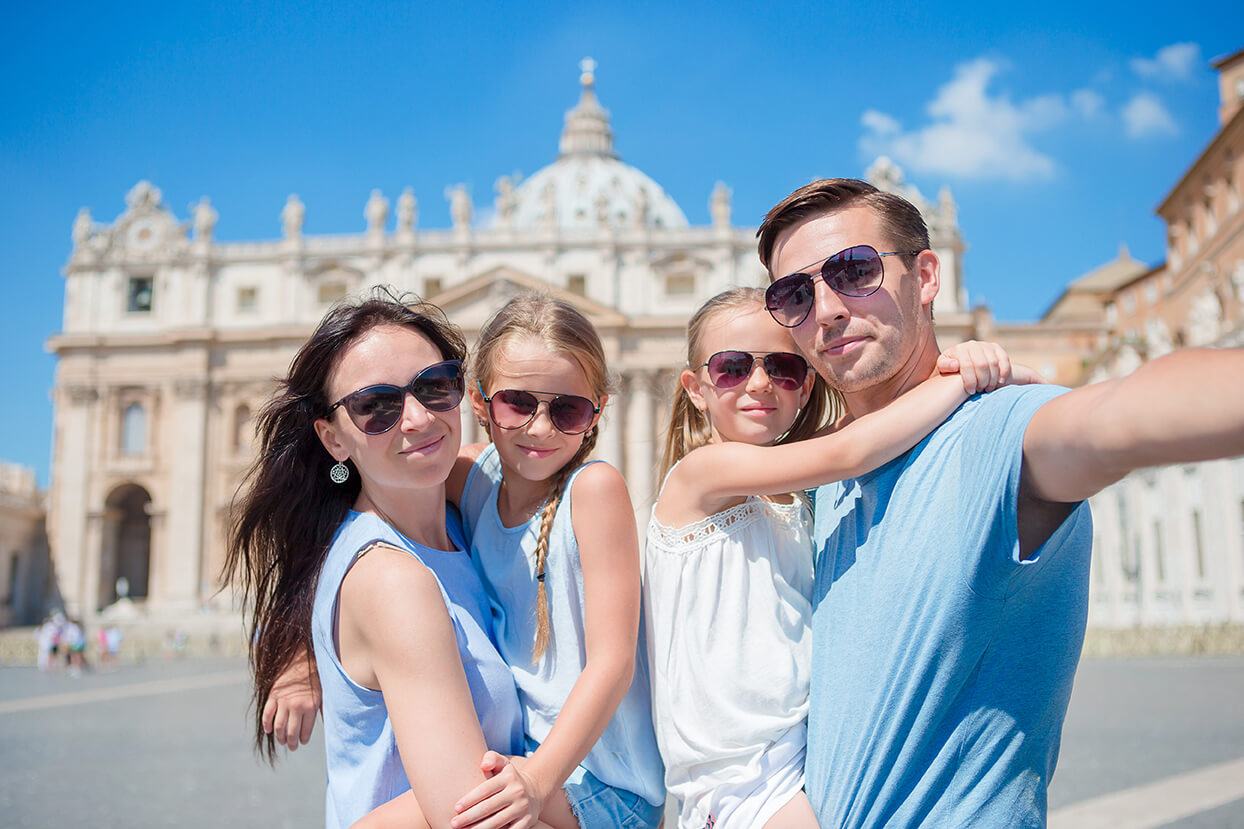
Ask a seven-year-old to look attentively at painted ceilings for four hours and you will lose that battle within forty minutes. Yet the standard Vatican Museums visit, the one printed on most tour itineraries and assumed by most self-guided planners, is built around exactly that: a long, mostly one-directional walk through room after room, ending at the Sistine Chapel. It works for adults who came specifically to look at art. It does not work for a family with a child under ten, and pretending otherwise is how afternoons collapse into meltdowns two-thirds of the way through the Gallery of Maps.
This is a guide to what actually changes when you shorten the route on purpose, built from the Vatican’s own published visitor policy plus a working operator’s sense of where families run out of patience.
Why the full route assumes an adult
The marketed route is not wrong, exactly. It is simply not designed with a small child’s attention span, bladder, or leg strength in mind. It stacks room after room of static visual content with almost no interactive element, asks visitors to stand and read wall text, and saves the single biggest payoff, the Sistine Chapel, for the very end. An adult can defer gratification for two hours. A six-year-old cannot, and by the time you reach Michelangelo’s ceiling, the child who needed the payoff most is already asking to go back to the hotel.
There is no official figure for how long the standard route takes or how far it covers on foot; the Vatican Museums’ own visitor-advice page gives no duration or distance number at all. Treat any “four hours” or “seven kilometres” claim you read elsewhere, including ours, as a market estimate rather than an official one. What is certain is the shape of the problem: a long corridor-style museum with one major room at the far end, and a young child whose patience runs out well before that room.
What the Vatican Museums actually offer families
Credit where it is due. The Museums are set up for families more thoughtfully than their reputation as an endurance test suggests. Their own advice page states plainly: “The Museums are pleased to welcome families with children and strollers in tow.” Staff at the entrance will “show visitors the easiest route and… direct them to dedicated elevators providing easy access to various museum spaces,” which matters a great deal once a stroller meets the first staircase.
Practical infrastructure exists along the way too. There are “baby changing facilities and a nursing room for breastfeeding mothers,” and “highchairs are provided in some refreshment areas.” Four named courtyards function as built-in rest stops: “Relaxation areas with seats are located along the museum itinerary to enable the visitor to take a break and to rest (Courtyard of the Cuirasses, Courtyard of the Pinacoteca, Square Garden, Courtyard of the Pinecone).” A fifth, the Courtyard of the Carriages, appears on a separate family-facilities page. None of this is secret. Almost none of it gets mentioned in the standard itinerary a family is handed.
There is also a dedicated Family Audioguide Tour, described on the Museums’ own site as “a fascinating treasure hunt, with special details to discover, mysteries to reveal and riddles to solve” for young visitors. We could not confirm its running time, price, or exact stop list from published material, so book it as a nice-to-have rather than plan your whole day around a duration you have not seen in writing.
The shortened family route: concrete stops, not a checklist
Cutting the route is not about skipping the Sistine Chapel. It is about reordering what you see and being ruthless about the long connective galleries that exist mainly to move adult tour groups from one highlight to the next.
Start early and go straight in. Do not linger through the opening galleries the way a self-paced adult would; walk them at a child’s pace, which is faster than you think when nothing has grabbed their attention yet. Use the Cortile della Pigna, the Courtyard of the Pinecone, as your first proper stop rather than your last. It is outdoors, it is open, and the giant bronze pinecone and the Sphere Within Sphere sculpture give a young child something concrete to look at and talk about, unlike a corridor of tapestries. Let them run a lap of it before you go back inside.
From there, aim for one or two galleries with real visual punch rather than the full sequence, then move toward the Sistine Chapel while the morning’s patience is still intact. Save the Gallery of Maps for a fast walk-through, not a stop: it is a beautiful corridor for an adult with time, and a very long hallway for a tired six-year-old. If a wall of your itinerary is mostly text panels or repeating similar objects, that is the wall to skip. A shortened family route is not a shorter version of the adult route; it is a different route that happens to end in the same room.
Use the courtyards on purpose. Plan a break at the Courtyard of the Pinecone or the Courtyard of the Pinacoteca roughly halfway through, even if the group does not feel tired yet. Sitting down for ten minutes before the meltdown, not after it, is the entire trick.
Timing that respects the closing rule
Vatican Museums hours run 08.00 a.m. – 08.00 p.m., Monday to Saturday. On the last Sunday of each month the Museums open 09.00 a.m. – 02.00 p.m. with free admission, which sounds attractive until you picture the queue a free Sunday draws; it is not the day to bring a stroller and a toddler who needs a nap.
One rule matters more for a family than almost anything else on the visitor page: “Visitors are required to leave the halls 30 minutes before museum closing time.” That half hour is not yours to browse in. If your child hits a wall at 6:45 p.m. on a day the Museums close at 8:00 p.m., you already need to be moving toward the exit, not toward one last room. Build your day backward from that hard stop rather than forward from your entry time, and you will not get caught mid-gallery when staff start clearing the halls.
For most families with children under ten, ninety minutes to two hours inside the Museums is a realistic, enjoyable ceiling, not a compromise. Longer is possible with an easygoing child and a lot of snack breaks. Longer is rarely enjoyable.
Tickets and the age question
The Vatican Museums’ published price list lists a full-price ticket at €20 at the door or €25 booked online in advance, and a reduced ticket at €10 at the door or €15 booked online. Free entry applies to “Children below the age of 7.” There is no separate published rate for children aged seven to ten; budget for that age band at the full adult price until you see a distinct child tier in writing, and treat any online listing that promises otherwise with a healthy dose of scepticism until it is confirmed at the ticket office.
Under-sevens go in free, which is one more reason the youngest children in a family are often the easiest to bring: no ticket cost, and the stroller access described above.
Feeding a family mid-visit
Two dining options sit inside the Museums complex. The Self Service corner runs “a special menu for children, rich in authentic and tasty food,” and a Pizzeria offers an alternative if a picky eater refuses whatever the day’s menu is. Both, per the Museums’ own family page, have “comfortable high chairs.” Building a proper sit-down break into a shortened route, rather than pushing through on sheer momentum, is often the difference between a family that leaves happy and one that leaves early and cross.
If you are pairing this with St Peter’s Basilica
Many families combine the Museums with St Peter’s Basilica the same day, and it is worth knowing the Basilica runs on its own separate schedule under a different authority, the Fabbrica di San Pietro. From 1 June its published hours are “from 7.00 am to 8:00 pm.” The dome is on its own timetable again: 7:30 a.m. to 5:00 p.m. in winter, 7:00 a.m. to 6:00 p.m. in summer. None of this overlaps automatically with Museums hours, so check both before you build a single-day plan around seeing both sites with a small child in tow.
A guide who has watched hundreds of families move through this route on the same morning will chop the day differently than a generic itinerary will: shorter museum stretch, real breaks in the courtyards, the Sistine Chapel reached while everyone still has patience for it, and the rest of the plan built around a child’s actual limits rather than an adult’s. If you would rather have someone plan and walk that route with you on the day, our Vatican tours page lists the guided formats set up for exactly this kind of family pace.