
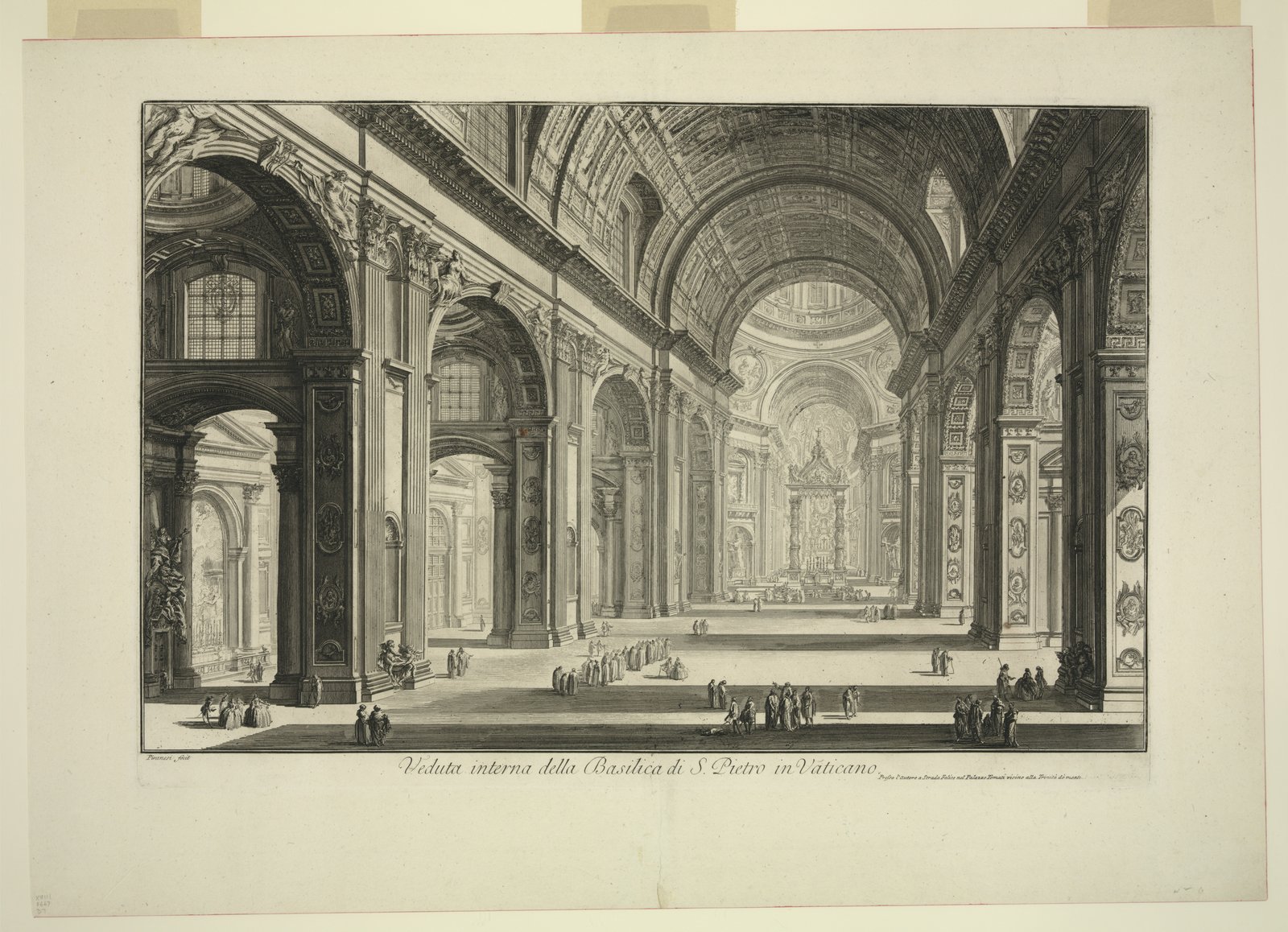
Stand in the nave of St Peter’s Basilica, walk halfway toward the altar, and stop. Directly ahead, framed by four immense marble piers and drenched in light from the drum of Michelangelo’s dome, sits a black-and-gold bronze canopy on four twisting columns. It is 28.74 metres tall, which is the height of an eight-storey building. It stands directly over the traditional burial site of the apostle Peter. It is one of the most looked-at pieces of sculpture in the world, and almost nothing you have heard about it is accurate.
The commission
In August 1623, the College of Cardinals elected Maffeo Barberini as Pope Urban VIII. Within weeks, the new pope had commissioned a young sculptor called Gian Lorenzo Bernini to design a permanent altar canopy for the new basilica — a structure grand enough to fill the crossing beneath the dome, and personal enough to be legible as a Barberini monument. Bernini was twenty-four (turning twenty-five that December) and had never worked in bronze on this scale.
Preparatory work for the foundations was under way in the months around Urban VIII’s election that summer. Fabrication of the bronze superstructure ran from 1624 to 1633. The Baldachin was inaugurated on 28 June 1633, the vigil of the feast of Saints Peter and Paul; the four crowning angels and the last decorative details were finished the following year. Ten years, one sculptor, and a room-sized furnace running near-continuously in the workshops behind the piers.
Where the bronze did not come from
Any decent guide to Rome will tell you that Urban VIII stripped the bronze from the Pantheon’s portico to build the Baldachin. There is a satirical Latin epigram attached to the statue of Pasquino that captures this: Quod non fecerunt barbari, fecerunt Barberini (“what the barbarians did not do, the Barberini did”). Every guidebook quotes it. Every guide who does not stop there is quietly incomplete.
Urban did strip the Pantheon. In 1625 and 1626 his workmen removed the bronze girders and trusses from the portico ceiling, and they melted the metal down in furnaces at the Vatican. Modern reconstruction of the accounting suggests that roughly 150 to 180 tonnes of Pantheon bronze was recovered. Of that mass, around 98 per cent went to cannons for Castel Sant’Angelo, not to the Baldachin. Most of the Baldachin bronze was purchased fresh, imported principally from Venice. The Pantheon supplied at most a small fraction of the metal in the canopy overhead, and possibly none of the visible bronze at all.
Say it out loud in the nave when a tour group nearby is being told the guidebook version. Small pleasures.
The columns
The four twisted bronze columns are the most quoted feature of the Baldachin and the most misread. They are Solomonic columns — a specific historical form, not a decorative flourish. In Bernini’s day, Rome held a set of ancient marble twisted columns believed to have been brought from the Temple of Solomon in Jerusalem by Constantine, and installed as a screen around Peter’s shrine in the old fourth-century basilica. Modern archaeology dates those columns to the second or third century AD, cut from Greek marble; they are not Solomonic in origin. But Bernini’s contemporaries believed the columns were, and the Baldachin quotes their form to make the point that this new altar stands in a direct line of continuity with the earliest Christian veneration of Peter.
Eight of the original twelve marble columns still survive in the basilica. Six sit in pairs in niches roughly halfway up the four crossing piers, framing the Baldachin, beneath the medallions of the Four Evangelists; the most venerated of them, the Colonna Santa, is displayed in the Treasury Museum. Once you have noticed them the whole crossing rearranges itself: Bernini’s four bronze columns are quotations, and the marble originals are visible in exactly the same room.
The bees, the laurels, and the pedestals
Look at the columns closely and you will see two decorative bands climbing the twist. Bees, three to a shield arranged in a triangle, are the Barberini family arms. Laurel branches climb between them. On the underside of the canopy, above where the pope stands when he celebrates Mass at the Papal Altar, a golden sun with a radiant face marks the exact centre. These are not neutral Christian symbols. They are personal Barberini emblems worked into a work of sacred art, and they were controversial in their own time.
The eight marble pedestals at the column bases carry a stranger sequence. A woman’s face on the Barberini shield changes its expression from panel to panel. Popular tradition, going back at least to the nineteenth century, reads this as the stages of childbirth — culminating in the eighth panel where a smiling infant appears. The most common version of the story has Urban’s niece in difficult labour and Bernini vowing the Baldachin’s completion for a safe delivery. No primary source documents this. Serious art historians treat it as folklore. The imagery is real; the childbirth reading is tradition, not fact.
What sits behind and below
Do not stop at the Baldachin. Twenty-three years later, in 1657, Bernini began work on the Cathedra Petri — the Altar of the Chair — in the apse directly behind the Baldachin. It is a gilt-bronze reliquary throne enclosing the ancient wooden chair traditionally identified with Peter, supported by four Doctors of the Church, and it is lit from behind by an alabaster window carrying the dove of the Holy Spirit in radiating bronze rays. It was completed in 1666. Bernini deliberately aligned the two works so that from the central nave the viewer’s eye travels along a single sight-line: dove, chair, canopy. It is a staged Counter-Reformation image of papal authority thirty years in the making, and most first-time visitors walk past it without noticing the alignment.
Directly below the Baldachin is the Confessio, a sunken chapel with a kneeling statue of Pius VI and ninety-nine oil lamps. Below the Confessio is the Vatican Necropolis, and within the necropolis is the Trophy of Gaius — the second-century aedicula that early Christians already venerated as Peter’s grave. On 26 June 1968, Pope Paul VI announced that relics identified as Peter’s had been recovered from a niche in the “Graffiti Wall” beside the aedicula, based on the work of the epigrapher Margherita Guarducci. Doctrinal certainty and archaeological consensus do not fully overlap, but the site’s veneration as Peter’s tomb is documented from the second century onward, and that alone is a reasonable answer to why an altar canopy stands directly above it.
Restoration and how it looks today
Between February and October 2024 the Baldachin underwent its first serious restoration since 1758. Funded by roughly €700,000 (about $760,000) from the Knights of Columbus, the work cleaned the surface of two centuries of soot, oxidation, and candle grime. Pope Francis unveiled the restored canopy on 27 October 2024, ahead of the 2025 Jubilee. Photographs taken before and after are startling: the gilding on the crown and angels reads as gold again, not brown. There is no scaffolding in place today.
How to see it well
Entry to St Peter’s Basilica is free. It opens at 07:00 daily and closes at 20:00 as of June 2026. The single security queue outside can run ninety minutes at midday in summer, and there is no way to skip it without an official reserved-entry slot or a bundled tour. Once you are inside, walk straight down the central nave. Whatever spatial effect Bernini and his patrons designed for this room, it is best received on foot rather than through a lens.
Three ways to see the Baldachin better than most visitors do:
- Arrive at 07:00 on a weekday. The security queue at that hour is under fifteen minutes, and the nave is close to empty until about 08:15. This is the only window during the day when you can walk the length of the aisle without another photograph being taken in front of you.
- Climb the Dome. The cupola ticket (about €10 stairs only, €15 with the elevator to roof level) takes you around an interior gallery at the base of the drum. From that walkway you look almost straight down onto the crown of the Baldachin — the four angels, the orb, and the gilt cross — with the marble compass of the crossing floor beyond. It is the best view of the top of the canopy that exists.
- Come back after the Cathedra sight-line has clicked. Once you have noticed the alignment (dove behind chair behind canopy), you cannot un-notice it. A second visit is a different one from the first.
For a full walkthrough of the Basilica visit — including the Dome climb, the Necropolis (Scavi) tour that lets you stand next to the second-century aedicula directly below the Baldachin, and the reservation options that skip the outside security queue — see our St Peter’s Basilica tickets and tours guide. For the Scavi specifically, our St Peter’s Tomb tickets and tours page has the booking mechanics for the Ufficio Scavi.