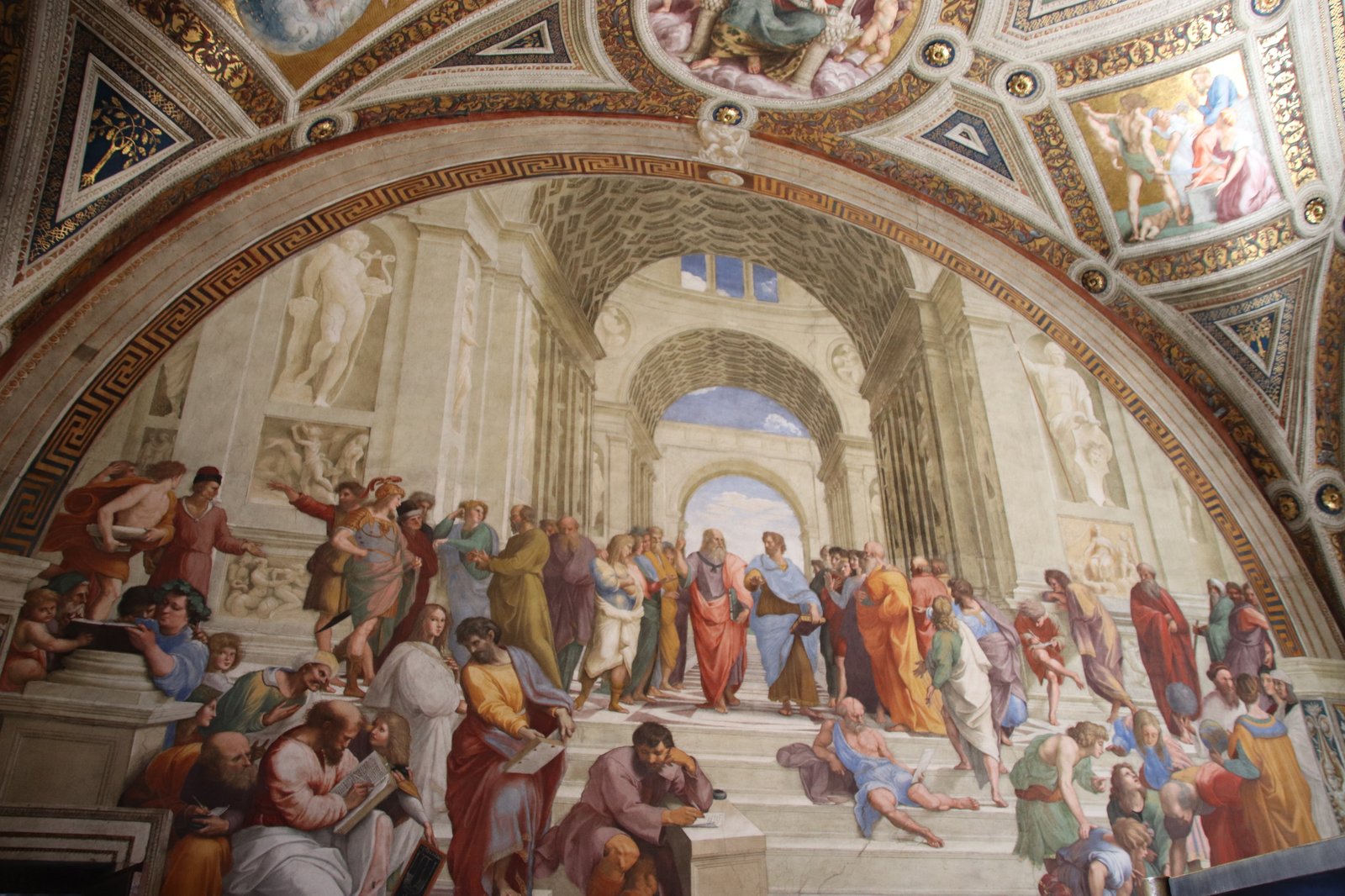
Most visitors walk through the Borgia Apartments on the way to somewhere else, following signs toward the modern collection or the Sistine Chapel, and barely register that the rooms themselves are the point. Rodrigo de Borja became Pope Alexander VI on 11 August 1492, and within months he had Bernardino di Betto — known to everyone as Pinturicchio — covering six rooms of his private apartment in fresco. Painters and gilders must have worked in relays to finish it as fast as they did. What emerged is one of the densest, strangest decorative programs in the Apostolic Palace, and its most talked-about detail is a face nobody can fully confirm.
A Spanish pope with something to prove
Vatican Museums’ own page describes him plainly: “The Spanish Rodrigo de Borja y Doms (Italianised as ‘Borgia’), elected as pope following the death of Innocent VIII with the name Alexander VI.” He was an outsider in Rome, a Valencian in a city that ran on Italian family networks, and he compensated the way popes usually did: with an unmistakable building project. Six rooms and one fresco cycle, with his own heraldic bull worked into nearly every scene he could justify it in. Whatever else people said about him — and plenty was said, most of it unverified rumour about his children and his rivals rather than settled history — the frescoes were a statement of arrival that has outlasted every scandal attached to his name.
Pinturicchio’s six rooms
His suite runs through the Room of the Sibyls, the Room of the Creed, the Room of the Liberal Arts, the Room of the Saints, the Room of Mysteries, and the Room of Pontiffs. Pinturicchio worked with a studio of assistants across roughly 1492 to 1494, a fast turnaround for this much gilded, crowded, gold-ground painting. Oldest of the six is the Room of Pontiffs: its architectural structure dates to 1277–1280, built under Nicholas III long before Alexander VI arrived, and Pinturicchio never touched it. Its original wooden ceiling collapsed in a storm in 1500 — Alexander VI himself was in the room at the time and survived by inches, sheltered under a fallen beam — and the space wasn’t redecorated until the 1520s, when Pope Leo X had Perin del Vaga and Giovanni da Udine paint an entirely different vault of grotesques, zodiac signs and planets that doesn’t match Pinturicchio’s cycle at all. Everything else in the sequence went up new under Alexander VI, more or less in one continuous campaign.
Walk the six rooms in order and the program reads as instruction and self-portrait at once, theological lessons for a papal household threaded with portraits of the family paying for them.
A triumphal arch for the pope’s own bull
Its set piece is the Disputation of St Catherine of Alexandria, in the Room of the Saints, showing the young saint refuting a room full of pagan philosophers in front of the Roman governor Maximinus Daia. Pinturicchio staged it as theatre. Vatican Museums curators describe the backdrop as “a monumental triumphal arch based on that of Constantine, surmounted by an idol in the form of a bull, alluding to Pope Borgia’s heraldic symbol.” Rome’s most famous ancient monument, repurposed as scenery for the pope’s own coat of arms — subtlety was never really the assignment here.
Whose face is this, really?
This is where the room earns its reputation beyond art history. Vatican Museums’ own description of the fresco notes that “portraits of illustrious contemporary figures have been recognised, if not always appropriately: Catherine-Lucrezia Borgia.” Read that sentence carefully and it is doing real hedging: the identification of Catherine’s face with Alexander VI’s daughter Lucrezia is traditional, not confirmed, and the museum flags that past attributions haven’t always been reliable. Wikipedia’s entry on Lucrezia Borgia uses the same caution independently, captioning the image only as a “purported portrait” of her as the saint.
So no art historian can hand you certainty here, and I won’t pretend otherwise on a tour. What’s certain is narrower and, honestly, more interesting: a pope had his family’s faces worked into a devotional fresco cycle inside his own private rooms, and five centuries later we’re still debating which face belongs to whom. That ambiguity is part of what makes the room worth slowing down for, rather than a trivia answer to file away and move past.
Sibyls, liberal arts, and the rest of the cycle
The other rooms reward the same close looking. Pagan prophetesses pair off with Old Testament figures in the Room of the Sibyls, a favourite humanist device for arguing that classical wisdom had quietly anticipated Christian revelation. Grammar and music, astronomy and the rest of the classical arts, all appear personified as seated women presiding over scholars in the Room of the Liberal Arts, a scheme aimed squarely at a papal court that liked to think of itself as learned. Apostles face off against Old Testament prophets in the Room of the Creed, matched line by line, each article of belief paired to its scriptural source. None of it is subtle. All of it is meant to be read, not just admired.
From private apartment to public gallery
What happens to the rooms after Alexander VI dies in August 1503 is where the story turns genuinely difficult to sum up in a sentence. Later popes were uneasy about living in his old apartment, and over the centuries the space passed out of use as a residence and into the Vatican Museums’ exhibition circuit. Today it also functions as an approach to the Vatican’s collection of modern and contemporary religious art, founded under Paul VI, with works by artists such as Carrà, de Chirico, Gauguin, Chagall, Klee, Dalí and Picasso hung not far beyond. Exactly how the six Borgia rooms and the collection’s several dozen modern-art galleries connect architecturally is a detail I’d rather not overstate on a page like this; the practical point for a visitor is that the sequence carries you from fifteenth-century fresco straight into twentieth-century painting with barely a corridor in between, a jump few museums in the world can offer in one unbroken walk.
Getting there and getting in
The Borgia Apartments sit inside the general Vatican Museums route, so a standard ticket covers them; there’s no separate booking to worry about. Full-price adult admission is “€ 20.00 (without online booking),” with a €5 booking fee if you reserve a skip-the-line slot online, which on a summer morning is worth paying for. Reduced tickets for students run €10, plus the same €5 booking fee. Opening hours run Monday to Saturday “08.00 a.m. – 08.00 p.m.,” with “final entry 06.00 p.m.,” and staff will ask you to “leave the halls 30 minutes before museum closing time,” so don’t plan the Borgia rooms as your last stop at quarter to eight. On the last Sunday of the month the museums open “09.00 a.m. – 02.00 p.m.” with free entry for everyone, which also means the heaviest crowds of the month; the Borgia Apartments are a natural place to duck into if the main galleries are jammed, since most visitors rush past toward the Sistine Chapel without stopping.
Book only through the museums’ own channel. As the site itself notes, the only official site for purchasing tickets online is tickets.museivaticani.va, and third-party resellers can charge well above face value for the same entry slot.
Why it’s worth the detour
Skip the Borgia Apartments and you still get the Vatican’s greatest hits: the Sistine ceiling and the Raphael Rooms, plus the famous spiral staircase on the way out. Slow down here instead and you get something rarer, an unfiltered look at how one Renaissance pope wanted to be seen, painted by an artist working at speed for a patron who didn’t do modesty. If you’d like a guide to walk that sequence with you rather than reading museum labels in a moving crowd, our Vatican Museums tours route through the Borgia Apartments before the crowds build.