Category: Uncategorized

  • The Bramante Staircase You Do Not See on the Way In

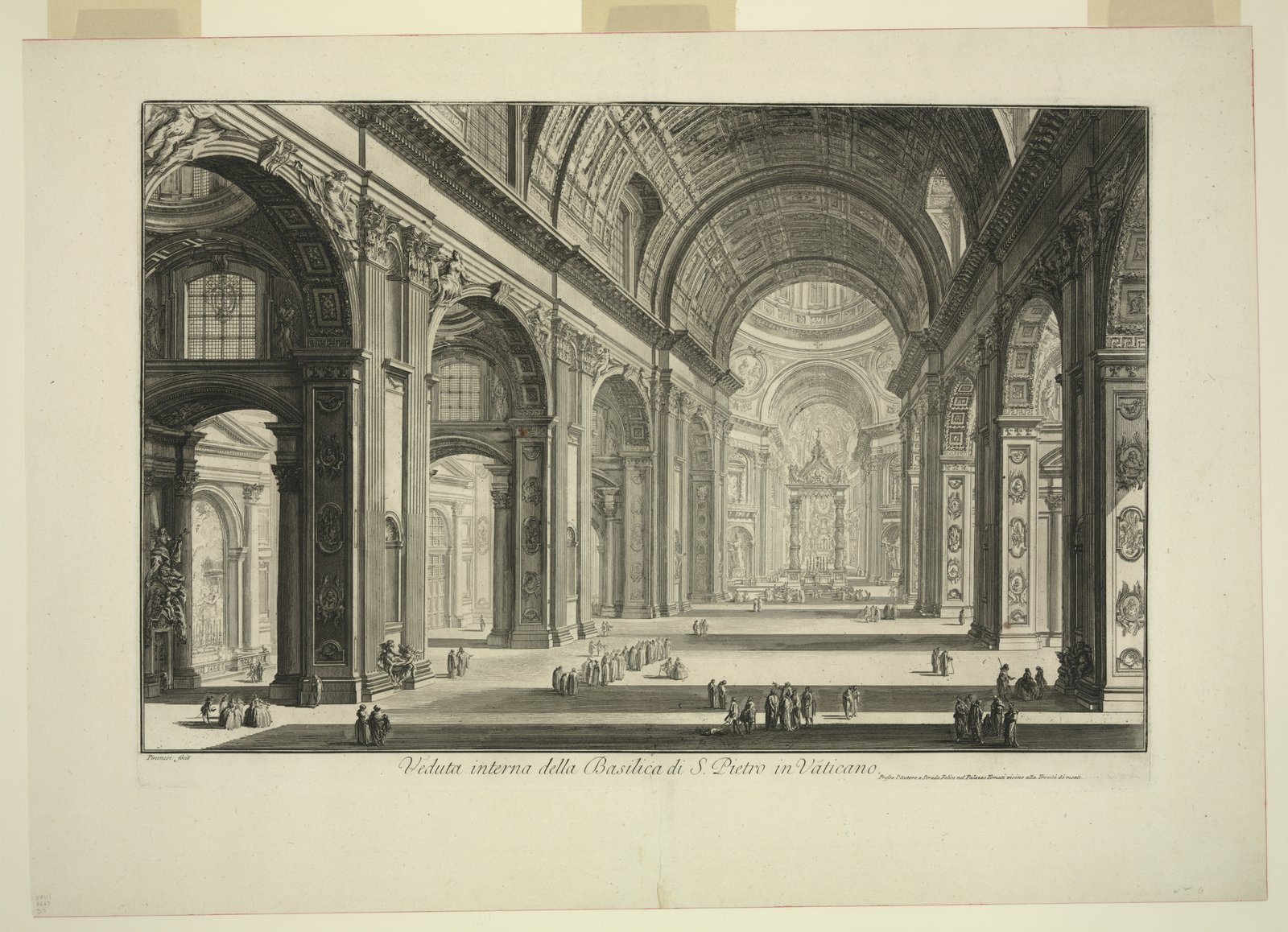
    The interior of St Peter's Basilica in a Piranesi engraving — same Vatican, different building. Bramante's real staircase sits in the Belvedere Palace, which most visitors never enter.
    Interior of St Peter’s Basilica by Piranesi, 18th century. Via Wikimedia Commons (public domain).

    Most people searching for “the Bramante Staircase” are looking at the wrong staircase. The famous double-helix spiral photographed at the exit of the Vatican Museums — the one you have seen a thousand times on Instagram, with the bronze balustrade and the light-well overhead — is not by Bramante. It is by an Italian architect named Giuseppe Momo, and it was built in 1932. Bramante’s real staircase is a different staircase, in a different building, four hundred and twenty years older, and unless you have booked a specific special-access tour, you have almost certainly never seen it.

    Almost every tourist blog and social post that names “the Bramante Staircase” is showing Momo’s 1932 ramp. Even reputable sources acknowledge this: Wonderful Museums, for instance, writes that “most people searching for the Bramante Staircase Vatican are actually picturing Giuseppe Momo’s 1932 double-helix ramp, not Donato Bramante’s original early-sixteenth-century spiral.” Wikipedia’s own solution to the confusion is to devote separate sections to “Original” and “Modern” and just describe them as two.

    Here is what each of them actually is.

    What Donato Bramante built in 1505

    Donato Bramante (c. 1444-1514) was the leading Renaissance architect working in Rome at the turn of the sixteenth century. His most famous project was the design for the rebuild of St Peter’s Basilica, started in 1506 and taken through by successive architects long after his death. Before that, in 1505, Pope Julius II commissioned him to redesign the Belvedere complex north of the papal apartments and connect it to the rest of the Vatican Palace.

    One piece of that commission was a spiral staircase, built inside a square tower of the Belvedere Palace. Wikipedia’s description is worth quoting in full: “The original Bramante staircase, in the Pio-Clementine Museum, was built in 1505 to a double helix design by Donato Bramante. It connects the Belvedere palace of Pope Innocent VIII to the outside and stands in a square tower of that building. The staircase was built to allow Pope Julius II to enter his private residence while still in his carriage, since walking up the several flights in heavy papal vestments would have been onerous.”

    Read that carefully. Bramante’s staircase is not a set of steps. It is a gently sloped continuous ramp built as a broad spiral, so that Julius could ride his horse (or be carried in a litter) all the way up to his private residence without dismounting. Around the central column, Bramante rotated the classical column orders as you climb — Tuscan at the base, then Doric, then Ionic, then Corinthian, and Composite at the top — a small architectural in-joke that would have delighted his humanist contemporaries.

    None of this is what you see on the Vatican Museums’ standard tour.

    What Giuseppe Momo built in 1932

    By the 1920s the Vatican Museums had a visitor-flow problem: a single monumental staircase at the exit could not manage the volume of tourists ascending and descending simultaneously. Pope Pius XI commissioned a new staircase specifically to handle two-way traffic. The architect was Giuseppe Momo (1875-1940), Turin-trained, who was already working on Momo’s larger project of redesigning the Vatican Gardens.

    Wikipedia describes what Momo delivered: “The modern double-helix staircase […] was designed by Giuseppe Momo, sculpted by Antonio Maraini and realized by the Ferdinando Marinelli Artistic Foundry in 1932. […] This staircase, like the original, is a double helix, having two staircases allowing people to ascend without meeting people descending.” Bronze balustrade cast by the Marinelli Foundry over travertine steps. A skylight overhead pulls daylight down the well.

    Mechanics matter here. Momo’s staircase is technically two ramps intertwined around a shared central well, with a common entry point at the top and a common exit at the bottom. You physically cannot meet someone walking the other direction. That solved the crowding problem, and it produced the visual effect that has made the staircase one of the most photographed spots in the entire Vatican Museums.

    Why the two are confused

    Momo’s staircase quotes Bramante’s directly. It uses the same double-helix logic (Bramante’s was also a double helix, per the Vatican’s own Pio-Clementine text — a fact the popular “single-helix ramp” description gets slightly wrong). It sits in the same complex. It is nearly always photographed. And when the caption goes up on Instagram, someone types “Bramante Staircase” because that is what they thought they had walked, and the search results feed the confusion for the next tourist.

    What makes it worse is that Momo’s staircase is genuinely beautiful. It deserves to be famous under its own name. There is no reason to keep giving Bramante the credit.

    When you actually see Momo’s staircase

    The Momo staircase is at the very end of the standard visit route. Walks in Rome puts it plainly: “The staircase is only open to visitors wishing to descend.” That is, it is an exit, not an entrance. You reach it after the Sistine Chapel and the long corridor sequence that takes you back toward the atrium.

    Included in any standard Vatican Museums ticket. No separate booking. It is where the Museums release you back onto Viale Vaticano. On a busy summer afternoon the queue to walk down (and photograph) it is a real delay; on the 08:00 morning slot it is close to empty by the time you get there.

    Photography rules on the staircase

    The Vatican Museums’ own useful-information page states verbatim: “It is permitted to take photographs, for personal and domestic use only, of the works in all areas of the Vatican Museums, apart from the Sistine Chapel.” Same page: “The use of tripods, stands, drones and/or professional equipment is not allowed; any eventual use must be authorised by the Directorate of the Museums and Cultural Heritage. The use of telescopic ‘selfie sticks’ is forbidden. Flash photography is strictly forbidden.”

    Which means: yes, hand-held phone and camera photos of Momo’s staircase are fine and normal. No, that tripod-and-slow-shutter shot you have seen from professional Instagram accounts is not permitted without written Museum authorisation. The staff at the top and bottom of the staircase enforce this quietly but consistently.

    How to actually see Bramante’s staircase in 2026

    Not via the standard Museums ticket. Not via the Vatican Gardens tour (a common assumption; the Gardens tour does not include the Belvedere Palace interior). The original Bramante staircase is only accessible on special-access guided tours sold as “hidden Vatican” or “closed-to-public-areas” experiences — the same kind of licensed private product that also unlocks the Cabinet of Masks, the Niccoline Chapel, and other normally-off-limits rooms.

    Group sizes are small (roughly twenty maximum). Prices are considerably higher than a standard skip-the-line ticket. And the tours generally run on weekday mornings only, in limited English-language slots. If you specifically want to see Bramante’s original, budget an extra half-day and a proper private-tour fee; the standard 08:00 skip-the-line will not get you there.

    Accessibility

    Momo’s staircase is the standard exit for the standard visit route, but wheelchair users can bypass it entirely. The Museums have an elevator alternative on the accessible exit route; ask any staff member for the accessible-exit signage from the atrium onward. The step-free path avoids the staircase without adding significant time to the visit.

    Two staircases, not one

    Two Vatican staircases, four hundred and twenty years apart, both named “Bramante” in the popular imagination and only one of them actually his. Momo’s is the more photographed and the more accessible, and it deserves its own credit line. Bramante’s is the older, more subtle, and mostly-hidden one, and it deserves the extra half-day if you want to see the room a Renaissance pope rode a horse up in 1505.

    Our Vatican tours page covers the private and special-access tour formats that include the original Bramante Staircase and other closed-to-public rooms. For the standard Museums visit that ends at Momo’s 1932 staircase, the Vatican Museums & Sistine Chapel skip-the-line ticket is what you want, ideally on the 08:00 slot when the exit queue is shortest.
  • The Vatican Necropolis (Scavi) Tour: How to Actually Get One

    Piranesi's engraving of St Peter's Basilica interior — the tour ends beneath the crossing, at the traditional site of the apostle's tomb
    Interior of St Peter’s Basilica, 18th-century engraving by Giovanni Battista Piranesi. Held at the Library of Congress. Via Wikimedia Commons (public domain).

    The Vatican Necropolis is the ancient burial ground several metres below the floor of St Peter’s Basilica. Guided visits run daily, capped at roughly 250 people, in groups of twelve. Booking is genuinely more opaque than any other Vatican experience, and almost every third-party guide you will find describes a process that has changed. Here is what actually works in 2026.

    What the tour is

    Under the Basilica floor sits a second-century Roman street of pagan and early-Christian mausolea. In the middle of that street, directly beneath the Papal Altar and Bernini’s Baldachin twenty metres above, is a small aedicula known as the Trophy of Gaius — the shrine early Christians already venerated as the tomb of the apostle Peter by around AD 160. Twentieth-century excavations under Pius XII (1940-1949) reached this shrine; on 26 June 1968, Paul VI announced that relics recovered from an adjacent niche in the “Graffiti Wall” had been identified as Peter’s, based on the epigrapher Margherita Guarducci’s work.

    The Scavi tour walks you along that Roman street, past the pagan mausolea, past the Graffiti Wall, and up to the shrine itself. Total duration: about sixty minutes. Group size: twelve, maximum. Guides are staff of the Fabbrica di San Pietro, not third-party operators.

    How to book, in 2026

    The primary booking channel is the Fabbrica di San Pietro’s online form at visite.basilicasanpietro.va. This replaced the legacy scavi.va email-first process; the older email address (scavi@fsp.va) is still cited by dozens of guide sites and appears in older Vatican communications, but the current portal is the reliable route.

    Fill in language preference, requested date and time, number of participants, a group representative’s name and email and phone, and full names plus ticket type of each participant. Payment is by credit card only. If you are approved, the payment link is time-limited; recent guidance is a five-day window (older sources cited ten), so check the exact deadline in your confirmation email.

    Acknowledgement of the request is usually quick. Full confirmation with the payment link can take weeks, and in peak season (April to October) that wait extends into months. Recent 2026 requests report anywhere from six weeks to fourteen weeks between initial request and confirmation. Plan on two to six months of lead time if you want a specific date; longer for July or the days around a canonisation.

    What it costs

    Current 2026 fees on the portal:

    • €20 full price.
    • €14 reduced (ages 10 to 17).
    • Credit-card payment only. No cash on arrival.

    You will still see €13 quoted on older third-party pages. That was the pre-portal rate and is no longer what the current booking system charges. Anyone advertising a “Scavi ticket” for €13 in 2026 is either working from old information or selling you something other than the official Fabbrica visit.

    Who cannot go, and what to know before you book

    Three restrictions matter:

    • Age minimum is 10. Under-10s are refused entry. This is a change from the previous threshold of 15 (still quoted in many third-party guides). A family with an eight-year-old cannot bring the child along and cannot leave them at the Bronze Door for the hour; make separate arrangements.
    • Wheelchair access: none. Steps at both entry and exit, and uneven ancient pavement throughout. The Fabbrica’s own FAQ is explicit that the Necropolis is not accessible to visitors with disabilities.
    • Physical conditions. Route is cramped and often warm. The Fabbrica specifically warns visitors with claustrophobia or heat-sensitive conditions against booking. A summer visit is a genuinely different experience from a winter one.

    Dress code is the same as the Basilica: shoulders and knees covered, no shorts or short skirts, hats off inside. Photography is forbidden entirely once you descend into the necropolis. No exceptions, and staff enforce it more strictly here than in the Basilica proper because the confined space of the ancient street makes flash and phone-held-aloft immediately visible.

    Languages and slot availability

    The tour runs in a rotating multilingual schedule. Official languages on the portal include Italian, English, Spanish, French, German, Portuguese, Dutch, Polish, Hungarian, and Japanese; smaller-audience languages (Czech, Romanian, Russian, Ukrainian, Slovak, LIS) are also selectable at booking time subject to guide availability. English slots run multiple times per day but not at every time slot. The portal’s live calendar shows exactly what is bookable on which day.

    The exit into the Basilica

    Here is the detail that most guides skip and that changes the practical value of the tour: the Scavi tour ends inside the Vatican Grottoes, and you exit up the steps directly into St Peter’s Basilica. You do not queue at the piazza security check on the way out. If your booking is on a day you also want to see the Basilica interior, the Scavi tour is your route in — you have already cleared the security check at the Arco delle Campane (Swiss Guard gate on the left-hand colonnade), the tour delivers you inside the Basilica, and you can walk the aisles, climb the Dome, or head straight to the Baldachin from where you emerged.

    Which means the honest way to plan a Scavi-day is: book the earliest slot the portal offers, aim to be at the Arco delle Campane fifteen minutes before your slot time, do the tour, emerge into the Basilica by mid-morning, and use the rest of the morning for the Baldachin, then the Pietà, then the Dome climb, without a second security queue.

    What the tour is not

    Two clarifications the Fabbrica’s own FAQ makes and worth naming explicitly:

    • The Vatican Grottoes are not the same thing. The Grottoes are the crypt below the Basilica floor holding the papal tombs; they are free, do not require booking, and are open daily from 09:00 with no age restriction. The Necropolis is the archaeological level several metres below the Grottoes, and needs the paid Scavi booking to access.
    • Photography and video are forbidden throughout. This is not “no flash” as elsewhere in the Basilica. It is no photography of any kind. Attendants will ask you to delete images taken.

    If the online portal is booked out

    If the visite.basilicasanpietro.va calendar shows no availability on your dates, three fallbacks exist:

    • Email the Fabbrica’s visits office (visiteguidate@fsp.va) explaining flexible dates. Slower and less reliable than the portal but occasionally surfaces cancellations.
    • For American pilgrims specifically, the Pontifical North American College’s Bishops’ Office for United States Visitors sometimes has allocated Scavi slots for group pilgrimages. Contact via pnac.org.
    • Move your dates. Peak-season slots go months ahead; the winter months around November and February consistently have more availability.

    Our St Peter’s Tomb tickets and tours page tracks the current booking mechanics for the Scavi tour and links to the Fabbrica portal. If you are planning the Scavi as part of a broader Basilica morning, our half-day at St Peter’s post covers the Dome climb, Baldachin, Pietà, and Grottoes sequence that pairs naturally with a Scavi exit into the Basilica interior.

  • A Half-Day at St Peter’s: 08:00 to Lunch

    Piranesi's engraving of St Peter's Basilica interior — the room a 07:00 arrival gets almost to themselves for the first hour
    Interior of St Peter’s Basilica, 18th-century engraving by Giovanni Battista Piranesi. Held at the Library of Congress. Via Wikimedia Commons (public domain).

    St Peter’s Basilica opens at 07:00 daily. Security queue at that hour is essentially walk-through even in July. By 10:00 the same queue is sixty to ninety minutes. Gap between those two states is why a half-day at St Peter’s starts before dawn on the alarm clock and not on any tour operator’s suggested itinerary.

    Here is the sequence for a non-Wednesday morning between 06:45 and lunch. Wednesday needs its own paragraph, added at the end.

    06:45: Ottaviano-San Pietro metro

    Line A drops you at Ottaviano-San Pietro-Musei Vaticani, roughly eight minutes on foot from the north edge of St Peter’s Square down Via Ottaviano. First metro through Termini arrives a few minutes after 05:30, so 06:45 at Ottaviano is easy. On foot from the metro exit to the square: 8 to 10 minutes. From the edge of the square to the security screening under the right-hand colonnade: another 2 to 4 minutes, depending on where the queue tail sits.

    Budget fifteen minutes from metro exit to security. Bring a light layer; the Basilica interior stays notably cooler than the outside in summer.

    07:00: security screening, walk-through

    Security is airport-style: bag on the belt, walk through, collect. At 07:00 the crowd is a few dozen pilgrims and a scattering of tourists. Screening for a bag-only visitor is measured in seconds rather than minutes. You are inside the atrium by 07:08.

    Dress code is checked at the same station. For men, long trousers are the safe choice at the Basilica; enforcement on shorts is stricter here than at the Museums even though the written rule reads the same. Shoulders covered on both sexes, hats off inside.

    07:15: the nave

    Walk straight down the central aisle. At this hour the nave holds perhaps thirty people distributed along its 187 metres of marble floor. The Baldachin, Bernini’s twenty-nine-metre bronze canopy over the Papal Altar, is directly ahead, cleaned in 2024 for the first time since 1758 and reading as gold again rather than as the darkened brown of pre-restoration photographs. Give yourself five minutes standing at the crossing to notice how the four Solomonic columns line up with the four crossing piers and how the sight-line through the Baldachin catches Bernini’s Cathedra Petri in the apse behind it. That alignment is deliberate; it took Bernini thirty years to build the two works and stage them as one image.

    07:35: the Pietà, behind glass

    Turn back toward the entrance and walk to the first chapel on the right. Michelangelo’s Pietà, carved when he was twenty-four, sits behind a nine-pane shatterproof-glass installation that went in during 2024. Reviewers of the new glass note that it slightly softens the marble; the viewing distance is about four to five metres from the barrier. Michelangelo’s signature on the Virgin’s sash is legible from that distance if you know to look for it — it is the only work Michelangelo ever signed, added late after he heard the sculpture being attributed to another artist.

    08:00: the Confessio, and around the crossing

    Descend the small sunken chapel at the crossing (the Confessio, kneeling statue of Pius VI, ninety-nine oil lamps, view down onto the traditional site of Peter’s tomb). Walk the four crossing piers, each holding a colossal relic-statue — Longinus’s spear, Veronica’s veil, a fragment of the True Cross, and the return of St Andrew’s head. Between the piers, look up into the drum of Michelangelo’s dome, 42 metres in diameter, 136.57 metres from the floor at the top of the cross.

    08:30: Cupola ticket kiosk, then the climb

    The Dome ticket kiosk is inside the portico on the right-hand side and opens at 07:30 from April through September. Prices at the on-site kiosk: €10 for stairs only, €15 with the elevator that lifts you to the roof-terrace level and saves the first 231 of the 551 total steps. The remaining 320 steps to the lantern are a narrow, curving climb that leans progressively as the dome shell narrows; the walls of the final section are the physical dome you were looking up at from the nave. Not for anyone with claustrophobia or knee trouble.

    Up and down at an unhurried pace, including time on the roof terrace and at the lantern viewing gallery: sixty to ninety minutes.

    10:00: back in the Basilica, then the Grottoes

    Descend the Dome, take five minutes on a bench in the nave to let your legs recover, and cross to the entrance to the Papal Grottoes at the base of the St Andrew pier. The Grottoes open at 09:00, so by 10:00 there is a small queue but not the walls-of-people it becomes after 11:30. Entry is free; photography is forbidden entirely once you descend. It runs beneath the Basilica floor and holds the tombs of a substantial number of popes going back to the Renaissance. (John Paul II, once buried here, was moved up to the Chapel of St Sebastian in the Basilica proper on 1 May 2011 for his beatification.) Twenty minutes is enough for a first walkthrough.

    11:00: one last loop, then out

    Exit the Grottoes, take a final slow walk along one of the side aisles you skipped, and head for the exit on the left-hand side of the entrance. By 11:30 you are back on the piazza. The security queue outside is now ninety minutes long. You have used the morning correctly.

    11:30: lunch in Prati

    Two neighbourhoods immediately behind the Vatican are the practical lunch options:

    • Prati, the residential grid north of the Vatican wall, is where locals eat. Better food-to-price ratio than Borgo, and the trattorie along Via Cola di Rienzo and its side streets open for lunch service around 12:30. Kitchens run to 14:30 or 15:00 for lunch, close mid-afternoon, then reopen from 19:30 for dinner.
    • Borgo, the tight lattice of streets between the Basilica and Castel Sant’Angelo, is closer but more tourist-priced. Anything directly on Via della Conciliazione charges Vatican-frontage rents and cooks accordingly. If you eat in Borgo, walk one street north or south of Via della Conciliazione for a fair price.

    Reserve if you can; on a summer Saturday the good Prati places fill by 13:00. If you are not reserving, aim for a 12:15 walk-in.

    The Wednesday warning

    On Wednesday mornings the Papal Audience typically runs from 10:00 to about 11:00 in St Peter’s Square (or the Paul VI Audience Hall in cold months). During the audience itself the Basilica is closed to visitors, reopening around 12:30. Which means the Wednesday version of this half-day has to end by 09:30. Get in at 07:00, do the Baldachin and Pietà and Confessio, skip the Dome climb, be out by 09:15. Or skip Wednesday entirely for the Basilica visit and put it on a Tuesday or Thursday.

    Also: on some summer Wednesdays the audience itself takes place inside the Basilica rather than the Square. Check the weekly schedule on vatican.va before you plan a Wednesday morning specifically for the Basilica.

    The one same-day combination worth knowing

    If you have only one day for both the Basilica and the Vatican Museums, do not follow this Basilica morning with a Museums afternoon. The Museums security queue peaks between 09:30 and 13:00, and a 14:00 arrival is workable but tight — the Museums stop admitting new visitors at 18:00 and you will want more than four hours.

    The counter-intuitive better plan: do the Museums in the morning and the Basilica in the afternoon. Book an 08:00 skip-the-line Museums slot, walk the standard route, and exit via the group-only Sistine-to-Basilica shortcut at the front-right corner of the Sistine Chapel (available only if you are on a guided tour with that access). That shortcut drops you directly into the narthex of St Peter’s, skipping the whole outdoor security queue at the piazza side, which by then is at its worst. You get both sites in one day with one security screening instead of two.

    Our St Peter’s Basilica tickets and tours page covers reserved-entry slots that skip the outdoor queue, the official audio guide, and the Necropolis (Scavi) tour that lets you stand at the second-century aedicula directly beneath the Baldachin. For the Museums morning that pairs with a Basilica afternoon via the internal shortcut, our VIP early-entrance guided tour is the format that includes the shortcut. And for the first-hour version of the same argument, applied to the Museums instead of the Basilica, see our first hour at the Vatican Museums post.

  • You Do Not Need a Guide for the Sistine Chapel. You Do for Everything Before It.

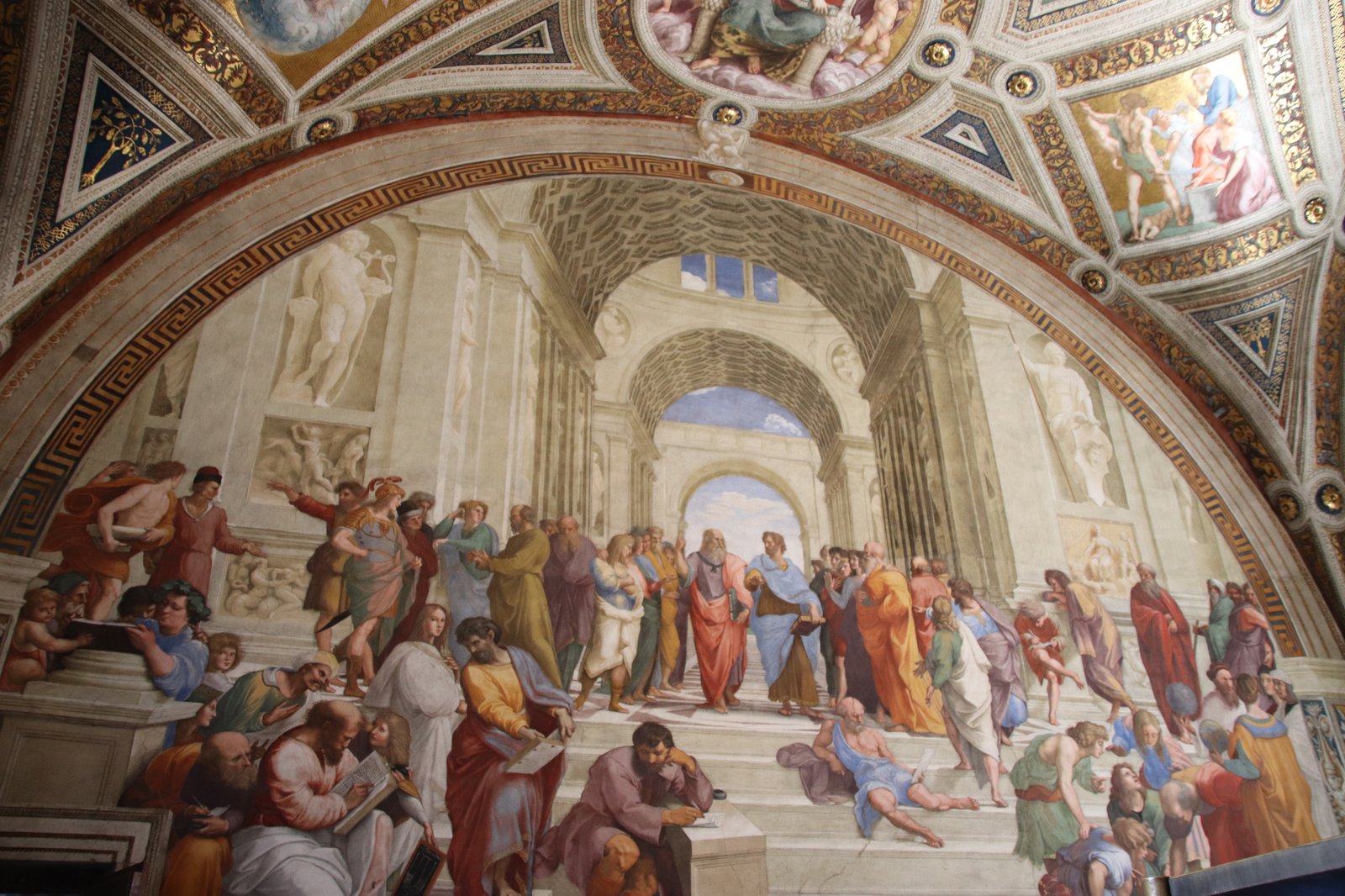
    Raphael's School of Athens fresco — the kind of room where a human guide adds more value than an audio guide because the composition is layered with argument you can miss
    The School of Athens by Raphael (1509-1510), Stanza della Segnatura. Photo by Gary Todd via Wikimedia Commons (public domain).

    Most first-time visitors to the Vatican Museums book a guide specifically for the Sistine Chapel. That is the exact wrong way round. Sistine is the room where a guide is at their weakest. Rooms you walk through on the way to Michelangelo’s ceiling (the Gallery of Maps, the Raphael Rooms, the Pio-Clementine sculpture galleries) are where a licensed human guide is worth their fee and an audio guide is not.

    This is an argument the Vatican itself makes, quietly, in a line most visitors do not read.

    What the Vatican’s own rulebook says

    From the Vatican Museums’ Useful information for visitors page: “Guided tour groups, although equipped with radio headsets, will receive all the relevant art-historical information prior to their entry in the Sistine Chapel.” Also: “During the visit to the Sistine Chapel visitors are kindly requested to observe absolute silence.”

    Read those two sentences carefully. Even a paid, licensed tour with radio headsets is not allowed to lecture inside the Chapel. Guides must brief you before you cross the threshold and then stay quiet once you are through the door. Attendants shush audibly and can escort out anyone talking above a whisper.

    Which means the money you pay for a guided Sistine visit is really money you pay for a fifteen-minute pre-brief on Michelangelo’s ceiling, delivered in a corridor. That is worth something. It is not worth the premium some tour operators charge for the “Sistine Chapel guided experience.”

    The audio guide covers the Sistine perfectly well

    The Vatican Museums’ official Audioguide costs €8, is available in twelve languages (including a couple you would not expect — Ukrainian, Korean, Japanese), and runs to roughly three hours of commentary across the standard route. Rent one at the entrance turnstiles in the Courtyard of the Cuirasses, or pre-book with your ticket.

    For the Sistine specifically, the audio guide’s Michelangelo track is thorough. It walks you through the ceiling’s nine central Genesis panels, the twelve prophets and sibyls, the corner spandrels, and the Last Judgement on the altar wall. You listen at your own pace, sitting on one of the stone perimeter benches. Nobody around you is being lectured. The room does the work.

    What the audio guide cannot do is the specific job a good human guide does elsewhere in the Museums — which is where the argument for spending on one starts.

    The Raphael Rooms are where a guide earns their fee

    Stanza della Segnatura contains the School of Athens on one wall and the Disputation of the Most Holy Sacrament on the wall opposite. Each fresco is a specific theological or political argument dense with cross-references. Raphael painted Leonardo da Vinci into the face of Plato. Michelangelo is generally accepted to appear as Heraclitus in the foreground of the School of Athens, added after Raphael had seen the Sistine ceiling. Raphael painted himself into the far right in a black beret, watching. The three other rooms — the Stanza di Costantino, the Stanza di Eliodoro, and the Stanza dell’Incendio del Borgo — each hold their own layered arguments.

    All of this is legible with an audio guide. But the difference between reading a fresco under a track that walks you through it in five minutes and standing in front of it while a licensed guide points and unpacks the argument at your pace is genuinely large. Raphael Rooms reward being talked at; the Sistine does not, because you are not allowed to be talked at inside.

    The Gallery of Maps hides a political argument

    Ignazio Danti’s forty frescoed maps between 1580 and 1583 look like decoration. They are not. Pope Gregory XIII commissioned them as a post-Tridentine assertion of Catholic Italy under papal spiritual sovereignty. Maps on the west wall show the territories washed by the Tyrrhenian Sea; on the east, the Adriatic. Eight end panels bracket the room’s argument between naval defence of Christendom (Malta 1565, Lepanto 1571) and papal commercial reach (Genoa, Venice, Ancona, Civitavecchia).

    Almost none of this is visible to a first-time visitor without briefing. An audio guide describes what you are looking at. A good human guide explains why it is arranged this way and what point the room is making. Both approaches take about the same amount of time; only one changes what you see.

    The Pio-Clementine needs the sequence

    Three sculptures in the Pio-Clementine galleries carry the weight of the whole Museums collection: the Laocoön Group, the Apollo Belvedere, and the Belvedere Torso. Each is worth stopping in front of; the sequence — how each influenced the next, and how all three were rediscovered in the Renaissance and shaped Michelangelo’s own thinking — is where a guide provides the value. An audio guide gives you three self-contained tracks. A guide gives you an argument connecting them.

    How to spot a licensed guide in 2026

    Italy’s tour-guide licensing regime changed in 2024. Law 190/2023 replaced the old patchwork of regional patentini with a single national qualification, and guides who pass are entered in the Elenco Nazionale delle Guide Turistiche maintained by the Ministero del Turismo. The first national exam ran in 2025 with a pass rate under two per cent — around 222 successful candidates from 12,000 who sat the written screening. A second national exam is running in 2026.

    In practice, almost every working Vatican guide today holds the older Regione Lazio patentino from before the reform. Legacy licences remain valid and holders were rolled into the national register. What matters for a visitor is the same as it always was: ask to see the badge before you hire. Licensed guides carry an ID card and are legally required to display it while working.

    Two signals that a guide is not licensed: they will not show a badge, and they will promise to talk to you inside the Sistine Chapel. A licensed guide knows that neither the rules nor the attendants will let them do that.

    What to actually book

    The move that reliably makes the Museums worth the ticket price is:

    • Book a licensed, group-limited guide for the run from Cortile della Pigna through the Gallery of Maps, the Raphael Rooms, and the walk to the Sistine door. Two hours is enough. The guide’s job is to point, argue, and cross-reference in the rooms where those things are visible.
    • Enter the Sistine Chapel silent. Sit on a stone bench along the wall. Listen to the audio guide’s Michelangelo track. Give the room fifteen to twenty minutes. Do not try to combine listening with a running dialogue.
    • Do not pay extra for a “Sistine Chapel guided experience.” The Vatican’s own rules mean it cannot be what the marketing implies. What you are paying for is a pre-brief in a corridor, and that pre-brief is delivered on any competent guided tour already.

    Our VIP early-entrance guided tour combines the two — a licensed guide walking you through the pre-Sistine rooms, arriving at the Chapel around the time the standard 08:00 slot begins to fill, with the guide going quiet at the door as they are supposed to. If you prefer the pre-brief without the guided walk, the Vatican Museums & Sistine Chapel skip-the-line ticket plus a €8 audio guide from the entrance is the reliable budget answer.

    Book the room you can be talked in, not the room you cannot.

  • The Papal Audience: What Happens in the First Ten Minutes

    The Papal Audience: What Happens in the First Ten Minutes

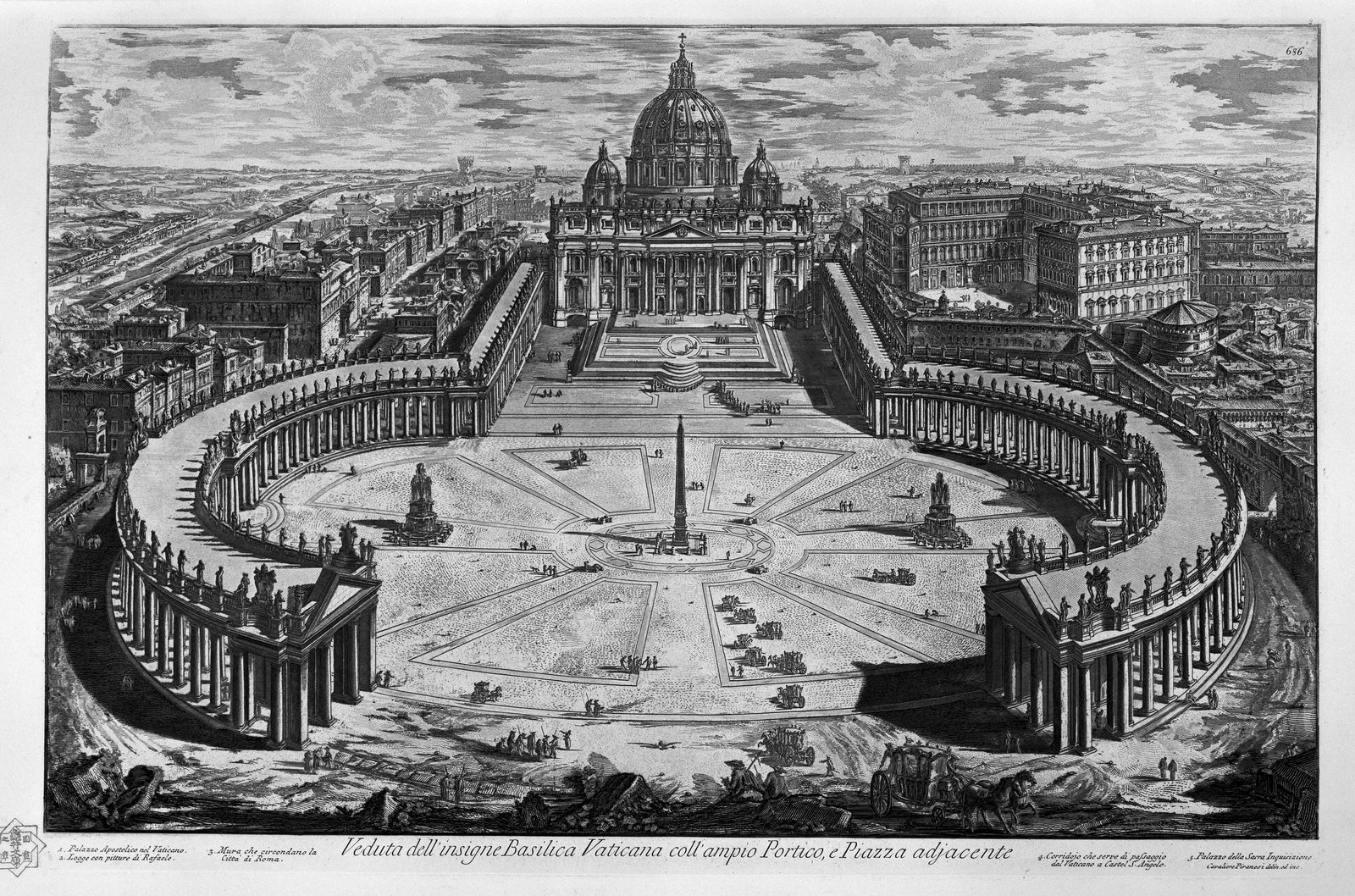
    Piranesi's engraving of St Peter's Square — the space that fits up to eighty thousand on a Wednesday morning with standing during a Papal Audience
    St Peter’s Square by Giovanni Battista Piranesi, 18th century. Via Wikimedia Commons (public domain).

    Just before 09:30 on a Wednesday morning in St Peter’s Square, the crowd of ticketed pilgrims quiets, and eyes turn toward the Arch of the Bells on the left side of the Basilica facade. A moment later the white Popemobile emerges, moves slowly into the piazza, and begins a circuit through the seated sections. The next ten minutes are the most concentrated part of the whole audience: babies handed up, blessings given, the pope working the crowd before he takes his seat at the sagrato and the catechesis begins.

    Most guides describe the Papal Audience in schedule terms. What follows is the mechanics: what happens step by step, in what order, and how to prepare.

    Getting a ticket

    Audience tickets are free. Since early 2025 the Prefecture of the Papal Household has run an online request form at eventi.pontificalisdomus.va, which supplements the older fax and email channels. Requests should go in at least two weeks ahead, and groups over ten need to reserve well earlier than that. Tickets are collected the day before or early the morning of the audience at the Bronze Door under the right-hand colonnade.

    American pilgrims are typically routed through the Bishops’ Office for United States Visitors to the Vatican at the Pontifical North American College. That office handles requests at visitorsoffice@pnac.org and can be a faster route than the general Prefecture form.

    05:30 to 07:30 — the pre-dawn queue

    If a good seat matters to you, arrive far earlier than you think you need to. Security screening at the piazza entrances typically opens around 07:30 for a 10:00 audience. Pilgrims who want front-area seats begin queueing at the barriers around Via della Conciliazione from about 06:30 or earlier. This is not a hyperbole for a lively summer Wednesday; the front rows within each ticketed section fill within minutes of gates opening.

    Bring water, a hat, and a light layer. Rome mornings from June through September can be twenty degrees by 07:00 and thirty by 11:00; the plastic chairs sit in direct sun once it clears the colonnade.

    07:30 to 09:00 — security and the scramble

    Security opens at 07:30 and gates close around 09:00. Screening is airport-style: bag scan, metal detector, walk through, collect. Dress code enforcement is stricter here than at the Museums door: shoulders and knees covered for both sexes, no shorts of any length for men, hats off. Vatican Gendarmerie and Italian police handle the approach cordon; ushers and stewards inside the piazza direct crowd flow into the ticketed sections but do not assign seats.

    Within each section, seating is first-come first-served. Tour groups do not get automatic priority over individuals. Only four categories have reserved zones: newlyweds within two months of their wedding (sposi novelli), the sick and disabled, a boxed VIP area beside the papal canopy, and clergy in cassock. Each of those requires a separate request through the Prefecture.

    09:30 — the Popemobile appears

    White Popemobile emerges from the Arch of the Bells at the left side of the Basilica facade at around 09:30, and that is the moment the audience actually begins for most of the crowd. It works a slow loop through the aisles between the seated sections, stopping frequently. Reported circuit lengths vary between about twenty and thirty minutes depending on the crowd size and the number of stops.

    Two things happen during this circuit that most first-time attendees do not know to expect:

    • Babies handed up. Papal ushers walk alongside the Popemobile and select infants from the aisles to pass up to the pope, who kisses or blesses them briefly before handing them back. There is no formal request procedure. What works is being close to the aisle with a small child visible; ushers do the selection. This practice has continued under Leo XIV, who took the name Leo after his May 2025 election following the death of Francis.
    • Individual greetings from the aisle. Pilgrims along the aisle who catch the pope’s eye will sometimes be greeted directly, occasionally handed something to sign or bless, occasionally spoken to briefly in whatever language works. This is not scheduled and no rule guarantees it, but it happens throughout the circuit.

    10:00 — the audience proper begins

    By roughly 10:00 the Popemobile has completed its circuit and Leo XIV is seated at the sagrato in front of the Basilica facade under a small awning. Format from that point runs a well-established sequence:

    • A short Scripture reading, in Latin or Italian.
    • The pope’s Italian catechesis. In 2026 this has been a series on the documents of the Second Vatican Council: Dei Verbum and Lumen Gentium were the completed cycles earlier in the year; Sacrosanctum Concilium is the live cycle running into July.
    • Multilingual summaries and greetings to pilgrim groups from designated multilingual clerics of the Secretariat of State. Standard rotation: French, English, German, Spanish, Portuguese, Polish, Italian, plus Arabic (a permanent part of the sequence since October 2012).
    • The Pater Noster sung in Latin by the whole assembly.
    • The Apostolic Blessing, not to be confused with the Urbi et Orbi which is reserved for Christmas, Easter, and immediately after a conclave.

    The whole thing concludes close to 11:00.

    The blessing at close, and what it covers

    At the closing Apostolic Blessing, longstanding practice holds that any religious articles you are carrying — rosaries, medals, crucifixes, holy cards, prayer books — are blessed if you hold them up during the blessing itself. Absent family members named in your intention are also included. No 2026 formal guidance from the Prefecture has altered this.

    If you brought objects specifically for blessing, hold them visible during the Apostolic Blessing and not before. The blessing at the end covers this; earlier segments of the audience do not.

    After the audience

    Leo XIV typically greets the VIP and sick sections briefly at the sagrato after the closing, then withdraws into the Basilica or the Apostolic Palace. He does not linger in the general crowd. Piazza dispersal is fast — the space substantially clears within thirty to forty-five minutes, though the immediate exits and the walk to Ottaviano-San Pietro metro can be crowded for roughly the first hour.

    If your day includes the Vatican Museums after the audience, expect thicker security queues at the Museums entrance for the same reason. The Museums do not close for the audience but the surrounding foot traffic peaks at exactly the moment the piazza clears.

    When the audience is not held

    Two windows to know about:

    • Most of July and part of August — audiences are typically suspended for the summer when the pope moves to Castel Gandolfo. Wednesdays in this window do not have a General Audience in Rome.
    • Any Wednesday the pope is travelling — apostolic journeys, hospitalisations, or major state functions can cancel a single audience. Announcements come through vatican.va and the Prefecture’s mailing list.

    Between October and Easter the audience moves indoors to the Paul VI Audience Hall behind the left arm of the colonnade — same format, roughly six thousand seats instead of the piazza’s ~50,000 seated capacity (up to ~80,000 with standing overflow on Easter-adjacent Wednesdays), no Popemobile circuit through the crowd. If you have a choice, the outdoor summer audience is the more atmospheric of the two.

    For the current 2026 opening calendar including which Wednesdays fall inside the audience season, see the Vatican Museums opening hours 2026 guide. If you are planning around a Wednesday and expect to combine the audience with a Museums visit, our post on why Wednesday mornings are a bad time to visit the Museums covers the knock-on effects that compound with audience day.

  • The Gallery of Maps: What Ignazio Danti Was Actually Doing in 1580

    The Gallery of Maps: What Ignazio Danti Was Actually Doing in 1580

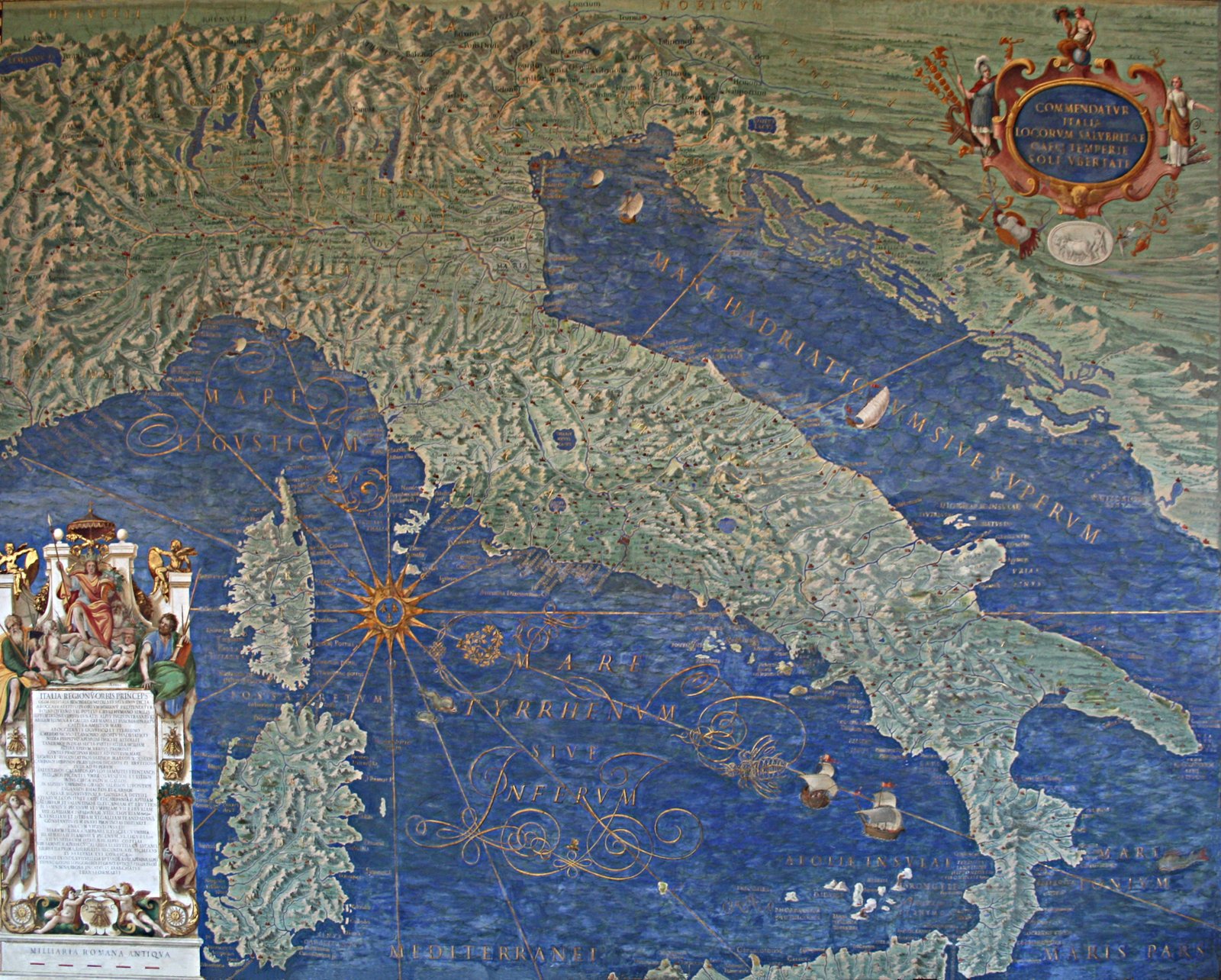
    Ignazio Danti's map of Italy, Corsica and Sardinia in the Gallery of Maps, one of the forty frescoed panels commissioned by Pope Gregory XIII in 1580
    Ignazio Danti, Italy with Corsica and Sardinia, from the Gallery of Maps (1580–1583). Via Wikimedia Commons (public domain).

    Walk the Vatican Museums’ standard route and you will spend somewhere between six and ten minutes inside the Gallery of Maps. A hundred and twenty metres of corridor, six metres wide, gilded ceiling above, forty large frescoed maps of Italy on the walls. Most visitors register it as one of the more beautiful passages between the Egyptian rooms and the Raphael Rooms, take a few photographs of the ceiling, and keep moving.

    What almost nobody explains is what the room is actually doing. Ignazio Danti painted these maps between 1580 and 1583, on commission from Pope Gregory XIII, in under two years. The Gallery is a political document as much as it is a decorative one. Once you know what it is arguing, it is difficult to walk through it the same way again.

    Who Danti was, and how he ended up in Rome

    Pellegrino Rainaldi Danti was baptised on 29 April 1536 in Perugia. He took the name Ignazio (sometimes Egnatio) on entering the Dominican Order in 1555, and spent his working life as a mathematician, astronomer, and cosmographer. He died Bishop of Alatri in 1586.

    Before Rome, Danti worked for Cosimo I de’ Medici in Florence from about 1567. His main project there is the reason he became famous: the map cupboards in the Sala delle Carte Geografiche of the Palazzo Vecchio, a Medici cabinet of the known world drawn on the inside of two dozen wooden doors. When Cosimo died in 1574, Danti fell out of favour with the new grand duke Francesco I and was effectively expelled from Florence. Gregory XIII summoned him to Rome, appointed him papal mathematician, put him on the calendar-reform commission that eventually produced the Gregorian calendar in 1582, and made him Bishop of Alatri in 1583.

    Somewhere in that busy decade, Gregory asked him to fresco a corridor.

    The commission and its message

    Construction of the Gallery ran from 1578 to 1580 under the architect Ottaviano Mascherino. Danti’s fresco programme ran from 1580 to 1583. The Vatican Museums’ own summary of the room says Gregory wanted “the entire peninsula to scale” — meaning a coherent, visual, papacy-sponsored cartographic survey of Italy at that specific historical moment.

    Why? Because 1580 is a specific moment for the Catholic Church. The Council of Trent had closed only seventeen years earlier. Protestant Europe had fractured off. Italy was, from Gregory’s angle, the physical territory of a spiritually unified Catholicism, and the room’s forty maps are an assertion that this territory can be surveyed, catalogued, and displayed as one thing under one pope. Every regional map is a statement that this valley, this island, this coastline is part of a single peninsula whose spiritual sovereign is the man walking the corridor with you.

    The eight naval and city panels at the two ends of the corridor make the argument more directly. At the current entrance end are the Siege of Malta (1565) and the Battle of Lepanto (1571) — two victories in which Catholic forces held off Ottoman advance and which the Vatican still cited as evidence of divine favour a decade after the fact. Flanking them: Elba and the Tremiti Islands. At the opposite end are the four great papal-era ports — Civitavecchia, Genoa, Venice, and Ancona. Together, the end-panel programme brackets the maps between the Church’s naval defence of Christendom and its commercial reach across the Mediterranean.

    How the room is organised

    Stand in the middle of the corridor and orient yourself with the Apennine spine of Italy. Maps on the west wall show regions washed by the Tyrrhenian Sea; maps on the east wall show regions washed by the Adriatic. Sequence runs roughly north to south as you walk toward the Sistine end. Each of the thirty-two regional maps is about three by four metres — large enough that you can read individual coastal towns from four or five metres away, small enough that they do not overwhelm the corridor’s proportions.

    Above your head, the ceiling holds fifty-one small painted panels set into stucco frames. Each scene is tied thematically to the geography of the map directly below it: a saint, a miracle, a battle, an event from Church history that happened in that region. Danti himself did not paint the ceiling. He supplied the iconographic and geographic design; the actual brushwork was done by a Mannerist workshop led by Cesare Nebbia and Girolamo Muziano.

    Notice this if you notice nothing else: the ceiling and the maps are talking to each other. A map of the Marche below and the miracle of a Marche-born saint above. A map of Sicily and Sicilian martyrs. Every square metre of both surfaces is doing the same argumentative work.

    How accurate the maps actually are

    Danti drew on Ptolemy’s ancient coordinates, medieval portolan sea charts, Roman itineraries, and whatever contemporary regional surveys he could commission. Where he had time, he sent surveyors into the field. Where he did not, he worked from what was available.

    The maps are surprisingly usable as maps, given the era. They are not, however, twenty-first-century cartography, and it is worth resisting the temptation guides sometimes indulge — quoting a specific “eighty per cent accurate” figure for the whole gallery. That number circulates in tour writeups and has no scholarly citation behind it. Danti’s coastlines drift, his mountain ranges are stylised, and specific towns migrate by a few kilometres. But he was working four hundred and forty years ago with a small workshop under a papal deadline. The wonder is not that the maps contain errors; the wonder is that they contain so few.

    The 2016 restoration

    The room you walk through today was cleaned and restored between September 2012 and April 2016, formally reopened on 27 April 2016. The California Chapter of the Patrons of the Arts in the Vatican Museums funded the project through a “map adoption” model that let individual donors sponsor a single panel; total cost was somewhere in the vicinity of $2.5 million.

    Photographs of the room before and after the restoration are startling. Centuries of soot and oxidation had darkened the ceiling to a uniform amber. The 2016 unveiling revealed the underlying palette — bright blues in the sea panels, gold that reads as gold in the ceiling stucco. If you visited before 2016, the room you saw was a shadow of the room Danti painted. If you have only visited since, you have been seeing something closer to what Gregory XIII’s court saw in 1583.

    How to actually look at the room on a visit

    The Gallery of Maps sits in the standard one-way route between the Gallery of Tapestries and the Raphael Rooms, and by design it is a walk-through corridor rather than a stop-and-look room. That is why the space bottlenecks between about 10:00 and 15:00 on a normal day.

    Two practical suggestions if you want more than the ten-minute walkthrough:

    • Book the 08:00 slot on a weekday. By 08:45 you can walk the entire hundred and twenty metres without another tour group in it. Any single map is available to you for as long as you want to stand in front of it. Between 09:15 and the end of the day this window closes.
    • Look up first, then down. Most visitors photograph the ceiling because it is the more immediately spectacular of the two surfaces. But the ceiling makes more sense once you have read the map underneath. Reverse the standard order: pick a map first, learn what it is showing, then look up at the ceiling panels above it, and the two surfaces will resolve into one argument.

    Gallery of Maps is one of the rare Vatican rooms where a return visit rewards a second reading more than a first one does. On a first visit you register the beauty. On a second, you notice that the maps are not neutral. On a third, you can hear Gregory XIII making his case.

    For a fuller breakdown of the Gallery of Maps and its place in the standard visit, see our Gallery of Maps guide. For the ticket that gets you into the room on the 08:00 slot, our Vatican Museums & Sistine Chapel skip-the-line ticket is the standard option.

  • The Same Painting, Three Visits Apart

    Raphael's School of Athens fresco in the Stanza della Segnatura, Vatican Museums — the painting this essay returns to at three different ages
    The School of Athens by Raphael (1509-1510), Stanza della Segnatura. Photo by Gary Todd via Wikimedia Commons (public domain).

    I have stood in front of Raphael’s School of Athens three times, at eighteen, thirty, and fifty-five, and each time I have looked at a different painting. Nothing on the wall has moved. Raphael finished the fresco in 1511 and it has held its position on the east wall of the Stanza della Segnatura ever since. Yet the room is not the same twice, and the fresco is not the same on a return, and this small unsettling fact is one of the reasons I keep going back.

    This is a short essay about that. If you have never been, some of what follows may sound abstract. If you have been once, some of it may sound familiar. If you have been three times, you already know.

    At eighteen

    The first visit was on a student trip, in a hurry, in an unhelpful red audio guide, in shoes that were the wrong shoes for the day. Memory of that room: smaller than the photographs suggested, hotter, darker in the corners. Standing in front of the fresco, I was surprised that I could see any of the individual faces at all, because the reproductions I had studied looked crisper than what my eye was actually taking in from a distance of six metres in a room full of other students on other trips.

    What I fixed on that first time were the two central figures under the arch. Plato on the left, older, white-bearded, pointing his index finger up. Aristotle on the right, holding a book, hand extended horizontally with the palm facing down. My audio guide told me these were about the theory of forms versus empirical knowledge and I nodded along, half-hearing, because the philosophy course I would take the following year had not yet started and I did not have the vocabulary to hold any of it. The painting was interesting because I had been told it was interesting. I did not disagree; I just did not have my own reason yet.

    I looked for four minutes and left, and if you had asked me afterwards to name a single specific detail I remembered, it would have been the temperature of the room and the shoes.

    At thirty

    The second visit was on my own initiative, twelve years later, on a trip to Rome that had been booked to give myself space after a difficult job change. I had my own philosophy degree by then and, more usefully, a working sense of what it was for. I had also learned that Leonardo da Vinci is a widely-accepted candidate for the face of Plato — long hair, beard, features that match Leonardo in his late fifties, sketched in by Raphael as an homage. So this time I was not looking at Plato. I was looking at Leonardo standing in for Plato, and that changes what the pointing hand means.

    I noticed other things I had not seen before. Diogenes lying half-clothed on the steps, reading, indifferent to the whole gathering above him. The pair of astronomers on the far right, holding the celestial and terrestrial globes, and beside them a beardless young man in a black beret looking directly out of the painting at me. That is Raphael. He painted himself in. Once you have seen him you cannot un-see him, and once you have registered that he chose to stand in that particular corner rather than any other, the composition rearranges around him.

    What I could not shake at thirty was Heraclitus. Not because I knew anything about him then, but because there is a figure in the front-centre foreground, leaning on a block of marble, brooding, writing, isolated from the group. He does not look like anyone else in the room. My guidebook told me this figure was added after the rest of the fresco was largely finished, and that it is generally accepted to be a portrait of Michelangelo, drawn in after Raphael had seen the first half of the Sistine ceiling, unveiled on 14 August 1511. That face is grave and heavy in a way no other face in the room is.

    At thirty I read that as art-historical detail. At fifty-five I would read it differently.

    At fifty-five

    The third visit was booked on the way home from a funeral. Not a specific plan; I had a Rome layover and I moved my flight to give myself the morning. I went in with the 08:00 slot, walked the standard route quickly through the Egyptian rooms and the Gallery of Maps, and found the Stanza della Segnatura at 09:15 with about a dozen other visitors distributed along the walls.

    Plato and Aristotle were still under the arch. The pointing hand still pointed up; the horizontal hand still hovered above the empirical world. I had spent three decades taking sides between the two attitudes and had arrived at the unfashionable answer that both had been mostly right and mostly incomplete, and that the argument was worth having again in every generation because the two impulses do not resolve.

    Raphael still watched me from his corner. I nodded at him.

    What arrested me this time was Heraclitus. Michelangelo, leaning on marble, alone, writing. He does not participate in the conversation happening above him. He is not in dialogue with Plato or Aristotle or Pythagoras or Euclid. He is doing his own work, at a slight distance from the group, and the group appears to have accepted this. At eighteen I had not seen him. At thirty I had seen him as a piece of art-historical trivia. At fifty-five I recognised him.

    The painting had not changed. What had changed was that I had done my own work at a slight distance from the group for long enough to know what that looks like from the outside.

    What you carry in changes what you see

    The obvious moral is that the Stanza della Segnatura rewards a return visit. That is true and boring. The less obvious one is that the room seems to be arranged specifically for return visits — not because Raphael planned for me to come three times, but because the fresco holds more information than any single visit can absorb, and the information is calibrated to different life stages of the same viewer.

    Plato and Aristotle are on the wall for the eighteen-year-old. Diogenes and the pointing hands are for the thirty-year-old. Heraclitus is for the fifty-five-year-old. Somewhere in the composition there is almost certainly a figure who will speak specifically to me when I am seventy, and I do not yet know which one.

    The Disputa is on the opposite wall of the same room, begun in 1509 slightly before Raphael started work on the School of Athens. Turn around from the fresco you came for and it is there. I have never really looked at it. That is next visit’s problem.

    Some practical notes for a return visit

    If you are coming back to the Raphael Rooms specifically, the route is unchanged. Modern visitor sequence takes you through the four rooms in order: Stanza di Costantino, Stanza di Eliodoro, Stanza della Segnatura, Stanza dell’Incendio del Borgo. The Segnatura is the third room. The School of Athens is on the wall opposite the door you enter through, so you cannot miss it and there is no queue for a specific vantage point.

    Two things I have learned about the second and third visits that I did not know on the first:

    • Go with time. The Raphael Rooms take fifteen or twenty minutes at a walk. On a return, budget forty-five. Sit down in the Stanza della Segnatura if you can find a spot on the bench along the wall. Look, then look at what you are noticing yourself notice.
    • Read one thing before you go. One book, or one long essay, on a specific figure in the fresco. Not a general overview; a specific figure. The next visit’s rearrangement will be more legible if you have a hook to hang the change on.

    For the full breakdown of what is in each of the four Raphael Rooms and the standard visit sequence, see our Raphael Rooms guide. For the ticket that gives you the whole route including the Sistine Chapel, our Vatican Museums & Sistine Chapel skip-the-line ticket is the standard 08:00 option.

    Come back in five years. The room will be here, and it will not be the same room.

  • Fiumicino Airport to the Vatican: Every Option, Ranked by Real Door-to-Door Time

    Fiumicino Airport to the Vatican: Every Option, Ranked by Real Door-to-Door Time

    Giovanni Battista Piranesi's 18th-century engraving of St Peter's Square — the destination worth calibrating your airport-to-Vatican transfer for
    St Peter’s Square by Giovanni Battista Piranesi, 18th century. Via Wikimedia Commons (public domain).

    Google will tell you the drive from Rome Fiumicino to the Vatican is thirty-two kilometres and forty minutes. Google is right about the distance and misleading about the time. Between airport terminal, luggage carousel, taxi rank or train ticket, and the actual walk to the Vatican Museums entrance on Viale Vaticano, no option reliably comes in under an hour door-to-door, and one popular option (the FL1 regional train) does not go where most tourist guides claim it goes.

    Here are the five real options for getting from FCO to the Vatican in 2026, priced and time-checked, ranked by realistic door-to-door time.

    Option 1: Licensed taxi at the €55 flat fare — fastest, most reliable

    Rome city ordinance sets a fixed fare of €55 for a licensed white taxi from Fiumicino to any address inside the Aurelian Walls, which includes the Vatican. That fare covers up to four passengers, all luggage, no night surcharge, no holiday surcharge, no luggage supplement. Only official white taxis with a “Roma Capitale” marking and a “Fiumicino–Roma €55” sticker qualify; anything else is negotiating from scratch.

    Journey time is 45–50 minutes off-peak, and 75–100 minutes during Rome’s morning (07:00–09:30) and evening (17:00–20:00) rush hours. Add the airport taxi-rank queue: 15–25 minutes at peak arrival waves. Total door-to-door: 60–75 minutes off-peak, 90–120 minutes at rush.

    This is the only option that reliably delivers you to the Vatican in about an hour. It is also the most expensive of the transit options and the one most vulnerable to A91 traffic. If your flight lands mid-afternoon Sunday, you will sit in traffic; there is no route around it.

    Option 2: Leonardo Express + Metro Line A — cheapest reliable train combo

    The Leonardo Express runs non-stop from Fiumicino to Roma Termini every 15 minutes, first departure from FCO around 05:38, last around 00:23. Journey time is 32 minutes. Fare is €14 one-way at Trenitalia counters or the official app; third-party resellers charge €17.90 with fees. Children under four ride free.

    At Termini you cross the concourse (roughly 8–10 minutes with a rolling bag) and board Metro Line A toward Battistini. Ottaviano–San Pietro–Musei Vaticani is six stops and about ten minutes; the standard BIT metro ticket is €1.50 with 100 minutes validity. From the Ottaviano exit it is a five-minute walk to the Vatican Museums entrance on Viale Vaticano and about eight minutes to St Peter’s Square.

    Realistic door-to-door: 85–100 minutes. This includes 15 minutes from baggage claim to the Leonardo Express platform, the 32-minute train, 8–10 minutes of transfer, the 10-minute metro ride, and a 5-minute walk. It is the cheapest option if you buy your ticket directly at €14, and it is completely traffic-immune, which matters more than the raw minute count if you are flying in on a weekday morning.

    Option 3: Terravision or SIT Bus — cheapest option overall

    Direct coach services run in 2026: Terravision and SIT Bus Shuttle both operate FCO to Roma Termini for about €7 online (€8 at the kiosk), €13 return. Journey is 50–60 minutes off-peak; expect 90–100 minutes at rush hour because buses are hostage to A91 traffic in a way trains are not. Departures every 20–30 minutes.

    Worth knowing: Terravision advertises a Vatican-area drop-off on selected departures at Via Crescenzio near Piazza Risorgimento, a ten-minute walk to the Museums. If your arrival timing lines up with one of those departures, the door-to-door drops to 60–70 minutes and you skip the Termini transfer entirely. Check the schedule before you fly.

    Option 4: Uber Black or NCC private transfer — same speed as taxi, higher price

    Peer-to-peer ridesharing (Uber X, Bolt) is illegal in Italy, and neither operates at FCO. What does operate: Uber Black (a licensed NCC chauffeur service), Uber Van, and the local FreeNow app which dispatches licensed white taxis at the standard €55 flat fare. Uber Black pickups happen at a designated ride-share zone at Terminals 1 and 3, not the arrivals curb.

    Typical Uber Black price to the Vatican area is €70–77 (Uber Van/UberLux tiers push into €105–116), spiking 40–70 per cent higher at night, on weekends, and in peak demand. Journey time is identical to a taxi because Uber Black uses the same roads. What you buy for the higher price is app-based payment, a guaranteed English-speaking driver, and the ability to schedule pickup in advance. Not worth the premium if you are travelling on your own and speak passable Italian.

    Option 5: FL1 regional train — skip this for Vatican trips

    Most airport-to-Rome guides mention the FL1 as a cheap alternative to the Leonardo Express (€8 vs €14) with more central stops. That is true for hotels in Trastevere or Ostiense. It is misleading for the Vatican.

    The FL1 runs Fiumicino to Fara Sabina via Ponte Galeria, Trastevere, Ostiense, Tuscolana, and Tiburtina. It does not stop at Roma San Pietro station. Roma San Pietro (which is a ten-minute walk to the Vatican Museums) is served by the FL3 and FL5 lines, not the FL1. If you take the FL1 aiming for the Vatican, your best option is to get off at Roma Trastevere and continue by tram 8 or bus 23, adding another 25 minutes to your journey. Realistic door-to-door: 90–110 minutes. Skip unless you are staying in Trastevere anyway.

    Time budget at a glance

    • Licensed taxi (€55 flat): 60–75 min off-peak, 90–120 min at rush.
    • Terravision or SIT bus to Vatican stop (if timing aligns): 60–70 min off-peak.
    • Terravision or SIT bus to Termini + metro: 80–95 min off-peak.
    • Leonardo Express + Metro A: 85–100 min.
    • Uber Black / NCC: same as taxi, €75–110.
    • FL1 + tram/bus from Trastevere: 90–110 min. Not recommended.

    When the airport itself will slow you down

    Peak arrival waves at FCO are 06:00–09:30 (early European inbounds and long-haul from Asia and the Middle East) and 17:00–20:30 (US and long-haul afternoon banks). During these windows, add 20–40 minutes to every estimate: passport control for non-Schengen visitors can hit 45–60 minutes in peak summer, the taxi-rank queue runs 15–25 minutes, and Leonardo Express ticket machines back up. Buy your train ticket in the Trenitalia app before you land and skip the machines entirely. Sunday afternoons and Monday mornings are the worst A91 traffic days.

    If you flew into Ciampino instead

    Rome’s second airport, Ciampino (CIA), handles most low-cost European carriers. No train station on-airport, so options are:

    • Terravision, SIT, or Schiaffini coach to Roma Termini: €6–7 online, about 40 minutes, then Metro A to Ottaviano. Total 75–90 minutes door-to-door.
    • Licensed flat-fare taxi: €31 all-inclusive from CIA to any address inside the Aurelian Walls (Vatican included), up to four passengers with luggage. Journey 35–50 minutes off-peak.
    • ATRAL bus to Anagnina metro terminus (about €1.20) + Metro A: cheapest at around €2.70 total, slowest at 90–100 minutes.

    The €31 taxi from Ciampino is by far the best value-per-minute at that airport.

    Do not go straight from the airport to the Museums with a suitcase

    The Vatican Museums enforce a hard size limit for what you can carry inside: 40 x 35 x 15 cm, roughly a small daypack. Anything bigger goes to the mandatory free cloakroom on entry, and rolling suitcases and large backpacks are typically refused at security screening entirely. Which means you cannot realistically go direct from FCO baggage claim to the Museums with your luggage.

    Three ways around this:

    • Drop your bags at the hotel first (adds an hour to the day but is the standard move).
    • Use paid left-luggage at Termini Station (KiPoint, about €6 for the first five hours) if you are transiting through Termini anyway.
    • Use one of the private luggage-storage services near Ottaviano metro or on Via Germanico, most of them app-booked (Radical Storage, Bounce, Stow Your Bags, Nannybag) at €2.50–5 per bag per day. This is the option most Vatican-bound travellers use if their hotel check-in is not until later.

    Also worth knowing: St Peter’s Basilica has no cloakroom at all. If you plan to visit the Museums and then continue to the Basilica the same day, do not check bags at the Museums cloakroom on the outbound leg — you cannot come back to collect them without a paid re-entry.

    The short recommendation

    If you land in the daytime with luggage, take the €55 taxi to your hotel, drop the bags, and go to the Museums from there. If you land at night or with only carry-on and your hotel is near the Vatican, the taxi is still the least stressful option. If you are on a strict budget and have time, the Leonardo Express plus Metro A is the honest choice; add 90 minutes to the flight arrival for a first sighting of the Vatican dome.

    For the full logistics of a Vatican visit — opening hours, dress code, Sistine Chapel etiquette, and the Necropolis booking process — see our Vatican FAQ. For the ticket options once you have arrived, the Vatican tickets page covers the skip-the-line, guided, and Necropolis paths.

  • Friday Evening at the Vatican Museums: The 19:00 to 23:00 Slot

    Friday Evening at the Vatican Museums: The 19:00 to 23:00 Slot

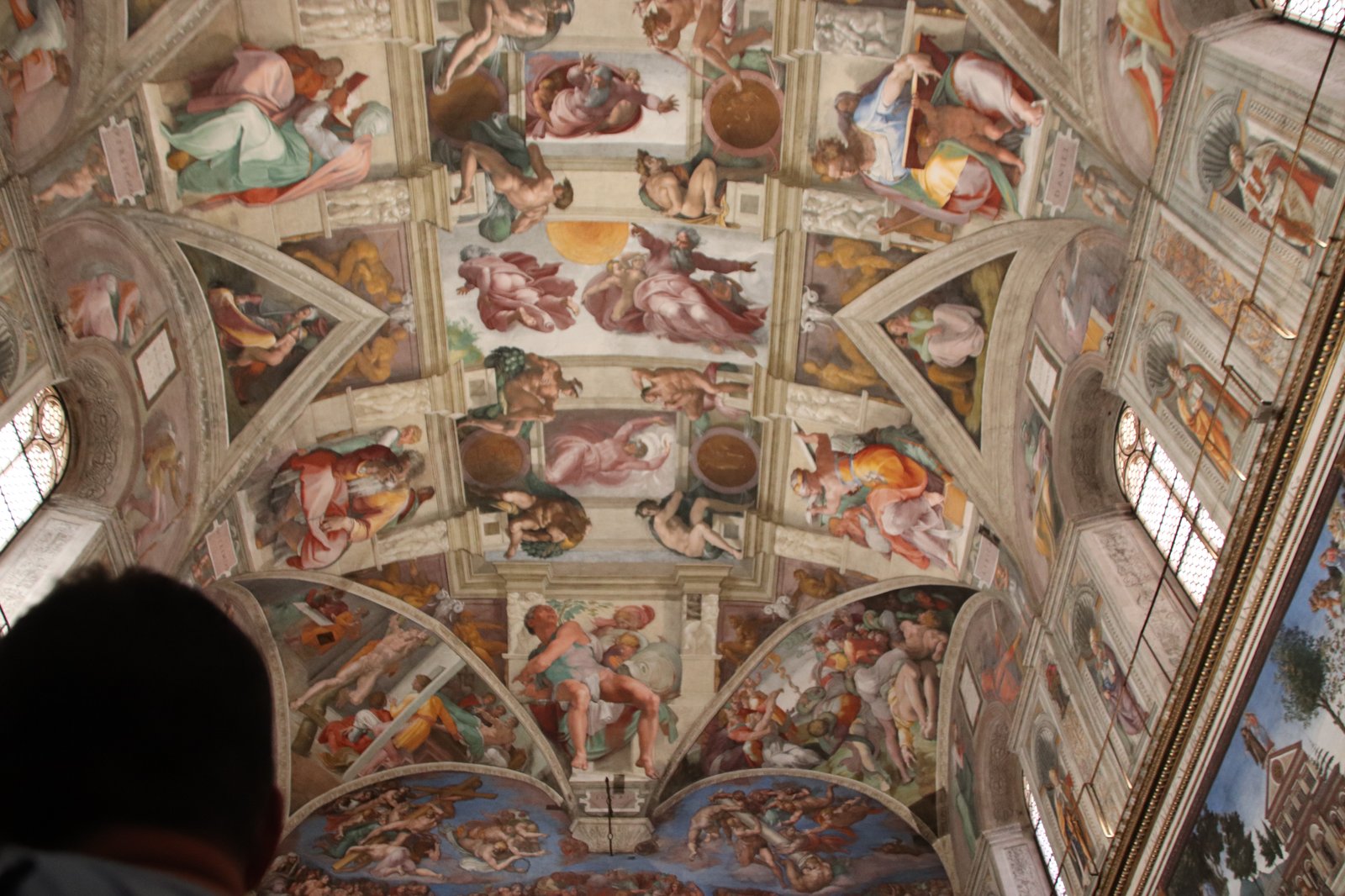
    The Sistine Chapel ceiling by Michelangelo, the room a Friday-evening ticket gives you at roughly a quarter of the usual crowd density
    Sistine Chapel ceiling by Michelangelo (1508-1512). Photo by Gary Todd via Wikimedia Commons (public domain).

    Almost nobody knows the Vatican Museums are open on Friday evenings from late April through late October. The “aperture serali” run from 19:00 to 23:00, with last entry at 21:30, and the daily cap for the evening slot is roughly 8,000 tickets. Compare that to the standard daytime cap of around 35,000, and you have a shorthand for what a Friday evening looks like inside: it is the same route, in the same rooms, at roughly a quarter of the crowd density.

    This post is a minute-by-minute account of what one of those evenings actually feels like. Precise 2026 opening and closing dates for the evening season are published on museivaticani.va; check them before you book. Everything below assumes a clear summer Friday and a 19:00 slot.

    18:40, Viale Vaticano

    Approach on foot from Ottaviano-San Pietro if you can. Metro Line A drops you six minutes walk from the entrance, and the walk down Via Ottaviano at 18:40 is a different city from the same walk at 09:00. Shops are open, dinner service is opening its doors at Prati trattorie, and the queue outside the Museums entrance is a few dozen people rather than the coiled-up hundreds of a July morning.

    Bring a light layer. Rome cools several degrees between eight and midnight in summer. The Museums climate-control the frescoed rooms (Sistine Chapel, Raphael Rooms) for art preservation, which incidentally keeps them cooler than the outdoor evening air.

    19:00, security

    Doors open on the hour. Security is the same X-ray-and-metal-detector routine as any daytime slot, but the guards are unhurried and the line is measured in single-digit minutes rather than tens. By 19:12 you are through, up the escalator, and standing in the atrium.

    19:20, the Cortile della Pigna

    Walk through the atrium and out into the Pinecone Courtyard. This is the last outdoor moment of the visit and the light is why it matters. Late-afternoon sun at 19:20 catches Pomodoro’s Sfera con Sfera and casts a long shadow across the paving. On some higher-tier evening tours the courtyard is used as an aperitif venue; if you have booked one of those you will find a small bar set up along the north wall. Otherwise the courtyard is quiet, and this is the moment when you can hear how quiet the whole evening is going to be.

    19:45, the corridor rooms

    Head into the standard route: Gallery of the Candelabra, Gallery of Tapestries, Gallery of Maps. These are the long corridor rooms that are wall-to-wall bodies from 10:00 to 15:00 on a normal day. At 19:45 on a Friday, you can walk down the centre of each of them without weaving. In the Gallery of Maps you can stop in front of any single map for as long as you want, at eye level, and read the coastal detail Ignazio Danti and his workshop painted between 1580 and 1583.

    This is worth naming clearly: the corridor rooms are the specific part of the Museums that daytime crowds erase. On a Friday evening they are legible in a way they physically cannot be at midday.

    20:15, the Raphael Rooms

    Down a set of stairs and through a corridor and you are in the four smaller rooms Raphael and his workshop frescoed between 1508 and 1524 (Raphael himself died in 1520; the Sala di Costantino was finished by his workshop). At 20:15 there might be twenty other visitors in the four rooms combined. On a normal day it is closer to two hundred at any given instant.

    The Stanza della Segnatura, third room in the visit sequence, contains the School of Athens on one wall and the Disputation of the Most Holy Sacrament on the wall opposite. If you have been putting off looking closely at either fresco because there was always someone in the way, this is when you look. Raphael painted himself into the far right of the School of Athens in a small black beret. See if you can find him.

    20:45, the door before the Sistine

    A short walk and stairwell and you are at the plain wooden door with a guard standing next to it. Same door, same guard style, same silence rule. Behind the door on a Friday evening: perhaps a hundred and fifty other visitors distributed along the long side walls, some sitting on the benches, some standing quietly, everyone in the same unhurried mode you would expect at a small evening concert.

    Find a bench along the north wall. Sit down. Look up. The room’s climate-control system is designed to hold the Chapel under 25°C regardless of how many people are inside, so the physical air is broadly the same at 21:00 as at midday. The comfort improvement is not thermodynamic; it is that there are fewer bodies, less humidity, and no one’s phone is going up because the attendants are not calling out silenzio every three minutes. Give yourself twenty minutes minimum in this room. You will not get a better opportunity.

    21:30 to 22:15, the wind-down

    Last entry is 21:30. Between then and 22:15 the Sistine begins to thin as the earliest ticket-holders head for the exit corridor. The rooms are quieter still. This is the window in which you can walk back through any two galleries you passed too quickly on the way in and look at the specific pieces you noticed but did not stop for. There is no obligation to leave; the Museums close at 23:00 and staff sweep quietly starting around 22:40.

    Exit is via the long corridor down toward the spiral staircase (either the modernist Momo staircase from 1932 or the tourist-shop route, depending on which door staff have open that evening) and out through the atrium.

    22:15, dinner in Prati

    You will be back on Viale Vaticano by about 22:20. That gives you a comfortable window at any of the trattorie in Prati or Borgo, most of which run kitchens until 22:30 or 23:00 (some to 23:30). Do not aim to sit down after 22:30; a table booked in advance is the honest solution if you want to eat without stress.

    Restaurants close to the Museums that stay open late enough for this window include the small trattorie along Via Cola di Rienzo and Borgo Pio. Reserve before you go into the Museums, or the Prati kitchens will already have closed their orders by the time you sit down.

    22:45, getting back

    Metro Line A runs later on Friday and Saturday nights than the rest of the week: last train from Ottaviano-San Pietro is typically around 01:30 on Friday, so a 22:45 walk to the metro leaves no risk at all. Bus 40 runs to Termini until roughly midnight (bus 64 ends earlier, around 23:00), then night buses (marked with an “N”) take over. If you are more than a few metro stops from your hotel, taxis at the Piazza Risorgimento rank meter at roughly €12 to €18 to most central Rome districts on evening runs (daytime meters lower; night surcharge applies) and are the least stressful way home after a long visit.

    How to book, and what to know about cancellations

    Friday-evening slots used to be under-booked. As of 2026 they are often sold out well in advance in high season, so book two to three weeks ahead if you can. Direct booking is via museivaticani.va. The official site sells the standard Friday evening entry slot and an official guided evening tour; aperitivo-in-the-Pigna packages exist but are typically sold by third-party operators, not directly by the Museums, so check who you are actually booking with.

    One risk worth naming: Friday evenings are slightly more vulnerable than a standard weekday morning to short-notice cancellation for papal ceremonies, canonisations, or state functions. The Museums announce cancellations on museivaticani.va and by email to ticket-holders; check your email 24 to 48 hours before your visit if the date coincides with anything unusual in Vatican life.

    A note on combining with St Peter’s Basilica

    You cannot pair a Friday-evening Museums visit with a same-evening Basilica visit. St Peter’s opens 07:00 to 20:00 daily (as of 1 June 2026) with no evening extension on Friday, so it will be closed by the time you exit the Museums. If you want both sites on the same trip, book a morning slot for the Basilica the day after your Friday evening — the two visits complement each other well when they are on separate mornings and evenings.

    For the full breakdown of tour formats that use the Friday-evening slot, including our guided version, see our Friday Evening Vatican Guided Tour page. For the 2026 opening calendar including which Fridays fall inside the evening season, see the Vatican Museums opening hours 2026 guide. If you already have a morning-slot ticket and want to compare, our recent post on the first hour of the day at 08:00 covers the opposite end of the same experience.

  • The Vatican Dress Code at the Door: What Actually Gets You Turned Away

    The Vatican Dress Code at the Door: What Actually Gets You Turned Away

    The Sistine Chapel ceiling by Michelangelo — one of the three Vatican rooms where the dress code is enforced with visible discretion at the door
    Sistine Chapel ceiling by Michelangelo (1508-1512). Photo by Gary Todd via Wikimedia Commons (public domain).

    A young couple at the front of the queue for St Peter’s Basilica opens their bags on the security table. Passports out, phones on the tray, bottles into the bin. A guard glances at the man’s Bermuda shorts, ends just above the kneecap, and says “no.” The couple is redirected off to the side. They walk two hundred metres to a vendor stall on Via della Conciliazione, buy a linen wrap for eight euros, come back, and queue again from the end. Total loss: about forty-five minutes.

    This scene plays out several hundred times a day at the Vatican’s three main entrances. Vatican dress code is one paragraph long. Refusals cluster around five or six specific outfit choices. And the rule reads slightly gentler than it is enforced.

    What the rules actually say

    The Vatican Museums publish a short “Rules of Conduct” that includes this line, verbatim: “Sleeveless and/or low-cut garments, shorts above the knee, miniskirts and hats are not permitted.” Visitors must be “appropriately dressed,” and the code applies “regardless of religion.” That is it. No dress code exists that specifies fabric, length below the knee, footwear, sunglasses, or beach attire — those are personal-tolerance interpretations that guards do not enforce.

    St Peter’s Basilica has an internally-published version of the same rule (shoulders and knees covered, no sleeveless, no shorts above the knee, no miniskirts, hats off inside). Dome-climb visitors get the same rule too, since you enter through Basilica security. So does the Sistine Chapel; the code applies at the Museums door and again inside the Chapel.

    The rule reads gentler than it is enforced

    Here is where first-time visitors get caught. One line in the rule says “shorts above the knee.” In practice, guards at St Peter’s Basilica frequently refuse Bermuda-style shorts on men even when the hem sits at or slightly below the kneecap. There is no formal “long trousers only for men” rule I can point you to; it is an enforcement convention that has hardened over years. If you are a man, long trousers are the only safe choice at the Basilica.

    Same rule also says “hats are not permitted.” Enforcement is universal on this one. Baseball caps, sun hats, wide-brim summer hats, all off inside. This is not “hats off during prayer” — it is hats off any time you are inside any of the three sites.

    The five outfits that reliably get people refused

    In my observation on summer mornings, the five outfits most commonly refused, in roughly descending frequency:

    1. Men’s tank tops and sleeveless shirts. Same rule as women’s sleeveless — refused at every gate. Same fix: a T-shirt or a light layer over the top.
    2. Spaghetti-strap sundresses. Classified as sleeveless. Refused at every gate. A scarf over the shoulders is enough to pass, provided it stays on.
    3. Men’s Bermuda shorts at the Basilica. That knee test is a kneecap-covered-when-standing test. Anything shorter is refused, and even hem-at-kneecap is a coin flip at the Basilica.
    4. Miniskirts and short skirts. Above-the-knee is the line. A sarong tied over the top is a common fix and is accepted, provided the sarong itself reaches the knee.
    5. Crop tops and cut-off tanks. Even with a jacket on your arm, if the midriff shows when you walk you will be asked to close the jacket. If you have no jacket, you will be sent to a vendor.
    6. See-through white shirts. Not named in the written rule, but read as low-cut / immodest by the guards; frequently refused especially for women. A camisole under the shirt fixes it.

    Two outfits that surprise people by being accepted: sarongs (accepted as a wrap or over-skirt if they reach the knee) and flip-flops or open sandals (not named in the rules, not enforced).

    How the check actually works

    There is no separate dress-code booth. That check happens at the security screening you already have to pass anyway. As you place your bag on the X-ray belt, the guard doing the visual scan is also looking at what you are wearing. If they refuse you, they will point off to the side and say “cover” or “no.” You are not given a wrap. You are not offered an alternative. You are politely removed from the queue.

    Your timed ticket clock keeps running. Your booking is not rescheduled. If you have a fifteen-minute booking window and you spend twenty minutes finding a vendor and covering up, your ticket may not be honoured when you come back and you may have to buy a new one at the walk-up desk. This is why the seven-euro scarf you buy from the vendor stall is the least stressful three minutes of the entire visit.

    What the vendors sell, and what it costs

    The scarves, shawls, pashminas and wraps sold from the folding-table stalls on Via della Conciliazione and along Viale Vaticano are a working economy, and the pricing reflects it. Expect five to fifteen euros for a scarf or pashmina. The “cashmere” claims are almost universally acrylic or rayon; the item’s job is to get you past the door once, not to become an heirloom. Some stalls also sell disposable ponchos for wet weather in the two-to-five-euro range.

    The Vatican does not provide free wraps at the entrance. Some third-party sources describe a paid disposable-poncho option sold near the Museums entrance (typically €3-5); I have not personally observed it in the way some Roman churches offer paper covers to visitors in shorts, so treat availability as inconsistent. If you are travelling with a small bag and want to skip the vendor step entirely, pack a lightweight scarf and pair of thin long trousers or a maxi skirt in your day bag. Both weigh almost nothing and remove the whole dress-code failure mode from the trip.

    The Sistine Chapel enforces the rule a second time

    If you got through the Museums door in a borderline outfit and started peeling off a layer as the rooms warmed up, expect a second check inside the Sistine Chapel. The attendants stationed along the walls are watching for bare shoulders and knees, and they will approach quietly and ask you to cover up. Visitors have been escorted out for arriving fully covered at the Museums entrance and stripping down to a tank top by the time they reached the Sistine. It is one enforcement, applied twice.

    Children and mobility

    The published rule applies “regardless of religion” and does not list an age exception. In practice, small children in shorts and sleeveless dresses are routinely admitted at guard discretion; enforcement is visibly relaxed for young kids and tightens noticeably for teenagers. If you are travelling with an eleven- or twelve-year-old, dress them as you would dress an adult — the visible age at which enforcement kicks in is around then.

    I have not found any published dress-code exception or wrap-provision for wheelchair users or visitors with accessibility needs. Enforcement appears to be applied identically, and the Vatican Museums are broadly wheelchair-accessible. St Peter’s Basilica is less so; if you are visiting with someone who uses a wheelchair, the accessible route to the Basilica avoids the Dome climb entirely, which is where the strictest enforcement typically sits.

    The Papal Audience gate

    The Wednesday Papal Audience in St Peter’s Square runs the same rule — shoulders and knees covered, hats off — and enforcement is at least as strict as at the Museums. Piazza security opens around 07:30 on audience mornings and the same visual scan happens as you enter through the colonnade. Refusal rates are visibly higher here than at the Museums, partly because of the sheer volume of foot traffic and partly because the crowd skews toward summer tourists who did not read the fine print. If you are attending the audience, dress for it the way you would for the Museums.

    The three lines to remember

    • Shoulders covered. This means no spaghetti straps, no cap sleeves that expose the shoulder joint, no crop tops.
    • Knees covered. Kneecap covered when standing, at all three sites. For men at the Basilica, long trousers are the only safe answer.
    • Hats off inside. All three sites, all the time.

    Everything else — sandals, sunglasses on top of your head, printed t-shirts, the entire shoulder-bag-through-security choreography — is your business. Pack a scarf and long trousers, or bring seven euros for the vendor. The refusal you avoid is worth both.

    For the full dress-code guide with day-of-visit tips and printable rules, see our Vatican dress code page. If you are booking around a Wednesday morning, our post on why Wednesday mornings are a bad time to visit the Museums covers the Papal Audience knock-on effects that compound with the stricter dress-code enforcement at the piazza gate.