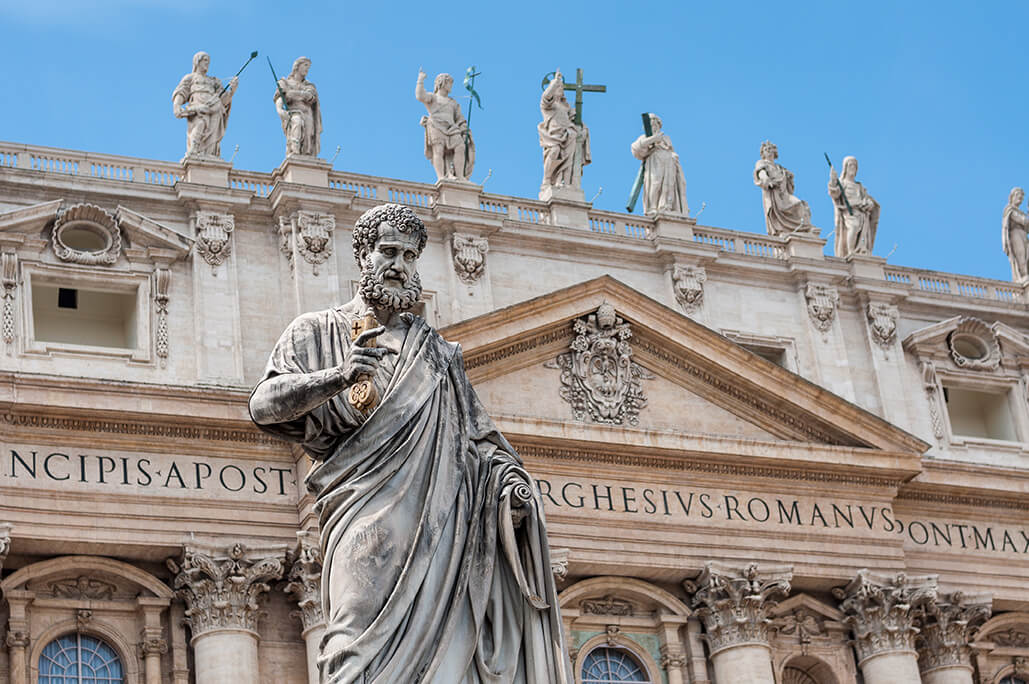
Category: Uncategorized

  • Bernini’s Skeleton: The Tomb of Pope Alexander VII Nobody Expects

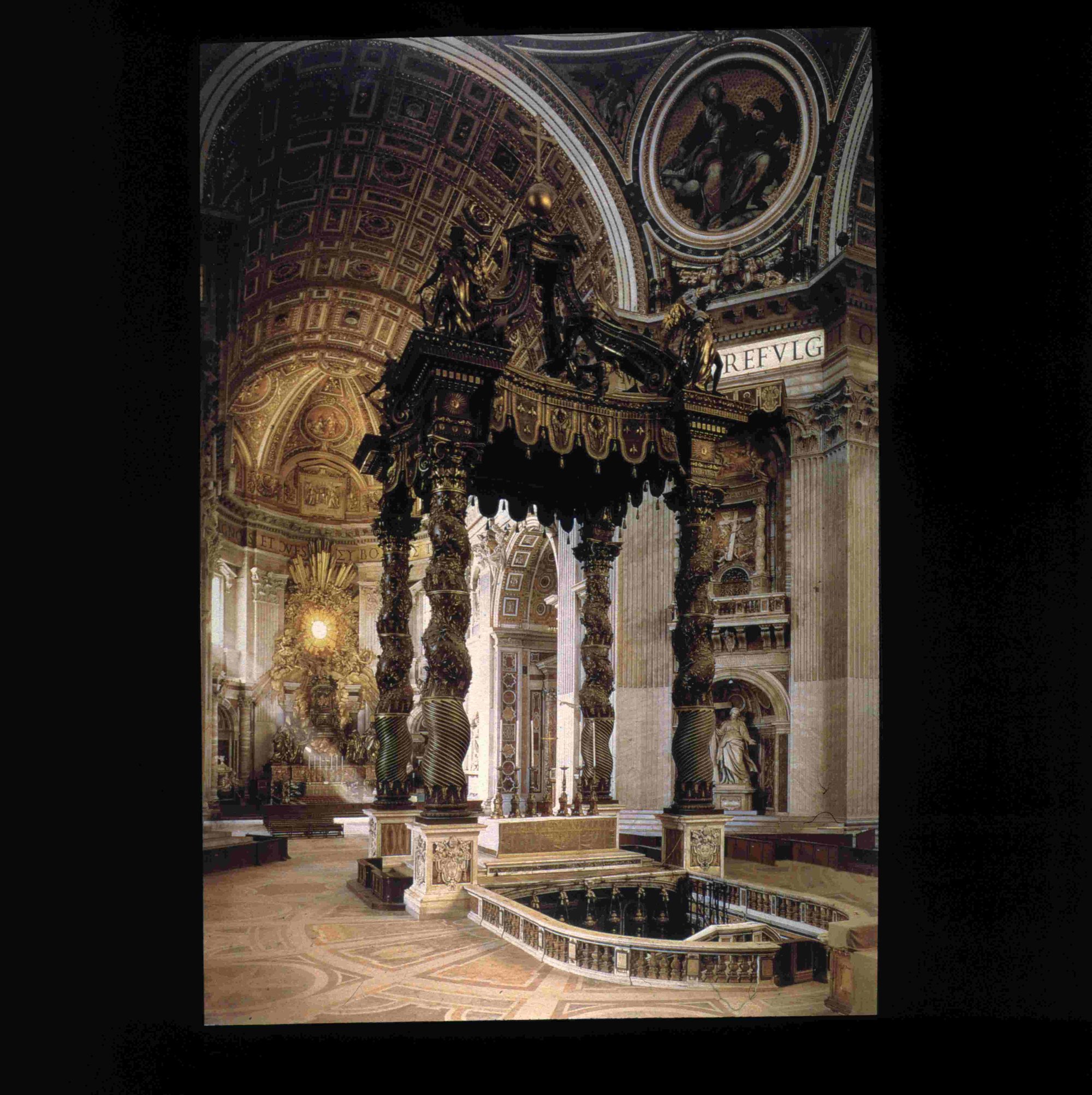
    Engraving of Bernini's Baldachin over the papal altar in St Peter's Basilica, the sculptor's best-known work in the church that also holds his tomb monument to Alexander VII
    Bernini’s bronze Baldachin over the papal altar, the work everyone photographs. His tomb for Pope Alexander VII, in a quiet corner of the same basilica, is the one that actually unsettles people. Public domain via Wikimedia Commons.

    Walk to the far end of the left transept in St Peter’s Basilica, past the Chapel of the Choir, and a doorway is doing something no other doorway in the building does: a skeleton in gilt bronze is heaving itself out from underneath it, one bony arm raised, holding up an hourglass. Above the door, a slab of deep red marble is draped like real cloth over a kneeling pope, folds bunching and billowing as if a wind had just caught it. This is the monument to Pope Alexander VII, and it is the single strangest thing Gian Lorenzo Bernini ever put inside a church.

    Most visitors never see it. It sits well off the route that carries people from the entrance to the Baldachin to the dome, in a transept most tour groups skip. That is a mistake, because it is arguably a more personal piece of sculpture than anything else Bernini made for St Peter’s, built by an artist in his seventies for a pope who had been thinking about his own death for decades.

    A pope who planned for this

    Fabio Chigi became Pope Alexander VII in 1655 and reigned until his death in 1667. Contemporary biographers describe him as unusually preoccupied with mortality even by the standards of a seventeenth-century churchman: later accounts of his household describe a coffin kept in his private apartments as a standing reminder of where everyone ends up, popes included. He had Bernini in his employ for most of his pontificate already, on the colonnade of St Peter’s Square and the Chair of St Peter behind the altar, so a tomb designed with the same taste for theatre was, in hindsight, close to inevitable.

    He commissioned his own tomb during his lifetime — the project is first documented in 1656 — but did not live to see it built. Actual construction did not begin until 1671, four years after his death, overseen and paid for by his nephew, Cardinal Flavio Chigi, on behalf of the family. Bernini finished the monument in 1678, in his own late seventies, roughly two years before he died. It was one of the last major sculptural projects he completed, and it shows an artist willing to take real risks with a genre — the papal tomb — that had settled into fairly predictable conventions long before he touched it.

    The door is not a prop

    The cleverest part of the design is the part easiest to miss. The doorway beneath the monument is a working door, part of the basilica’s actual architecture, not a sculpted stand-in. Bernini built his composition around it instead of ignoring it: the great sheet of red marble drapery appears to spill directly out of the doorway’s frame, hiding its plain stone lintel and turning a strictly functional opening into the mouth of the scene.

    Underneath that drapery, low down near the door itself, is the skeleton. It is gilt bronze, partly wrapped in the same red-veined marble sheet, one arm thrust upward with an hourglass held aloft in its bony hand. Read as a whole, the monument stages an image rather than simply displaying one: death climbing out through an ordinary door that clergy still use, holding up the instrument that measures how little time anyone has left. It is a memento mori built into working architecture, which is a very different thing from a memento mori carved onto a slab.

    A pope kneeling above it all

    Above the drapery and the skeleton, gilt bronze again, Alexander VII kneels in prayer on a cushion, hands together, facing the high altar rather than the viewer. He is not shown enthroned or triumphant, the way earlier papal tombs tended to present their subjects. He is shown mid-devotion, apparently unaware of the skeleton working its way out from beneath him. That contrast between the still, praying figure above and the frantic motion of the skeleton below is what gives the monument its charge: stillness and struggle occupying the same small space, one directly on top of the other.

    Four women holding up a pope’s reputation

    At the base, flanking the doorway, four female figures in white marble personify virtues traditionally associated with good rule: Charity, Truth, Justice, and Prudence. Each is carved with the fluid, almost liquid handling of drapery Bernini had spent a lifetime perfecting, in deliberate contrast with the stiffer red marble sheet above them. Justice and Prudence sit closer to the door on one side; Charity, shown nursing a child, and Truth sit on the other.

    Truth is the figure worth pausing on. Her bare foot rests on a globe, and directly under it, driven into the section of the globe representing England, is a small thorn. It is a piece of pointed political commentary rather than decoration: a reference to England’s break from the Catholic Church under the Reformation, a wound in the map that a pope’s-eye view of the world could not ignore even in stone.

    The virtues that got dressed later

    Truth and Charity were both originally carved with far less covering, in keeping with the classical convention for personifying unconcealed virtues. That did not survive intact. Early in 1678, with the tomb practically finished, Pope Innocent XI objected to Truth’s nudity and to Charity’s bare breast, and Bernini was ordered to dress both figures. The fix was a cast lead drape fitted over Truth and painted white to pass for marble, with a similar covering added to Charity.

    It is a small, telling footnote to the monument as a whole. Even a pope obsessed with mortality and prepared to have his own tomb double as a piece of theatre could not fully control how later generations would receive it.

    Finding it inside the basilica

    Entry to St Peter’s Basilica is free, and the monument requires no separate ticket or booking; it is simply part of the building. The obstacle is not access but attention. Walk down the left aisle from the main entrance, past the Chapel of the Choir, toward the far corner of the transept nearest the sacristy exit, and look up and slightly to your left rather than straight ahead. Most first-time visitors are still oriented toward the Baldachin and the dome at this point in a visit and walk within a few metres of the tomb without registering it.

    Give it a minute rather than a glance. From a distance the red drapery and gilt bronze read as one dramatic mass; only up close does the skeleton, the thorn in the globe, and the covered Truth resolve into individual details worth the detour.

    Worth the extra few minutes

    Nobody plans a Vatican visit around a single tomb in a side transept, and this one does not need to be the centrepiece of anyone’s day. But it rewards the kind of visitor willing to walk past the obvious stops and look up in a quieter corner of the building. If you are putting together a fuller basilica visit and want a guide who will actually walk you to corners like this one rather than straight past them, our St Peter’s Basilica tickets and tours page lays out the guided options for seeing the building properly, skeleton included.
  • Finding John Paul II’s Tomb Inside St Peter’s Basilica

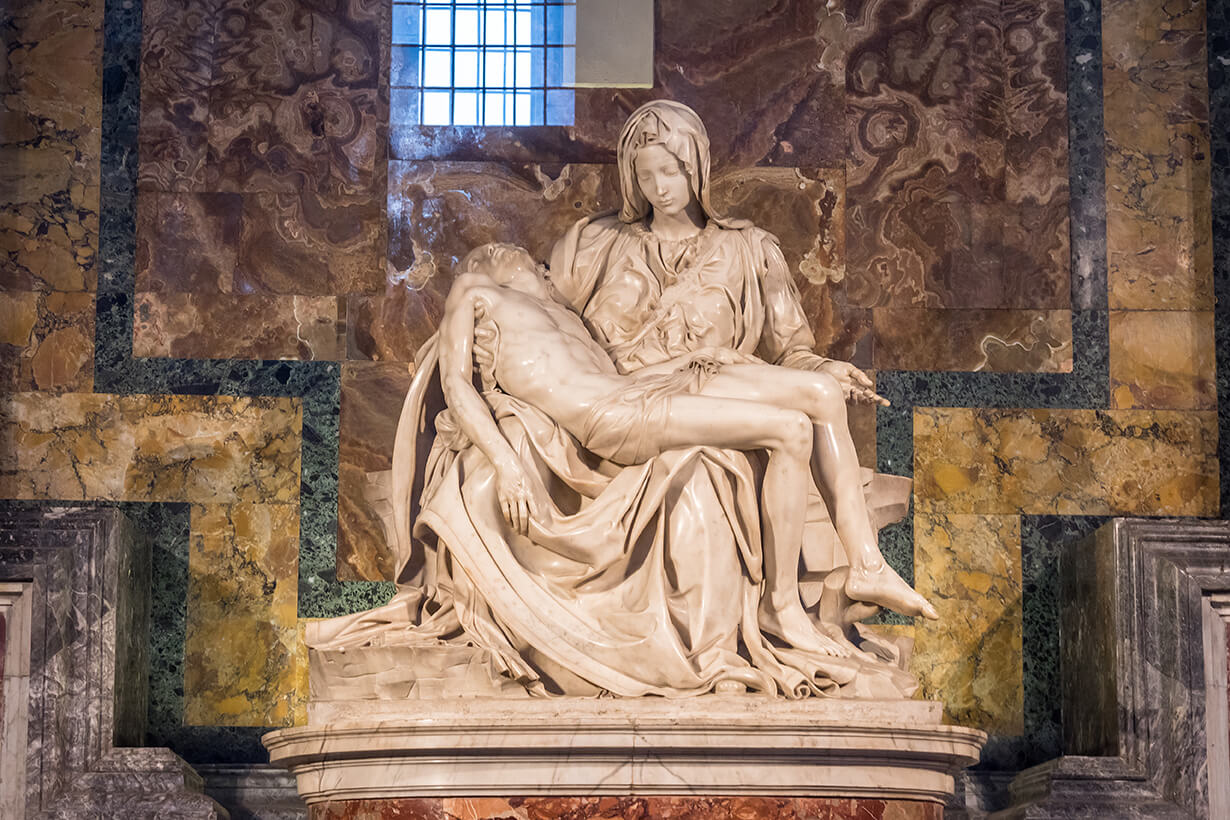
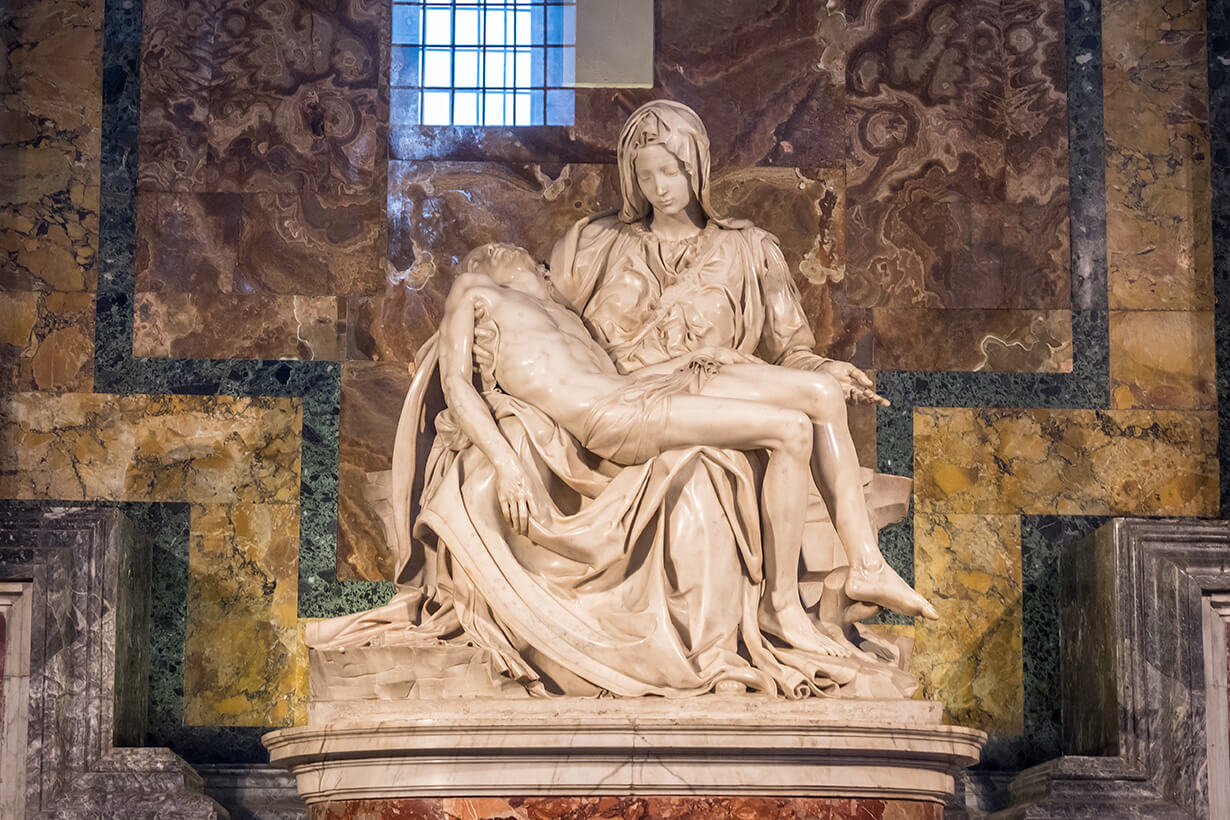
    Michelangelo's Pieta in St Peter's Basilica, in the same right aisle as the Chapel of St Sebastian where John Paul II is now buried
    Michelangelo’s Pieta, the landmark most visitors use to find their way to the Chapel of St Sebastian a few steps further along the same aisle.

    Visitors ask our guides the same question almost every day: where exactly is John Paul II buried? The honest answer takes a minute to explain, because his body has been in three different spots since 2005, and two of them sit in completely different parts of the building. Get this wrong and you can spend twenty minutes wandering the underground Grottoes looking for a tomb that isn’t there anymore. Here is where he actually rests today, how to walk there directly, and why the Grottoes keep tripping people up.

    Where John Paul II Is Buried Today

    John Paul II’s tomb is on the main floor of St Peter’s Basilica, inside the Chapel of St Sebastian, along the right aisle near Michelangelo’s Pieta. Wikipedia’s own summary of his life is blunt about it: he was “Buried … Chapel of St. Sebastian, St. Peter’s Basilica.” There is no staircase to climb down, no separate ticket, and no underground passage involved. You reach it the same way you reach the Pieta, walking at ground level from the main entrance.

    Two Moves in Six Years

    The tomb’s current location is the end point of a short, well-documented sequence. John Paul II died in April 2005 and was first entombed in the Vatican Grottoes, the underground chambers beneath the nave. He stayed there for six years. On 29 April 2011, days before his beatification, his casket was exhumed from the Grottoes. As Wikipedia’s account of the beatification puts it, “the casket in which he was interred was exhumed and placed before Saint Peter’s tomb” so pilgrims could venerate it during the ceremony. Three days later, on 2 May 2011, the casket was sealed in its final resting place: “the casket was reinterred in the Chapel of St Sebastian,” under what is now called the Altar of St Sebastian.

    So the tomb moved twice: from the Grottoes to the main altar area for a few days, then permanently into the Chapel of St Sebastian. Anything you read that stops at “he’s in the Grottoes” is describing where he was between 2005 and 2011, not where he is now.

    Grottoes or Chapel of St Sebastian? Don’t Confuse Them

    This is where most confusion happens, and it’s understandable. The Vatican Grottoes are real, they’re open to visitors, and they genuinely do hold papal tombs, ninety-one of them according to Wikipedia’s entry on the site, which describes the Grottoes as “a series of underground chambers and chapels located under part of the nave of St. Peter’s Basilica.” Older guidebooks and search results written before 2011 still point readers there for John Paul II, because that was accurate for six years. It just isn’t accurate now.

    A separate related site, the Vatican Necropolis (also called the Scavi), sits even deeper, below the Grottoes, and holds the excavated tomb of St Peter himself. It requires its own advance reservation and is a different experience entirely from either the Grottoes or the Sebastian chapel. If a tour or a website is trying to sell you Necropolis access to see John Paul II, that’s the wrong product for that stated goal.

    Finding the Chapel from the Basilica Entrance

    Once inside the Basilica through the main entrance and security screening, keep to the right-hand side of the nave rather than heading straight up the center aisle toward the papal altar. Michelangelo’s Pieta, behind its glass screen, is the landmark everyone recognizes, and it sits early along that right aisle. The Chapel of St Sebastian is a short walk further along the same side. Look for the altar itself rather than a freestanding monument; the tomb is set into the floor beneath it, marked with a simple inscription, not a raised sarcophagus you can walk around.

    What You’ll Find at the Altar

    Unlike the Pieta, which draws a constant crowd pressed against the barrier, the Sebastian chapel tends to be calmer, partly because so many visitors still walk past it toward the Grottoes staircase looking for the wrong tomb. Flowers are usually left near the altar, and it’s common to see people pause quietly rather than take photos. Treat it as an active place of prayer rather than a monument stop on a checklist; Mass is still said in the Basilica’s side chapels, and this one is no exception.

    Basilica Hours vs Museums Hours — Don’t Mix These Up Either

    St Peter’s Basilica and the Vatican Museums are two separate sites with two separate schedules, and the tomb sits in the former. The Basilica’s own site states that “from June 1st, the Basilica is open from 7:00 am to 8:00 pm,” though we couldn’t confirm whether that window shifts later in the year, so check the current posting before you go rather than relying on a fixed rule.

    The Vatican Museums, home to the Sistine Chapel, run on an entirely different clock: “08.00 a.m. – 08.00 p.m.” Monday to Saturday, with “final entry 06.00 p.m.,” and on the “last Sunday of the month 09.00 a.m. – 02.00 p.m.” with free entry, according to the Museums’ own hours page. That page also warns that “the only official site for purchasing tickets online is https://tickets.museivaticani.va.” None of this governs the Basilica or the tomb; if your plan is the tomb alone, you don’t need a Museums slot at all.

    Planning the Visit

    Go early if you can. The Basilica fills up through the late morning as Museums visitors finish the Sistine Chapel route and cross over to St Peter’s Square, and by midday the nave gets loud and the queue for security screening lengthens. Arriving close to opening gives you a quieter walk past the Pieta and a few minutes of relative calm at the Sebastian chapel before the crowds catch up. Note that the reigning pope today is Leo XIV, elected in May 2025, so the Basilica remains a working church with an active liturgical calendar, not a static museum; occasional closures for ceremonies do happen, and staff at the entrance will redirect you if the nave is temporarily off-limits.

    If you’d rather skip the guesswork on timing and entry altogether, our St Peter’s tomb tickets and tours are built around getting you inside efficiently and pointed straight toward the right aisle, so you spend your time at the tomb itself rather than working out which staircase not to take.

  • The Baptistery Chapel Most Visitors Walk Past in Thirty Seconds

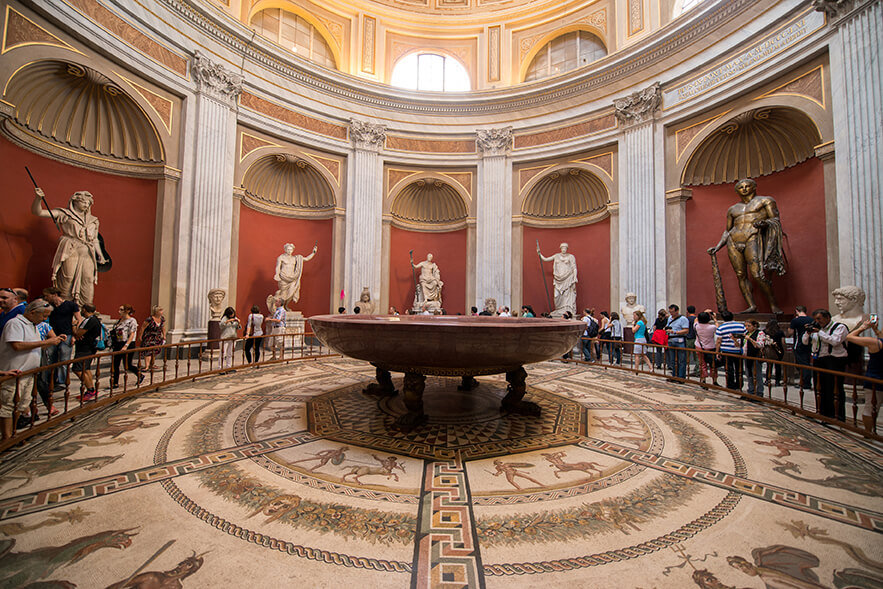
    Red porphyry basin known as Nero's bathtub in the Round Hall of the Vatican Museums, the same rare imperial stone used for the Baptistery font in St Peter's Basilica
    A different porphyry basin, on display a short walk away in the Vatican Museums’ Round Hall — but the same imperial-red stone as the font waiting in the Baptistery Chapel.

    Most people who reach the Baptistery Chapel in St Peter’s Basilica are not really there. They are near the exit, mentally already outside, and the last thing that stopped them was Michelangelo’s Pietà a few chapels back. A red stone basin the size of a small bathtub sits under its own cupola in the left aisle, and it gets glanced at, not looked at. That is a shame, because the object itself has one of the odder biographies of anything in the building.

    What you are actually looking at

    The centrepiece of the St Peter’s Basilica Baptistery Chapel is a basin cut from red porphyry, a stone the Romans reserved for emperors because it was harder to quarry and more expensive to work than almost anything else available to them. According to stpetersbasilica.info, it is “a rich bowl in red porphyry measuring 4×2 meters” — large enough that it reads less like church furniture and more like something salvaged. It has, in a sense, been salvaged twice.

    A font carved from someone else’s tomb

    The stone did not start life as a baptismal font. Porphyry basins this size were almost never quarried new for a purpose this modest; they were recut from older imperial objects, and this one is no exception. stpetersbasilica.info describes it as having been “previously used as the cover of the sarcophagus of Emperor Otto II,” the Holy Roman Emperor who died in Rome in 983. Other material from the same source describes the stone as “believed to derive from the tomb of Emperor Hadrian (Castle San Angelo).”

    Those two claims are not the same claim, and nothing found while researching this piece ties them together into one clean chain of ownership. The likeliest reading is that the porphyry passed through more than one reuse: quarried and worked in antiquity, possibly associated with Hadrian’s mausoleum, later recut as a sarcophagus lid said to have covered Otto II, and later again cut down to the basin now sitting in the chapel. Treat the imperial pedigree as plausible and well attested by this one source family, not as a single settled fact. What survives every version of the story is the plainer claim: the font was repurposed from an ancient Roman sarcophagus lid, not carved for the job it now does.

    Carlo Fontana’s “suffered project”

    The chapel around the font is a later addition to the Basilica. Architect Carlo Fontana (1634–1714) was commissioned in 1692 to design it and, per stpetersbasilica.info, “completed it in 1698.” The same source notes that “the work was realized after a suffered project,” a polite way of saying an earlier, more expensive design got rejected before Fontana’s version went ahead. Six years between commission and completion is not fast, even by the standards of a building that took over a century to finish.

    What Fontana added on top of the ancient basin is where the real craftsmanship sits. A gilded bronze cover, made by Giovanni Giardini to Fontana’s design, carries an Agnus Dei motif and a medallion of the Holy Trinity. Sculptors Lorenzo Ottoni and Michel Maille also worked on the chapel’s decoration. None of it is easy to appreciate from four steps away on the way to the doors, which is exactly the problem this piece is about.

    The mosaics above your head

    Three mosaic altarpieces finished around 1722 fill the chapel, reproducing paintings by Carlo Maratta, Giuseppe Passeri, and Andrea Procaccini. St Peter’s is full of mosaics standing in for paintings too fragile to survive centuries of candle smoke and humidity, and these three are no exception. They sit under an elliptical cupola, a shape distinct from the domes over the Basilica’s larger chapels, which gives the whole space a self-contained feel rather than an extension of the nave.

    Why almost nobody stops

    The general shape of a Basilica visit explains a lot here. Visitors typically enter through the main doors, encounter the Pietà almost immediately in the first chapel on the right, then loop through the nave, past Bernini’s baldachin and toward the apse, before the standard route brings them back along the far aisle toward the exit. The Baptistery Chapel sits in that left aisle, and for many visitors it lands somewhere in the final stretch of the walk, after the emotional high point of the visit has already happened and before the doors are close enough to see.

    None of that is an official sequence with a number attached to it, and this piece will not pretend otherwise. What can be said with more confidence is simpler: attention inside a building this large is a finite resource, and a basin under a side cupola is competing with a dome by Michelangelo and a sculpture by Michelangelo for whatever is left of it by the time a visitor reaches the left aisle.

    Seeing it properly

    Basilica entry itself carries no ticket, which is part of why so many visitors treat the building as a quick stop rather than a destination in its own right; check current basilica opening times locally before you go, since this piece cannot confirm exact clock hours for the Basilica against a live source. The neighbouring Vatican Museums, a separate ticketed institution, run Monday to Saturday “08.00 a.m. – 08.00 p.m.” with “final entry 06.00 p.m.,” and on the last Sunday of most months from “09.00 a.m. – 02.00 p.m.” with “final entry 12.30 p.m.” and free admission, exceptions applying around Easter, 29 June, and the Christmas period.

    If you want the Baptistery Chapel to register as more than a red smear on the way out, give it thirty deliberate seconds rather than an accidental glance: find the bronze lid, find the Agnus Dei on it, then look up at the mosaics before you leave. It takes less time than reading this paragraph and it is the only part of the visit almost nobody else bothers with.

    For a guided walk through the Basilica that actually slows down for corners like this one, rather than sprinting from the Pietà straight to the doors, our St Peter’s Basilica tickets and tours page lists the guided formats running through the rest of 2026.

  • Getting Into St Peter’s Sacristy: The Basilica’s Working Entrance

    Panoramic view of Vatican City and St Peter's Basilica
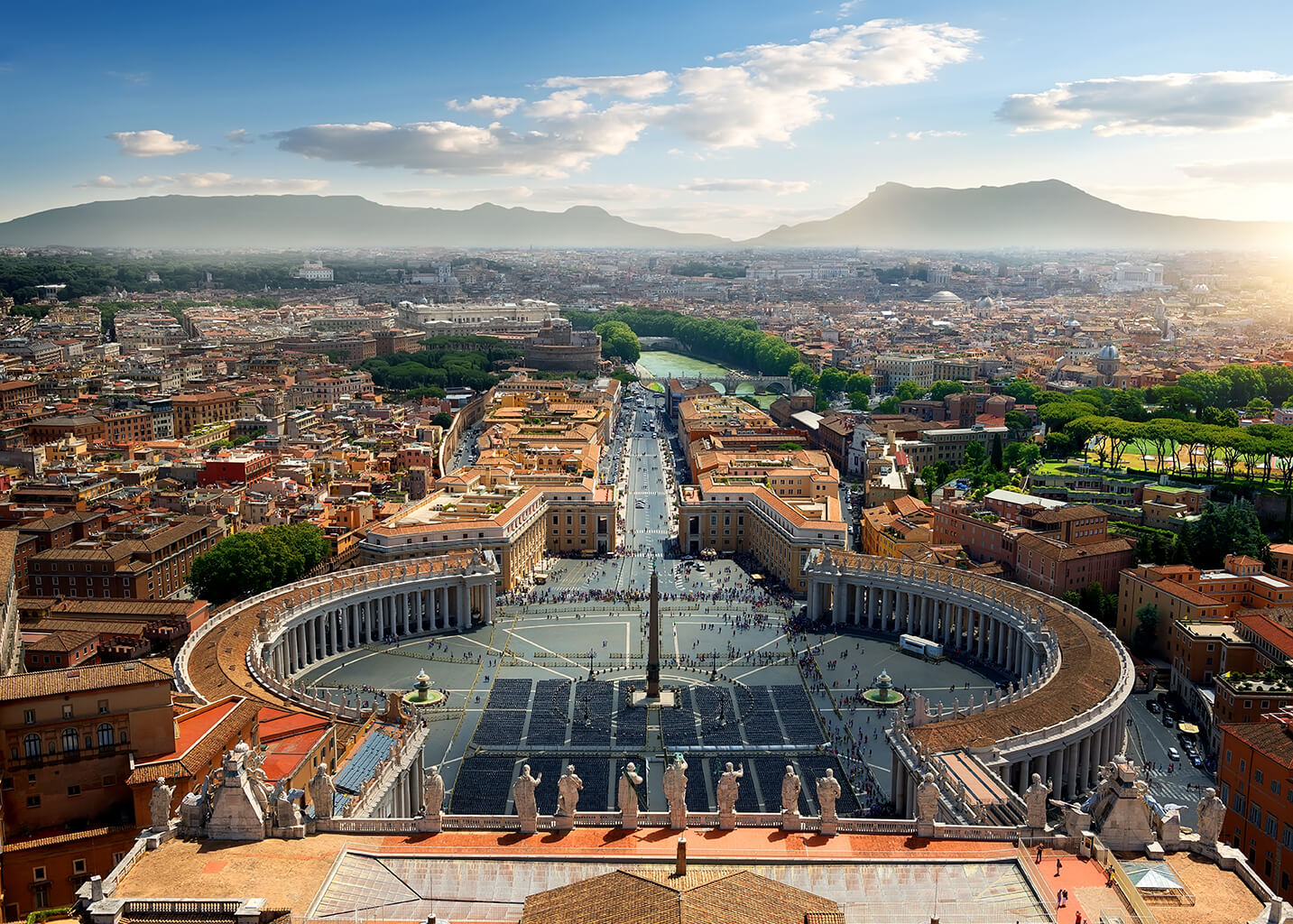
    Vatican City and St Peter’s Basilica seen from above. Built onto the church’s south flank in 1776, the sacristy sits inside this same walled complex, out of view from the square below.

    Every visitor who queues in St Peter’s Square eventually walks through one of the basilica’s great bronze doors. Almost none of them notice the smaller, working entrance tucked into the left aisle, under the monument to Pius VIII. That door leads to the sacristy: the part of the basilica complex built not for crowds but for the clergy who run it, and for the treasury of relics and vestments kept behind it. It has its own history, its own architecture, and a set of rules that have nothing to do with the ones printed on your ticket.

    Where the Door Actually Is

    You will not find the sacristy entrance by scanning the facade from the square. It sits inside the basilica itself. In the left aisle, under the monument of Pius VIII, is the entrance to the sacristy, and from there the space opens into a main sacristy that is octagonal, decorated with eight columns brought from Hadrian’s Villa in Tivoli. From that octagonal room, ten further rooms fan out to house the Treasury of St Peter’s. None of this is visible from outside. You walk past a monument most people photograph without reading, and the working half of the basilica begins on the other side of it.

    A Building Commissioned in 1776

    The structure standing there today is not part of the original Renaissance basilica. In 1776, Pope Pius VI commissioned the architect Carlo Marchionni to design the current sacristy building. That result stands on the south flank of the basilica, inside Vatican City proper — a distinct addition grafted onto Bramante and Michelangelo’s church nearly two centuries after the dome went up. It reads less like an afterthought and more like a second, smaller building doing a very different job: storage, vesting, and administration, rather than worship on the grand scale the nave was built for.

    What’s Actually Behind the Door

    Marchionni’s building holds three distinct sacristies: the Sacristy of the Canons, the Sacristy of the Beneficiaries, and the Common Sacristy. These are functional rooms, used by the clergy attached to the basilica for exactly what their names suggest, not spaces designed with a tour group in mind. A separate part of the same structure houses the Treasury of St Peter’s, the collection of liturgical objects, vestments, and relics tied to the basilica’s history. It is worth being clear-eyed about this: most of the building is administrative and liturgical space that happens to be old and well-built, not a gallery. Of the whole building, only the Treasury section was ever meant for public eyes.

    Treasury Museum, Currently Closed

    The Sacristy of the Beneficiaries today forms part of the museum route through the Treasury, a route established in 1975 by Pope Paul VI. As of this writing, though, that route is not open. The basilica’s own site states plainly that due to the continuation of work on the new layout, the Treasury Museum will be temporarily closed. No reopening date has been announced. If you were planning your visit specifically around the Treasury, hold off on that part of the plan; the rest of the basilica is unaffected, and visitors can still enter the basilica without a reservation, from the ordinary entrance in St Peter’s Square. Older guides that quote a Treasury ticket price or a set of seasonal hours are describing a version of the museum that, for now, does not exist. Skip those numbers until the Fabbrica publishes new ones.

    Not the Same as the Main Doors

    It helps to separate two things that get conflated: the sacristy door and the basilica’s public entrances. Access to the basilica begins with security checks run by the Italian State Police, and those checkpoints sit in the right hemicycle of St Peter’s Square, facing the church, with at least four other gates on the same side handling the queue. That is the route every visitor uses, sacristy-bound or not. That door under the Pius VIII monument is not a separate way in from outside; it is an internal threshold, reached only after you have already cleared security and walked into the nave. Think of it less as another entrance to the complex and more as a door between two different jobs the same building does.

    Whose Jurisdiction This Is

    The basilica and its sacristy fall under the Fabbrica di San Pietro, the Vatican body founded in 1523 by Pope Clement VII. Its remit covers the conservation and maintenance of St Peter’s Basilica and exercising vigilance over its sacred character and the organisation of visitors. That is a different chain of command from the Vatican Museums next door, which run the picture galleries and the Sistine Chapel under their own administration. Mauro Gambetti has served as archpriest of the basilica, and president of the Fabbrica, since February 2021. If a rule about the sacristy or the Treasury seems to contradict something you read about the Museums, that is usually why: two institutions, two sets of hours, two sets of decisions.

    Practical Notes for Visitors

    From 1 June, the basilica opens from 7:00 am to 8:00 pm. The Vatican Museums run on a separate schedule entirely: Monday to Saturday from 8:00 am to 8:00 pm, with last entry at 6:00 pm, and on the last Sunday of the month from 9:00 am to 2:00 pm, with last entry at 12:30 pm and free admission. The Museums close on ordinary Sundays and on a long list of Vatican holidays through the year. None of these hours currently apply to the Treasury, which stays shut regardless of what time you arrive. Build your morning around the basilica and, if it interests you, the Vatican Museums proper, and treat any Treasury visit as a bonus to check for on the day rather than something to plan around.

    If you would rather have someone else handle the queueing and the timing while you focus on the building itself, our St Peter’s Basilica tickets and tours cover the basilica entry end to end, sacristy closures and all.

  • Spotting the Swiss Guard: Where They Actually Stand Around St Peter’s Square

    St Peter's Square and the basilica facade
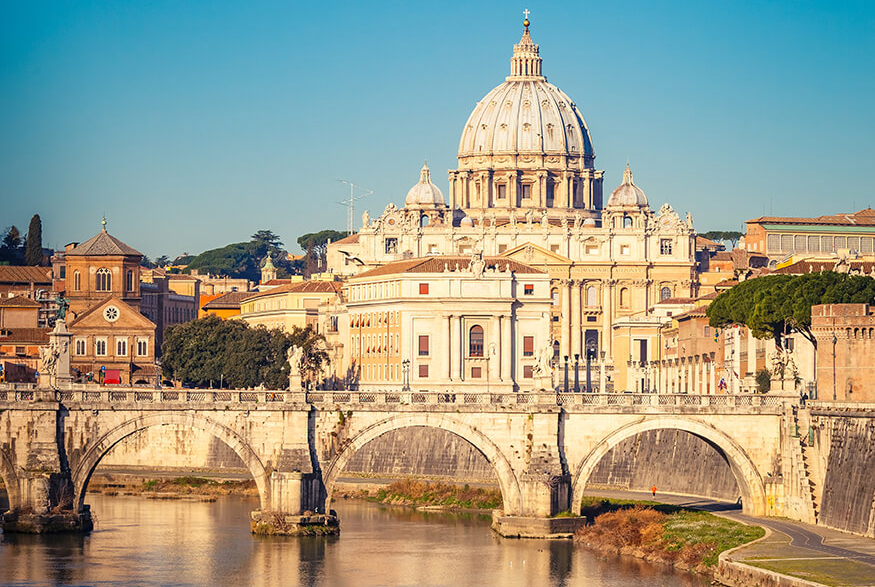
    St Peter’s Square and the basilica facade, the setting for this guide to where the Swiss Guard stand. Photo via Shutterstock.

    Walk into St Peter’s Square from the Via della Conciliazione and most visitors do the same thing: photograph the obelisk, photograph the dome, then spot a man in stripes and stop dead. Where the Swiss Guard actually stand, and why, is less obvious than the uniform suggests. There is one fixed post most tourists can reach on foot, a second gate they will never be waved through, and a plainclothes force working the crowd that most people never notice at all. Here is how to read the square correctly.

    The Bronze Door: the post you can actually walk up to

    Stand with your back to the basilica facade and look left, toward the end of Bernini’s colonnade nearest the Apostolic Palace. The Portone di Bronzo, the Bronze Door, is the main entrance from the square into the papal palace. It is the one guard post an ordinary visitor without an appointment is likely to see up close. It is not decorative. According to the independent guide site stpetersbasilica.info, “Swiss Guards stand at this door, but they may be approached to obtain tickets to the Wednesday Papal Audience.” That is a genuinely useful fact if you are trying to sort out audience logistics on the ground rather than online. I would not treat a guard on duty as a customer-service desk, though. Ask briefly, expect a brief answer, and move on.

    The Arch of the Bells: guarded, not open

    On the opposite side of the facade, to the left as you face the basilica and tucked beneath the bell tower, sits the Arco delle Campane, the Arch of the Bells. A travel-guide source describes it plainly: “The Arco delle Campane is located to the left of the façade of St. Peter’s Basilica in Rome.” It functions as “the official entrance to the Vatican City and to the Vatican Gardens.” It is not a photo-op gate you can wander through. “The arch is protected by the Swiss Guard, as one may enter it only with the permission of the Vatican authorities.” Try walking toward it out of curiosity and a guard will step into your path well before you reach the threshold. That said, the same source notes something worth knowing if you just want the shot: “Swiss Guards at this entrance to the Vatican will not let you pass, but gladly allow photos.” Treat that as a friendly convention reported by guides on the ground, not a published Vatican policy. There is no official photography rule to point to. Read the guard’s body language on the day rather than assuming a blanket right to shoot close-up portraits.

    What the uniform is actually telling you

    The famous stripes are not the only uniform in rotation. The differences are not random either. “The full dress uniform is of blue, red, orange and yellow with a distinctly Renaissance appearance” — that is the gala version, reserved for major ceremonies. It comes with the tall plumed morion helmet: “A black or silver morion helmet with red, white, yellow, black, and purple ostrich feathers is worn for ceremonial duties.” Most days at the Bronze Door or elsewhere on routine posting, you will instead see “the modern regular duty service dress uniform.” Wikipedia describes it as “more functional, consisting of a simpler solid blue version of the more colorful tricolor grand gala uniform.” If you catch a guard in full plate armour rather than fabric, note the date. Full armour was once worn at canonisations too, but its use has been limited to the annual oath ceremony on 6 May since 1970. Outside that one day, plate on a guardsman at the square would be unusual enough to be worth photographing for its own sake.

    Reading rank on sight

    Once you know what to look for, rank is legible from a distance. Ordinary halberdiers carry the long-handled halberd, the weapon everyone associates with the corps. Corporals and vice-corporals instead carry a shorter polearm called a partisan. They show red braid at the cuff. Sergeants stand out more clearly still: “All sergeants have essentially the same pattern of dress as ordinary guardsmen, but with black tunics and red breeches,” topped with a red helmet plume. A sergeant major swaps that plume for white. Officers are the easiest to pick out of a lineup, in an all-red uniform with gold sleeve embroidery. They too don armour for the most formal occasions. None of this is guesswork on the guards’ part; it is a fixed visual grammar built to be read at a glance by the guards themselves as much as by tourists.

    Who gets to serve, and how few of them there are

    The corps is smaller than most visitors assume. Recruits must be “unmarried Swiss Catholic males between 19 and 30 years of age and at least 174 cm (5 ft 8.5 in) tall,” with prior Swiss Armed Forces training and a completed diploma behind them. “As of 2024, there were 135 members” in total, commanded by Colonel Christoph Graf. Spread across the Bronze Door, the Arch of the Bells, ceremonial duty, and close protection of the pope himself, that is not a large pool of manpower, which is part of why the visible posts around the square are so limited and so consistent rather than scattered across every gate.

    Swiss Guard versus Gendarmerie: two different jobs

    The pikemen in stripes are the ones tourists photograph, but they are not Vatican City’s police force. Wikipedia is direct about the split: “The Guard serve as watchmen of Vatican City, the overall security and law enforcement of the city-state is conducted by the Corps of Gendarmerie of Vatican City, which is a separate body.” The Gendarmerie handles “security, public order, border control, traffic control, criminal investigation, and other general police duties in Vatican City.” Day to day they wear dark blue uniforms. But “a dark suit may be worn when gendarmes carry out close protection duties” — those are the plainclothes officers you will not clock in a crowd unless something goes wrong. The division of labour around the pope himself is precise. Wikipedia states that “the protection of the Pope’s person is primarily the Swiss Guard’s responsibility.” The gendarmes’ job sits one layer out from that: they keep public order whenever he holds an audience, and at any meeting or ceremony he attends. At around 122 sworn members as of 2022, the Gendarmerie is smaller than the Swiss Guard and far less visible, since its job is crowd flow and plain-sight security rather than standing sentry at a gate.

    Why Italian police are in the square too

    One more layer catches first-time visitors off guard: St Peter’s Square is Vatican territory, yet it is not only Vatican personnel patrolling it. “The Italian Polizia di Stato and sometimes Italian Carabinieri patrol St. Peter’s Square,” working “in liaison with the local police authorities” alongside the Gendarmerie. So on a busy Wednesday morning you may well see four different uniforms in the same fifty metres — Swiss Guard halberdiers at the Bronze Door, a Gendarmerie officer in dark blue near the crowd barriers, an Italian police officer directing traffic at the edge of the piazza, and a plainclothes gendarme somewhere in the mix you will never spot unless you know to look. Only the first of those is there for the photograph; the rest are there for the logistics that make the photograph possible.

    If sorting out who does what at the gates has you more curious about what is actually inside them, a guided visit through the Vatican Museums and St Peter’s Basilica is a good next step — you can browse our Vatican tours for options that get you past the queue and into the rooms the guards are standing between you and.

  • Why St Peter’s Basilica Has No Paintings — Only Mosaics That Look Like Paint

    Interior of the dome of St Peter's Basilica, one part of the roughly 10,000 square metres of mosaic that cover the basilica's walls, piers and altars
    Looking up into the dome of St Peter’s Basilica. Photo via Shutterstock.

    Stand at the crossing under Michelangelo’s dome and look toward any side altar. What you are seeing looks, from thirty feet, exactly like an oil painting: brushwork, shading, soft transitions between light and shadow. Walk closer, right up to the frame, and the illusion breaks apart into thousands of tiny coloured squares. Nothing in St Peter’s main altarpieces is paint. It is glass, cut and set by hand, and the reason has nothing to do with taste.

    Where the original paintings went

    Most of the altars in St Peter’s originally held real oil paintings, commissioned from the leading artists of the sixteenth and seventeenth centuries. They did not survive the building they were made for. According to the basilica’s own account of its Mosaic Studio, work began on “the reproduction in mosaic of the painted altarpieces of the Basilica’s altars, which were deteriorating due to humidity.” A vast stone building with poor air circulation, incense smoke drifting through the nave daily, and candle soot settling on every surface is a hostile environment for oil on canvas. Some sources add the smoke and incense themselves as a contributing factor, though the humidity explanation is the one the Vatican states directly.

    Restoration was not the fix the Church settled on. Replacement was, in a material that does not fade, does not absorb moisture, and does not need to be relit every generation by a workshop of restorers. Once mosaic went up, it stayed up.

    A project that started under one pope and finished under a dozen more

    The earliest mosaic work in the basilica actually predates the humidity-driven altarpiece campaign. Per the basilica’s official history, “the history of the Vatican Mosaic Studio dates from the beginning of the sixteenth century, when Pope Gregory XIII Boncompagni decided to entrust the painter Girolamo Muziano with the mosaic decoration of the dome of the Gregorian Chapel of the Vatican Basilica (1578-1580).” That project set the template: painters supplied the designs, and mosaicists translated them into tesserae.

    Formal status came only later, on paper. “In 1727, at the behest of Pope Benedict XIII, the ‘workshop’ was organized as a permanent institution named ‘Vatican Mosaic Studio.’” From that point the conversion of the basilica’s paintings into mosaic copies became a settled, ongoing programme rather than a one-off commission, and it continued for generations after the studio was founded.

    Ten thousand square metres, twenty-eight thousand colours

    The scale of the finished project is easy to state and hard to picture. “The Basilica was thus covered with around 10,000 square metres of mosaic.” That is roughly the footprint of one and a half football pitches, applied not to a floor but to curved domes, coffered ceilings and vertical altar walls, each surface demanding its own approach to matching light and shadow in glass rather than pigment.

    Matching a painter’s palette in tesserae required an enormous range of raw material. Per the studio’s own account, this meant “the production of approximately 28,000 enamels in different colour tones,” driven by “the great variety of colours in enamel necessary for such a procedure.” That figure is corroborated independently by Inside the Vatican magazine, which puts the studio’s output at close to 28,000 distinct colours. Twenty-eight thousand shades is not a palette for painting broad fields of red and blue; it is a palette built to reproduce the gradual transitions of a face, a cloud or a fold of drapery without a visible seam between one tile and the next.

    A stucco recipe kept for four centuries

    None of this works without an adhesive that can hold thousands of glass tesserae to a curved plaster or stone surface indefinitely, in a building where humidity was the whole reason the project started. Its solution has barely changed since it was invented: “a special stucco made of linseed oil was used for the first time in the sixteenth century, the recipe for which has been preserved for over four centuries.” It is a small, almost bureaucratic-sounding detail, and it is the actual reason the mosaics have outlasted the paintings they replaced by five hundred years and counting.

    A technique built to fool your eye

    Early mosaic tesserae were relatively large, the kind you would spot as tiles even from across the nave. That changed around 1775, when, per the basilica, “the mosaicists Giacomo Raffaelli and Cesare Aguatti ‘rediscovered’ the technique of ‘spun enamel’ mosaic.” The tesserae in this technique, known as smalti filati, are drawn out from thin rods of coloured enamel glass and cut minuscule, small enough to render fine detail that older, chunkier tile work could never manage.

    Inside the Vatican magazine frames the payoff directly: “Roman artisans pioneered a new technique, known as smalti filati, that allowed them to create tiny tiles; the resulting mosaics were so detailed that they could easily be confused for paintings.” That confusion is the whole point of a visit today. From the nave floor, an altarpiece executed in smalti filati reads as brushwork. Only up close does the surface resolve into a grid of individual glass pieces, each one a deliberate colour choice rather than a blended stroke.

    How to actually see the tiles

    Most visitors never register that the altarpieces are mosaic at all, because the standard viewing distance in a working church is set by the balustrades, not by curiosity. Getting close enough to see individual tesserae takes a bit of deliberate effort: pick one altar, walk right up to the rail in front of it, and look at a small patch, a fold of cloth or the edge of a halo, rather than taking in the whole composition at once. That shift from painting to a field of glass squares happens at a fairly short range, and it happens all at once rather than gradually, which is part of why it is worth doing on purpose rather than hoping to notice it in passing.

    A good comparison point is one of the frescoes back in the Vatican Museums, in rooms like the Stanza della Segnatura, where Raphael’s brushwork really is paint on plaster. Seeing both in the same visit makes the difference in surface texture obvious in a way that reading about it does not.

    Still a working studio

    The Vatican Mosaic Studio is not a museum piece itself. It is a functioning workshop, and its artisans still cut tesserae the way their sixteenth-century predecessors did. A recent account of the studio’s methods describes the process plainly: “each artist cuts his or her own tiles and uses tweezers to place each glass piece into a plaster base — the same manual method that mosaic artists have used for several centuries.” Restoration and small-scale replacement work continues, tile by tile, exactly as it did when the workshop was formalised under Benedict XIII three hundred years ago.

    Planning the visit

    The basilica keeps long hours through the warmer months: from 1 June, doors are open “from 7.00 am to 8:00 pm.” Going early, well before the tour groups arrive, gives the best light for spotting tesserae along the lower altars, where sun through the windows rakes across the glass at an angle that flattens back out by midday. Dome-climb hours run on a separate schedule, “7am – 6pm” through the summer season, dropping to “7.30am – 5pm” once winter hours begin at the end of October.

    If the museums themselves are part of the plan, they open earlier still, Monday to Saturday “08.00 a.m. – 08.00 p.m.,” with a free, shorter morning session on the last Sunday of each month. Pairing a museum morning with a basilica visit later the same day works well logistically, since the two sites are a short walk apart and neither requires the whole day on its own.

    Once you know what you are looking at, the basilica reads differently. These altarpieces are not paintings that happened to survive four centuries of candle smoke and Roman humidity. They are copies that were built, tile by tile, specifically so nothing would ever need to survive that again. For a longer look at how to plan a visit around details like this one, our Vatican guides cover the practical side of getting the timing right.

  • The Chapel of the Blessed Sacrament: The One Part of St Peter’s You Can’t Just Walk Through

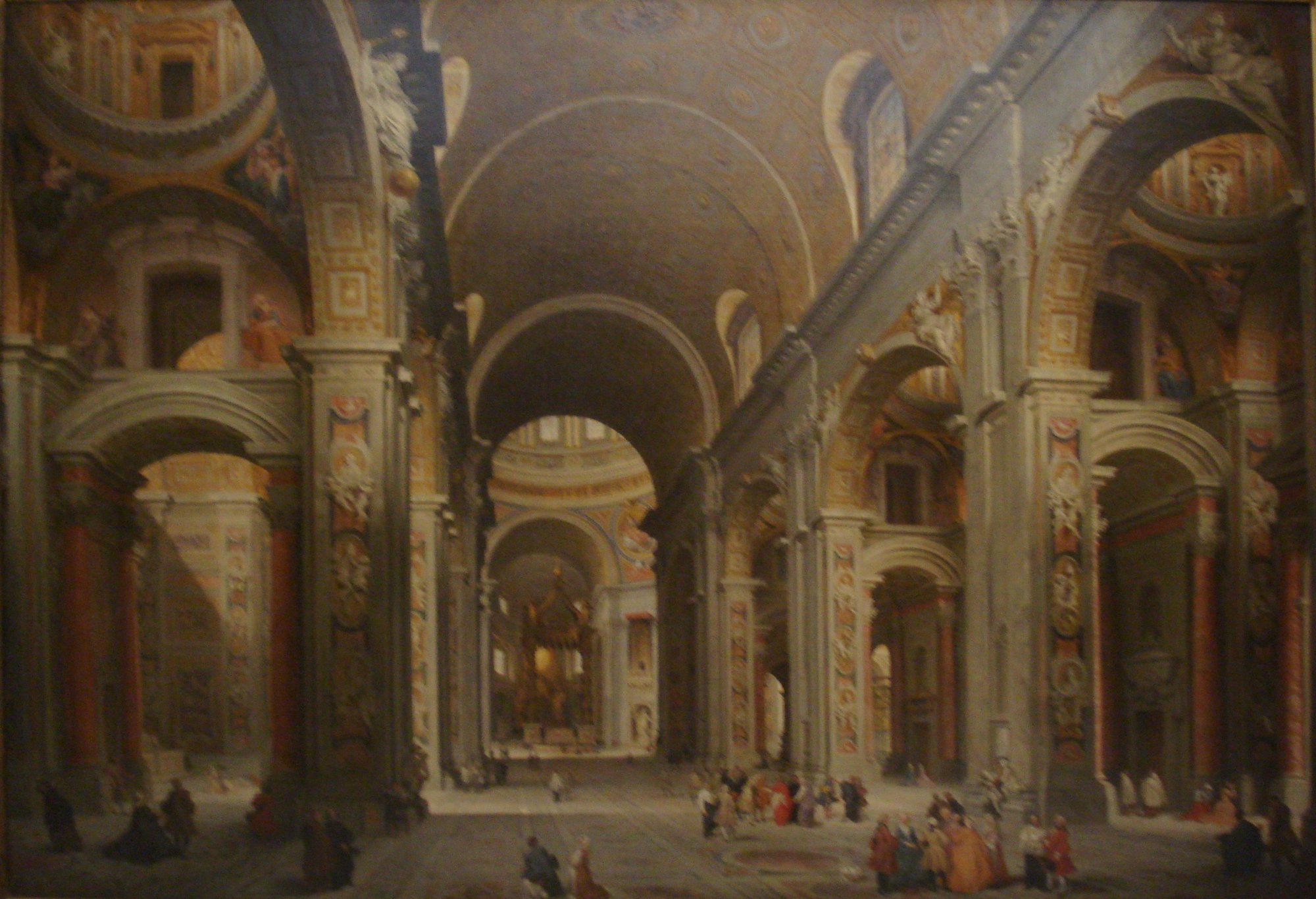
    Painted view of the nave of St Peter's Basilica and Bernini's Baldachin, by Giovanni Paolo Panini
    Panini’s view of the nave and Bernini’s Baldachin. Out of frame in a side aisle sits a gate Bernini never touched at all. Public domain via Wikimedia Commons.

    A guide stops the group about ten metres short of a gilded iron gate, waves a hand toward it, and keeps walking. No one in the group gets a photo of what’s behind it. That gate, a few chapels down the right aisle, past the Pieta, is the Chapel of the Blessed Sacrament, and it is the one part of the basilica you cannot simply wander through with a tour group. You can look. Entry is a different matter.

    A gate Borromini designed, not Bernini

    It is easy to assume the wrought-iron grille sealing the chapel is Bernini’s work, since almost everything else gilded in this building is. It isn’t. Francesco Borromini designed the gate, an architect better known for the twisting geometry of San Carlo alle Quattro Fontane and for his lifelong professional rivalry with Bernini. His grille carries bronze decorative elements, including the coat of arms of Pope Urban VIII, and it does a job a velvet rope elsewhere in the basilica does not: it physically closes the space to casual foot traffic.

    Bernini’s tabernacle, borrowed from Bramante

    Bernini’s contribution sits inside the gate rather than across it. The gilded bronze tabernacle, or ciborium, on the chapel’s altar was designed and executed by Gian Lorenzo Bernini between 1673 and 1674, near the end of his career. He modelled it on Donato Bramante’s Tempietto di San Pietro in Montorio, the small circular temple on the Janiculum hill that marks the traditional site of St Peter’s crucifixion. Shrinking a freestanding building into a tabernacle small enough to sit on an altar was a deliberate echo, not an accident of scale. Bernini was quoting the beginning of the story on an object built for its most sacred moment.

    The one painting in a basilica of mosaics

    Nearly everything that looks like a painting inside St Peter’s is a mosaic copy, reproduced in tiny coloured tesserae because oil paint doesn’t survive the basilica’s damp for long. This chapel is the exception. Its altarpiece, the Holy Trinity by Pietro da Cortona, painted between 1628 and 1631, is the only oil-on-canvas painting left in the entire building. On the right-hand altar wall hangs a mosaic copy of Domenichino’s Ecstasy of Saint Francis, which follows the basilica’s usual convention instead. Stand in front of both and you can see the difference in surface immediately: one has the sheen of pigment, the other the faint grid of glass tile.

    “Only those who wish to pray may enter”

    A sign posted at the chapel spells out the rule in plain terms: “Only those who wish to pray may enter.” The Blessed Sacrament is “exposed here for the continuous adoration of the faithful,” which is why the space functions less like a museum room and more like a working chapel that happens to sit inside one of the most visited buildings on earth. One visitor’s account describes it as a space that “is roped off, and behind a curtain,” with an attendant nearby to manage who comes in, particularly when the basilica gets busy. No posted timetable of adoration hours turned up in our research; the continuous-adoration wording is the closest thing to an official schedule.

    Why groups get steered around it

    Licensed guides don’t take tour groups through the Blessed Sacrament chapel, and the reason tracks the signage rather than any published Vatican policy on group routing. A chapel reserved for people who came to pray isn’t a stop on an itinerary built for forty people with earpieces and a running commentary. Guides route around the gate the same way they’d route around a side altar where a Mass is in progress: not because a rule forbids it in writing, but because the purpose of the space makes the choice obvious. Point it out from ten metres, explain what’s behind the gate, and move on to the next chapel: that’s the pattern on nearly every guided walk through the basilica. If you want to actually go in, go alone, go quietly, and go to pray rather than to look.

    When to actually see it

    From 1 June 2026, St Peter’s Basilica has kept new hours, open daily from 7:00 a.m. to 8:00 p.m. with last admission at 7:15 p.m. Early morning is genuinely early: the doors open well before most Rome hotel breakfasts do, and the first hour inside is the calmest the nave gets all day. The dome keeps separate hours, 7:30 a.m. to 5:00 p.m. through 28 March 2026 and 7:00 a.m. to 6:00 p.m. from 29 March, but that’s a climb up a different staircase entirely and has nothing to do with the chapel at ground level. If your visit lands on a Wednesday, check whether a papal general audience is scheduled first; the square fills fast on those mornings, and the calmer basilica visit is usually the afternoon instead.

    What to look for once you’re past the gate

    If you do go in to pray, or you’re simply standing at the grille looking through it, three things reward a slow look: Borromini’s ironwork itself, which is finer up close than it reads from ten metres away; Bernini’s tabernacle catching whatever light reaches that corner of the basilica; and Pietro da Cortona’s Trinity, the one canvas in a building otherwise built out of stone and glass. It’s a small room by St Peter’s standards, and that’s rather the point. Everywhere else in the basilica is designed to be seen by thousands of people at once, with sightlines planned around crowds moving through in one direction. This one room was designed to be used by a single person at a time, kneeling, with nobody behind them checking a watch.

    Most of the basilica’s other highlights don’t come with a locked gate, and seeing them properly still benefits from going early with a plan rather than joining whichever queue happens to be shortest. If you’re mapping out a visit that covers the dome, the grottoes, and the rest of St Peter’s without losing half a morning to lines, our St Peter’s Basilica tickets and tours page lays out the options.

  • When St Peter’s Holy Door Actually Opens (And Why It’s Bricked Shut Otherwise)

    St. Peter's Basilica facade seen from St. Peter's Square
    St Peter’s Basilica, seen from the square — home to the Holy Door discussed below, currently sealed between jubilees.

    Stand in the portico of St Peter’s Basilica today and you can walk through four of the five main doors without a second thought. Try the fifth, on the far right as you face the church, and it will not budge. It is not locked. It has been bricked up from behind since early January.

    Visitors ask about it constantly, usually after reading something about the 2025 Jubilee and wondering if they can still see the Holy Door in action. Short answer: not this year. Here is what it actually looks like right now, how the opening and closing ritual works, and when the door is next expected to swing.

    What the Holy Door looks like right now

    The panel you see today is bronze, sixteen sections cast for Pope Pius XII after the 1950 Holy Year, replacing an earlier wooden door that Pope Benedict XIV had installed in 1748. Vico Consorti modelled the reliefs; the Ferdinando Marinelli Artistic Foundry cast them. It is a real, physical door, which is more than could be said for most of its history.

    Between a jubilee’s closing and the next one’s opening, the door does not simply get locked. According to Wikipedia’s entry on the Holy Door tradition, “the doors are normally sealed by mortar and cement from the inside so that they cannot be opened.” That is the state it is in now: bronze on the outside, mortar behind it, functionally a wall until the next ceremony.

    It was more literal than that for centuries. “Between 1500 and 1974, the entrance portal was barricaded by a solid wall, not a door,” the same source notes. There was no bronze to look at at all for most of that span, just brickwork where a doorway should be. That current arrangement, a door that gets sealed rather than a wall that gets built, only dates to 1974.

    How the door is closed

    The Holy Door most recently closed on 6 January 2026, Epiphany, ending the 2025 Jubilee Year. Per Wikipedia’s entry on Jubilee 2025, “on 6 January 2026, Pope Leo XIV closed the Holy Door of St Peter’s Basilica, thus officially concluding the Holy Year.” That detail carries weight this time round. Pope Francis opened the door on Christmas Eve 2024; he died at Easter 2025 and never got to close it. Leo XIV, elected that May, inherited the closing ceremony for a jubilee he had not opened.

    As of this writing the door has been sealed for roughly seven months, and it will stay that way for years yet.

    How the opening ritual actually works

    The tradition goes back to 1300, when Pope Boniface VIII proclaimed the first Holy Year. For most of that history the opening was a piece of theatre involving a hammer. Popes struck the sealed door three times while singing a versicle: “the Pope knocked upon the door three times with a silver hammer, singing the versicle ‘Open unto me the gates of justice.’” Only after the ceremonial blows did masons move in and physically break through the mortar.

    That changed with the Jubilee of 2000. Rather than have the pope hammer through actual brickwork on camera, workers pre-emptively cleared the seal beforehand. “Workers removed the concrete before the ceremony, so that the Pope only had to push on the doors with his hands.” The three symbolic knocks stayed as ritual; the demolition work happened out of sight ahead of time.

    2024’s opening followed that modern form. Francis, by then using a wheelchair, arrived at the door on Christmas Eve. “The jubilee began on Christmas Eve (24 December) 2024, with Francis knocking on the Holy Door of St Peter’s Basilica in the Vatican from his wheelchair. The door was swung open and Francis rolled through the doorway as the basilica’s Christmas Eve Mass began.” From the following day, the door was open to any pilgrim who wanted to walk through it: official Jubilee materials record that “from December 25, 2024 all the faithful who wish to do so can make a pilgrimage to the Holy Door of St Peter’s Basilica in the Vatican.”

    Why it gets sealed again at all

    The mortar is not maintenance, it is the point. A Holy Door that stayed open would just be a fifth entrance to the basilica. Sealing it between jubilees is what makes walking through it, on the rare occasions it opens, a distinct act rather than routine foot traffic. The 2025 Jubilee ran 379 days start to finish, Christmas Eve 2024 to Epiphany 2026, a span close to the 1999-2001 jubilee that preceded it. Once that window closes, the door goes back to being wall.

    When it opens next

    Here the honest answer is: nobody has proclaimed a firm date yet. Ordinary jubilees have historically run every 25 years, which would point toward 2050, but extraordinary jubilees have opened the door outside that cycle before. Wikipedia’s entry on the Holy Door notes that the passageway “will be bricked up again until the next Extraordinary Jubilee, probably in 2033,” a year some point to because it would mark two thousand years since the Crucifixion. That is speculation being floated by commentators, not a papal bull. Treat 2033 as a number worth watching rather than a booking you can plan a trip around.

    Until any such announcement, the door you will see on a visit is the sealed bronze panel, not an open passage.

    What you can still see and do

    None of this affects entry to the basilica itself, which remains free and open through its other doors. Current published hours run from 7:00am to 8:00pm from June onward, per the basilica’s own site, though it flagged a change to those hours announced in May 2026, so it is worth checking the current posting before you build a schedule around it. The dome climb and the Pétros ení digital experience run on their own separate hours and carry their own fee.

    The Holy Door itself is worth pointing out to a guide on your way past, if only because so few visitors know what they are looking at: a genuine bronze door, sealed shut behind sixteen bronze panels, waiting out a gap in the calendar that could run another two decades.

    Planning a visit

    If you are coming to see the basilica’s interior, the Pietà, Bernini’s baldachin, the dome, or the necropolis beneath the altar, none of that depends on the Holy Door being open. A guided visit gets you past the queue and gives you someone to point out details like the sealed door that a self-guided walk-through would miss entirely. You can browse St Peter’s Basilica tickets and tours to find a slot that fits your dates.

  • Bernini’s Colonnade Trick: Find the Spot Where Four Columns Become One

    Bernini's colonnade in St. Peter's Square, Vatican City — the four-row colonnade behind this piece's single-column illusion
    St Peter’s Square colonnade, Vatican City. Photo via Shutterstock.

    Two round stones are set into the paving of St Peter’s Square, one on each side of the obelisk, and almost nobody standing on them knows why they are there. Find one, plant both feet on it, and look toward either arm of Bernini’s colonnade. Four rows of columns that fan out in every other spot on the piazza suddenly line up, rank behind rank, until you are looking at what appears to be a single column. Step off the disc and the illusion collapses; the columns spread back into their hundreds. It is not a trick of light. It is geometry, built into the piazza on purpose in the 1650s and 60s.

    Where to stand

    Both discs sit beyond the outer ring of the compass-rose pavement pattern that circles the obelisk at the centre of the square. Wikipedia’s description is precise: the foci are “marked in the paving by roundels of stone six or seven metres beyond the outer ring of the compass rose centered on the obelisk, on either side.” One disc lies toward the colonnade on the north side, the other toward the south. Locals and guides sometimes call them the “magic points,” though that name is a modern shorthand rather than anything Bernini himself used. Walk out from the obelisk along the paving lines and you will feel the stone underfoot change; that change is your marker.

    An oval that behaves like a circle

    Bernini designed the piazza as what he called an ovato tondo, his own term for a shape that reads as an oval but is generated the way a circle is. In architecture, Wikipedia notes, “an ‘ovato tondo’ is an oval shape that is also circular.” Overall, the embrace of the square measures a genuinely large span: “the ovato tondo is 240 metres across.” An oval, unlike a circle, does not have one centre. It has two foci, and those two stone discs mark them exactly.

    This is the part that makes the trick work rather than just being a curiosity. Instead of a flat wall of columns facing the piazza, the colonnades stand in four straight rows, set radially so that each row points back toward the oval’s foci. From any ordinary spot in the square, your eye crosses those four rows at an angle, and you see four separate ranks of stone with daylight and shadow between them. Only from a focus does the angle drop to zero. All four rows sit exactly behind one another along your line of sight, and a colonnade with hundreds of individual supports reads, for a moment, as a single fat column.

    Why he built it this way at all

    Pope Alexander VII commissioned the redesign of the square, and Bernini’s own biography dates the project to “St. Peter’s Square (1656–67),” a span that matches Alexander VII’s papacy almost to the year; he died in May 1667. The brief Bernini was working to, as Wikipedia records it, called for a square built “so that the greatest number of people could see the Pope give his blessing,” whether from a window of the Apostolic Palace or the loggia of the basilica itself. Bernini’s colonnades were meant to read as an embrace rather than a barrier, described in the same source as “the maternal arms of Mother Church” reaching out to gather the crowd in.

    Bernini kept the columns themselves deliberately restrained. He used what Wikipedia calls a Tuscan order, the plainest of the classical column styles, “to avoid competing with” Carlo Maderno’s ornate basilica façade behind them, applied “on an unprecedented colossal scale.” Four rows deep, unbroken around both curved arms of the square, topped by a cornice carrying statues of saints well over life size. Scale was the whole point: a design this large needed a party trick this precise to prove it was not just mass for its own sake.

    So how many columns are there, exactly

    Here honesty matters more than a tidy number. Wikipedia’s St Peter’s Square article gives a figure of 248 columns and 88 pilasters, with 140 saints along the cornice above. A separate tourism source puts the column count at 284, while agreeing on the 88 pilasters and the four-rows-deep arrangement. The two totals do not match, and neither source resolves the gap. Rather than repeat one number as settled fact, it is fairer to say the colonnade holds several hundred columns arranged in four ranks, a scale that later restorers have apparently found genuinely hard to tally with agreement, let alone a tourist trying to count from ground level.

    Finding the discs without a guide

    Stand with your back to the obelisk facing either colonnade arm and walk outward along the paving, past the compass-rose ring, roughly six or seven metres further out. You are looking for a stone disc set flush with the paving, distinct from the travertine around it. Test the illusion from a metre either side of it first; the effect narrows fast, and you will feel the moment the columns lock into line. The square itself is open-air and freely walkable, so there is no ticket or timed entry involved in trying this. It rewards patience more than luck: on a crowded morning, waiting for a gap in the crowd to see the columns clearly is often the harder part.

    The discs are a five-minute detour before or after seeing the basilica itself, and they explain something about the square that a photograph never quite gets across: Bernini was not just decorating an open space, he was engineering how it would look from specific points within it. If you would rather have someone walk you to both spots and time the visit around the basilica’s own crowds, our Vatican tours page lists guided options that build the square into the itinerary rather than treating it as a walk-through on the way to the doors.

  • How a 350-Ton Obelisk Ended Up in the Middle of St Peter’s Square

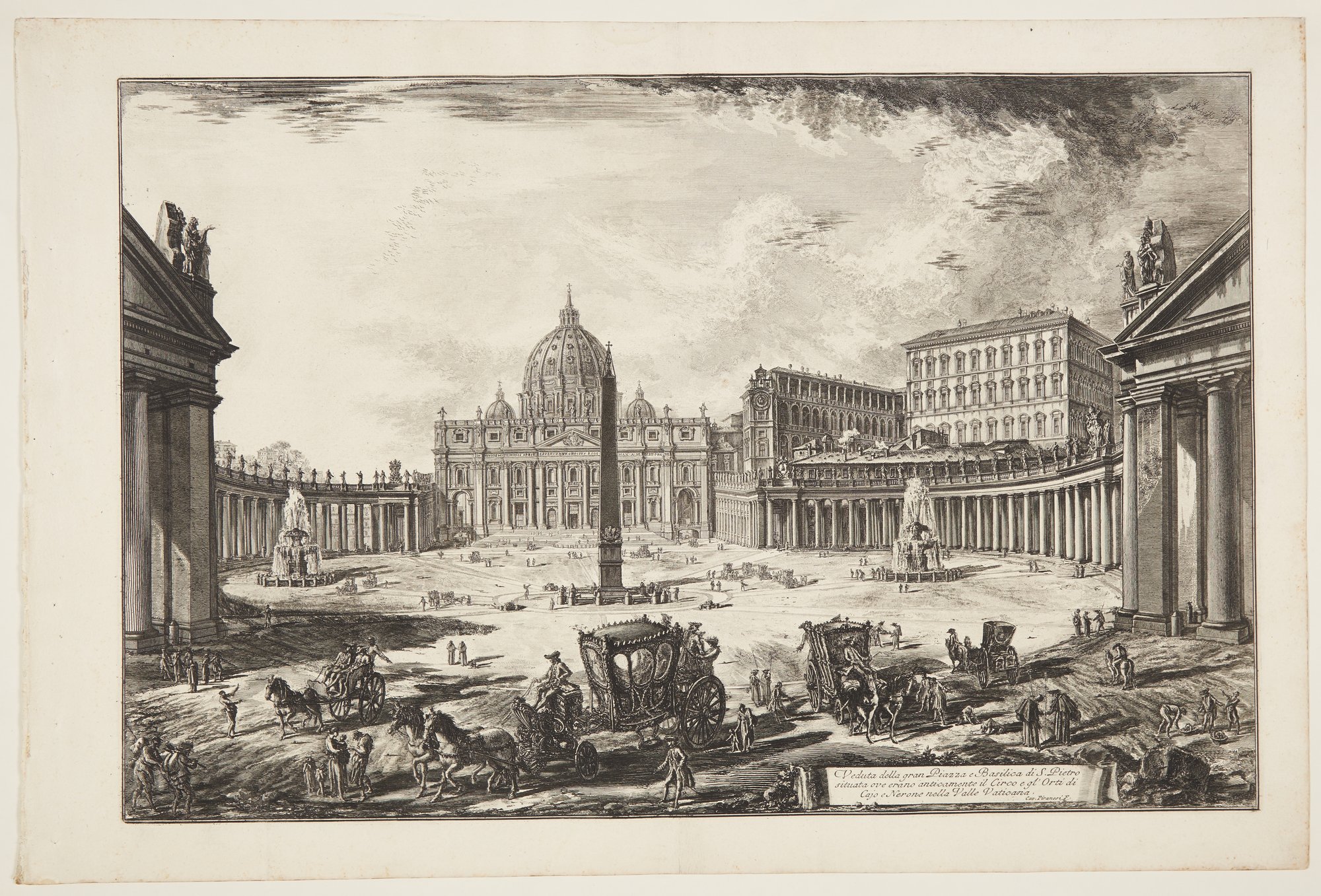
    Piranesi's 1772 engraving of St Peter's Square and the Basilica facade with Bernini's colonnade, the piazza where the obelisk has stood since 1586
    Giovanni Battista Piranesi’s 1772 engraving of St Peter’s Square and the Basilica facade with Bernini’s colonnade — the piazza built around the obelisk two centuries earlier. Public domain via Wikimedia Commons.

    Stand at the center of St Peter’s Square and you are standing next to the oldest object in Vatican City by a margin of more than a thousand years. Everything around it, Bernini’s colonnade, Maderno’s facade, even Old St Peter’s before it, came later. The plain granite shaft at the heart of the piazza was already ancient when Julius Caesar was alive. It carries no cross carved by a Christian hand and no hieroglyph naming a pharaoh. It simply arrived, by way of a Roman emperor’s private racetrack, and stayed.

    A monument with no name on it

    The obelisk was quarried in Egypt, and tradition, going back to Pliny the Elder, places its origin at Heliopolis, the sun-worship center near modern Cairo. That much is generally accepted. What is unusual is what the stone doesn’t say. Every other standing Roman obelisk carries hieroglyphic inscriptions naming the pharaoh who raised it and the god it honored. This one is blank. As one Vatican reference site puts it, it is “the only one devoid of hieroglyphics, but with Latin inscriptions” — the Latin came fourteen centuries after the Egyptian carving would have. Whether the hieroglyphs were erased at some point or the obelisk was simply never inscribed is not something anyone can say with confidence. Either way, a granite giant that has stood in the middle of the Roman Catholic Church’s main square since the sixteenth century cannot be tied by name to the ruler who commissioned it.

    The shaft alone runs a little over 25 metres. With its base, pedestal and the bronze cross now fixed to its tip, the whole assembly rises close to 40 metres above the paving stones. Weight is where the sources start to disagree: some put it at 320 tons, others closer to 330, and the figure of roughly 350 tons that gets repeated in guidebooks and on tour buses isn’t pinned down by any of the primary references. Call it somewhere in the 320-to-350-ton range and you’re on solid ground. Nobody has weighed it on a scale, obviously, and estimates this old carry a margin of error that no single number quite captures.

    Caligula’s circus

    The obelisk came to Rome under the emperor Caligula, sometime around 37 or 40 AD depending on which account you follow; the surviving records don’t let you pick one date over the other with certainty. What is clear is where it went once it arrived. Caligula erected it in the spina, the low central barrier of a private chariot-racing circus he built on the west bank of the Tiber, on ground that would later be called the Circus of Nero after Claudius completed it and Nero, who succeeded Claudius two reigns after Caligula, made it his own. That circus sat immediately beside a hillside necropolis, the same burial ground that, per longstanding tradition, held the grave of the apostle Peter.

    For more than fifteen centuries the obelisk stood there, a few dozen metres from where Old St Peter’s Basilica would eventually rise beside it, watching over a track where, in the mid-first century, early Christians were reportedly executed as spectacle under Nero. It is a strange piece of continuity: a pagan monument to a sun god, planted next to a killing ground that a persecuted faith would later claim as sacred, and then adopted, centuries on, as that faith’s own centerpiece.

    A pope decides to move it

    By the 1580s the obelisk was still standing roughly where Caligula had put it, but it was no longer in front of anything that mattered. The new St Peter’s Basilica, under construction since 1506, was rising on a different axis, and the obelisk sat off to one side, disconnected from the piazza taking shape in front of the church. Pope Sixtus V decided to fix that. He wanted the obelisk, this ancient, weathered, un-Christian column, planted dead center of the new square, and he wanted it topped not with whatever pagan ornament it had originally carried but with a cross.

    Moving a 300-plus-ton stone column 260 metres without breaking it, in an age before hydraulics or steel cable, was not a small engineering request. Sixtus put the job to the architect Domenico Fontana, working with the astronomer Ignazio Danti, and Fontana treated the whole operation as a demonstration piece as much as a construction job. He later published his own account of it, “Della transportatione dell’obelisco Vaticano e delle fabriche di Sisto V,” in 1590 — part technical record, part victory lap.

    The machine that lifted a granite tower

    The mechanics were, by any standard, audacious. A timber scaffold tower was built around the obelisk, tall enough to enclose the whole shaft, anchored by a forest of ropes running to capstans on the ground. One Wikipedia account of Fontana’s career sums up the scale bluntly: “This feat of engineering took the concerted effort of 800 men, 160 horses and countless pulleys and metres of rope.” Other sources give slightly different figures, closer to 900 men and 70-odd horses working somewhat fewer winches, and the discrepancy is a reminder that even a well-documented sixteenth-century project didn’t leave behind a single tidy number everyone agrees on. What both versions agree on is the order of magnitude: hundreds of men and well over a hundred horses, working in coordinated silence.

    That silence was enforced by decree. Fontana knew that a shout at the wrong moment, a horse startled mid-pull, could snap a rope under a load of that mass and send the half-raised obelisk crashing. So a strict no-noise rule was imposed on the crowd gathered to watch, on pain of death by some accounts. The work of tipping the obelisk from horizontal to vertical and setting it onto its new pedestal ran across roughly four and a half months in 1586, following well over a year of preparatory groundwork.

    “Water on the ropes!”

    The most famous moment of the whole operation almost wasn’t in the plan at all. As the obelisk neared vertical, the hemp ropes, stretched to their limit under the strain, began to smoke and fray from friction. Tradition holds that a sailor from Bordighera named Benedetto Bresca broke the silence rule and shouted the warning that saved the job. As Wikipedia records it: “During the move, there was a famous cry by sailor Benedetto Bresca: Acqua alle funi (‘Water on the ropes!’), in order to avoid breaking the ropes that were about to give in under the great weight of the obelisk.” Water was thrown on the fraying ropes, they held, and the obelisk settled onto its base intact. As reward, Sixtus V is said to have granted Bresca’s hometown the privilege of supplying the palm fronds used at the Vatican for Palm Sunday each year, a custom the town of Bordighera still keeps.

    Consecrating a pagan stone

    Once the obelisk stood upright in the square, Sixtus V made sure nobody mistook it for a leftover relic of paganism left standing by accident. The pope had it stripped of an ancient bronze ball that had capped it since Roman times, an object popularly rumoured, without any real confirmation, to hold the ashes of Julius Caesar or the emperor Trajan. When it was finally opened, it was empty. That ball now sits in the Capitoline Museums, moved there in 1848. In its place, Sixtus V installed a bronze cross reputed to hold a fragment of the True Cross, and had the base carved with a formal Latin inscription consecrating the whole monument to Christianity.

    “SIXTVS V PONT MAX / CRUCI INVICTAE / OBELISCVM VATICANVM / AB IMPVRA SVPERSTITIONE / EXPIATVM IVSTIVS / ET FELICIVS CONSECRAVIT / ANNO MDLXXXVI PONT II” — “Sixtus V, Pontifex Maximus, consecrated to the invincible cross the Vatican obelisk, expiated of impure superstition, in the year 1586, the second of his pontificate.” Later inspections of the cross reportedly turned up no actual relic fragment, despite indulgences granted at the time that implied one was there. It is worth treating as legend rather than settled fact, much like the ashes said to have once sat in the bronze ball below it.

    Standing in the square today

    None of this history announces itself when you walk into the square today. The obelisk simply stands there, plain grey granite against the theatrical curve of Bernini’s colonnade, doing double duty as a sundial gnomon: the paving around its base is marked with the signs of the zodiac and the hours, so its shadow tells the time on a clear day. Most visitors photograph it and move on toward the Basilica steps without registering that it predates the religion whose central square it now anchors by well over a thousand years.

    If you time a Vatican Museums visit around it, the practical detail worth knowing is that “visitors must vacate exhibition areas 30 minutes before museum closing time,” per the museums’ own posted hours, so plan your obelisk stop for the square itself, which is open air and unticketed, rather than folding it into the last half hour of a museum visit. The Museums run 08:00 to 20:00 Monday to Saturday, with last entry at 18:00.

    A guide who has walked past that obelisk hundreds of times can point out the zodiac markings, the Bresca inscription tucked into the base, and the line of sight Fontana engineered between it and the Basilica facade, details that are easy to miss on your own in a crowded square. If you want that context built into your visit rather than pieced together afterward, a guided Vatican tour is where it comes together, alongside the Museums and the Sistine Chapel the obelisk now quietly faces.