Category: Uncategorized

  • The Borgia Apartments: Pinturicchio’s Frescoes for a Scandalous Pope

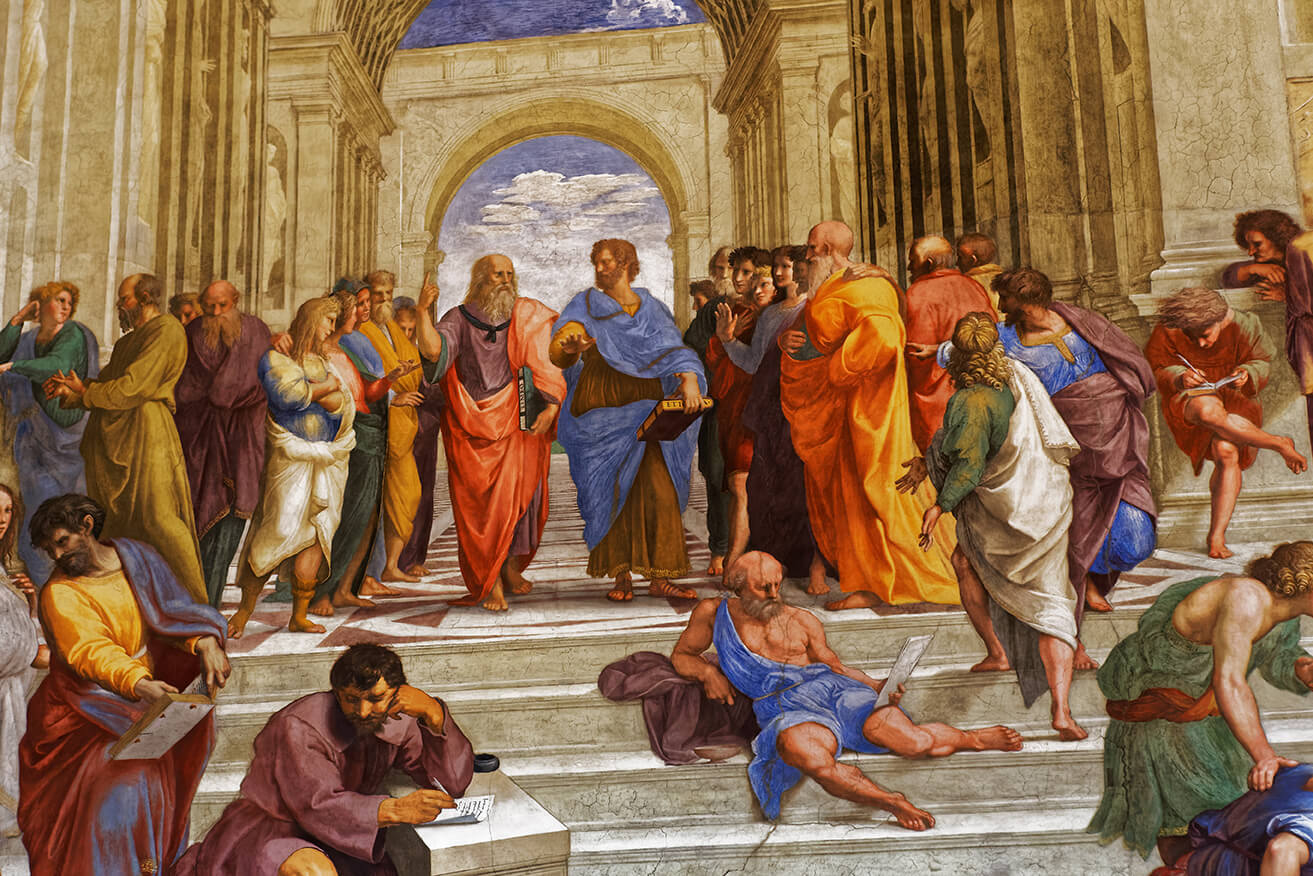
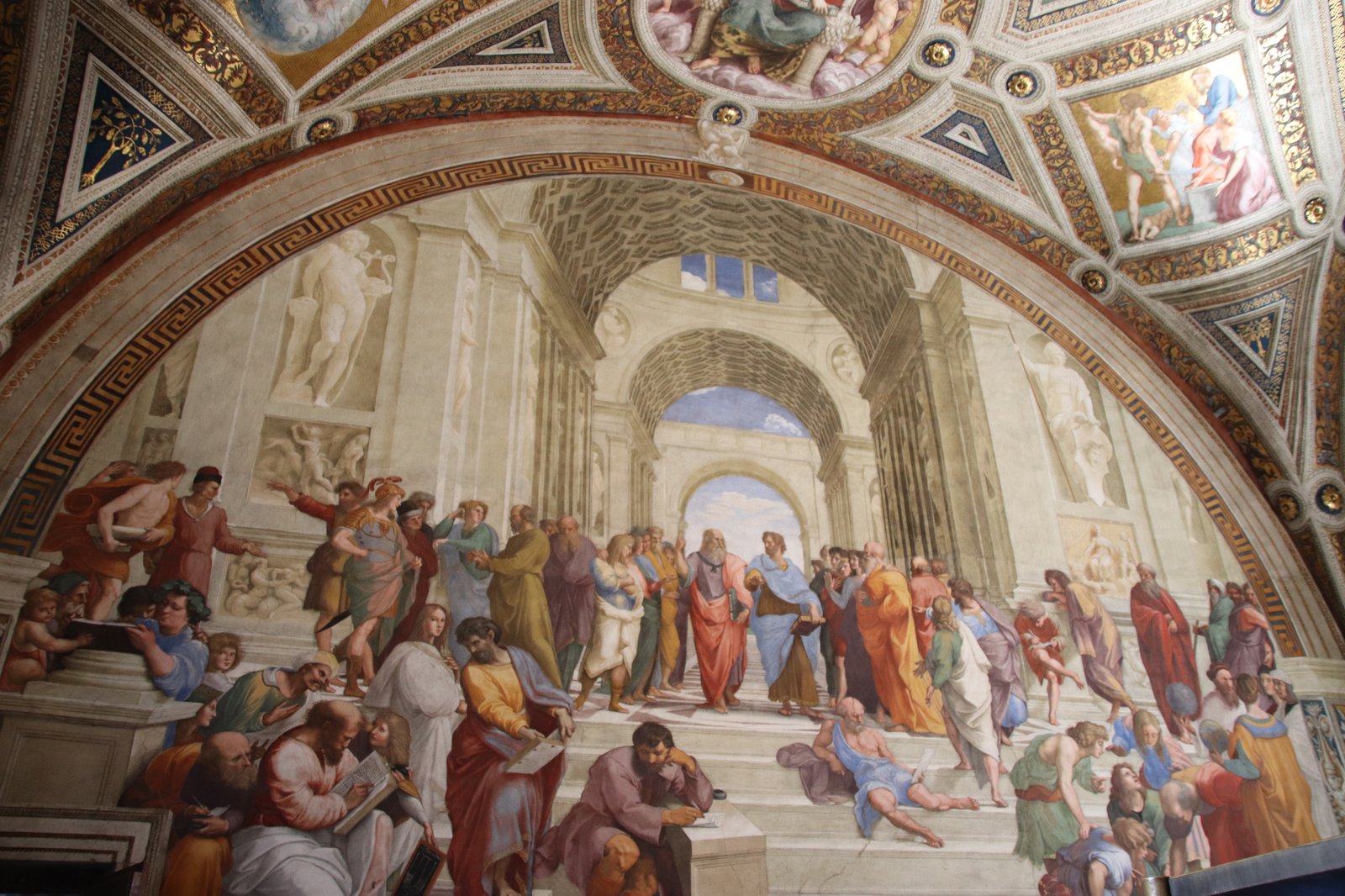
    Raphael's School of Athens fresco in the Stanza della Segnatura, Vatican Museums
    Raphael’s School of Athens in the Stanza della Segnatura, painted elsewhere in the Apostolic Palace a generation after Pinturicchio finished the Borgia Apartments. Public domain via Wikimedia Commons.

    Most visitors walk through the Borgia Apartments on the way to somewhere else, following signs toward the modern collection or the Sistine Chapel, and barely register that the rooms themselves are the point. Rodrigo de Borja became Pope Alexander VI on 11 August 1492, and within months he had Bernardino di Betto — known to everyone as Pinturicchio — covering six rooms of his private apartment in fresco. Painters and gilders must have worked in relays to finish it as fast as they did. What emerged is one of the densest, strangest decorative programs in the Apostolic Palace, and its most talked-about detail is a face nobody can fully confirm.

    A Spanish pope with something to prove

    Vatican Museums’ own page describes him plainly: “The Spanish Rodrigo de Borja y Doms (Italianised as ‘Borgia’), elected as pope following the death of Innocent VIII with the name Alexander VI.” He was an outsider in Rome, a Valencian in a city that ran on Italian family networks, and he compensated the way popes usually did: with an unmistakable building project. Six rooms and one fresco cycle, with his own heraldic bull worked into nearly every scene he could justify it in. Whatever else people said about him — and plenty was said, most of it unverified rumour about his children and his rivals rather than settled history — the frescoes were a statement of arrival that has outlasted every scandal attached to his name.

    Pinturicchio’s six rooms

    His suite runs through the Room of the Sibyls, the Room of the Creed, the Room of the Liberal Arts, the Room of the Saints, the Room of Mysteries, and the Room of Pontiffs. Pinturicchio worked with a studio of assistants across roughly 1492 to 1494, a fast turnaround for this much gilded, crowded, gold-ground painting. Oldest of the six is the Room of Pontiffs: its architectural structure dates to 1277–1280, built under Nicholas III long before Alexander VI arrived, and Pinturicchio never touched it. Its original wooden ceiling collapsed in a storm in 1500 — Alexander VI himself was in the room at the time and survived by inches, sheltered under a fallen beam — and the space wasn’t redecorated until the 1520s, when Pope Leo X had Perin del Vaga and Giovanni da Udine paint an entirely different vault of grotesques, zodiac signs and planets that doesn’t match Pinturicchio’s cycle at all. Everything else in the sequence went up new under Alexander VI, more or less in one continuous campaign.

    Walk the six rooms in order and the program reads as instruction and self-portrait at once, theological lessons for a papal household threaded with portraits of the family paying for them.

    A triumphal arch for the pope’s own bull

    Its set piece is the Disputation of St Catherine of Alexandria, in the Room of the Saints, showing the young saint refuting a room full of pagan philosophers in front of the Roman governor Maximinus Daia. Pinturicchio staged it as theatre. Vatican Museums curators describe the backdrop as “a monumental triumphal arch based on that of Constantine, surmounted by an idol in the form of a bull, alluding to Pope Borgia’s heraldic symbol.” Rome’s most famous ancient monument, repurposed as scenery for the pope’s own coat of arms — subtlety was never really the assignment here.

    Whose face is this, really?

    This is where the room earns its reputation beyond art history. Vatican Museums’ own description of the fresco notes that “portraits of illustrious contemporary figures have been recognised, if not always appropriately: Catherine-Lucrezia Borgia.” Read that sentence carefully and it is doing real hedging: the identification of Catherine’s face with Alexander VI’s daughter Lucrezia is traditional, not confirmed, and the museum flags that past attributions haven’t always been reliable. Wikipedia’s entry on Lucrezia Borgia uses the same caution independently, captioning the image only as a “purported portrait” of her as the saint.

    So no art historian can hand you certainty here, and I won’t pretend otherwise on a tour. What’s certain is narrower and, honestly, more interesting: a pope had his family’s faces worked into a devotional fresco cycle inside his own private rooms, and five centuries later we’re still debating which face belongs to whom. That ambiguity is part of what makes the room worth slowing down for, rather than a trivia answer to file away and move past.

    Sibyls, liberal arts, and the rest of the cycle

    The other rooms reward the same close looking. Pagan prophetesses pair off with Old Testament figures in the Room of the Sibyls, a favourite humanist device for arguing that classical wisdom had quietly anticipated Christian revelation. Grammar and music, astronomy and the rest of the classical arts, all appear personified as seated women presiding over scholars in the Room of the Liberal Arts, a scheme aimed squarely at a papal court that liked to think of itself as learned. Apostles face off against Old Testament prophets in the Room of the Creed, matched line by line, each article of belief paired to its scriptural source. None of it is subtle. All of it is meant to be read, not just admired.

    From private apartment to public gallery

    What happens to the rooms after Alexander VI dies in August 1503 is where the story turns genuinely difficult to sum up in a sentence. Later popes were uneasy about living in his old apartment, and over the centuries the space passed out of use as a residence and into the Vatican Museums’ exhibition circuit. Today it also functions as an approach to the Vatican’s collection of modern and contemporary religious art, founded under Paul VI, with works by artists such as Carrà, de Chirico, Gauguin, Chagall, Klee, Dalí and Picasso hung not far beyond. Exactly how the six Borgia rooms and the collection’s several dozen modern-art galleries connect architecturally is a detail I’d rather not overstate on a page like this; the practical point for a visitor is that the sequence carries you from fifteenth-century fresco straight into twentieth-century painting with barely a corridor in between, a jump few museums in the world can offer in one unbroken walk.

    Getting there and getting in

    The Borgia Apartments sit inside the general Vatican Museums route, so a standard ticket covers them; there’s no separate booking to worry about. Full-price adult admission is “€ 20.00 (without online booking),” with a €5 booking fee if you reserve a skip-the-line slot online, which on a summer morning is worth paying for. Reduced tickets for students run €10, plus the same €5 booking fee. Opening hours run Monday to Saturday “08.00 a.m. – 08.00 p.m.,” with “final entry 06.00 p.m.,” and staff will ask you to “leave the halls 30 minutes before museum closing time,” so don’t plan the Borgia rooms as your last stop at quarter to eight. On the last Sunday of the month the museums open “09.00 a.m. – 02.00 p.m.” with free entry for everyone, which also means the heaviest crowds of the month; the Borgia Apartments are a natural place to duck into if the main galleries are jammed, since most visitors rush past toward the Sistine Chapel without stopping.

    Book only through the museums’ own channel. As the site itself notes, the only official site for purchasing tickets online is tickets.museivaticani.va, and third-party resellers can charge well above face value for the same entry slot.

    Why it’s worth the detour

    Skip the Borgia Apartments and you still get the Vatican’s greatest hits: the Sistine ceiling and the Raphael Rooms, plus the famous spiral staircase on the way out. Slow down here instead and you get something rarer, an unfiltered look at how one Renaissance pope wanted to be seen, painted by an artist working at speed for a patron who didn’t do modesty. If you’d like a guide to walk that sequence with you rather than reading museum labels in a moving crowd, our Vatican Museums tours route through the Borgia Apartments before the crowds build.
  • The Regolini-Galassi Tomb: Etruscan Gold Found Intact in 1836

    A gallery of classical antiquities at the Vatican Museums; the Regolini-Galassi gold is displayed separately in the Museo Gregoriano Etrusco
    A Vatican Museums antiquities gallery, shown here for general atmosphere. Regolini-Galassi treasures hang in a dedicated room of the Museo Gregoriano Etrusco, not pictured here. Photo via Shutterstock.

    Most tomb finds arrive in fragments: a shard here, a corroded fitting there, decades of guesswork stitching the pieces into a story. Regolini-Galassi is the rare exception. When it came out of the ground near Cerveteri in the winter of 1836-37, an entire seventh-century BC burial arrived close to how its owners had left it, complete with gold. A single excavation is the reason a dedicated room of the Vatican’s Etruscan museum exists at all.

    Who found it, and where

    The tomb sits in the Sorbo necropolis outside Cerveteri, ancient Caere, one of the wealthiest cities of the Etruscan league. The tomb was excavated over the winter of 1836-37 by General Vincenzo Galassi and the archpriest of Cerveteri, Alessandro Regolini — a soldier and a parish priest, digging together on a hillside outside Rome. The Vatican Museums’ own room page confirms only that the tomb “was discovered still intact in 1836,” without naming either man; their names and titles come from the wider historical record. Either way, they opened a corridor tomb that had lain sealed for roughly 2,500 years. Their names now label a room in the Vatican Museums.

    That find mattered enough to help justify an entirely new museum. A new Museo Gregoriano Etrusco was “founded by Pope Gregory XVI and inaugurated on 2 February 1837,” within months of the excavation closing, making it one of the earliest museums anywhere built specifically to house Etruscan material. Room II of that museum still carries the tomb’s name.

    Archaeologists label the seventh century BC in southern Etruria the Orientalizing period, and this tomb is the reason the label sticks. Caere sat on trade routes reaching the eastern Mediterranean, from Phoenician ports to Cyprus and Egypt, and its goldsmiths were clearly looking east for both raw technique and finished imagery, then reworking both in ways no Levantine workshop would have produced. The pectoral and fibula are the two clearest demonstrations of that exchange the Vatican owns.

    What “intact” actually means here

    Tomb robbery is the default condition of ancient burial archaeology; grave goods worth having tend to leave the ground long before archaeologists arrive. This tomb broke that pattern. Wikipedia describes it as having been “discovered in 1836 in modern-day Cerveteri in an undisturbed condition,” meaning nineteenth-century looters had never reached it before Galassi and Regolini did.

    Inside, the layout held three separate burials. A woman of evident high status occupied the end chamber, laid out among the richest of the grave goods. A cremated man lay in a side cell. A third individual, whose identity nobody has pinned down, rested on a bronze funerary bed in an annex. No inscription survives naming any of them, so guides who claim to know the woman’s name are inventing a detail the tomb itself never gave up.

    Pectoral hammered from a single sheet

    The single object visitors remember is a gold pectoral now catalogued as no. 20552, measuring 38.1 centimetres across and 42 centimetres tall, dated by the Vatican to 675-650 BC. Worn across the chest, its catalog description calls it “a single shaped sheet of metal with complex embossed decorations, executed using different punches.” That is craftsmanship of a very particular kind: every figure raised from one continuous gold sheet, hammered from behind rather than cast or assembled.

    At the centre stands a “male figure between two rearing lions held by their hind legs (so-called ‘lord of the animals’),” an image with roots stretching back through Near Eastern art. Around him crowd ibex and gryphons; chimeras and a winged horse; lions paired with lotus flowers; deer and winged female figures — all pressed into gold within a border of “uniform triangles (so-called wolf’s teeth).” Its text does not soften the impression the piece made on its discoverers: the deceased, it says, was found “literally covered in gold before its astonished discoverers.” That pectoral, the same page notes, was “worn along with the fibula belonging to the deceased.” Both pieces were made and worn as a set.

    Fibula built for parade, not for holding a cloak shut

    A fibula is a clasp, “an ancient version of the modern safety pin, used to fasten and decorate robes,” in the Vatican’s own phrase. This one, from the lower chamber, is anything but a functional accessory. Scaled up into a showpiece, it is a disc brooch “embossed, punched, cut and granulated,” carrying imagery drawn from further east than Etruria itself. Gryphons appear again alongside interwoven arches and palmettes, and the arch finishes in “the head of the Egyptian goddess Hathor which concludes the arch.” Look closely and the fine detail resolves into granulation: edges built from “minute micro-welded spheres,” each one soldered on individually by a goldsmith working at a scale most modern jewellers would find punishing.

    Both pieces sit under the same catalogue grouping, both came from the tomb’s lower chamber, and both point the same direction: Cerveteri in the seventh century BC was pulling in imagery and techniques from Phoenician and broader Eastern Mediterranean workshops, then reworking them into something distinctly its own.

    Everything else that came out with the gold

    Gold gets the attention, but it was one part of a much larger haul. Wikipedia’s list runs to bronze cauldrons; silverware and gilt vessels; a chariot; Phoenician metal bowls; and a decorated plaque roughly 25 centimetres across with imagery of Eastern origin. Independent confirmation comes from the Vatican room’s own navigation menu, which names bracelets; a necklace; silver vessels; a funerary bed; bucchero mourning figures; carts; a cauldron fitted with lion-head handles; a shallow libation dish; and a Phoenician-Cypriot cup. Weigh the gold against that inventory and a picture forms of a household, or a lineage, wealthy enough to bury bronze furniture and imported tableware alongside its jewellery, not merely its finest pieces.

    Seeing it in Room II

    The pectoral and fibula live today in Room II of the Museo Gregoriano Etrusco, named for the tomb itself, inside the wider Vatican Museums complex. It is a small, quiet room by Vatican Museums standards, easy to walk past on the way toward the Sistine Chapel if you are not looking for it. Worth the pause: nothing else in the museums shows Etruscan goldwork of this quality, and none of it is behind the kind of crowd you fight through in the Raphael Rooms.

    Display cases in Room II hold the pectoral and fibula alongside the wider grave-goods set, so a slow circuit of the case line covers the bronze cauldron, the funerary bed, and the smaller silverware in the space of a few minutes. There is no glass barrier equivalent to what protects the Pietà; a case is simply a case, close enough to see the granulation on the fibula without binoculars. Bring that close a look and the “micro-welded spheres” the Vatican describes stop being a phrase in a catalogue and start being something you can actually count.

    Standard opening hours run Monday to Saturday, “08.00 a.m. – 08.00 p.m.,” with last entry at 6.00 p.m., two hours before closing. On the last Sunday of most months the museums open free of charge, “09.00 a.m. – 02.00 p.m.,” though that exception does not apply when the date falls on Easter, 29 June, or the late-December holidays. Plan an Etruscan detour for a weekday morning if you can. Crowds build fast in the two hours after opening and again in early afternoon, so an early visit is what actually buys you a quiet look at Room II.

    If you would rather have a guide walk you straight to Room II instead of hunting for it on the map, our Vatican Museums tours cover the Etruscan collection alongside the more famous stops, so a find this good does not end up an afterthought squeezed between the Sistine Chapel and the exit.

  • Is the Vatican’s Egyptian Museum Worth the Detour?

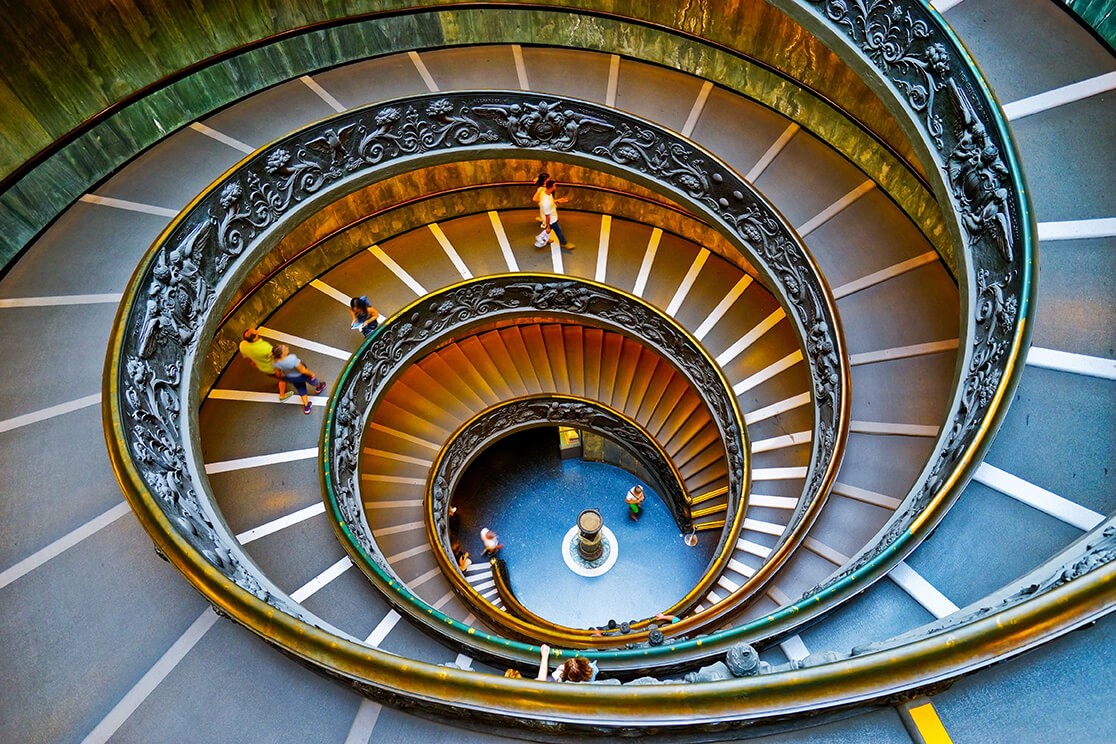
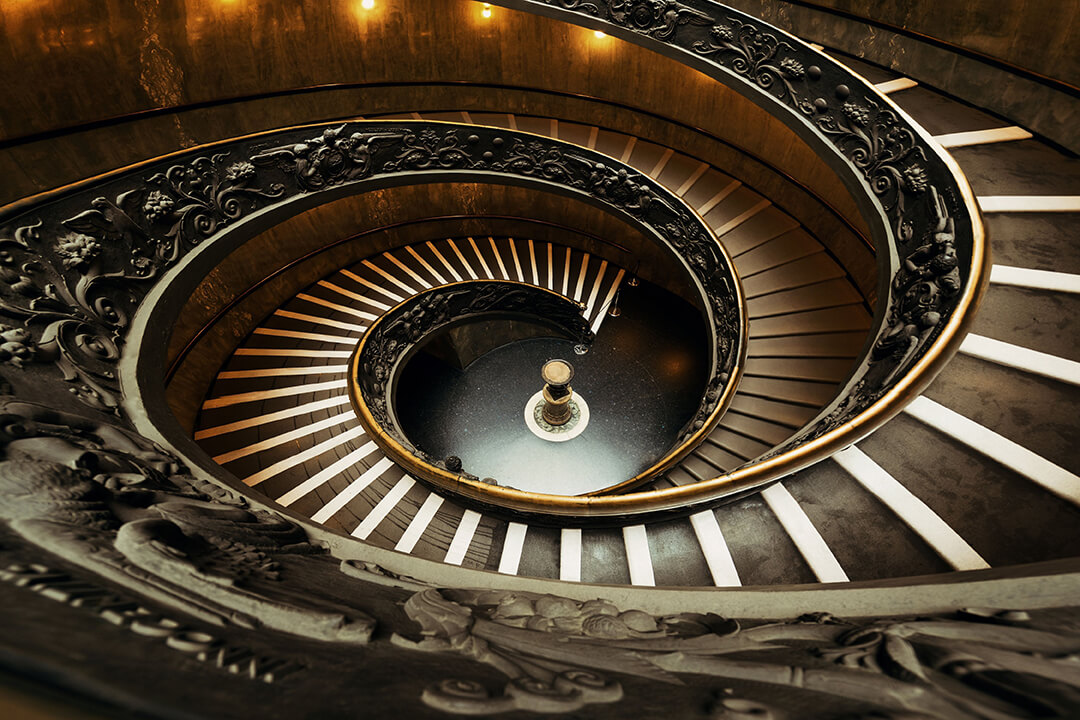
    Giuseppe Momo's spiral staircase at the Vatican Museums exit, a symbol of how tightly the one-way route controls visitor movement
    Giuseppe Momo’s spiral staircase at the Vatican Museums exit. It is not the Egyptian Museum’s own entrance, but it is a good picture of how firmly the one-way route decides what you see and what you don’t.

    Ask a guide leading a two-hour express group whether they’re stopping at the Gregorian Egyptian Museum and the answer, more often than not, is no. It isn’t hidden. It sits on the ground floor, easily reached soon after the entrance atrium, with mummies, sarcophagi, and fragments of the Book of the Dead sitting in cases a few minutes’ walk from where everyone else is queuing for the escalators up to the main galleries. Groups on a fixed Sistine Chapel timeslot skip it anyway, and the skipping has almost nothing to do with what’s in the rooms.

    Why guided groups walk past it

    The reason is scheduling, not quality. A widely used two-hour express itinerary lists the Egyptian rooms as a deliberate cut, describing them as “significant collections in their own right but cannot be accommodated in 2 hours alongside the main route.” That is an honest way of putting it. A one-way system pushes large groups toward the Sistine Chapel on a clock, and nine rooms of Egyptian material sitting slightly off that main current become the easiest thing to drop when the schedule is tight. Guides aren’t being lazy. They’re triaging a building that takes most of a day to see properly, and a group with a 45-minute Sistine Chapel slot cannot afford detours.

    That triage decision, repeated across thousands of tour groups a year, has turned a genuinely substantial collection into something most visitors never even learn exists. It isn’t tucked behind a locked door or reached by some awkward detour; it sits just off the main current of foot traffic near the entrance atrium, close enough to reach in minutes. The barrier is entirely the clock, not the floor plan.

    What Gregory XVI actually built here

    The Gregorian Egyptian Museum opened in 1839 on the initiative of Pope Gregory XVI, who put a Barnabite priest and Egyptologist, Father Luigi Ungarelli, in charge of curating it. This wasn’t a side cabinet bolted onto the main collection. It occupies nine rooms, arranged around a broad hemicycle, with a layout reportedly designed to evoke the atmosphere of the Nile. Whether or not that architectural intention reads clearly to a modern visitor, the scale of the commitment is real: an entire wing, purpose-built, for material that had no obvious place in a papal collection otherwise built around classical antiquity and Renaissance painting.

    Room by room, the collection covers epigraphic material, funerary customs, a reconstruction of the Serapeum from Hadrian’s Villa at Tivoli, Egyptian statuary, and the Carlo Grassi Collection, and in the 1970s the last three rooms were given over to Ancient Near East antiquities: material from Alexandria and Palmyra, further Ancient Near East holdings, and Assyrian palace reliefs and inscriptions. Among the funerary holdings is a painted sarcophagus known as the Yellow Coffin, decorated with dense iconic and textual symbolism, alongside mummies, papyri, and reproductions of the Book of the Dead. A separate guide’s suggested full-day itinerary allots the Egyptian rooms 25 to 30 minutes, roughly the time most visitors spend circling the Laocoön.

    The kind of rarity that doesn’t photograph well

    Part of why this collection gets underrated is straightforward: it isn’t marble, and it isn’t a fresco by a name everyone already knows. A mummy in a case or a coffin covered in hieroglyphs doesn’t produce the same instant recognition as the Sistine ceiling or the School of Athens. There’s no single image from these rooms that circulates the way Michelangelo’s Creation of Adam does. But genuine funerary artefacts of this age, held outside Egypt itself and displayed with this much context, are not common. Most museums that claim an “Egyptian collection” mean a handful of shabtis and a sarcophagus lid. Nine rooms of material, assembled by a working Egyptologist within a decade of the collection’s founding, is a different order of thing.

    There’s also a quieter kind of value here: less crowding. Rooms that draw crowds do so precisely because everyone has already been told to go there. Walk into a space that a guidebook has flagged as skippable and you get something closer to a museum experience than a queue experience: cases you can actually stand in front of, texts you can read at your own pace, nobody’s elbow in your ribs.

    What “skip” actually costs you

    Ninety minutes into a standard visit, most people are somewhere around the Belvedere Courtyard or heading up toward the long galleries, mentally saving their energy for the Sistine Chapel. Adding 25 to 30 minutes for the Egyptian rooms near the start of the visit, before that fatigue sets in, is a modest addition to a day that will run several hours regardless. Skip it and you lose access to material that exists nowhere else on the standard Vatican route: no other room in the complex holds mummies, painted coffins, or Book of the Dead fragments. The Assyrian and Palmyrene rooms added in the 1970s are similarly singular. There’s no substitute elsewhere in the building.

    The trade-off is worth naming plainly. If your priority is purely the Sistine Chapel and you have a hard time limit, skipping the Egyptian rooms is a rational choice, and the itinerary guides that recommend it aren’t wrong to do so. But if you’re building your own pace, or your guide has flexibility, treating these rooms as optional because a two-hour express route treats them that way is a different matter. The rooms aren’t a lesser stop. They’re a stop that doesn’t fit a tight clock.

    Practical notes for planning around it

    The Vatican Museums open Monday to Saturday from 08.00 a.m. – 08.00 p.m., with last entry two hours before closing. On the last Sunday of each month, entry is free and hours run 09.00 a.m. – 02.00 p.m., with last entry at 12:30 p.m.; that Sunday draws heavier crowds than a normal weekday, which cuts against the quieter-rooms advantage described above. Sundays otherwise, the museums are closed. The complex also closes entirely on a fixed list of dates through the year, including August 14 and 15, so anyone planning around those days should check first.

    Ticket prices aren’t listed here because the only place to get a current, accurate figure is the Vatican’s own booking system: the museums’ website states plainly that “the only official site for purchasing tickets online is https://tickets.museivaticani.va.” Anywhere else claiming to sell official Vatican Museums tickets isn’t the primary source, and prices printed on third-party pages go stale fast enough that quoting a euro figure here would do you no favours.

    If you’re building a self-guided route, the practical move is simple: head for the Egyptian rooms first, before the escalators, rather than saving them for “if there’s time later.” Time later rarely materialises once the Sistine Chapel queue and the Raphael Rooms are ahead of you. Give the coffins and papyri their 25 to 30 minutes while your legs and attention span are still fresh, then let the rest of the day unfold at whatever pace the crowds allow.

    If you’d rather not build the route yourself, our Vatican Museums tours can be arranged to include time in the Egyptian rooms rather than routing around them, which is the simplest way to make sure a fixed schedule doesn’t quietly decide this part of the visit for you.

  • The Gallery of Candelabra: Worth Slowing Down For, or Just a Hallway?

    The Gallery of the Candelabra in the Vatican Museums, showing the paired marble candelabra sculptures and the painted vaulted ceiling above
    The Gallery of the Candelabra, named for the paired marble candelabra sculptures set beneath the arches. Photo via Shutterstock.

    Most people walk through the Gallery of the Candelabra without breaking stride. It sits between the Tapestries, where everyone stops for the ghost-Christ effect, and the Gallery of Maps, where everyone stops for the gold ceiling and the corridor selfie. The candelabra room in between gets treated as connective tissue: a wide, well-lit hallway you cross on the way to somewhere better. Guides on a schedule barely slow down here. That is a mistake, and it is worth explaining why.

    What actually survived here

    The gallery takes its name from the pairs of monumental marble candelabra positioned along its length, set under six arches that used to be open loggia arcades before the space was enclosed and roofed over in the 1780s. These are not modern reconstructions dressed up to look ancient. Several pairs are genuine Roman-era marble, restored and completed in the eighteenth century when matching a broken piece to its twin was standard museum practice rather than forgery. Carved marble candelabra of this scale, in matched pairs, are not common. Most ancient stone furniture of this kind either got broken down for lime kilns centuries ago or survives as single fragments in a dozen different collections, split up by whoever excavated and sold them first. Having pairs still together, in the room built to display them, is the rare part.

    Look closely at the bases and you find the usual repertoire of Roman decorative sculpture: masks, animal heads, acanthus leaves, small figures wrapped around the shaft. It is dense, curling, high-relief carving, the kind that photographs badly from six feet away and rewards getting close. Most visitors pass within arm’s reach of it without pausing to look.

    The sculpture crowding the walls

    Between the candelabra, the gallery is lined with more Roman and Roman-copy sculpture than most people register on a first pass: a satyr from the circle of Praxiteles, a Diana of Ephesus with her strange tiered chest, a Penelope figure, assorted busts and sarcophagi fragments. None of it is a single showstopper on the level of the Laocoön or the Belvedere Torso two rooms over. That is precisely why it gets skipped. There is no one piece here that a guidebook can point to and say “stop for this.” The value is cumulative, not singular, and cumulative value does not photograph well or fit into a highlights list.

    If you have ever wondered where the Vatican’s sculpture collection actually comes from in bulk, rather than the handful of famous names, this corridor is a fair sample. It is eighteenth-century papal collecting on display: acquire, restore, arrange in matched sets, install in a purpose-built gallery. The room itself is part of the artefact.

    The ceiling nobody looks at

    Here is the part that gets missed almost entirely. When the arcade was closed in and turned into a proper gallery under Pope Pius VI, the vaulted ceiling was frescoed in a lighter, more decorative register than the heavier Baroque ceilings elsewhere in the museums. It leans Rococo: pale grounds, gilt stucco framing, painted medallions and grotesque ornament rather than a single dramatic narrative scene punched through the middle. It does not announce itself the way the Sistine ceiling or the Gallery of Maps ceiling does. There is no obvious “look up” moment, no gold blaze visible from the doorway pulling your eyes upward.

    That absence of drama is exactly why almost nobody looks up here. Ninety seconds spent tilting your head back and walking slowly down the centre of the room shows a different building than the one at eye level: a lighter, more playful decorative programme, clearly by a different sensibility than the sculpture underneath it, added two centuries after the marble it now shelters. Two visits to the same room, stacked on top of each other. Almost everyone takes only the lower one.

    Why the pass-through habit exists

    None of this is a mystery. The Vatican Museums route is long, the crowds are real, and by the time most visitors reach this stretch they have already done the Belvedere Courtyard, the Egyptian rooms and the Gallery of Statues, or they are still ahead of the Sistine Chapel and mentally saving their attention for it. The Gallery of the Candelabra sits in the middle of that fatigue curve. It is also architecturally shaped like a corridor: long, straight, lined symmetrically, built to be walked through rather than gathered in. Nothing about the room’s layout invites a group to stop and cluster the way a domed hall does.

    Add a guide working to a fixed timeslot for the Sistine Chapel and the incentive to keep the group moving here is strong. None of that reflects what is actually in the room.

    A slower way through, if you have it

    If your schedule allows it, thirty seconds at two or three of the candelabra pairs, plus the ninety seconds looking up at the ceiling, adds maybe three or four minutes to a visit that otherwise takes several hours regardless. That is a small cost for the only stretch of the standard route where you can examine matched Roman marble furniture up close without a rope barrier, followed immediately by an eighteenth-century decorative ceiling that gets essentially zero attention. Early-entry visits, before the museums open to the general public, are the easiest place to actually do this, since the gallery is one of the first long stretches after the Belvedere Courtyard and the crowd density is still low enough to stop without blocking anyone.

    Where it sits on the route

    The Gallery of the Candelabra is the first of the four long galleries that lead toward the Sistine Chapel, followed by the Gallery of Tapestries, then the Gallery of Maps, then the Raphael Rooms. If you are budgeting attention across that stretch, it is reasonable to give the Tapestries and the Maps more time. They are, in fairness, more visually immediate. But treating the candelabra gallery as pure transit space means missing the one room on that walk where the sculpture is genuinely rare and the ceiling is genuinely ignored, which is a specific kind of overlooked that the more famous rooms do not offer.

    Our early-entry Vatican tours route through this stretch before the main crowds arrive, which is the difference between glancing at the candelabra on the way past and actually having room to stop.

  • The Gallery of Tapestries Trick That Only Works Walking One Direction

    Vatican Museums gallery corridor leading toward the Sistine Chapel, part of the fixed one-way visitor route
    A corridor on the Vatican Museums’ one-way route toward the Sistine Chapel — the same fixed direction every visitor walks, room after room, with no route back the way they came.

    Guides in the Gallery of Tapestries say some version of the same line to every group: watch the eyes on the panel with the empty tomb, they follow you across the room. Ask about a Gallery of Tapestries Vatican optical illusion before a trip and you will find the same claim repeated on travel blog after travel blog, almost word for word. What gets left out is anything about who actually made that effect, or what it takes to see it properly on a day when several hundred people are walking the same corridor as you, in the same direction, at the same time.

    None of that makes the room less worth a slow look. It just means the trick is harder to catch than the guides make it sound, and the museum’s own traffic pattern is part of the reason why.

    A Room Built Around One Effect

    The Gallery of Tapestries runs about seventy metres between the Raphael Rooms and the Gallery of Maps, part of the fixed corridor every visitor crosses on the way to the Sistine Chapel. Eight large wool-and-silk panels — out of twelve originally woven for the series — hang along both walls, mostly scenes from the life of Christ, in heavy gilt frames that make the room read as an extension of the papal apartments rather than a separate museum stop. Most people pass through it in under five minutes. It rewards closer to fifteen.

    Whose Design Is Actually Hanging Here

    The panels on display today are usually credited to Raphael, and that shorthand is close enough for a passing mention but wrong on the specifics. Raphael’s own cartoons produced an earlier set, woven “tessuti al tempo di Leone X (1513-1521) nella manifattura di Pieter van Aelst a Bruxelles su cartoni di Raffaello” — in the time of Leo X, at Pieter van Aelst’s workshop in Brussels, on cartoons by Raphael himself. Those panels, known as the Scuola Vecchia, hang elsewhere in the museums today, in the Pinacoteca.

    What fills this gallery is a second, later set: the Scuola Nuova, commissioned under Pope Clement VII and designed not by Raphael but by his workshop, chiefly Giulio Romano and Gianfrancesco Penni, working in his manner. Weaving happened at the same Brussels manufactory, roughly between 1523 or 1524 and 1531. The room reached its present form as a single gallery under Pope Pius VII, in the early 1800s, after Pius VI had the space first carved out between 1788 and 1789. So the honest version of the credit line is “designed in Raphael’s style by his pupils,” not “designed by Raphael,” and the distinction matters if you’re standing in front of the panels rather than reading a caption from across the room.

    The Panel Everyone Talks About

    The specific piece guides point to is the Resurrection of Christ, on the left as you enter. Two claims about it circulate constantly among Rome travel sites. One: “Christ’s eyes appear to follow you as you walk past, and the tomb slab appears to change orientation depending on your angle.” Two, a more technical version of the same claim: “The weavers incorporated an optical effect into the rendering of Christ’s eyes, achieved through the precise placement of highlight threads at an angle relative to the viewing position, such that the eyes appear to follow the viewer as they walk along the gallery.”

    Both descriptions come from travel and guide sites, not from the Vatican Museums itself — the museum’s own page for this gallery has been unreachable for some time, and no art-conservation source lays out the weaving technique behind the effect. Treat the eyes-follow-you claim as a well-repeated observation rather than documented fact, but go and look anyway. Plenty of visitors, guides included, describe seeing it plainly.

    Why the Direction You Walk Might Matter

    Here is where most write-ups quietly stop being careful. If a woven highlight is angled to catch light and shift as a viewer moves, logic says the effect should read differently depending on which direction past the panel you’re walking. Whether the Vatican’s fixed route happens to send you the “right” way past the Resurrection or the “wrong” way is a genuinely open question, and nobody, official or otherwise, has published anything settling it either way. Nothing here is confirmed one direction beats the other. What is confirmed is that you only get to walk it once.

    That single pass is the real constraint. The Vatican Museums run their galleries as one continuous one-way route: “The Vatican Museums cram the Raphael Rooms, the Gallery of Maps and Michelangelo’s Sistine Chapel into a single one-way route of roughly seven kilometres.” There’s no doubling back through the Gallery of Tapestries once the crowd has carried you into the Gallery of Maps. If the angle you happened to walk wasn’t the one that shows the effect best, you don’t get a second lap to try the other direction.

    What Actually Works, in Practice

    Walking backward against the flow isn’t realistic and staff will move you along if you try it in a crowded gallery. What does work is slowing your feet without stopping them: approach the Resurrection panel from an angle rather than straight on, and let your eyes drift sideways toward it for several strides instead of glancing once and moving past. The follow effect, real or partly suggestion, needs sustained movement across your own field of view to register at all. A single glance from directly in front rarely shows anything.

    Early entry helps more than any viewing trick. Tours that start at 7:30 or 8:00, ninety minutes before the general public queue forms, put you in the gallery with room to actually stand still for a few seconds near the panel, something that gets close to impossible once the corridor fills. If a private or small-group format is available on the day you’re visiting, that gap in foot traffic is worth more than any angle advice.

    When You Can Get In

    Regular hours run Monday to Saturday, 8:00 AM to 8:00 PM, with last entry at 6:00 PM. On the last Sunday of each month the museums open 9:00 AM to 2:00 PM with free admission and last entry at 12:30 PM, except when that Sunday falls on Easter, 29 June, or over the Christmas and New Year closures. Every other Sunday, the museums are shut, along with a handful of religious and civic holidays through the year. Check the date against the calendar before booking a Sunday visit; it’s the single most common scheduling mistake.

    Seeing It for Yourself

    The eyes-follow-you claim about the Resurrection panel is one of those details that spreads because it’s fun to repeat, confirmed or not. Walk it slowly, at an angle, and decide for yourself rather than taking a guide’s word alone. If you’d rather have someone point out exactly where to stand and when the gallery is quietest, our Vatican Museums tours run at the early-entry hours that give this room some breathing space before the one-way crowd catches up.

  • The Vatican Pinacoteca in 45 Minutes: Which Rooms to See

    Raphael's Disputa fresco in the Stanza della Segnatura, Vatican Museums
    Raphael’s Disputa in the Stanza della Segnatura, painted a decade or so before the Transfiguration that hangs in the Pinacoteca’s Raphael room. Public domain via Wikimedia Commons.

    A gallery most visitors walk straight past

    The Pinacoteca sits in its own building, reached down a side path rather than through the long sequence of halls that carries most groups toward the Sistine Chapel. Guides and repeat visitors describe it as easy to miss, and in practice that tracks: people who skip it are rarely skipping it on purpose, they simply never see the turn-off. That’s a pity, because the paintings inside aren’t minor work parked in a side room. “The art gallery was housed in the Borgia Apartment until Pius XI ordered construction of a dedicated building,” and architect Luca Beltrami’s building opened in October 1932, holding the collection’s best pieces ever since. The wider Vatican Museums run to a long circuit; Wikipedia counts “24 galleries, or rooms, in total,” with the Sistine Chapel as the last stop on that route. The Pinacoteca isn’t part of the 24. It’s a side trip, and if your schedule only allows for one, you need to know which of its rooms are worth taking. Sixteen chronological rooms sounds like a lot to sort through on foot, especially after an hour or two spent working through the Raphael Rooms and the Gallery of Maps already. It isn’t, once you know that only three of them hold the paintings people travel for.

    The room built around Raphael

    One room holds nothing but Raphael, and it’s usually the first stop worth planning around. Inside hang the Oddi Altarpiece from around 1503, the Madonna of Foligno from about 1511, and the Transfiguration, his final painting, left unfinished on an easel in his studio when he died in 1520. Tapestries woven from his cartoon designs line the same walls, covering roughly two decades of a career that reset how the High Renaissance approached composition. If you have time for one stop in the whole gallery, make it this one. Nothing else in the Pinacoteca draws a comparable crowd, and nothing else rewards five extra minutes of standing still quite like the Transfiguration, whose upper register of radiant figures was built to pull the eye away from the chaos painted below.

    Leonardo’s unfinished Saint Jerome

    A short walk further sits a small, dim room holding a painting Leonardo never finished. Saint Jerome in the Wilderness is a monochrome underpainting, the kneeling saint sketched in umber with a lion at his feet, abandoned mid-process for reasons no one has fully pinned down. It shares the room with work by Correggio and Giovanni Bellini, but visitors come for the Leonardo, and precisely because it’s unfinished, it shows his working method laid bare instead of buried under layers of finished glaze. People sometimes walk past it, expecting something more polished and not realising what they’ve seen. Don’t. An incomplete Leonardo is still one of a small handful in existence anywhere, and this is the only one in Rome.

    Caravaggio’s octagonal room

    Further along, an octagonal room brings together four painters who rarely share wall space anywhere else. Caravaggio’s Entombment of Christ anchors it, a composition so influential that painters were still copying its diagonal drop of the body a century after he painted it. Guido Reni’s Crucifixion of St Peter, from around 1605, hangs nearby, alongside landscape and devotional work by Poussin and Domenichino. Where the Raphael room rewards lingering on a single canvas, this one rewards a slower turn round all four walls. Give it real time if the Baroque interests you. Give it two minutes and keep moving if it doesn’t.

    Everything else, walked at pace

    The rooms before and after these three do genuine work telling the story of Italian painting, and a specialist could happily lose an afternoon in the early rooms of gold-ground medieval panels alone. But with forty-five minutes as your ceiling, most of the gallery is for walking through rather than stopping in. Glance at the icons near the entrance, skim the later rooms of Baroque and eighteenth-century work, and don’t feel obliged to read every label along the way. The museum organises the collection chronologically across sixteen numbered rooms by its own account, with a further room set aside for temporary exhibitions. Treat that layout as a route to move through briskly, not a checklist to finish. Rooms devoted to Fra Angelico and Filippo Lippi, or to the later Bolognese and Neapolitan schools, are the kind of thing worth thirty seconds of your attention on a first visit and a full return trip if the period genuinely interests you. Save that return trip for a day when the Sistine Chapel and St Peter’s aren’t also competing for your time.

    Fitting it into forty-five minutes

    Split your time roughly like this: ten minutes in the Raphael room, ten in the Leonardo room, ten in the Caravaggio room, and the remaining fifteen for everything in between, including the walk in and back out. That pacing only holds up if you already know which three rooms matter, because wandering in cold and hoping the right paintings announce themselves burns the clock fast. Build the Pinacoteca into the early part of your visit rather than the end, when queues for the Sistine Chapel and simple fatigue both work against a detour. “The entry ticket for the Vatican Museums entitles the visit to the Museums and Sistine Chapel solely on the day on which the ticket is issued,” so there’s no added cost to breaking your route for this. You’ve already paid for it.

    Tickets and hours

    The Museums open Monday to Saturday, 8:00am to 8:00pm, with final entry at 6:00pm and a firm requirement to exit thirty minutes before closing. On the last Sunday of most months the Museums open 9:00am to 2:00pm with free admission, though that exception is waived when the date falls on Easter, June 29, or the days around Christmas and New Year. Full adult tickets run €20 at the door or €25 booked online with skip-the-line entry; reduced tickets run €10 or €15, and under-7s go free. “The only official site for purchasing tickets online is https://tickets.museivaticani.va,” and “tickets cannot be refunded,” so book the date you actually intend to go. The Museums are closed every Sunday except that last-Sunday exception, plus a run of fixed dates through the year: January 1 and 6, February 11, March 19, April 6, May 1, June 29, August 14 and 15, November 1, and December 8, 25 and 26. Check the calendar before you build a Pinacoteca stop into a plan for one of those weeks, because there’s no gallery to detour into if the whole complex is shut.

    If you’d rather not plot the route yourself, a guide can build these three rooms into a fixed itinerary alongside the Sistine Chapel and St Peter’s. Take a look at our guided Vatican tours for options that already account for the timing.

  • Leonardo da Vinci’s Unfinished St. Jerome in the Vatican Pinacoteca

    Botticelli's Temptations of Christ, painted in 1481-82, the same years Leonardo began his unfinished St Jerome now held in the Vatican Pinacoteca
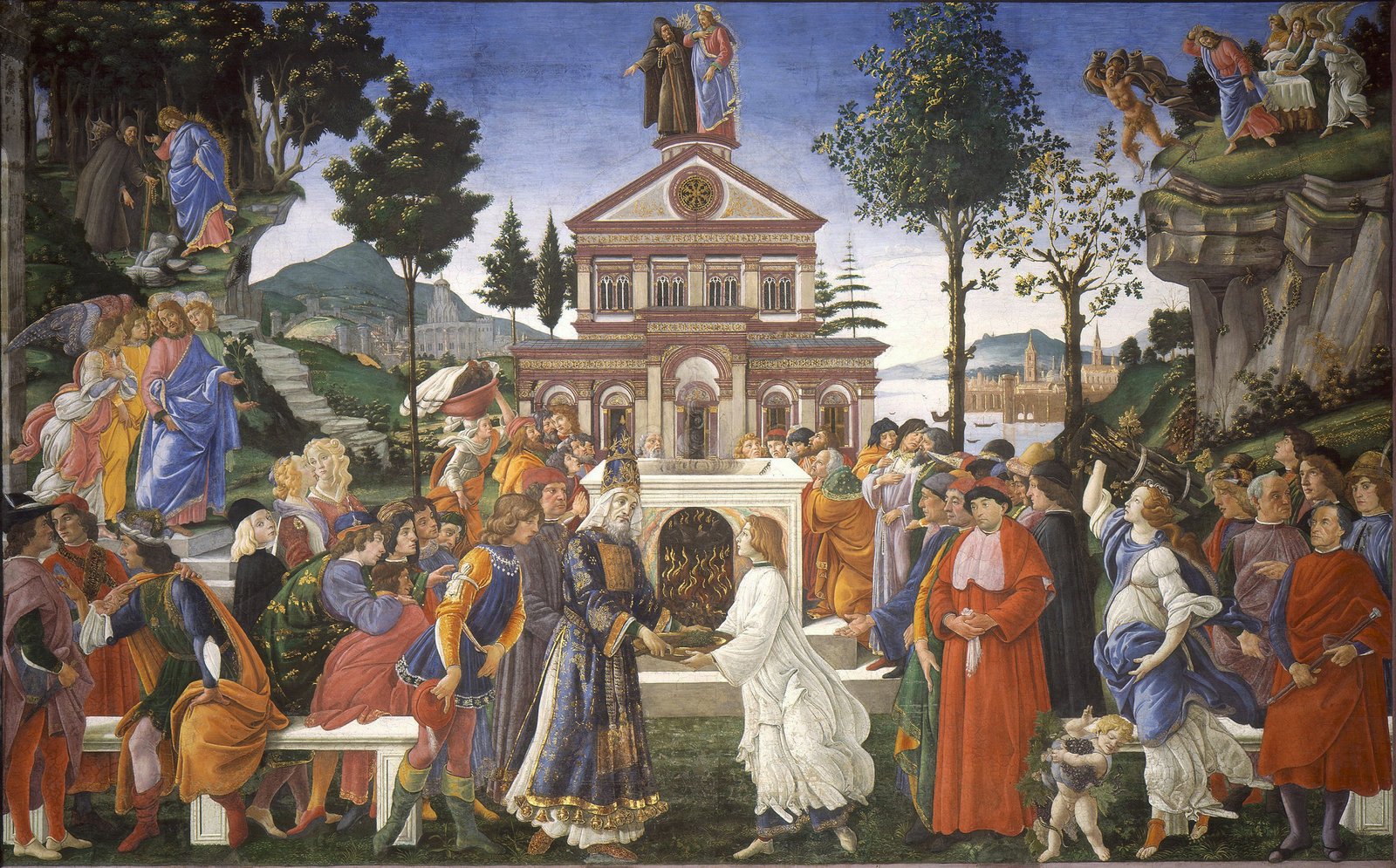
    Botticelli’s Temptations of Christ, painted on a Sistine Chapel wall in 1481-82, the same years Leonardo was at work on the St Jerome panel now in the Pinacoteca. Public domain via Wikimedia Commons.

    Most visitors walk past Room IX of the Pinacoteca Vaticana without slowing down. There is no crowd here, no queue, no phone held overhead. A kneeling old man in a rocky landscape, painted mostly in shades of brown and green, waits on the wall with a lion at his feet and a stone in his raised hand. It is one of the few paintings by Leonardo da Vinci in Rome, and it never left the drawing-board stage.

    A painting Leonardo never finished

    Vatican Museums curators date the panel to around 1481-1482, early in Leonardo’s career, before Florence, Milan and old age gave him the reputation that now fills museum gift shops. Its subject is Saint Jerome kneeling in the wilderness, beating his chest with a stone in an act of penance, a lion beside him in place of the thorn he is said to have pulled from its paw. Their catalogue entry is blunt about the panel’s condition: it is “still in a draft state and with different degrees of completion in the various parts.” Some passages, the head above all, are worked up with real finish. Others are barely underpainted, a brown wash over a drawn outline, waiting for glazes that never came.

    Nobody disputes who painted it. “Its attribution to Leonardo has never been questioned,” the Vatican states, and that single sentence carries weight in a field where attribution fights can run for decades. What is less certain is why Leonardo stopped. He left Florence for Milan around 1482, and the St Jerome may simply have been abandoned mid-commission when a bigger opportunity called. He did this more than once. The Adoration of the Magi in the Uffizi has the same underpainted, unglazed look, stopped at almost the identical stage.

    Why the monochrome state is worth looking at closely

    A finished Renaissance panel hides its scaffolding. Layers of oil glaze sit over the drawing until the brushwork disappears into smooth transitions of light and shadow. This panel shows the scaffolding. You can see the underdrawing through the thin brown wash in Jerome’s torso, the way Leonardo built form with hatched strokes before he ever picked up a brush loaded with color. Vatican curators praise exactly this: “a very high quality of drawing and an extraordinary mastery of painting technique, particularly in the use of overlapping glazes in the areas of chiaroscuro.” That mastery is visible precisely because it is incomplete. In a finished painting the glazes cover the drawing. Here, in the unglazed passages, the drawing is the painting.

    Stand close to the head and the lion, both further along than the rest of the panel, and you get a preview of the sfumato technique that later made the Mona Lisa’s face seem to shift depending on where you look. Move to Jerome’s exposed torso and shoulder and the illusion breaks. You are looking at a diagram of muscle and bone rendered in near-monochrome, closer to a plate from an anatomy textbook than to a devotional image.

    An old man’s throat, rendered with unusual precision

    Jerome’s neck and collarbone are rendered with a specificity that goes beyond what the subject strictly needed. Tendons stand out under thin skin, the throat is hollowed with age, and the shoulder reads as a study of bone structure as much as a devotional figure. One art-historical account of the panel notes that “the head is similar to Leonardo’s anatomical studies of the head and neck of an old man and is quite skeletal in its appearance,” and it is easy to see why once you look for it.

    It is tempting to connect this directly to Leonardo’s dissections, and plenty of popular writing does. Chronology makes that a shakier claim than it sounds: Leonardo’s documented, systematic human dissections date to around 1508-1511, roughly three decades after this panel, with an earlier phase of skull studies around 1489, still years later than the St Jerome. Whatever informed the throat and shoulder here, it was not yet the anatomy theatre. More likely it reflects Leonardo’s habit, well established even in his twenties, of drawing from close observation of aged sitters and studying how bone shows through skin. That precision is real, but the direct line to the dissection table stays an interpretation, not a documented fact, worth holding lightly.

    Cut into pieces, and put back together

    The panel’s afterlife is stranger than its unfinished state. At some point after Leonardo’s death it was cut apart. The Vatican’s own account credits the rediscovery to Cardinal Joseph Fesch, Napoleon’s uncle and an avid, occasionally reckless collector: “The Saint Jerome was found by chance by Cardinal Joseph Fesch, Napoleon’s uncle, who, according to tradition, found it divided into two parts. The panel was in fact cut into five pieces.” A widely told popular version of the story adds that fragments turned up reused as furniture, a workbench lid or a cabinet panel, before being tracked down. That detail makes for a good tour anecdote, but it does not appear on the Vatican’s own page and should be treated as legend rather than documented fact.

    A more carefully sourced account, drawn from later scholarship, points instead to a Roman art dealer named Pietro Camuccini, described by one source as having “evidently dismembered the panel… in order to extract the head, the most finished part of the painting, which he believed would fetch a higher price than the panel in its entirety.” On this version, Camuccini sold the head to Fesch in 1819; Fesch separately located the body panel in a Roman antiques shop and had the pieces reunited at Palazzo Falconieri. Either way, the panel survived being broken up and reassembled, missing only a small triangular sliver at one edge. After Fesch’s collection was dispersed following his death, Pope Pius IX bought the reunited panel for the Pinacoteca in 1856, and it has stayed in Vatican hands since.

    Seeing it in Room IX

    The St Jerome hangs in Room IX of the Pinacoteca Vaticana, the section devoted to fifteenth- and sixteenth-century painting, a few rooms past the crowd-heavy Raphael tapestries and well short of the Sistine Chapel line. Because the painting is small, unglazed in a lot of its surface, and mostly brown and green rather than the gilded color of the rooms around it, it rewards a slow look rather than a glance. Bring the details above with you: the finished head against the underpainted torso, the throat and shoulder built like a drawing rather than a painting, the faint ghost of the old cut lines if you know where the panel was rejoined.

    The painting travelled to New York in 2019 for a single-work loan exhibition at the Metropolitan Museum of Art, marking 500 years since Leonardo’s death, and close study during that period reportedly turned up Leonardo’s own fingerprints pressed into the paint surface. It has since returned to the Pinacoteca, where it normally hangs, though as with any single Old Master panel it is worth checking that it is on display rather than out on loan before you plan a visit around it specifically.

    Practical details for visiting

    The Vatican Museums open Monday to Saturday “08.00 a.m. – 08.00 p.m.” with “final entry 06.00 p.m.,” and the museum requires that “visitors are required to leave the halls 30 minutes before museum closing time,” so the Pinacoteca itself effectively closes earlier than the stated hour. On the last Sunday of the month the museums open 09.00 to 14.00 with free entry, though that day draws heavier crowds than any weekday morning.

    A full-price ticket costs “€ 20.00 (without online booking),” or with the recommended advance reservation, “€ 10.00 + 5.00 (with ‘Skip the Line’ booking on the official Vatican Museums website)” at the reduced rate, full price adding €5 to the base €20. Note that “tickets cannot be refunded,” so a plan is worth firming up before you pay. This gallery sits apart from the main museum route in its own building, easy to skip by accident if you are following signage toward the Sistine Chapel, so it is worth building it into your route deliberately rather than hoping to stumble on it.

    Worth the detour

    The Sistine Chapel and the Raphael Rooms get the crowds, and reasonably so. But a five-minute walk through the Pinacoteca puts you in front of one of the only Leonardo paintings in Rome, unfinished, cut apart, and reassembled, still showing the bones of how it was built. If you want a guide who can point out exactly where to look once you’re standing in front of it, our Vatican Museums tours route through the Pinacoteca on request.

  • The Last Months of Raphael’s Transfiguration

    Raphael's Disputa fresco in the Stanza della Segnatura, an earlier two-tier composition of heaven above and debate below that he returned to in the Transfiguration
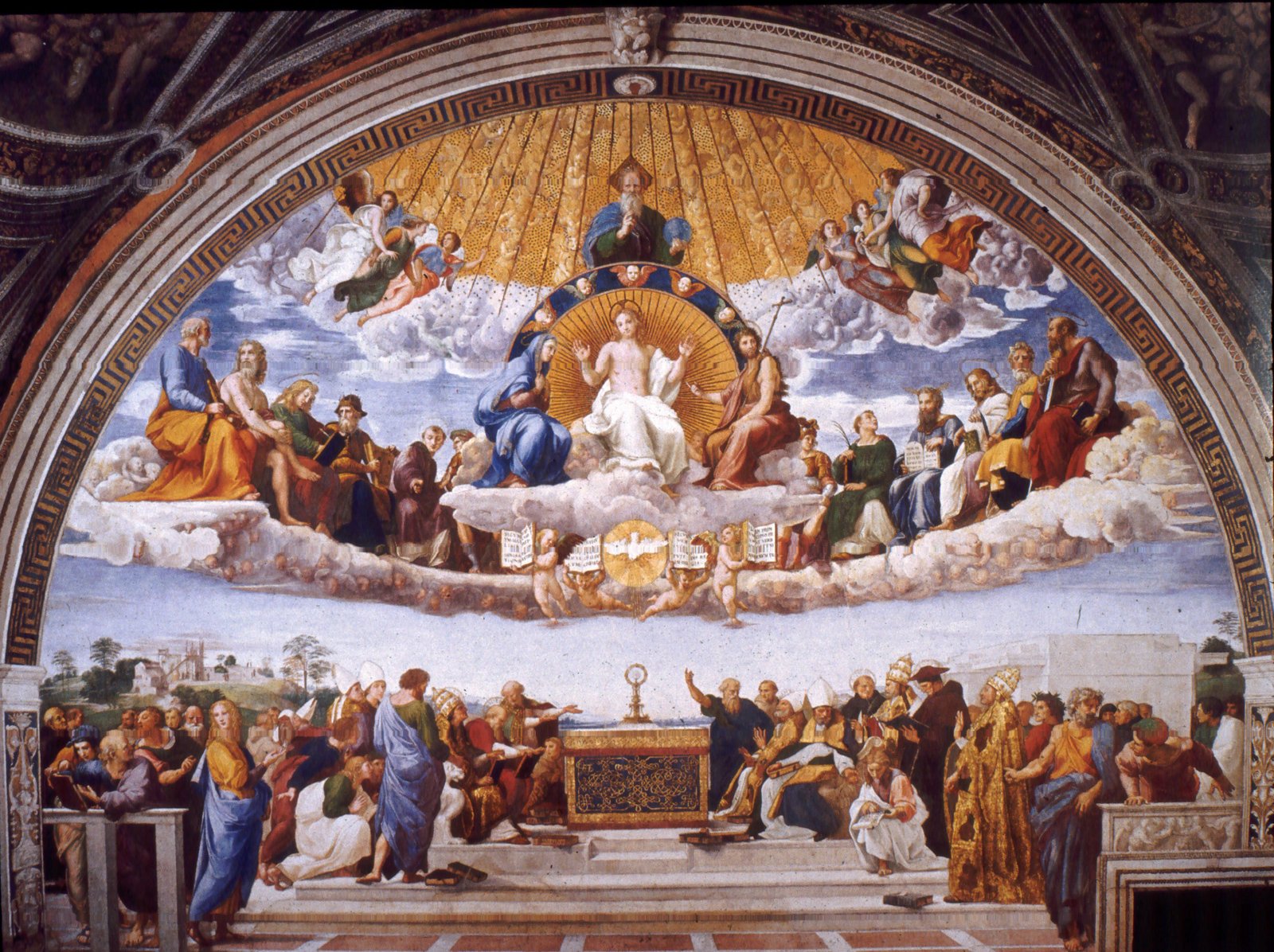
    Raphael’s Disputa in the Stanza della Segnatura, painted around a decade before the Transfiguration. Public domain via Wikimedia Commons.

    Stand in front of the Transfiguration in the Pinacoteca long enough and the two halves of the canvas start to argue with each other. Above, a weightless Christ hovers over Mount Tabor between Moses and Elijah, bathed in a light that has nothing to do with the sun. Below, a crowd of apostles gestures in confusion around a possessed boy nobody can help. It reads like two different paintings glued together, because in a sense the man who painted it never got the chance to reconcile them. Raphael died before he could finish the bottom half, and the picture that hangs in Sala VIII today carries that interruption inside it.

    A Commission From the Vice-Chancellor

    The painting began as a rivalry. Cardinal Giulio de’ Medici, who would later become Pope Clement VII, was in late 1517 the sitting pope’s vice-chancellor and the archbishop of Narbonne, and he wanted an altarpiece grand enough for Narbonne cathedral. Wikipedia’s account of the commission puts it plainly: “By December 1517, the latest date of commission, Cardinal Giulio de Medici…was also the Pope’s vice-chancellor.” He didn’t commission just one painting. He asked Sebastiano del Piombo to paint a companion piece, the Raising of Lazarus, for the same French cathedral, and historians have long read the pairing as deliberate pressure: give Raphael a rival to outpace and he’ll work faster.

    The Vatican Museums’ own account of the picture gives its painting span as 1516 to 1520, which already tells you something. Four years is a long time for an artist who, a decade earlier, had covered entire papal apartments in fresco at a clip that still startles art historians. This one didn’t move at that pace, and it never reached Narbonne at all.

    A Painting Built in Two Layers

    What makes the Transfiguration unusual isn’t just its size, at 410 by 279 centimetres of tempera grassa on wood. It’s that Raphael fused two separate Gospel episodes into one frame. Upper register: the Transfiguration itself, Christ ascending in light on the mountain with Moses and Elijah beside him and three apostles shielding their eyes below. Lower register: the scene that follows in the Gospel text, back at the foot of the mountain, where the remaining apostles try and fail to cure a boy possessed by a demon until Christ descends to do it himself. Two moments, two moods, one canvas. Nobody had painted the pairing quite this way before, and once you notice it you can’t unsee the seam running through the composition’s middle.

    It’s worth knowing that Raphael had built compositions on this heaven-above, chaos-below logic before. In the Stanza della Segnatura, his Disputa stacks a serene celestial court over an animated group of theologians arguing on the ground. The Transfiguration pushes the same idea further and darker, because by the time he was working on it, the lower half had become a genuine race against his own mortality rather than a formal device.

    Still Unfinished in Advent, 1519

    We know almost exactly how far behind schedule the painting was, because Sebastiano’s Raising of Lazarus reached a checkpoint that Raphael’s picture missed. Pope Leo X formally inspected Sebastiano’s finished companion piece on Sunday, 11 December 1519, the third Sunday of Advent. Wikipedia’s summary of that inspection notes the contrast directly: “When Sebastiano del Piombo’s work was officially inspected in the Vatican by Leo X on Sunday, 11 December 1519, the third Sunday of Advent, The Transfiguration was still unfinished.” Four months later, Raphael would be dead. The gap between that Advent Sunday and Good Friday is the entire remaining runway he had to close the distance, and it wasn’t enough.

    Good Friday, 1520

    Raphael died in Rome shortly after 10pm on 6 April 1520, Good Friday, at the age of thirty-seven. Apollo Magazine’s account of his final hours states the time and date without ambiguity: “Raphael died shortly after 10pm on 6 April 1520 – Good Friday – at the age of 37.” He had been the most sought-after painter in Rome for over a decade, running a workshop of dozens of assistants, and he left behind an altarpiece with its lower half still visibly incomplete under the paint layers, a fact confirmed centuries later when conservators finally looked closely enough to tell.

    The Painting at His Bier

    What happened next is the detail that gives this painting its afterlife as a story, not just an object. Raphael’s body was laid out in his house in the Borgo, and the unfinished Transfiguration was placed at the head of his catafalque, where it stayed for roughly two days while Rome came to pay respects. Apollo Magazine’s description is spare and exact: “His body was laid out on a bier beneath his final painting, the Transfiguration.” Popular retellings often go further and describe the panel being carried above his coffin through the streets to the Pantheon, and that image has stuck because it’s a genuinely striking one. It’s worth being careful here, though. His house is where the well-documented part happened; the precise choreography of the funeral procession itself, whether the painting was physically carried through the streets or displayed separately near the body during the funeral mass, is thinner ground. Tradition holds the two were joined that day. Historians can point to the house display directly.

    He was buried in the Pantheon, a resting place he is said to have requested himself, among the emperors and the gods of a building older than the Church that now used it.

    Who Actually Finished the Painting

    For centuries the story went that Raphael’s pupil Giulio Romano completed the Transfiguration after his master’s death, filling in the unfinished lower register from Raphael’s designs. It’s a tidy story, and largely wrong. Restorers who cleaned the painting between 1972 and 1976 got close enough to the surface to settle the question with paint itself rather than legend, and what they found reassigned nearly the whole canvas back to Raphael. As the record of that cleaning puts it: “The cleaning of the painting from 1972 to 1976 revealed that assistants only finished some of the lower left figures, while the rest of the painting is by Raphael himself.” So the confusion, the gesturing, the desperate crowd around the possessed boy in the lower half, almost all of it came from Raphael’s own hand, worked right up against the deadline his death imposed. Only a handful of figures on the lower left belong to someone else.

    Giorgio Vasari, writing decades later in his Lives of the Artists, called it Raphael’s finest work, describing it in terms that later writers have quoted as “the most famous, the most beautiful, and the most divine” painting Raphael ever produced. Vasari wrote with his own biases and occasional embellishments, so treat the superlative as a contemporary’s verdict rather than settled fact, but it tells you how quickly the painting’s reputation calcified after the artist’s death made it impossible to finish anything else.

    From Narbonne’s Loss to the Pinacoteca

    Cardinal de’ Medici never sent the painting to Narbonne. He kept it in Rome instead, and it was installed over the high altar of San Pietro in Montorio, where it stayed for nearly three centuries. Napoleon’s forces took it to Paris in 1797 under the Treaty of Tolentino, part of the wholesale removal of Italian art that followed the French campaigns. It came back to Rome in 1816, after the Congress of Vienna forced restitution, and entered Pope Pius VII’s newly formed Pinacoteca, where it remains, now displayed in Sala VIII among the museum’s other altarpieces.

    If you want to see it, the Vatican Museums are open Monday to Saturday from 08:00 to 20:00, with last entry at 18:00, and on the last Sunday of the month from 09:00 to 14:00 with free entry and last entry at 12:30. Every other Sunday the museums are closed, along with a handful of religious holidays through the year. The Pinacoteca sits toward the end of the standard visitor route, well past the Sistine Chapel, which is one reason so many visitors miss it entirely on a rushed morning.

    Raphael’s own painted rooms elsewhere in the museums tell a different chapter of the same career, finished at speed rather than cut short by it, and our guide to the Raphael Rooms covers how to see them without losing half your visit to the crowds around the School of Athens.

  • Caravaggio’s Entombment of Christ: What to See in Room XII of the Pinacoteca

    Michelangelo's Pietà in St Peter's Basilica, a Vatican depiction of the mourning over Christ's body related in theme to Caravaggio's Entombment altarpiece in the Pinacoteca
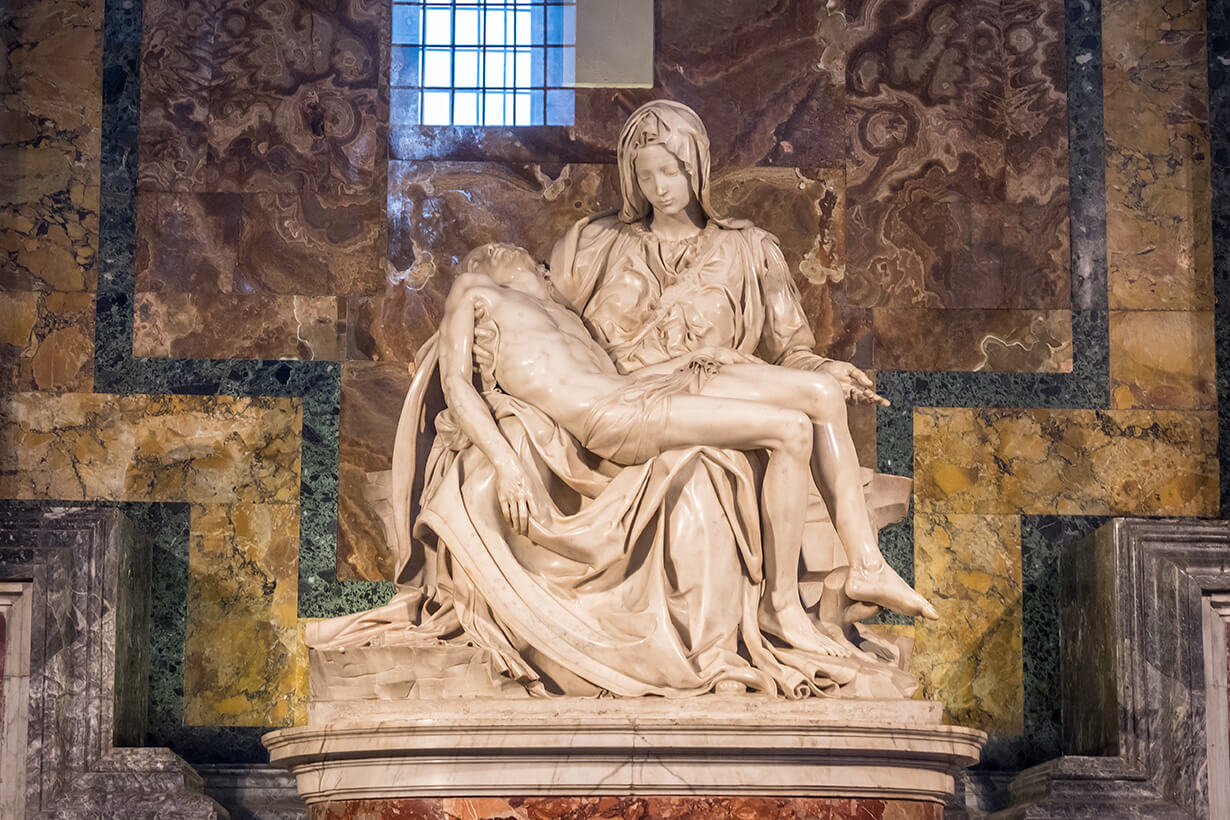
    Michelangelo’s Pietà, in St Peter’s Basilica, treats the same subject as Caravaggio’s Entombment: the moment Christ’s body is lifted after the Crucifixion. Public domain photograph.

    Most visitors reach the Sistine Chapel with nothing left in the tank. Two hours of galleries, a wall of Raphael, a crush of shoulders under Michelangelo’s ceiling, and by the time the one-way route spits them out near the exit, the last thing on anyone’s mind is a side wing they walked past an hour earlier. That wing is the Pinacoteca, the Vatican’s painting gallery, and Room XII holds a canvas that rewards five quiet minutes more than almost anything else in the collection: Caravaggio’s Deposizione di Cristo, known in English as the Entombment of Christ.

    What you are actually looking at

    The Vatican’s own catalogue lists the work as Pala d’altare: Deposizione di Cristo, an altarpiece painted by Michelangelo Merisi da Caravaggio (Milan, 1571 – Porto Ercole, 1610) between 1603 and 1604. It shows the instant after the Crucifixion when Christ’s body is laid on the Anointing Stone, the slab meant to seal the tomb, held by Nicodemus at the legs and John the Evangelist under the shoulders. Behind them, the Virgin Mary, Mary Magdalene, and Mary of Cleophas witness the descent. Caravaggio paints the moment just before burial, not the burial itself: the body has not yet touched stone, arms are still bracing its weight, and the whole group reads as a single downward motion caught mid-fall.

    Mary of Cleophas is the figure most visitors miss on a quick pass. She stands furthest back, arms raised, face turned up and away from the body in front of her. The museum’s own description calls it “a gesture of high dramatic tension,” and it reads as the one note of vertical release in a painting built almost entirely on a diagonal plunge. Look for her before you look for anything else in the group; once you have found her, the rest of the composition organises itself around that raised pair of arms.

    The diagonal that does the work

    Stand a few metres back and the composition reveals its structure: a line runs from Mary of Cleophas’s raised hands, down through John’s arm, along Christ’s torso, to the corner of the stone slab nearest the viewer. Everything above that stone is in motion; everything below it is where that motion is heading. Caravaggio lets the slab’s corner jut slightly toward the room, so the weight of the body seems aimed at your own feet rather than staying safely inside the frame. It is a painting built to be walked into, not just looked at.

    That trick depends on light as much as geometry. The figures emerge from near-black shadow, lit from a source outside the canvas, so the eye has almost nowhere else to land except the pale skin of Christ’s body and the whitened knuckles gripping it. Stand close and the darkness around the group nearly disappears into the wall behind it. Step back six or seven feet and the whole scene reassembles into that single falling line. Both distances are worth taking; most people only try one, then move on to the next room within thirty seconds.

    Why it is easy to walk straight past

    This part is not an official Vatican claim, just consistent advice from people who lead tours through the museums: the Pinacoteca sits off to one side, near the entrance, on a gallery you can detour into before the main route locks you onto its one-way path toward the Sistine Chapel. Once you are past that point, there is no doubling back. Visitors who skip the early detour, or who save the Pinacoteca for “afterward,” often find there is no afterward. The exit route simply does not loop back past it, and by then the museums have been open for hours. Combine that with Sistine Chapel fatigue, and a room holding one of the great altarpieces of the entire collection can end up nearly empty while a few hundred metres away people are standing shoulder to shoulder under Michelangelo’s ceiling.

    If you want to see the Entombment properly, treat the Pinacoteca as a first stop, not a last one. Ask your guide, or check the museum map at the entrance, for the turn into the gallery before you commit to the main circuit.

    From a Roman side chapel to the papal collection

    The painting was not made for a museum. Girolamo Vittrice commissioned it for his family’s chapel in Santa Maria in Vallicella, the church known locally as the Chiesa Nuova, a short walk from Piazza Navona. There it hung as a working altarpiece over a real chapel, lit by candles and incense smoke, not by museum spotlights. In 1797, under the terms of the Treaty of Tolentino, Napoleon’s forces seized it along with a large body of Italian art and shipped it to Paris. It returned to Rome around 1816 or 1817 (sources give both years) and entered Pope Pius VII’s newly formed Pinacoteca collection in 1820, where it has stayed since.

    Even the canvas’s exact size carries a small discrepancy worth knowing about if you go looking for it elsewhere: the Vatican’s English-language collection page gives roughly 300 by 203 centimetres, the more commonly cited figure. The official online catalogue record lists 306 by 214 by 7 centimetres for the canvas alone, and 335 by 237 by 22 centimetres including the frame. Either way, it is a large altarpiece, built to dominate a chapel wall, not a small devotional panel.

    Finding Room XII

    The Pinacoteca opened as its own purpose-built gallery on 27 October 1932, designed by the architect Luca Beltrami, and its seventeen rooms move roughly in chronological order from Room I’s medieval panels through to temporary exhibitions in Room XVII. Room XII sits in the seventeenth-century section, a few rooms past the gallery’s midpoint. Caravaggio is not the only reason to be there. Guido Reni and Guercino both hang nearby, and either is worth a minute, but Caravaggio is the reason most people who make the detour do so in the first place.

    Practical details before you go

    The Vatican Museums are open Monday to Saturday, 08.00 a.m. – 08.00 p.m., with final entry 06.00 p.m. On the last Sunday of the month, hours shrink to 09.00 a.m. – 02.00 p.m. and entry is free, except when that Sunday coincides with Easter, 29 June, or the Christmas period. The museums are closed on ordinary Sundays and on a list of fixed dates, including 14 and 15 August, which is worth flagging for anyone reading this the same week: both closure dates fall a few days from now.

    A full ticket costs € 20.00 at the door, or € 20.00 + € 5.00 booked online in advance through the only official channel, tickets.museivaticani.va. A reduced ticket runs € 10.00 without booking, or € 10.00 + € 5.00 with it. Booking ahead is less about saving money than about not losing an hour of your morning to the entrance queue, time that is better spent standing in front of a seventeenth-century altarpiece than waiting in a line outside it.

    If you would rather have someone walk you straight to Room XII instead of hunting for the turnoff yourself, a guided visit through our Vatican tours can build the Pinacoteca into the route from the start, so Caravaggio does not end up as the room you meant to see and ran out of time for.

  • Why the Apollo Belvedere Became the Measure of Beauty for 300 Years

    A sculpture gallery inside the Vatican Museums, the kind of room the Apollo Belvedere stands in
    One of the Vatican Museums’ classical sculpture galleries. The Apollo Belvedere itself stands a short walk from rooms like this, in the Cortile Ottagono of the Museo Pio-Clementino. Photo via Shutterstock.

    Most people meet the Apollo Belvedere before they ever see it. It arrives first as a photograph in an art history textbook, or as a plaster cast in the corner of some 19th-century academy, captioned as the closest thing Western art has to a perfect male body. So when you finally round the corner into the Cortile Ottagono and find the actual marble, the first reaction is rarely awe. It is recalibration. The statue is smaller than its reputation, more weathered, and somehow more like a person standing in a courtyard than like an ideal. That gap between the myth and the object is most of what makes the Apollo Belvedere worth understanding before you go looking for its meaning in the Vatican Museums.

    A Roman copy of a Greek original nobody has seen in two thousand years

    Strictly speaking, the statue in the octagonal courtyard is not the famous Apollo. It is a copy of it, carved centuries after the original was lost. Precision here comes straight from the Vatican Museums’ own catalogue entry: it was made “by a copyist workshop that, active in Rome in the first decades of the 2nd century A.D., replicated a bronze masterpiece made in Greece around 330 B.C., probably by the Athenian Leochares, one of the most famous artists of the time, also known for working at the Mausoleum of Halicarnassus.” No trace of that bronze survives. Every Apollo Belvedere admirer for five centuries, Winckelmann included, has been responding to a Roman marble stand-in for a Greek sculpture nobody alive has ever laid eyes on.

    Apollo’s pose freezes him an instant after loosing an arrow. His bow, now missing, sat in the extended left hand; the right arm swings back in the follow-through. It is a picture of motion just completed, caught the way a photograph catches a tennis serve at its highest point. Knowing that the gesture is finished, not in progress, changes how the whole body reads. He is relaxed. He has already won.

    Found on the Viminal Hill, kept by a future pope

    According to the Vatican Museums’ own account, the statue “was discovered in Rome in 1489, among the ruins of an ancient domus on the Viminal Hill, and was immediately acquired by Cardinal Giuliano della Rovere.” Della Rovere was not yet pope. He became one in 1503, taking the name Julius II, and brought his marble Apollo with him. By 1508 it was installed in the Belvedere courtyard that eventually gave the statue its name, and it has effectively stayed on Vatican ground ever since.

    That timing matters more than it looks. Julius II is the pope who commissioned Michelangelo’s ceiling and Raphael’s Stanze, all in the same building complex within a few years of each other. Apollo did not arrive as an isolated curiosity. It arrived as part of a single pontiff’s project to make the Vatican the centre of Renaissance taste, standing shoulder to shoulder with frescoes still being painted down the corridor.

    A missing hand and the sculptor who filled it in

    When it was found, the statue was largely intact but missing its left hand and the fingers of its right. For decades it stood incomplete, arrow-hand gesturing at nothing. In 1532–33, Giovannangelo Montorsoli, a pupil of Michelangelo, restored the missing sections: he completed the left arm, replaced the right forearm, and rebuilt the top of the tree-trunk support behind the right leg. For nearly five centuries afterward, most of what visitors admired as “the Apollo’s hand” was Montorsoli’s invention, not ancient marble at all.

    That detail rarely makes it into the reproductions. A plaster cast copied from a plaster cast just reads as Apollo, full stop, with no asterisk noting which parts came from a 2nd-century Roman workshop and which from a 16th-century restorer improvising a gesture. The statue that shaped three centuries of taste was, quite literally, part invention from the start.

    Winckelmann’s verdict, and why it stuck

    One name explains why the Apollo Belvedere outgrew every other antique statue in the Vatican’s collection: Johann Joachim Winckelmann, the German art historian whose writings on Greek art reshaped 18th-century taste across Europe. Vatican Museums credit him directly on the statue’s own catalogue page: it “owes its consecration to the inspired pages of Johann Joachim Winckelmann who considered it a sublime expression of Greek art, «the highest ideal of art among the ancient works that have been preserved to us so far».” That single line of praise, printed and reprinted through the Grand Tour era, did more to build the statue’s reputation than the marble itself ever could.

    Winckelmann never saw the lost Greek bronze, and neither has anyone else in two millennia. He was responding, like every visitor since, to a Roman copy with a restorer’s hand grafted on. He decided it was the summit of ancient art anyway, and Europe largely took his word for it.

    How one statue became the whole curriculum

    Once Winckelmann’s verdict circulated, the Apollo Belvedere stopped being a single object in a Roman courtyard and became a teaching tool. Grand Tour travellers scheduled Rome stops around seeing it. Plaster-cast workshops in London, Paris and Dresden reproduced it by the hundred for academies, where students learned to draw the male figure from a cast of a cast of a copy, several removes from anything Leochares ever touched. By the time photography arrived, the Apollo Belvedere was already the most familiar body in Western sculpture, known mostly through objects that were never in the same city as it.

    Paris, and back

    Its Roman residence was interrupted only once. Napoleon’s forces carried it off to Paris along with a great deal of other Roman art, and it did not return to the Vatican until 1816. On its return, the Vatican Museums credit the sculptor Antonio Canova with devising a support solution for the reinstalled statue, “a solution that had previously been adopted, no doubt by Antonio Canova, upon the return of the statue from Paris in 1816” — the same phrase the Vatican used, centuries later, to describe the logic behind its most recent structural repair.

    What stands there now

    Serious structural problems surfaced in December 2019. Conservators found the statue needed real intervention, not cosmetic cleaning, and the restoration that followed added a carbon-fibre support anchored into the plinth at the rear, invisible from the front but doing the load-bearing work that centuries of marble could no longer manage alone. The project also swapped Montorsoli’s 16th-century left hand for something closer to the ancient original: a cast taken from the “Hand of Baia,” a Roman-era plaster fragment itself copied from the lost Greek bronze. So the hand you see today is not Montorsoli’s invention and not the vanished original either. It is a plaster echo of a plaster echo, cast in the closest material anyone has to the god’s actual missing fingers.

    Stand in front of it now and none of that history is loud. What you notice is scale: a marble figure not far off human height, catalogued as no. 1015 in the Museo Pio-Clementino, standing quietly in a courtyard rather than looming over it. Five hundred years of reputation built a statue in most people’s heads that is taller, whiter, and more perfect than the one actually carved. Up close, the real Apollo has weathering on its surface, a visible seam where Montorsoli’s forearm meets ancient marble, and a support structure engineers had to design around. It looks like something that survived two thousand years, not something built to prove a theory about beauty.

    Seeing it for yourself

    The Apollo Belvedere is in the Cortile Ottagono, the Octagonal Court, inside the Museo Pio-Clementino, an early section of the Vatican Museums route that most first-time visitors reach within the opening stretch of their visit. It shares that courtyard with other famous antiquities, including the Laocoön group, so budget a few unhurried minutes rather than a single glance on the way past.

    Opening hours are straightforward: Monday to Saturday, 8:00 a.m. to 8:00 p.m., last entry 6:00 p.m. On the last Sunday of each month, entry is free from 9:00 a.m. to 2:00 p.m., last entry 12:30 p.m.; every other Sunday, plus a handful of fixed holidays through the year, the museums are closed. Standard adult tickets run €20 at the door, or €20 plus a €5 booking fee online, with a reduced €10 rate for eligible visitors. If you would rather skip the queue with a guide who can point out the seam in Montorsoli’s forearm on the way past, our guided Vatican tours route through the Pio-Clementino early, before the courtyard fills in.