Category: Uncategorized

  • How Long the Vatican Museums Security Line Actually Takes, Hour by Hour

    The Cortile della Pigna in the Vatican Museums, where the route opens out after the entrance halls
    The Cortile della Pigna, where the route opens out once visitors are through the entrance and security halls. Photo via Shutterstock.

    Ask a first-time visitor what they are dreading about the Vatican Museums and most say the ticket queue. That line has largely been solved by timed online booking. What catches people off guard is the one after it: the security checkpoint, where every ticket holder, skip-the-line or not, funnels through metal detectors and a bag check before reaching the entrance hall. This is the line that actually decides how much of your morning gets eaten before you see a single fresco.

    Why the checkpoint, not the ticket desk, is the real chokepoint

    Once a ticket is booked online, there is no separate queue to buy one at the door in most cases, and the entry itself moves fast. Security screening is a different animal. The Vatican Museums’ own advice page tells visitors plainly: “To facilitate and speed up security checks by metal detector, visitors are advised to remove inadmissible items from their hand baggage beforehand, and to inform staff in advance.” That single sentence explains most of the delay. People arrive at the scanner still holding water bottles, penknives, tripods, or oversized bags, and every one of those items has to be dealt with on the spot, which stalls the person behind them too.

    The same page adds a rule that catches even more travelers by surprise: “Before entering the exhibition spaces, visitors are required to leave in the cloakroom all luggage, suitcases, rucksacks, packages and containers not considered suitable by staff on account of their size or nature.” If you arrive straight from a hotel checkout with a rolling suitcase, budget extra time for the cloakroom detour before you even reach the scanner.

    What the Vatican does and does not publish about wait times

    Before going hour by hour, it’s worth being honest about what is actually knowable here. The Vatican Museums do not publish a live queue counter, a historical wait-time chart, or any official hour-by-hour crowd figure. Nothing on their site measures how long the security line runs at 9am versus 2pm. What follows below is the pattern our guides describe from years of walking groups through that checkpoint at different hours, not a statistic lifted from an official source. Treat it as operator experience, not measured data.

    Opening hour: 08:00 to 09:00

    This is the hour every guidebook warns about, and for good reason. The doors open at 08:00 on the days the Museums are open (Monday to Saturday, per the official hours page), and a large share of the day’s coach tours, cruise-ship groups, and independent visitors with 08:00 or 08:30 slots converge on the checkpoint at once. Even with efficient scanning, that volume compresses into a genuine crowd at the doors. Anyone who has booked an early-entrance product, ours included, is walked in ahead of this crush specifically to sidestep it.

    Mid-morning: 09:00 to 11:00

    The initial surge thins out, but new arrivals keep the checkpoint busy through this window. Coach groups on staggered entry times continue arriving, and independent travelers with mid-morning slots add to the flow. It rarely feels as chaotic as the opening hour, but it is not a quiet window either. If your booking gives you a choice of morning times, 09:00 sits in the trailing edge of the rush rather than clear of it.

    Midday: 11:00 to 13:00

    Late morning into early afternoon tends to carry the heaviest overall foot traffic of the day, driven by same-day ticket holders, groups on standard half-day itineraries, and visitors who slept in. This is also roughly when St Peter’s Basilica next door is busiest, so anyone splitting a day between both sites will feel the crowding on both ends. There is no verified figure for exactly how much longer this makes the security line, but it is not a stretch to expect the checkpoint to be working at full capacity through most of this block.

    Early to late afternoon: 13:00 to 18:00

    Conventional travel wisdom holds that early afternoon brings a lull, as morning tour groups have already entered and the lunch hour thins the crowd outside. We hear this from other guides and it lines up with general sense: fewer people are choosing to start a multi-hour museum visit at 1pm than at 9am. But it is a pattern based on observation and reasoning about visitor behaviour, not a published or measured statistic, so treat it as informed opinion rather than a guarantee. Late afternoon then compresses again as the museum races toward closing. Final entry is at 18:00 on standard days, and visitors “leave the halls 30 minutes before museum closing time” at 20:00. Arriving at 17:30 for a 18:00 cutoff can mean queuing at the checkpoint with a hard deadline bearing down, which is its own kind of stress even if the line itself is short.

    Days that break the whole pattern

    Two calendar quirks matter more than any hour-of-day guess. First, the last Sunday of every month runs on a shortened schedule, 09:00 to 14:00 with final entry at 12:30, and admission is free. Free entry reliably draws a bigger crowd than a paid weekday, so treat that Sunday as an exception to everything above rather than a bonus quiet slot. Second, the Museums close entirely on a fixed list of dates each year: 1 January, 6 January, 11 February, 19 March, 1 May, 29 June, the 14th through 15th of August, 1 November, 8 December, and the Christmas period on the 25th and 26th. Check the calendar before you plan a visit around a specific date. No amount of good timing helps on a day the doors don’t open at all.

    Booking through the right channel

    One more practical note before you plan around any of this: book only through the Vatican Museums’ own platform. The official site states directly, “The only official site for purchasing tickets online is https://tickets.museivaticani.va,” warning against look-alike domains that charge inflated prices. A full adult ticket runs €20.00 at the door or €25.00 booked online in advance, reduced tickets €10.00 or €15.00, and children under 6 enter free. Whichever route you choose, remember that “tickets cannot be refunded,” so it pays to be certain of your date and time slot before you pay.

    Timing the line versus skipping it

    Everything above describes patterns, not guarantees, because nobody outside the Vatican’s own security staff has hard numbers on how the checkpoint behaves hour to hour. What we do control is when our groups arrive. Our VIP early entrance guided tour gets you through that checkpoint before the public doors open at all, which sidesteps the entire question of which hour is worst.
  • What Closing Time Actually Looks Like at the Vatican Museums

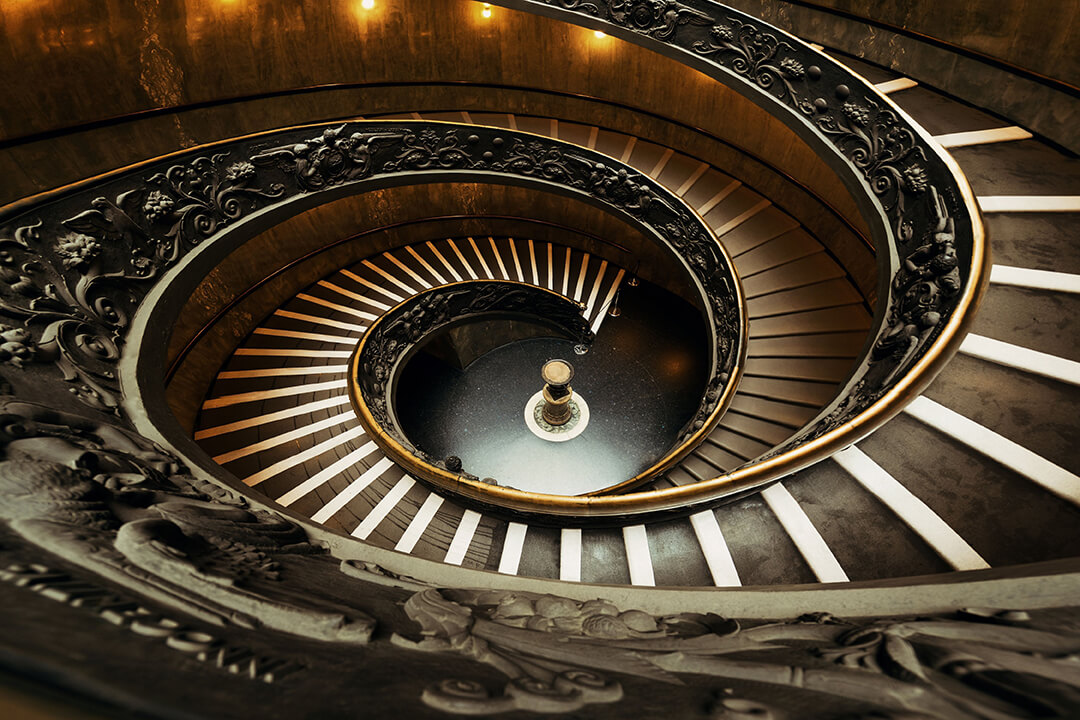
    Giuseppe Momo's spiral double staircase at the Vatican Museums exit
    Giuseppe Momo’s spiral staircase at the Vatican Museums exit, the last thing most visitors see on the way out.

    Most visitors never think about how the Vatican Museums actually end. You look at frescoes, you queue for the Sistine Chapel, and at some point you’re back on the street without quite remembering the walk out. But the closing sequence is a real, timed process, and knowing its shape changes how you plan the last stretch of a visit. Here’s what the final ninety minutes look like, hour by hour, from Monday to Saturday.

    The official clock: 6:00, 7:30, 8:00

    The Vatican Museums keep three separate deadlines each day they’re open, and conflating them is the most common planning mistake. The museum’s own hours page states the doors run “From Monday to Saturday 08.00 a.m. – 08.00 p.m.,” with “final entry 06.00 p.m.” That six o’clock cutoff is a ticket-office rule, not a room-closing rule: it’s the last moment you can walk through the entrance turnstiles with a valid ticket, whether booked online or bought at the door.

    A second deadline sits thirty minutes before the doors actually shut. That same official page is explicit about it: “Visitors are required to leave the halls 30 minutes before museum closing time.” On an 8:00 p.m. close, that means the galleries need to be clear by roughly 7:30 p.m., not eight. Full closure, the third deadline, comes at eight o’clock sharp, when the building shuts completely and the last staff finish their sweep.

    So a visitor who enters at 6:00 p.m., right on the last-entry cutoff, has ninety minutes of walking time before the halls need to be empty, then a further thirty minutes as the building itself winds down around them.

    6:00 p.m. — the last ticket through the door

    If you arrive at the final-entry window, expect the queue to be short compared with midday but the pace inside to be brisk. Staff at the entrance aren’t rushing you, exactly, but they know what’s coming down the corridor behind you: nobody else is being let in tonight. Groups who book this slot tend to move with intent, heading toward the Sistine Chapel first and saving the smaller galleries for the walk back, since the Chapel is usually the reason for the visit and the one room nobody wants to see rushed.

    This is also, incidentally, the quietest version of the museum most people will ever experience during regular hours. Most of the day’s ticket-holders have already come and gone by then, leaving the last-entry group a fraction of the midday crowd.

    6:30 to 7:00 p.m. — the middle stretch

    With ninety minutes on the clock and no new arrivals behind you, this half-hour is where the visit finds its own rhythm. Some people linger in the Gallery of Maps, the long corridor of sixteenth-century topographical panels under a gilded ceiling, because the evening light through the windows changes how the gold reads. Others push straight through to the Sistine Chapel and only backtrack afterward. There’s no fixed order the Museums impose on you here; the layout is one long route toward the Chapel, with side rooms branching off it, and how you spend this window is entirely a matter of what you haven’t seen yet.

    What does start to become visible around this point is staff presence thinning in the rooms furthest from the main route. Attendants in smaller side galleries are often the first to be reassigned toward the exit corridor as the evening goes on, though the Museums don’t publish a formal schedule for how that reassignment happens.

    7:00 to 7:30 p.m. — the room-clear window

    This half hour is the one that actually matters if you’re trying to see something specific before leaving. Since the thirty-minutes-before-closing rule means the halls need to be empty by 7:30 on an 8:00 p.m. night, anything you still want to look at closely needs to happen now. Visitor reports describe staff becoming more visible during this stretch, moving between rooms and encouraging stragglers to keep heading toward the exit, though the exact method, whether that’s a verbal reminder, a gesture, or simply presence, isn’t something the Museums document publicly, and it’s worth treating as general visitor colour rather than an official procedure.

    What is official is the deadline itself. By 7:30 p.m., the expectation is that the halls are cleared. If you’re still deep in a gallery at 7:15, this is the moment to start moving rather than the moment to start a new room.

    7:30 to 8:00 p.m. — the last thirty minutes

    Once the halls are meant to be clear, the remaining half hour belongs to the exit route rather than the galleries. For most visitors that route ends at Giuseppe Momo’s spiral double staircase near the main exit, the same staircase built in 1932 that has become one of the more photographed architectural details in the whole complex, if only because it’s the last thing between the collection and the street. Descending it at closing time, with the crowds gone and the building settling into its evening quiet, is a genuinely different experience from doing the same walk at midday.

    By 8:00 p.m. the building is closed. Staff finish their own exit procedures after that, but for a visitor, eight o’clock is the hard end of the day regardless of what time you arrived.

    What this means if you’re planning a late visit

    The practical takeaway is straightforward: treat 6:00 p.m. as your latest possible arrival, not your target arrival. If you want any real time in the Sistine Chapel without feeling the room-clear pressure, aim to be through the entrance by 5:00 or 5:30 p.m. instead, giving yourself closer to two full hours before the 7:30 sweep begins. Entering right at the six o’clock cutoff works if your priority is simply seeing the Chapel and accepting a compressed walk through everything else.

    It’s also worth remembering this schedule applies Monday to Saturday. The Museums are closed on ordinary Sundays, with the exception of the last Sunday of each month, which runs on an entirely different timetable: “Every last Sunday of the month 09.00 a.m. – 02.00 p.m.,” with “final entry 12.30 p.m.” and free admission. That day has its own crowd dynamics and isn’t a useful guide to what a normal evening close looks like.

    A note on St Peter’s Basilica

    Because the Basilica sits a short walk from the Museums’ exit and shares the same skyline, visitors sometimes assume the two run on one clock. They don’t. St Peter’s Basilica is managed separately from the Vatican Museums, and its current posted hours read “From june 1st: from 7.00 am to 8:00 pm,” with no last-entry time stated on the Basilica’s own page. If your evening plan includes both, check each site’s hours independently rather than assuming a shared cutoff.

    One more detail worth knowing before you buy: the Museums’ own ticket page states plainly that “Tickets cannot be refunded,” so a last-entry ticket bought for a specific evening is a commitment, not a flexible option if plans change.

    If watching the galleries empty out at closing time sounds more appealing than fighting the midday crush, a guided evening visit built around exactly that quiet stretch is worth considering; our Friday evening Vatican guided tour takes small groups through the Museums after the day’s crowds have thinned, timed to end near closing rather than rushing to beat it.

  • Why the Group Entrance Line Moves Faster Than the Individual One

    The Vatican Museums skip-the-line entrance lane used by visitors with pre-booked tickets
    The Vatican Museums entrance lane reserved for visitors who arrive with a booking already confirmed. Photo via Shutterstock.

    Stand outside the Vatican Museums on any weekday morning and you will see two crowds moving at two speeds. One shuffles forward in short bursts behind a guide holding up a folded umbrella or a laminated sign. A second line barely moves at all, visitors checking phones, re-reading confirmation emails, occasionally stepping out of formation to ask a staff member a question. A tidy explanation gets repeated for this: groups get special treatment, some kind of arrangement that lets a tour operator’s clients walk past the rules everyone else follows. That explanation is neat, and it is almost certainly wrong.

    The assumption that doesn’t hold up

    Nobody at the entrance is handing group tickets a shortcut through security. No policy on the Vatican Museums’ own advisory pages describes a separate screening lane, a faster metal detector, or preferential handling for guided visitors. Search that material and you will not find the claim anywhere. What you will find is a set of rules that apply the same way to everyone who walks through the door, whether they arrived alone with a printed voucher or as visitor eighteen of twenty behind a guide.

    So if there is no official fast lane, the speed difference has to come from somewhere else. It does, and it has less to do with privilege than with preparation that already happened before either group reached the door.

    What the Vatican has actually confirmed about groups

    Entry rules tightened in 2024, ahead of the 2025 Jubilee, and the changes are specific rather than vague. An official notice states that “each accredited tour guide can have a maximum of 20 visitors,” a hard cap that did not exist in the same form before. That single rule reshapes how a group arrives at the checkpoint: twenty people, one accredited leader, one set of pre-purchased entries tied to a known headcount. Nothing about that number gets worked out at the door.

    That same reform introduced “the introduction of the nominative ticket, accompanied by thorough checks of the holder’s identity.” Officials framed that measure as an anti-scalping and anti-bot control rather than something built for groups specifically, but it applies to every ticket, individual or collective. Anyone assuming groups skip identity checks entirely is working from a myth the Vatican’s own notice does not support.

    Where the real time savings come from

    A tour group’s speed advantage starts well before the metal detector. Everyone in that line of twenty already has a ticket. Nobody is deciding at the gate whether to buy the reduced-price entry or the full one, nobody is hunting for a booking confirmation buried three emails deep, and nobody is discovering for the first time that the site they bought from was not the official one. Officials warn about that last problem directly: “The only official site for purchasing tickets online is https://tickets.museivaticani.va” — a line that exists because enough individual visitors have shown up with tickets from lookalike resale sites that were never going to scan.

    A guide has already resolved all of that logistics work days or weeks earlier. Individual walk-up visitors, by contrast, surface those unresolved questions in real time, one at a time, each one adding a small delay that compounds down the line. It is worth being honest about what is and is not confirmed here: no official Vatican Museums page states or explains a specific mechanism by which the group queue physically moves faster, and nothing published describes a dedicated group turnstile or a manifest that bypasses individual checks. What is documented is the removal of upstream friction — ticketing, headcount, identification of the responsible guide — that otherwise plays out at the door for someone buying and organising everything on the spot.

    The metal detector doesn’t care who booked you

    Security screening itself is not described in Vatican materials as group-specific. Its cloakroom is “accessible from the entrance hall after passing through the metal detector,” a step every visitor passes through regardless of ticket type. What differs is how ready each person is for it. Vatican advice asks visitors to remove inadmissible items from hand baggage beforehand specifically to keep that line moving, and a guide leading twenty people has usually already told the group what not to carry: no large umbrella, no tripod, no pocketknife left over from a hiking trip. An individual visitor working it out for the first time at the belt is the reason the queue behind them stalls, not because of who they booked with, but because the questions a guide answers in advance for a group are the same ones a solo visitor answers under time pressure in front of a guard.

    Groups running ten or more participants also face a rule most individual visitors never encounter: “The use of radio headsets is obligatory for all tours, including pilgrimages, universities and schools, with 10 or more participants up to a maximum of 20 (30 for school tours).” That system exists for visitor courtesy inside crowded galleries, not for speeding up entry, but it is another example of a process a guide sorts out at a desk in one transaction rather than something that happens individually, one rental at a time.

    Prices tell part of the story too

    Ticket type also shapes how much friction shows up at the point of entry. A full walk-up ticket costs €20.00, or €25.00 booked online with the €5.00 booking fee. Reduced tickets run €10.00 walk-up and €15.00 online. School groups pay a reduced €5.00, or €7.00 booked in advance. Pilgrimages and university institutes both sit at €10.00 walk-up and €15.00 with booking, and seminaries or religious colleges pay the same €5.00 and €7.00 tier as schools. Every one of those categories, when booked through the correct channel, arrives at the gate with the paperwork already sorted rather than being negotiated on the spot.

    When the museum is closed matters more than which line you’re in

    None of this timing advice means anything if you arrive on the wrong day. Sundays are closed except the last one of each month, when entry is free from 9.00am to 2.00pm with last entry at 12.30pm — a schedule the official hours page gives as “09.00 a.m. – 02.00 p.m.” On a normal open day the hours run “08.00 a.m. – 08.00 p.m.,” with last entry at 6.00pm and visitors asked to leave the halls thirty minutes before closing. A list of fixed dates closes the Museums entirely through the year, including January 1 and 6, February 11, and December 25 and 26 among others. Checking that calendar before booking anything, group or individual, avoids the one delay no queue strategy can fix.

    What this means for planning a visit

    The lesson is not that joining a tour group buys you a secret door. It is that most of what makes a group move faster is homework somebody else already did: tickets bought from the right source, a headcount fixed under the guide’s 20-person cap, prohibited items already left at the hotel, and a single point of contact handling identification instead of twenty separate conversations. An individual visitor can close most of that gap by doing the same preparation solo, before arriving rather than at the belt. For a walkthrough of what a pre-booked, guided entry into the Sistine Chapel actually looks like once you are past the door, our guide to skip-the-line entry for the Vatican Museums and Sistine Chapel covers the booking side in detail.

  • What the Vatican Museums Ticket Refund Policy Actually Covers

    The Cortile della Pigna in the Vatican Museums, part of the standard ticketed route
    The Cortile della Pigna, part of the standard ticketed route through the Vatican Museums. Photo via Shutterstock.

    Every so often a visitor writes to ask what happens if they miss their slot, fall ill the night before, or arrive to find the Museums shut for a reason nobody warned them about. The honest answer starts with what the Vatican Museums’ own ticketing page says, in bold, without qualification: “Tickets cannot be refunded.” That single line is the entire official policy. There is no separate clause for illness, no carve-out for a cancelled flight, and no published process for claiming your money back under any circumstance.

    What the official policy actually says

    The Vatican Museums’ “Prices and Tickets” page states two things that matter here. First, the refund line above. Second, a companion sentence that explains why: “The entry ticket for the Vatican Museums entitles the visit to the Museums and Sistine Chapel solely on the day on which the ticket is issued.” A ticket is a dated entitlement, not a voucher you can redeem whenever it suits you. Buy a ticket for Tuesday and you have a ticket for Tuesday. If Tuesday doesn’t happen, the ticket doesn’t roll over to Wednesday, and it doesn’t convert to cash.

    We searched the hours and closures page, the visitor-tips page, and the official booking subdomain at tickets.museivaticani.va for any refund exceptions, cancellation window, or claims form. None exists. There is no dedicated refund FAQ anywhere on the site’s navigation or sitemap. The absence is itself the useful fact for anyone planning a visit: refund eligibility isn’t tiered by reason at all. It’s a flat zero, and the reason you missed your slot doesn’t change that.

    Illness and medical emergencies

    This is the exception most people assume must exist, and it’s worth being direct about it: the Vatican Museums do not publish any illness or medical-emergency provision. No doctor’s note process, no partial credit, no rebooking allowance tied to a health event has been documented on the official site. That doesn’t mean nobody has ever been shown flexibility by a member of staff at the door. It means there is no policy you can point to, and nothing you can rely on in advance. If you’re travelling with a condition that might flare up, the only real safeguard is travel insurance that covers pre-paid, non-refundable attraction tickets, arranged before you buy.

    Scheduled closures aren’t the same as surprises

    The Museums publish their closure calendar well in advance, and it’s worth knowing by heart before you book. The site is closed on Sundays, apart from the last Sunday of each month, and on a fixed list of dates: 1 and 6 January, 11 February, 19 March, 6 April, 1 May, 29 June, 14 and 15 August, 1 November, and 8, 25 and 26 December. A full calendar for the year is linked from the hours page, and none of it is a mystery once you’ve checked it.

    What isn’t published is a separate policy for unscheduled closures: a security lockdown, a papal event that bumps public access, a strike, or bad weather that shuts a wing early. These events are rare, but they happen, and the official site offers no dedicated refund mechanism for them either. In practice this pushes the risk onto the visitor for tickets bought directly from the Museums. Building a buffer day into a Rome itinerary, rather than a single make-or-break morning, is the only real hedge against it.

    No-shows: no grace period on record

    Timed-entry tickets are enforced fairly strictly at the door, and visitors are required to leave the galleries thirty minutes before the museum closes regardless of when they arrived. No official grace period, late-arrival window, or same-day reissue policy for missed slots is published anywhere on museivaticani.va. If your booked entry time comes and goes without you at the gate, the working assumption should be that the ticket is simply spent. Arriving even fifteen minutes past a Skip the Line slot during peak season can mean rejoining the general queue, so build in transit time the way you would for a flight, not a dinner reservation. The Museums open at 08.00 Monday to Saturday with final entry at 18.00, and on the last Sunday of the month the whole window compresses to 09.00 through 14.00 with final entry at 12.30, which leaves far less margin for a late arrival to recover.

    Official site versus third-party bookings

    The Museums are unambiguous about where tickets should come from: “The only official site for purchasing tickets online is https://tickets.museivaticani.va,” and the site warns repeatedly about lookalike pages charging inflated prices. That no-refund clause applies to tickets purchased through the official portal. Tour operators and resale platforms such as Tiqets, GetYourGuide, or Viator sell under separate consumer contracts, each with its own cancellation terms, and those terms vary by vendor and by product. This piece hasn’t verified any specific reseller’s refund window, so treat that as a question to put directly to whichever operator you book through, and read the cancellation terms on their checkout page before you pay, not after.

    What to actually do if plans change

    Given all of this, the practical approach is fairly simple. Book through a channel whose cancellation terms you’ve actually read, not assumed. Keep your entry-time window loose if your schedule is uncertain, favouring a guided or Skip the Line product with a documented flexibility policy over the cheapest official ticket if you think you might need to move dates. Check the closure calendar before you commit to a date at all, particularly around the fixed public holidays listed above and the last Sunday of the month, when hours run 09.00 to 14.00 with free admission and a much larger crowd than usual.

    If a question does come up about a ticket you’ve already bought, the Museums list one phone number, +39 06 69883145, and one email address, info.musei@scv.va, as general contact channels. Neither is billed as a refunds line, and no dedicated refund team is advertised, so keep expectations modest and keep a written record of anything you’re told.

    The bottom line

    “Tickets cannot be refunded” is not marketing language softened for a webpage. It’s the entire policy, stated once, with no exceptions carved out for illness, closures, or missed slots. Plan around that fact rather than against it, and if you’d rather book through a channel with clearer flexibility built in, our Vatican Museums tickets page lays out the options and what each one actually includes before you commit to a date.

  • Can You Change the Date on a Vatican Museums Ticket After Booking

    Visitors entering the Vatican Museums with skip-the-line tickets
    Visitors entering the Vatican Museums with skip-the-line tickets — once you’re through, the date on that ticket is locked in.

    You booked a Vatican Museums ticket, then your flight moved, or you picked a Sunday without checking the calendar. Now you need a different day and you want to know, plainly, whether that’s possible and how long it takes. The honest answer depends entirely on where you bought the ticket, and the two paths lead to very different afternoons.

    What the official ticket actually says

    If you bought directly through tickets.museivaticani.va, the terms are printed on the Vatican’s own prices page: “The entry ticket for the Vatican Museums entitles the visit to the Museums and Sistine Chapel solely on the day on which the ticket is issued. Tickets cannot be refunded.” That single line does two things at once. It fixes your ticket to one calendar date, and it rules out a refund if that date no longer works for you.

    Nowhere on the official site is there a published self-service process for swapping that date. There’s a “Manage Booking” link from the ticket portal for people who already have a reservation, but what it actually lets you do with an existing booking isn’t something we can confirm from the outside, so we won’t guess at it here. Treat the date on an official ticket as fixed unless a Vatican representative tells you otherwise directly.

    A useful comparison from next door

    The Fabbrica di San Pietro, which runs ticketing for the Dome and other paid access points at St Peter’s Basilica, states its policy even more bluntly in its own FAQ: “No, after purchase, refunds, date changes, or booking modifications are not permitted.” That’s the Basilica’s rule, not the Museums’, but the two organisations sit inside the same Vatican ticketing culture. Once you’ve paid, the date on the paper is the date you get. Budget for that stance whenever you’re weighing whether to gamble on an official booking made months in advance.

    Why people end up needing to change a date

    Most requests trace back to one of three things: a travel schedule shifting after booking, a closure day nobody checked, or a Sunday mix-up. The Museums close on Sundays except the last Sunday of the month, when entry runs 09.00 to 14.00 with last admission at 12.30 and free entry for everyone. Regular days run Monday to Saturday, 08.00 to 20.00, with last entry at 18.00. Add the fixed closures — 1 January; 6 January; 11 February; 19 March; 6 April; 1 May; 29 June; 14–15 August; 1 November; 8 December; and 25–26 December — and it’s easy to book a date that quietly falls on a closed day, especially around the August recess. Check the calendar before you book, not after.

    If your official ticket is now on the wrong day

    Since date changes and refunds aren’t offered on official tickets, the practical route is to treat the old ticket as sunk and buy a new one for the correct date. That means paying full price again: €20.00 at the door without a reservation, or €20.00 plus a €5.00 booking fee online for the skip-the-line slot; €10.00 reduced (plus €5.00 online); €5.00 for school and seminary groups (plus €2.00 online). Free entry still applies to children under seven, anyone with a 67% or higher disability certification, and everyone on the last Sunday of the month. There’s no fee-waived swap built into the system, so it’s worth checking your calendar twice before the first purchase rather than paying twice for the same visit.

    Resellers: it depends on the supplier, not the platform

    Tickets bought through a reseller sit under a different set of rules, and those rules aren’t uniform even within one platform. Tiqets’ own terms are explicit about this: “Sometimes you can cancel or change a ticket, for example, if you want to visit the venue on another date. That varies per supplier, as stated on the product page on our platform or in the delivery email.” In plain terms, the date-change policy lives on the specific listing you bought, not on the reseller’s homepage. Read the fine print on the product page before you assume flexibility exists.

    Other large platforms describe general cancellation and amendment windows on their help pages, but whether those windows apply to a specific Vatican Museums listing is something only that listing’s own terms will confirm. Some marketplaces route amendment requests to a local operator for approval, which adds a step and a delay rather than an instant swap. The pattern across resellers is the same one Tiqets states outright: check the individual product page and the confirmation email for what your particular ticket allows, and do it before travel day, not after you’re standing outside the walls.

    The fastest way to actually get it done

    Whichever channel you booked through, speed comes from having the right information ready rather than from any special trick. Pull up your booking confirmation and locate the reseller or the official order number, the exact ticket type, and the date you need instead. If you bought official, check whether the Manage Booking link on tickets.museivaticani.va offers anything for your order, and don’t wait until the morning of your visit to find out; unresolved date problems compound quickly against the Museums’ closing time. If you bought through a reseller, go straight to their support channel with your order number and the new date in hand, since a vague “can I change this” message takes longer to resolve than a specific request. In every case, having a backup plan — a second date that also works — turns a support conversation into a quick fix instead of a back-and-forth.

    Booking again, this time with room to breathe

    If a date change isn’t on the table and you’re buying fresh, build in a little slack. Pick a date a day or two before you actually need flexibility, so a late flight or a closed Sunday doesn’t strand you. Keep the confirmation email and the exact entry time somewhere you’ll actually check it, and note the last-entry cutoff for your chosen day rather than the closing time, since arriving after last entry means no visit at all regardless of what your ticket says.

    If you’d rather skip the guesswork on availability and closures altogether, you can check current Vatican Museums ticket options and open dates here before you commit to a day.

  • The Door Only Guided Groups Use to Leave the Sistine Chapel

    Vatican Museums gallery corridor leading to the Sistine Chapel, near where the guided-group exit door branches off toward St Peter's Basilica
    One of the gallery corridors on the approach to the Sistine Chapel — the same stretch most visitors retrace on the way out, unless their group has been cleared for the side door.

    Stand near the Last Judgement wall at the end of a visit and watch what happens once a guide finishes talking. Most of the room drifts toward the main doors at the far end, back into the long chain of galleries that eventually spits everyone out at the Momo staircase, the double-helix ramp near the exit. A smaller cluster peels off through a plain door on the side of the chapel instead, and within a minute or two they are standing inside St Peter’s Basilica. Same chapel, same fifteen minutes earlier, and yet two completely different exits, with no obvious sign explaining why one group gets the shortcut and the rest keep walking.

    Where the door sits

    It’s tucked into the chapel’s lower corner near the altar end, easy to miss if you’re not looking for it because there’s no signage pointing tourists toward it. Unlike the grand public route, it isn’t decorated or announced. It leads down a short staircase and through a corridor that connects directly into the Basilica, close to where sightseers normally queue to get in from St Peter’s Square. Walk it and you skip the queue entirely, arriving inside from a direction almost no one else does.

    What it actually shortcuts

    The standard exit from the Sistine Chapel is not short. After the chapel, the public route continues through more gallery rooms, sometimes the Vatican Library sections, sometimes a stretch of the modern religious art collection, before reaching the Momo staircase, the double-helix ramp that deposits everyone back near the museum entrance on Viale Vaticano. It’s a genuinely interesting stretch of the museum in its own right, just not one anybody is in the mood to appreciate after two hours of the main collection and the Sistine Chapel itself. That’s a fifteen-to-twenty-minute walk on a good day, longer with crowds, and it lands you outside, a fair distance from the Basilica, with the security queue for St Peter’s still ahead of you if that’s your next stop. The side door removes all of it. Groups that use it are inside the Basilica in a couple of minutes, already at the point most independent visitors are still queuing to reach.

    Who gets to use it

    This is the part worth being precise about, because it isn’t a matter of asking nicely at the door. The passage is reserved for guided groups whose licensed guide has arranged access with the Vatican in advance, as part of a formally booked group tour. It is not available to individual ticket holders, to self-guided visitors working from an audio guide, or to smaller private groups without that prior clearance. Vatican staff stationed near the chapel check who’s approaching, and a guide without the right paperwork gets turned back to the ordinary route along with everyone else.

    The logic is straightforward crowd control. If the door were open to anyone who fancied a shortcut, it would jam within minutes and stop functioning as an exit at all. Keeping it to pre-arranged groups means the Vatican can control the flow through a comparatively narrow corridor that was never built for casual foot traffic.

    How a guide actually arranges it

    Licensed guides working for tour operators request the passage ahead of time as part of the day’s group booking, and approval isn’t automatic. It depends on the operator’s standing arrangements with the Vatican, the size of the group, and how the museum’s own staffing looks that morning. A guide can plan for it and still end up walking the long way if the corridor is closed for the day or a larger group has priority. It’s a working arrangement between tour operators and Vatican staff, not a fixed feature anyone can rely on booking a la carte.

    What this means practically: if you’re joining a small-group or private guided tour and this shortcut matters to you, it’s worth asking the operator directly whether their guides typically get cleared for it, rather than assuming every “skip the line” tour includes it. Some operators build the passage into their standard route and can tell you honestly how often it actually comes off; others have simply never applied for it and will tell you the same thing if you ask.

    What the walk through feels like

    The contrast is part of what makes it memorable. The Sistine Chapel is dim, hushed, packed shoulder to shoulder under Michelangelo’s ceiling. The connecting corridor is narrow and plain, a service passage rather than anything built for spectacle. Then a door opens and you’re suddenly under the full height of St Peter’s Basilica, marble and gold light after a low stone stairwell. Visitors who’ve done both routes tend to remember this one specifically: the size of the Basilica hits harder when you arrive at it in thirty seconds than when you’ve spent twenty minutes walking gradually toward it from outside.

    Why you can’t just tag along

    It’s tempting, standing near the chapel exit, to simply drift after a group heading for the side door. Staff posted at the entrance to the passage are there specifically to prevent that. They check group composition against what the guide has arranged and don’t simply wave through anyone who looks like they belong. Attaching yourself to a stranger’s tour group is also, separately, not something any licensed guide will let happen; groups are counted, and an extra body gets noticed fast in a corridor this size.

    If you’re not on a group tour

    For independent visitors, the practical move is simply to plan for the standard exit route and build the extra walking time into your day. It’s not a bad walk — you pass more of the collection on the way, including stretches most rushed groups skip past — but it will land you outside the museum complex rather than inside the Basilica, so budget time for the security queue at St Peter’s separately if that’s where you’re headed next. Travelling with a small group and a Vatican-licensed guide is really the only reliable way to get the shortcut, and even then it isn’t guaranteed on every visit.

    If having a guide sort out logistics like this — the exit route included — sounds more appealing than working it out alone, our guided Vatican tours are worth a look before you book tickets.

  • Is the Vatican Museums Cafeteria Worth Stopping For?

    The Sistine Chapel ceiling at the Vatican Museums, the point in the route where many visitors start weighing whether to stop for food
    The Sistine Chapel ceiling — for most visitors, the last stretch of the route before the question of lunch becomes unavoidable. Photo via Shutterstock.

    Partway through the Vatican Museums route, your feet will start asking a question your stomach already knows the answer to: should you stop and eat here, or push through to the Sistine Chapel and find food afterwards? Several places along the way sell lunch. Whether any of them deserve your time is a different question, and the honest answer is more complicated than the marketing on the museum’s own website suggests.

    What is actually on offer inside

    The Vatican’s own visitor pages list a self-service restaurant simply called Self Service, described as “the ideal solution for an informal self service lunch, and a broad range of dishes.” Around it sit several smaller outlets: Bistrot La Pigna in the Cortile della Pigna, a pizzeria for quick slices, Caffetteria Il Forno near the Sistine Chapel exit, and Caffetteria Le Carrozze by the Carriage Pavilion. There is also Caffetteria Centrale, which the museum describes as “annexed to the Self Service corner, in the Vatican Museums restaurant area,” and calls “the ideal place for a quick coffee at the bar or for a more comfortable and leisurely breakfast at the table.” That one is “bar service only, with free use of available tables” — you order at the counter and sit wherever you like.

    None of these venues publish opening hours or menu prices anywhere I could find, which is itself worth noting. A restaurant confident in its food usually tells you what things cost before you queue for them.

    When stopping makes sense

    Distance is the honest argument in the cafeteria’s favour. The Vatican Museums hold roughly seven kilometres of galleries in total, and even the shorter highlights route to the Sistine Chapel and out through St Peter’s Basilica is a long, multi-hour walk, and the official ristorazione page notes that “several cafeteria and restaurant services are located along the itinerary” for exactly that reason. If you are visiting with small children, with someone who tires easily, or on a day when the galleries are running slow because of crowding, a sit-down break with a coffee and a sandwich can genuinely save the visit rather than interrupt it. You are not losing time hunting for a restaurant outside; you are spending ten minutes at a table that is already there.

    Cash and most cards work at Caffetteria Centrale, though the museum specifies that “American Express and Diners Club credit cards are not accepted” — worth knowing before you’re standing at the till with the wrong card in hand.

    What other visitors say about the food

    I have not eaten at the Self Service restaurant myself, and I won’t invent a verdict on flavour or portion size where I have none. But the pattern in public reviews is loud enough to report. On TripAdvisor, the listing for the Vatican Museums Self Service Store sits at roughly 2.4 out of 5 stars from several hundred reviews, and ranks near the very bottom of restaurants listed for Rome — a city with well over ten thousand dining options. Review titles include “Poor food, poor service, expensive cost,” “Awful disgusting food and far too expensive!,” “What a con, avoid if you can,” and “What a rip-off!” One reviewer summed up the wider pattern: “Great museum but terrible, horrible, awful service.”

    Take the exact star rating as approximate rather than a live figure, since it shifts as new reviews land. But a cluster of reviews using words like “rip-off” and “avoid” about the same venue is not noise. It is a signal worth weighing against the convenience argument above.

    Why re-entry matters

    Here is the detail that changes the calculation for a lot of visitors: once you are inside, leaving to eat somewhere better is not simple. Vatican Museums tickets are commonly reported, by third parties rather than an official Vatican terms page I could locate, as single-entry — once you exit, you do not get back in on the same ticket. If that holds for your ticket type, then “I’ll just pop out for a real lunch” is not actually an option once you have passed the entrance turnstiles. Your choice, in practice, gets made the moment you walk in: eat inside at whatever is available, skip food until you are out, or eat well beforehand and carry a bottle of water and a snack for the stretch in between.

    Given that constraint, it’s worth confirming your ticket’s re-entry terms before you plan around leaving mid-visit. Don’t assume you can duck out for a proper meal and walk straight back to where you left off.

    A stronger option: eat before or after

    Rome does not lack for lunch near the Vatican. Streets such as Via Ottaviano and Via Candia, a short walk from the museum entrance, have far more competitive food than anything inside the walls, at prices that are easier to check in advance because restaurants there post them. If your entry slot is in the morning, eat a proper breakfast beforehand and treat the visit as a three-to-four-hour block you push through, saving lunch for afterwards when you can sit down properly and choose where. If you have an afternoon slot, eat first and go in on a full stomach rather than gambling on the queue at Self Service partway through.

    One scenario still calls for the museum’s own cafeteria: a genuine energy dip, small children flagging, a long stretch mid-visit, or a hot day when a bottle of water and five minutes off your feet matter more than the quality of what you’re eating. In that specific case, Caffetteria Centrale’s bar-only setup — quick coffee, a seat at a free table, no formal seating wait — is the more sensible stop of the group precisely because it doesn’t pretend to be a proper meal.

    How to time it either way

    The museums open at 08:00 Monday to Saturday, with last entry at 18:00 and halls cleared thirty minutes before the 20:00 close, so there is a wide window to plan lunch around rather than through. On the last Sunday of the month the museums open free but only from 09:00 to 14:00, with last entry at 12:30 — a compressed morning that makes stopping for a sit-down meal inside even less appealing, since you’d be trading gallery time for a queue. On a normal day, arriving early and finishing your visit by early afternoon leaves you free to eat properly once you’re back outside, with the whole city’s lunch options open to you rather than one counter’s.

    Bottom line: eat outside instead

    The Vatican Museums cafeteria system solves a real problem: a seven-kilometre route is long, and sometimes you need to sit down before you’ve seen the Sistine Chapel. But solving that problem is different from being worth seeking out. Reviewers describe food that doesn’t match its price, and the museum itself hasn’t published hours or a menu to help you judge in advance. Unless you are travelling with young children or the crowd has slowed your morning to a crawl, eating just outside the walls, before you go in or once you’re out, is the better use of your appetite and your euros.

    If you’d rather spend your museum hours on the art instead of weighing lunch logistics, a guide who plans the route and timing for you, including when to go in and when to break, is one way to skip the guesswork — you can see what’s available through our Vatican tours.

  • The Free Water Fountains Inside the Vatican Museums

    The Sistine Chapel interior looking toward the altar wall, with the Last Judgment beneath Michelangelo’s ceiling
    The Sistine Chapel looking toward the altar wall and the Last Judgment. Photo via Shutterstock.

    Rome in July does not care about your itinerary. It climbs into the low thirties by early afternoon, and the galleries themselves, packed with bodies and lit for art rather than comfort, run warmer still. Good news: you do not need to buy your way out of that problem. An empty bottle, filled once you clear security, gets you through most of a visit for free.

    Bringing an empty bottle in is fine

    The Vatican Museums do not publish a bottle policy on their own site, which is a gap worth naming rather than papering over. What the official page does say, under its security advice, is to take anything questionable out of your bag ahead of time and flag it to staff so the metal-detector line moves faster. An empty plastic bottle clipped to a daypack has never been on anyone’s list of questionable items, and multiple independent visitor guides describe carrying one through screening without trouble. One puts it plainly: “There is a security check as you enter into the Vatican museums so it is important that you only bring a plastic bottle.”

    Where the free water actually is

    This is the part where I have to be careful, because the guides that promise you an exact map of the taps do not agree with each other, and the Vatican itself does not confirm any of it. What is consistent across sources is the shape of the thing: several “nasoni,” Rome’s cast-iron public drinking fountains, sit in the Museums’ outdoor courtyards, the same style you will already have seen bubbling on street corners across the city. As one guide summarises it, “several ‘nasoni’ (public fountains) in the outdoor courtyards, plus water taps.” Another describes the same idea more loosely: “there are courtyards where you can fill up your water bottles at the fountains where the water is fresh.” Neither source names which courtyard reliably has one working on the day you visit, and I would not trust a blog post that claims otherwise. One low-authority source cites the Cortile della Pigna, for instance, as a refill point, but two other write-ups describe its famous centrepiece, the bronze pinecone fountain, as a historic monument rather than a drinking spigot. Treat that courtyard as a shaded rest stop with a striking backdrop, not a guaranteed water source, and keep an eye out for the plainer, unglamorous nasone as you cross the open-air sections of the route.

    Plastic over glass

    If you are choosing a bottle the night before, choose plastic. Several visitor guides report a consistent pattern even where the Vatican’s own site stays silent on bottle material: glass gets confiscated or checked at the cloakroom, plastic does not. “Glass bottles will be taken from you or you will be forced to leave them in the locker room,” one site warns. That tracks with what the Museums do publish about the cloakroom, which is where alcoholic drinks are sent regardless of container: “It is not permitted to bring alcoholic and super alcoholic beverages inside the Vatican Museums (these must be left in the cloakroom for the duration of the visit).” A soft, collapsible plastic bottle avoids the question entirely and takes up almost no room once it is empty.

    What you cannot do once you are inside

    Filling up is allowed in the open courtyards; drinking inside the gallery halls is not. Food rules generally cover drink too, and the Museums are explicit that anything checked at the cloakroom has a deadline: “This must be reclaimed before the closing time of the day of the visit; unclaimed food and beverages will be destroyed.” Practically, that means: fill your bottle outdoors, sip it outdoors or in a corridor between rooms, and do not try to drink from it while standing under the Sistine ceiling. Staff in the Sistine Chapel in particular are quick to signal visitors to put bottles away.

    If you’d rather just buy it

    There is no shame in skipping the search for a nasone. The Museums confirm on-site paid options: “Refreshment areas with cafeteria, self-service, and pizzeria services are available throughout.” Expect café-style pricing rather than street-kiosk pricing, roughly what you would pay at any museum restaurant in central Rome, though I would not quote you an exact euro figure since the Museums do not publish one and the estimates floating around online come from a single blog rather than anything official. If your priority is speed over saving a couple of euros, buying inside is a perfectly reasonable call, especially with young kids in tow.

    Rome’s tap water is better than tourists expect

    Visitors from places with metallic or heavily chlorinated tap water sometimes assume Rome’s fountains are a downgrade. They are usually surprised. Rome draws much of its supply from aqueduct-fed mountain sources, and the nasoni that dot every neighbourhood exist precisely because locals consider the water good enough to drink straight from the street. Museum courtyard fountains, where they exist, run on the same civic supply. A refilled bottle here is not a compromise; for most visitors it is simply free water that happens to taste fine.

    Planning the timing around it

    Hours matter for more than crowd avoidance. The Museums run “08.00 a.m. – 08.00 p.m.” Monday to Saturday, with last entry at 6:00pm and halls cleared thirty minutes before closing. On the last Sunday of most months, entry is free from “09.00 a.m. – 02.00 p.m.,” last entry 12:30pm, though that free Sunday is suspended around Easter, 29 June, and the Christmas and New Year dates. Regular Sundays are closed entirely, along with a short list of fixed holidays through the year. A midsummer morning slot, early enough to beat both the heat and the queue, is the setting where a refilled bottle earns its keep the most: you are outdoors in the courtyards before the galleries get crowded, exactly when a nasone is easiest to find and use.

    None of this replaces knowing your entry time and route in advance, and that is where a booked slot helps more than a water bottle ever will. If you want the hours sorted before you land, our Vatican Museums tickets page lays out the entry options so you can spend less time at the gate and more time finding the nearest fountain.

  • Where the Bathrooms Actually Are Inside the Vatican Museums

    The Sistine Chapel interior looking toward the altar wall, with the Last Judgment beneath Michelangelo’s ceiling
    The Sistine Chapel looking toward the altar wall and the Last Judgment. Photo via Shutterstock.

    Nobody plans a bathroom break around a museum visit until they need one, and by then it is usually the wrong moment. The Vatican Museums route runs in one direction only, through room after room of statues and painted ceilings, with tapestries strung between, and once you are committed to a stretch of it there is no slipping out to check a map on your phone. Knowing roughly where the facilities sit before you go in saves you from doing that calculation while queuing for the Sistine Chapel with a fidgeting child.

    Where to find the official map

    The museum publishes its own floor plan, the “Vatican Museums Map — Collections and Services,” as a downloadable PDF on museivaticani.va. It marks every route level, Entrance Area/First Floor, Second Floor and Basement, with a dedicated icon legend that includes Toilets and Disabled toilets alongside Checkroom, First aid, Baby changing table, Elevator, Cafeteria/Bistrot and Bookshop symbols. Grabbing that PDF before your visit, or screenshotting the relevant floor, is worth more than any verbal description, this one included.

    First floor: from the entrance to Quattro Cancelli

    The entrance and exit foyer carries its own toilet cluster, which is the obvious stop if you arrive early or need to go right before you leave. Further in, a second cluster sits near Quattro Cancelli, the four-gates junction where the museum’s own map splits the route toward the Sistine Chapel on one side and the Pinacoteca on the other. This is a genuinely useful landmark, not just for restrooms: if you get turned around anywhere on the first floor, Quattro Cancelli is the point the signage steers you back to. A third cluster sits near the Museo Profano and the Pinacoteca zone, around rooms 16 to 19, useful if you are looping through the picture gallery on its own.

    Second floor: the last stop before the Sistine Chapel

    This is the one worth memorising. Near the Sala dell’Immacolata Concezione and the Stanze di Raffaello, rooms 9 and 10 on the official numbering, there is a toilet cluster positioned right before the final approach to the Sistine Chapel. Once you pass this point the museum funnels you fairly directly into the chapel and then out through the exit corridor, with limited opportunity to backtrack. If your group has small children, an older relative, or anyone who tends to need a bathroom on a schedule, treat this cluster as the last reliable chance before the chapel itself.

    Basement level: near the numismatic and ethnological museums

    Down on the basement level, the toilet cluster actually sits near the Padiglione delle Carrozze (Carriage Pavilion), room 22, right next to a Cafeteria/Bistrot icon on the map. That is on the far side of the basement from the Museo Filatelico e Numismatico and the Museo Etnologico Anima Mundi, rooms 20 and 21, which the map marks with an accessible-elevator icon only, not a toilet. Fewer visitors take this stretch of the route since it branches off the main path, so if your itinerary includes the carriage collection, it is worth pairing that detour with a break rather than treating it as a separate trip.

    A caveat worth stating plainly: these positions come from reading the icons on the official map graphic, not from walking the route with a tape measure. The PDF is undated, so treat it as the best published reference rather than a guarantee that nothing has shifted since it was last updated.

    Accessible facilities

    The First Floor legend on the same map lists accessible toilets separately, described verbatim as “Disabled toilets (also public accessible).” That phrasing matters: they are not restricted to wheelchair users only, so anyone who needs more space or a quieter facility can use them too. If you are travelling with a wheelchair user, it is worth noting that the Vatican Museums also waive the entry fee for visitors with a certified invalidity of 67% or higher, and for visitors who are not self-sufficient, that free entry extends to a companion as well, so the accessibility planning and the ticket planning can happen in the same conversation.

    What else sits along the route

    Restrooms are not the only thing worth locating in advance. Before you even reach the exhibition spaces, the museum requires visitors to check in bags and packages: “Before entering the exhibition spaces, visitors are required to leave in the cloakroom all luggage, suitcases, rucksacks, packages and containers not considered suitable by staff on account of their size or nature.” The good news is that this costs nothing, since “the cloakroom service is free of charge.”

    For sitting down without necessarily needing a restroom, the museum names four spots directly: “Relaxation areas with seats are located along the museum itinerary to enable the visitor to take a break and to rest (Courtyard of the Cuirasses, Courtyard of the Pinacoteca, Square Garden, Courtyard of the Pinecone).” The Courtyard of the Pinecone, shown above, doubles as one of the most photogenic pauses on the whole route, home to the large bronze Sphere within Sphere sculpture.

    Travelling with an infant is also covered on the official useful-advice page: “Along the itinerary there are dedicated spaces equipped with baby changing facilities and a nursing room for breastfeeding mothers.” And if hunger strikes alongside everything else, “several vending machines and refreshment areas with cafeteria, self service and pizzeria services are available to the public” are scattered through the same stretch of galleries.

    How to plan around it

    With 24 galleries in total and the Sistine Chapel as the final room on the route, according to the Wikipedia summary of the museum’s layout, there is a lot of ground to cover before you reach the end. Build your bathroom stops around the natural pinch points rather than waiting until you feel the need: use the entrance foyer before you start, treat Quattro Cancelli as a good midpoint check, and do not skip the cluster near rooms 9 to 10 if the Sistine Chapel is your next stop. Given that the museums drew 6.8 million visitors in 2024, those clusters near the Sistine approach can queue, so building in a few spare minutes matters more than it might for a quieter attraction.

    If you are coming with young kids or anyone on medication with a fixed schedule, plan your entry time around this too. An early slot near opening avoids the thickest crowds at the second-floor cluster, while a mid-afternoon visit means you are more likely to be queuing behind other people with the same idea.

    Once you have the restroom stops mapped out, the other variable worth locking down is timing. Check the current Vatican Museums hours before you go, since entry cut-offs and the shortened last-Sunday-of-the-month schedule both affect how much slack you actually have to take a break mid-route.

  • Inside the Vatican Museums Lost and Found Office

    Giuseppe Momo's spiral double-helix staircase at the Vatican Museums exit
    Giuseppe Momo’s spiral staircase, the route out of the Vatican Museums — and the point after which a lost item stops being the Museums’ problem and starts being yours.

    Ask ten guides where the Vatican Museums keeps its lost and found office and most will point vaguely toward the exit near Momo’s staircase. None of them can walk you to a desk. There is no marked lost-property counter with opening hours printed on the door. What exists instead is a procedure, spread across a security checkpoint, an inbox, and a police force that has nothing to do with running the galleries. Understanding that procedure matters more than knowing where a desk sits, because there isn’t one to find.

    There’s no shopfront, just a chain of hand-offs

    Official guidance for visitors lives inside a general “useful advice” page on the Museums’ own site, not on any page dedicated to lost property. It reads: “The visitor is advised to report any loss of personal belongings at the nearest security point, to enable the object to be found.” That is the entire on-site mechanism. Whichever guard or checkpoint happens to be near you when you notice something is missing becomes your first stop. The complex runs roughly seven kilometres of galleries between the entrance and the Sistine Chapel, so “nearest” could mean anywhere from the Pinacoteca to the Cortile della Pigna. Report early, close to where you lost it, rather than waiting until you reach the exit.

    If you have already walked out

    Realizing a phone stayed behind on a bench only after you’re back at the hotel is the more common version of this problem. The Museums address it directly, in the same paragraph of advice: “If the visitor has already left the Museums, it is possible to make a request for assistance by email at accoglienza.musei@scv.va.” Note the phrasing. It is a request for assistance, not a guaranteed retrieval service. Send that email with a specific description — room, approximate time, item — because a vague “I lost a bag somewhere inside” message gives whoever reads it nothing to search against.

    Where an unclaimed item actually ends up

    This is the part most visitors, and some guides, get wrong. Nothing sits in a Museums storeroom waiting for you to come back for it. The same advice states plainly that “items found and not reclaimed by the end of the day will be placed in storage at the Vatican Gendarmerie.” The Gendarmerie is Vatican City’s police force, a separate institution from the Museums administration, with its own building and its own procedures. Once your umbrella or camera crosses into Gendarmerie custody, you are dealing with a law-enforcement body, not a museum help desk. No published page lists retrieval hours for that storage, an ID requirement, or how long an item is held before it is discarded or donated.

    What gets confiscated at the door is a different problem

    Worth separating from lost property entirely: the cloakroom. Large suitcases and rucksacks are checked there, along with knives, scissors, and other metal tools, medium and large umbrellas, tripods, video cameras, and alcoholic drinks. That checking is free and mandatory. It is also not lost and found. A checked umbrella isn’t lost; it’s sitting at a known counter and you collect it on your way out the same day. A phone left on a chair in the Raphael Rooms is the scenario the security-point-and-email procedure actually exists for. Confusing the two wastes time for a visitor trying to solve either problem.

    Basilica visitors are in a different jurisdiction

    If your day continues from the Museums into St Peter’s Basilica, the advice page flags something easy to miss: “Visitors who continue their tour in the Vatican Basilica are reminded not to leave their baggage in the Vatican Museums.” The two sites are administered separately. Something lost inside the Basilica after you cross over does not follow the Museums’ Gendarmerie hand-off; it runs through the Basilica’s own security chain instead. Ask at whichever building you are actually standing in when you notice the loss, not the one where your day began.

    Realistic odds, in the Museums’ own words

    The advice page closes with a line every visitor should read before assuming a lost item will simply turn up: “In no event can the Vatican Museums be held responsible for the loss of personal belongings.” That is not a customer-service failure; it is the honest baseline the institution sets for itself. No official source publishes a recovery rate, a typical response time for the accoglienza inbox, or a breakdown of what gets turned in most often. Treat the on-site report and the follow-up email as your best real shot at getting something back, not as a formality that guarantees an outcome.

    The practical version

    Report on the spot, at the nearest guard, the moment you notice. Don’t wait until you reach the exit and Momo’s staircase to mention it. Already gone? Email accoglienza.musei@scv.va with a room, a time, and a description, and keep expectations calibrated to “request for assistance” rather than “guaranteed return.” Anything checked at the cloakroom is a same-day pickup, not a lost-item case at all. And if the general information line, +39 06 69883145 or info.musei@scv.va, or the directorate office, +39 06 69883332 or musei@scv.va, seem more responsive than the lost-property inbox on a given day, it doesn’t hurt to try them too. They’re the same institution, just different doors.

    None of this replaces good planning. Knowing roughly which checkpoint sits near which gallery, when the Museums are actually staffed to notice a loss (Monday to Saturday 08:00 to 20:00 with last entry at 18:00; the last Sunday of the month 09:00 to 14:00 with free admission and last entry at 12:30), and how your route runs before you set off all cut down how often this procedure gets used at all. Our Vatican Museums guides cover that groundwork, from routes to timing to what to expect at each checkpoint, so the lost-and-found chain stays a backup plan rather than the plan itself.